Hiring the right person for the job is challenging. That’s why value-based recruitment can be the next big strategy you can utilize to ensure the hiring candidates are aligned with the core decision-making principles of the organization. It’s not always about their skills and experience that fit the role, but the company’s mission that brings them together.
You’ve hired someone who looks like a perfect candidate through their CV, confidence, and good references. But three months later, the relationship is unraveling without any strong reason.
This situation is not a recruitment anomaly, but a most common outcome of a hiring process that measures the wrong metrics altogether. The candidate’s skills and experience were real. What the process never surfaced was whether the way they make decisions, handle pressure, and define success is aligned with how your organization operates. That’s 80% of new employee turnover affected due to the lack of such an assessment.
This is where values become crucial since most hiring processes have no structural way to surface these hidden traits. Let’s explore the five-stage values-based recruitment framework, why even meticulously designed processes fail, and how we can fix this.
TL;DR
- Value-based recruitment (VBR) screens candidates for alignment with the company’s core decision-making principles rather than just skills or experience.
- VBR is structurally distinct from culture fit screening, which is either subjective, bias-prone, and susceptible to iterating the same team rather than strengthening it.
- A strategic VBR process requires five stages: mapping live values, embedding them in the job brief, signaling them in the employer brand, and running structured interviews using a values evaluation instrument.
- Even well-structured processes fail when the panel impression remains the primary evaluation instrument.
What is Values-Based Recruitment?
Value-based recruitment is a hiring methodology that evaluates candidates on whether their core values and principles align with the organization and drive their decisions and behavior under pressure.
What is it not?
Value-based recruitment is frequently brought together with three things it is not:
- VBR is not a skill-based recruitment. Skills screening and values screening are complementary and not interchangeable. Candidates can have all the required skills and still be a damaging hire if their values conflict with the organization's.
- It is not personality profiling since personality defines how someone tends to behave. Values define what they will and will not compromise on, which is a more precise predictor of behavior in a specific context.
- It is not a culture fit assessment (Covered briefly in the next sections and a standalone diagnosis).
How does values-based recruitment differ from traditional hiring
Each question above covers how VBR intentionally measures the right things, whereas traditional hiring measures mostly what’s on the resume. Using this paradigm shift, VBR predicts better outcomes with long-term retention and performance.
Who uses values-based recruitment?
You can use values-based recruitment if:
- Your organization is undergoing cultural change, where new hires must accelerate rather than resist the shift.
- High-trust roles where misalignment has created a reputational or operational risk.
- Scaling businesses where early hiring decisions require a foundational pattern for everything that follows.
Public sectors and healthcare organizations have used structured values-based hiring frameworks for over a decade since the NHS VBR framework was introduced in 2013. It remains one of the most well-documented examples of the approach applied at scale.
What is the Difference Between Values Fit and Culture Fit?
Values and culture are not the same thing, and treating them equally is where most hiring processes introduce their most persistent bias:
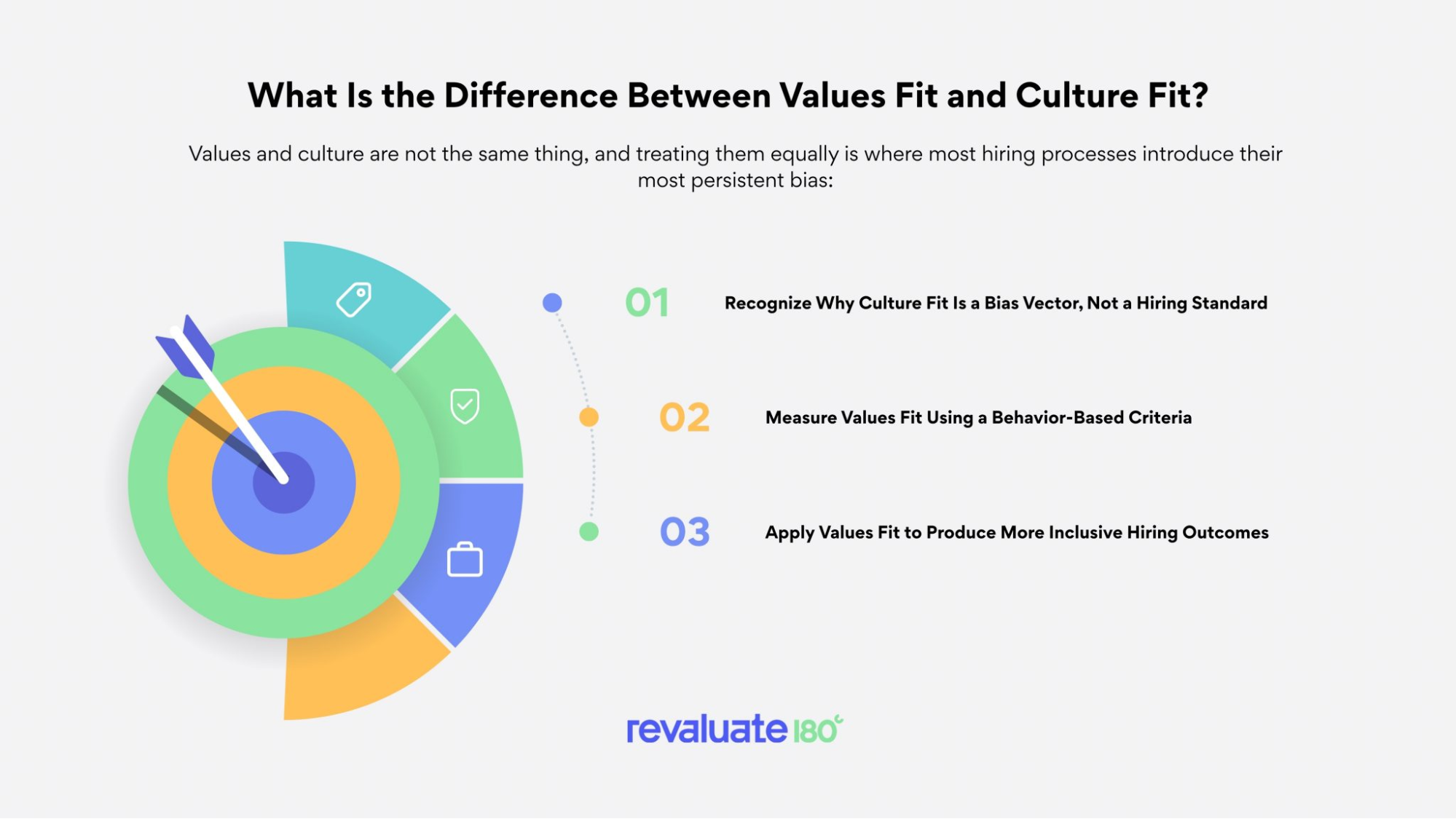
Recognize why culture fit is a bias vector, not a hiring standard
Culture fit is a post-hoc rationalization. When a hiring panel says a candidate fits the culture, they almost always mean the candidate reminded them of people already in the organization. This means people with similar backgrounds, communication styles, or dispositions.
Measure values fit using a behavior-based criterion
Values fit is measurable because it is a precise metric. Instead of asking if the candidate will deliver the job, the values-fit assessment asks if the candidate chooses to deliver as expected when conflict arises between speed and quality. When the conflict is unresolved, how will they respond? What did they refuse to compromise on, and when did it cost them?
Apply values fit to produce more inclusive hiring outcomes
Values-based recruitment produces more diverse hiring outcomes than culture-fit screening because it removes the primary mechanism by which homogeneity self-replicates. When alignment is assessed against defined values rather than panel-level intuition, candidates are evaluated on what they bring to the role and not how well they replicate the people already in it.
The 5-Stages of Values-Based Recruitment Process
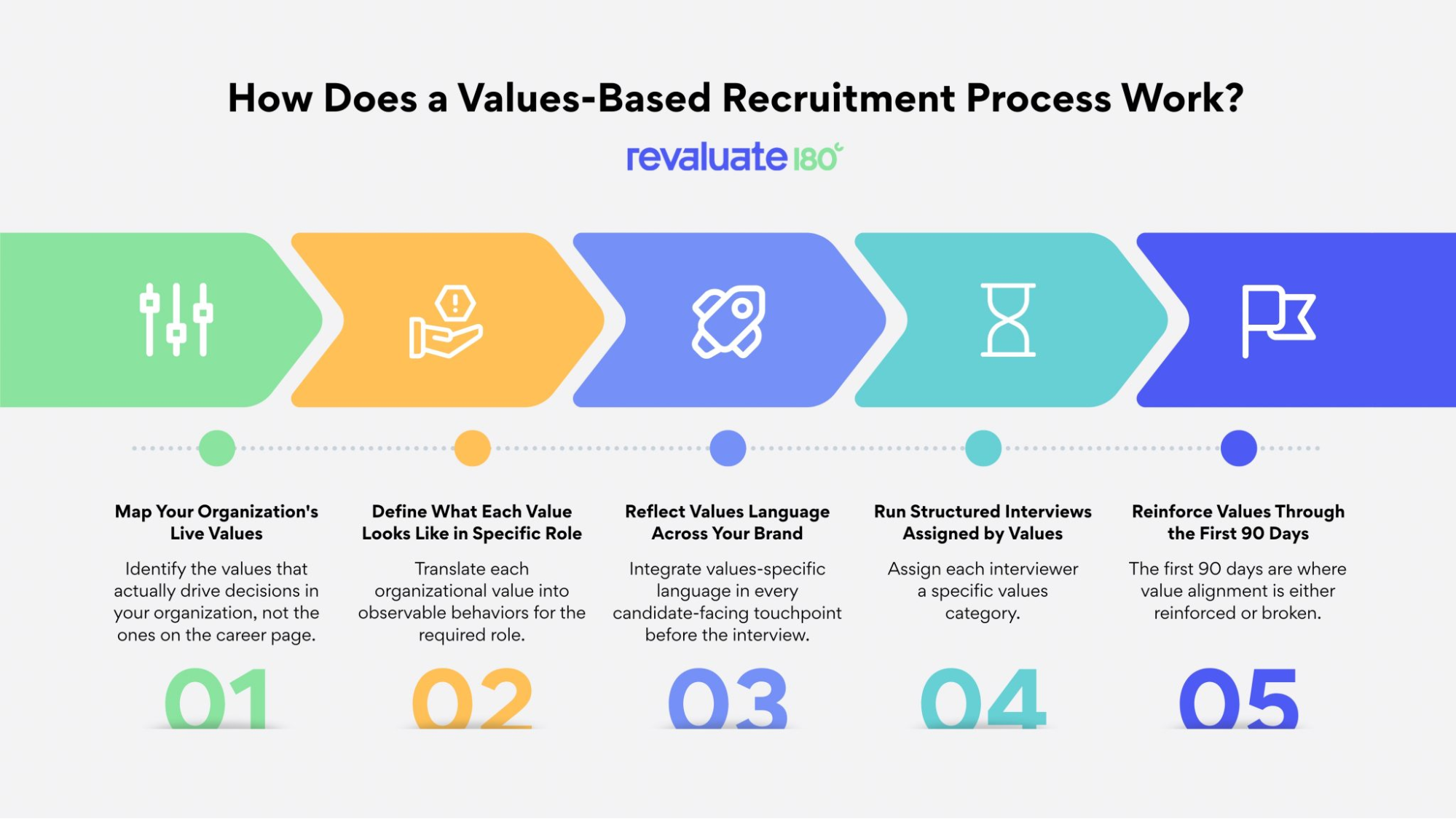
A value-based recruitment process is a five-stage structure that incorporates values alignment into every decision point from job design to the end of probation.
Stage 1: Map your organization’s live values (not the poster values)
Identify the values that actually drive decisions in your organization, not the ones on the career page. These two sets are often different: in interview five, people across seniority levels are asked to identify a recent decision as right or wrong.
The principles that are revealed after those answers are your actual organizational values. Not the brand-valued statements that are stated otherwise. This creates a process that screens for cultural aspiration rather than cultural reality.
Stage 2: Define values in the job brief
Translate each organizational value into observable behaviors for the required role. Integrity means something different for a sales director than it does for a compliance officer or an SE. For each value, define what a serious violation of it would look like in this role.
This translation work makes the subsequent interview process scorable rather than impressionistic. Without it, interviewers revert to gut feeling regardless of how structured the questions are.
Stage 3: Reflect values in your employer brand
Integrate values-specific language in every candidate-facing touchpoint before the interview. Job advertisements, the careers page, application questions, and recruiter outreach should all use the same values vocabulary. This, in fact, signals to values-aligned candidates that the organization takes these principles seriously, and it begins a self-selection process even before the first screening call.
Candidates who are actively misaligned with your values will often self-select out when the organization is specifically clear about it. This reduces the number of misaligned candidates who reach the interview stage without increasing the volume of screening tasks.
Stage 4: Run structured values-based interviews
Assign each interviewer a specific values category rather than an unstructured questionnaire. Each interviewer prepares two to three behavioral questions for their assigned value, uses a consistent scoring rubric, and does not deviate from their category.
This will prevent the two most common failures: duplication and gaps. The scoring rubric should define what a strong, acceptable, and weak answer looks like for each question.
Stage 5: Reinforce values-aware onboarding
The first 90 days are where value alignment is either reinforced or broken. Onboarding belongs within the recruitment framework because a candidate who joined based on the organization's specific values and commitments needs to see them demonstrated in practice.
If the stated values and the lived experience differ, the hire will disengage within the first quarter, regardless of how strong the values-alignment score was at the interview. Structure the first 90-day plan to include explicit exposure to the values in action.
Where Values-Based Recruitment Breaks Down Even When the Process Is Well-Designed
Now that we know the five-stage framework above, let’s go deeper to see how we can succeed in the process:
Structured interviews still carry evaluator bias
Structured questions reduce the variance in what gets asked. They do not remove the bias in how answers are interpreted. An interviewer assessing a candidate’s response to a values question is filtering that answer through their own values framework.
What they consider a strong demonstration of accountability or collaboration is shaped by their own experience with a value, which will consistently score candidates who express that value more highly, regardless of the rubric.
Understand the ceiling of interviewer training as a bias fix
Interviewer training absolutely reduces bias, but it does not eliminate it. Calibration sessions, rotating panel composition, and unconscious bias training all meaningfully help reduce the effects of it, but as long as the panel’s subjective judgment is the final evaluation instrument, that judgment has a risk of carrying its bias.
Mind you, this is a lamination of the method and not the people. Even highly trained, well-intentioned panels will produce systematically skewed outputs when they share similar value profiles. This solution cannot be revealed within the panel but only outside it.
Replace the panel impression with an independent candidate values profile
A structurally sound values assessment creates an independent candidate values profile that exists separately from any interviewer’s impression. This profile is then mapped against the role requirements, the corporate context, and the existing team profile to produce a quantifiable alignment score.
This panel then evaluates the candidate against the empirical data rather than their gut feeling. This alignment question becomes answerable with evidence and not inference.
This is what R180’s candidate value profiling produces. Rather than trying to make panel judgment less biased, R180 generates an independent values profile through a proprietary assessment, maps it against the specific hiring context, and delivers a quantifiable alignment output before the interview panel forms a view.
Practical Checklist: Is Your Process Actually Values-Based?
Use the checklist below to measure if your current process screens for values:
-
Do you have documented values and behaviors, not just words?
- Values words without behavioral definitions cannot be assessed consistently.
-
Are interview questions assigned to value categories rather than left to the interviewer’s discretion?
- If interviewers choose their own questions, coverage is accidental, and duplication is inevitable.
-
Do you have objective data on candidates’ values, or are decisions based primarily on panel impressions?
- If the answer is panel impression, your process is structured around your gut feel rather than the values assessment.
-
Do you use scored rubrics rather than holistic impressions as the evaluation output?
- A rubric defines strong, acceptable, and weak before the interview. Holistic impression is a second priority.
-
Are the values translated in your job description?
- Candidates who see value in language only after applying cannot self-select out. This means you screen out misaligned candidates only at the interview, not before.
-
Do you track whether new hires’ values match their 90-day performance?
- Without this metric, you cannot validate whether your values assessment is predictive or decorative solely on gut feeling.
-
Have you tested your process for values replication versus values alignment?
- Having the same values team will not bring any new perspectives. Make sure your hires come from diverse backgrounds and dispositions.
-
Does your process produce quantifiable alignment data, or is it just a gut feeling?
- If the only output from your interview process is a hire or no-hire recommendation, you have no mechanism for learning from misaligned hires or replicating successful ones.
Conclusion
Values-based recruitment isn’t some new talk of the town. It’s a proven way to build a committed, high-performing team. By focusing on values rather than just credentials, you can reduce turnover, improve morale, and foster a highly inclusive culture.
However, getting it right requires more than good intentions. It requires a structured process and awareness of potential failure points. Companies that stop at simply adding value questions leave themselves vulnerable to hidden bias and a major misjudgment. We have addressed this by exploring not only how to design a complete VBR process, but also how to avoid the final pitfall through a comprehensive data-driven assessment.
The missing layer is not better panels. It is objective candidate alignment data — a Value Profile mapped against the role and team before the panel's impression becomes the verdict. This is what R180 produces.

Unlock AI-Powered Hiring Analytics
Transform the way you hire with insights that create aligned, collaborative, and high-performing teams.
- Smarter Hiring Decisions
- Reduce Expensive Turnover
- AI-Driven Insights
- Optimize Team Performance