Hiring is a crucial part of the employment lifecycle for all companies, big and small. This step helps companies acquire their most important assets—highly skilled employees.
Like any other business strategy, hiring the right employees requires meticulous planning and execution to ensure companies hire the right person for the right job role.
In this guide, we will learn about the hiring process and the non-negotiable steps that apply to all kinds of job roles.
TL;DR
- Employers must understand the hiring process they should follow to attract the best candidates for their job roles.
- The hiring process must consider exact hiring needs, evaluation criteria and methods, and behavioral requirements to identify the right fits.
- Recruitment efforts must aim to minimize turnover and ensure long-term employee retention.
- Learn how to optimize your hiring decisions with data-driven insights to reduce bad hires and recurring hiring cycles.
What is a Hiring Process?
The recruitment or hiring process involves employers finding, evaluating, selecting, and onboarding skilled and qualified candidates to work for their company. Hiring processes provide a fair opportunity for all eligible candidates in the job market to apply for job roles that best suit their skills.
From the outside, hiring seems simple: apply, complete interviews, and receive a decision.
In reality, hiring consists of several stages for employers and recruitment professionals. Behind-the-scenes screenings, evaluations, selections, and subsequent proceedings must be conducted with patience and caution to ensure fairness and select the right candidates.
Let’s learn more about how companies conduct the hiring process across different stages.
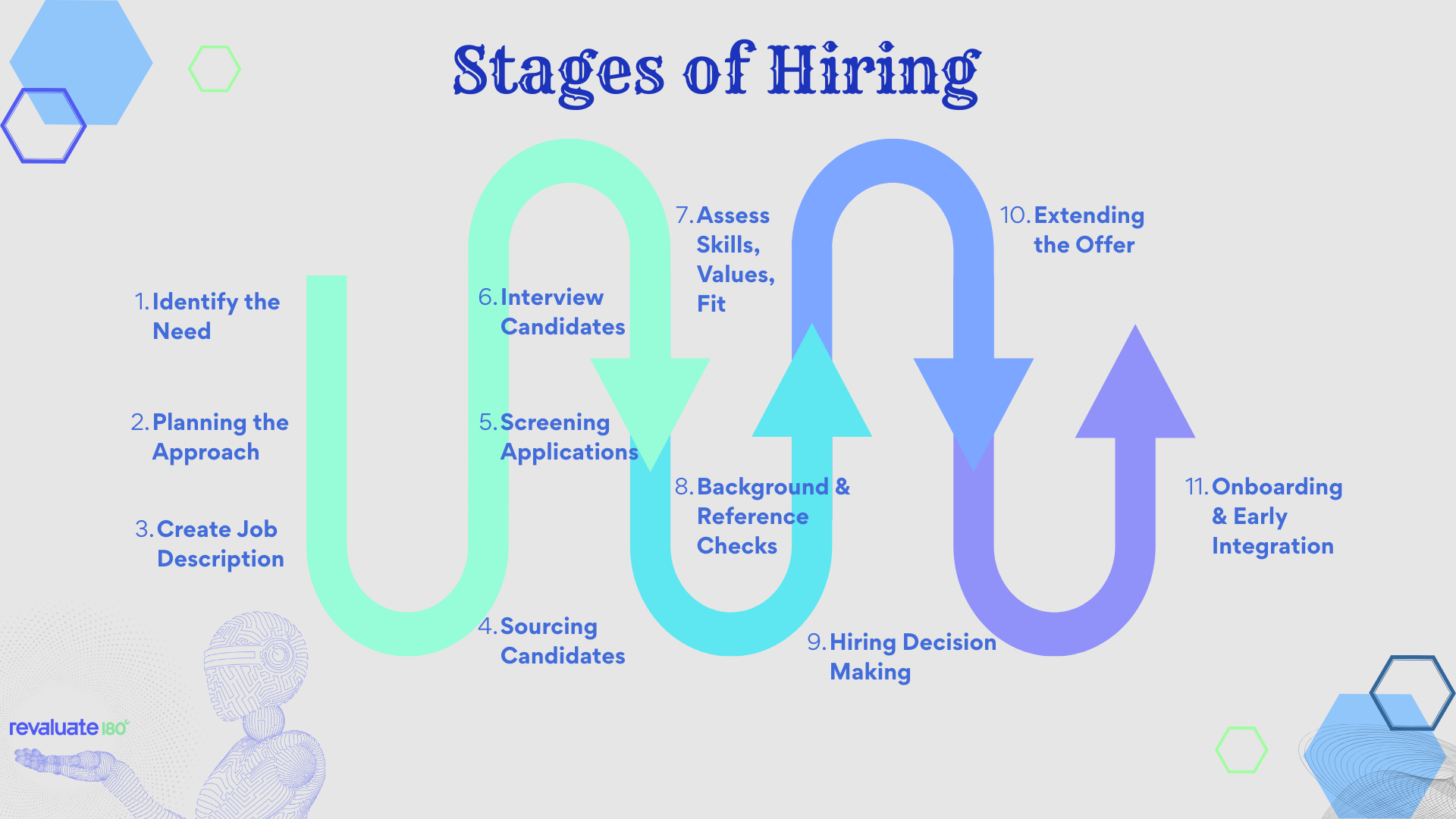
What Are the Stages of the Hiring Process?
Hiring is a step-by-step process that involves planning, strategizing, and execution. Today, hiring is not just about filling roles; it's about getting the right people who are willing to stay for the long term and make a difference in their work.
In order to land the right candidates for your vacancies, ensure you follow these steps without fail.
Step 1 - Identifying the Real Hiring Need
The first step of the hiring process is about framing your company’s recruitment strategy, which includes:
- ➔ Hiring for the long term
- ➔ Hiring the right numbers, and not going more or less.
- ➔ Hiring for a company’s cultural fit, and not just skill matching.
Some large companies prefer an anytime-ready talent pool, where selected hires continue learning relevant technologies and skills to fill vacancies as they become available. Such a method does not work for small and mid-sized businesses that cannot afford to have such hires on their payroll.
Identify the roles your company currently needs and will need in the near future as your business scales. Ensure you get the correct candidate count for each job role so that none of your teams remain understaffed or lack the talent needed to achieve a business goal.
Step 2 - Planning the Hiring Approach
Once you decide on the list of roles requiring candidates and the number for each, you can start planning where you will get your candidates from.
In most companies, there is an “Internal Job Transfer” portal where you can find applications from employees in other teams who are willing to try working in a different team.
If none are available, then you can target different talent pools and recruitment platforms, such as:
- ➔ Referrals from existing employees
- ➔ Job advertisements on online job portals
- ➔ Contractual partnerships with talent development agencies
- ➔ Advertisements in print media
- ➔ Pitch emails to potential candidates who applied earlier
Candidates may apply from one or more of the above sources, where they get official notifications from the company’s recruitment personnel regarding job vacancies.
Step 3 - Creating a Role-Accurate Job Description
Writing job descriptions is often seen as an easy, routine task that can be rewritten using a standard template. However, descriptions can go a long way toward helping you find the most appropriate candidates for a role.
Job descriptions often ignore preferred psychological traits and culture-related requirements that candidates must abide by or adapt to when choosing to work in that company. Such missing details often cause gaps between expectations and reality when applying for a job role.
- ➔ Write compelling and inclusive job descriptions that target a wide range of candidates.
- ➔ Highlight the role's significance in contributing to business development.
- ➔ Mention the evaluation criteria, qualification parameters, and bonus skills that can help candidates get their dream job.
- ➔ Prioritize company culture, the joining team’s work dynamics, and associated characteristics while describing your ideal candidate.
Step 4 - Sourcing and Attracting Candidates
Different job roles require different target areas from which you can get your ideal candidates. Once you have prepared your job descriptions, the next step in the hiring process is to post your job advertisements in the right channels.
For instance, hiring for entry-level roles may be handled directly by company professionals at several academic institutions and universities with job-ready candidates. Job fairs and walk-in recruitment drives are also great ways to invite lateral and fresh talent.
Social media platforms like LinkedIn, ADP, and more are powerful ways to fetch target candidates for your job descriptions. This method has proved effective at identifying candidates with the most matching and required skills for different job roles.
- ➔ Leverage the power of social media and talent acquisition platforms to get access to highly relevant talent pools.
- ➔ Send pitch emails to previous candidates who applied but were not selected, encouraging them to consider reapplying.
- ➔ Announce referral rewards and perks to your employees for getting ideal candidates to apply for vacant job roles.
Step 5 - Screening Applications
A highly essential yet mundane step in the hiring process is parsing and filtering hundreds or thousands of job applications for a single job role. Several AI recruitment tools have now made this job easier by identifying the best candidates who can go directly to the evaluation rounds.
Such screening tools do not just look for skillset matches but also look at patterns, such as academic backgrounds, linguistic and cultural backgrounds, work experience, social media presence, and behavioral traits, to ensure fair selection.
This stage also involves passive interactions with candidates, where AI chatbots or assistants may help them with their concerns, FAQs, and other details related to their selection for the next stages.
- ➔ Invest in a robust screening application or platform that saves hours of manual evaluation.
- ➔ Ensure your applications do not get selected or favored on any common ground or rules other than the job’s requirements.
- ➔ Always have a human professional oversee and approve the final shortlist of candidates suggested by the screening tools.
Step 6 - Interviewing Candidates
A significant part of the hiring process involves evaluating a candidate's skill set to determine eligibility for a given job. While technical and skill-based evaluations may span 2-3 rounds of interviews, each round must have a good dose of strategic interview questions.
Keeping a list of strategic interview questions is mandatory to assess overall fit for a role, with questions spanning cultural fit and industry awareness to motivational factors at work and career growth plans.
A good mix of interview questions is crucial for understanding candidates' willingness to work at the company long term and for avoiding sudden, unexpected turnover.
- ➔ Have the interview panel be diverse to prevent rejections due to unconscious bias.
- ➔ Keep a standard interview format with a common set of questions to evaluate all candidates fairly during a single hiring cycle.
- ➔ Collect feedback from candidates during each interview round to understand their experience and if they would prefer any changes.
Step 7 - Assessing Skills, Values, and Fit
The most crucial turning point in recruitment involves selecting the set of candidates most preferred for the job role. As we saw earlier, hiring is not just about ticking checklists and giving the right or expected interview performance.
Evaluations must also include assessing candidates’ work samples, past performance, ability to solve problems in real time, and their suitability for adapting to the company’s work culture.
Behavioral and cultural fitness, and the selection of skilled candidates from diverse backgrounds, help promote diversity in work teams, making this the best way to improve diversity in a company.
- ➔ Leverage the help of AI tools to predict if your chosen candidate exhibits signs of any bad hires in the past.
- ➔ Have dedicated interaction rounds as part of the hiring process, where the candidate interacts with team members and evaluates their sync.
- ➔ Update existing talent pools with your current eligible candidates to fill vacant roles sooner.
Step 8 - Background and Reference Checks
Yet another cumbersome but most important step in hiring involves verifying and validating your selected candidates. Background checks involve verifying the details your candidates provide, such as their place of residence, nativity, previous employers, academic qualifications, and more.
Reference checks involve contacting individuals from a candidate’s college, university, or previous workplace to verify the details they have furnished in their applications. Thanks to several AI-based recruitment platforms, reference checks are now easier with tools that verify candidates' achievements using their social media posts and referral testimonials.
- ➔ Check for a candidate’s employment tenure, career gaps, reasons for quitting their past jobs, and similar details.
- ➔ Include assessing a candidate's public social media accounts to better understand their areas of interest.
- ➔ Find out how they reached out to your job post and what motivated them to apply to this job role.
Step 9 - Making the Hiring Decision
After all the above processes of selection, interviews, assessments, and background checks come the final decision - choosing that one perfect candidate for the job. Thankfully, today this decision does not rely solely on human judgment, which is error-prone.
Data-driven decision-making provides clear insights from past hiring data and analysis of candidates who left the job without making any significant contributions. These insights and patterns provide evidence-based reasons for hiring a particular candidate.
Recruiters use these insights to support their selections without any confusion, resulting in a win-win situation for both candidates and the company.
- ➔ Never decide on a candidate based solely on past experience or interview performance.
- ➔ Use data-driven analytics to ensure candidates do not exhibit signs of any employees who have exited early in the past.
- ➔ In cases with more than one ideal candidate, define tie-breaking criteria to ensure fair selection.
Step 10 - Extending the Offer
Finally, you communicate the selection to the candidate through an official HR partner. This step is important and must not involve any bots or AI-assistants, as the candidate may be unsure of the authenticity of the job offer.
- ➔ Send an email that includes a congratulatory message, a brief description of the processes they will need to take up before joining, the date of joining, and other important information.
- ➔ The first email containing the job offer must come from the company/team’s official HR business partner.
- ➔ Send an estimated timeline of their date of joining, dates by which they must furnish official documentation, and other information.
- ➔ Encourage the new team members to connect with the candidate on platforms like LinkedIn.
Step 11 - Onboarding and Early Integration
Hiring does not end with selecting the right person for the job role. It is necessary to induct the person as an important asset for the company and explain to them how their contributions will make an impact on the business.
Onboarding and orientation involve getting the employee familiar with the company's processes and work culture, and understanding corporate compliance and technicalities. Research also shows that onboarding plays a significant role in retaining employees, preventing early turnover.
- ➔ Prepare a checklist of essential documents that employees must submit before their first day and carry with them on that day.
- ➔ Schedule sessions for team leaders and C-Suite executives to interact with new joiners to help them feel welcome in their new company.
- ➔ Conduct periodic onboarding surveys to understand and address concerns that may reduce new employee engagement.
Common Hiring Process Mistakes Companies Make
The steps above that constitute the hiring process represent the ideal pathway for all companies to land the best candidate for their roles. Candidates hired in such a process prove to be trustworthy and deliver expected results within the set timeframe.
While everyone desires dream candidates, many recruiters end up with bad hires because they deviate from, fast-track, or skip some of the above stages. Here are some common mistakes recruiters make that lead to bad hires who do not contribute to the company’s growth or who exit the company within a short span.
Hiring too fast or too slow
Rapid or fast hiring happens when a highly critical job role requires immediate replacement upon a sudden exit. The pressure to fill a role to meet an urgent business requirement often leads to poor background checks or improper behavioral evaluations. While this can help meet short-term targets, this method is ineffective for hiring high-quality long-term candidates.
Similarly, keeping the hiring process too slow, by having a massive gap between subsequent rounds of interviews, often makes candidates consider other companies that hire faster and more effectively.
Overvaluing resumes and undervaluing fit
Traditional hiring methods often rely on shortlisting candidates and evaluating if their performance matches what is mentioned in their resumes. Such resumes and interview performances are never an indication of how an employee will actually perform at work.
Not considering behavioral aspects and team dynamics during hiring often results in teams having a poorly engaged team member.
Ignoring post-hire performance signals
The onboarding phase must include periods during which employees are expected to meet specific milestones/performance goals at designated times. Not having such timelines to track performance during the probation period often results in bad hires once those employees become permanent.
Treating hiring as a one-time event
Hiring an employee isn't the end. Companies must consistently invest in retaining employees who were carefully evaluated and selected. Most companies disregard feedback after the selection process. However, most employees face stark differences between expectations and reality during the onboarding process and when working with the team.
How Revaluate180 Supports Optimal Hiring Decisions
AI and data-driven insights have become essential at every stage of the hiring process, helping organizations plan and build a more resilient workforce.
R180 enables companies to look beyond resumes and evaluate a candidate’s overall Value Profile, including alignment with the role, team dynamics, and organizational culture. This value-based assessment leads to stronger hiring decisions and better long-term fit.
Our AI-powered analytics leverage data to deliver predictive insights, helping reduce costly hiring mistakes and improve new-hire retention.
With expert guidance, we help organizations optimize their hiring processes, minimizing repeated hiring cycles, reducing financial loss, and lowering the time and effort spent on recruitment, onboarding, training, and replacement.
A Final Word
The hiring process forms the foundation of a company’s growth, as the quality of its candidates determines the company's future. Hiring is a laborious process that requires strategic planning and effort from recruiters to conduct it systematically.
With data-driven insights, companies can optimize the hiring process, making decision-making easier at each stage of the hiring pipeline. Feel free to contact us if you require any assistance in framing a foolproof hiring process that brings in the best talent capable of delivering long-term, promising returns.

Unlock AI-Powered Hiring Analytics
Transform the way you hire with insights that create aligned, collaborative, and high-performing teams.
- Smarter Hiring Decisions
- Reduce Expensive Turnover
- AI-Driven Insights
- Optimize Team Performance