In the modern workplace, we have come to understand the value of smart work through collaboration. In fact, 83% of employees say they do most of their work through team collaboration. While high-performing teams can dramatically improve productivity, creativity, and engagement, low-performing teams can drag down the results of hard work done.
This guide explains what makes a high-performing team and walks you through practical steps to build one that drives long-term performance.
TL;DR
- High-performing teams combine complementary skills with shared purpose to achieve the defined success.
- High performance is built on trust, transparent communication, and strong collaboration that models the right team.
- Hiring should focus on culture fit, modus operandi, and skills that harmonize, not just qualifications.
- Clear mission, defined roles, and informed decision making will not only bring performance back but also sustain it long term.
- A strong culture is a byproduct of open feedback, healthy conflict, accountability, and continuous learning and development.
- Leaders are also responsible for maintaining team ethics by empowering team members, setting ambitious goals, removing blockers, promoting transparency, and truly understanding everyone's strengths and motivations.
- Data-driven insights will help you minimize resistance and improve team cohesion for sustained performance.
What is a High-Performing Team?
A high-performing team is more than a group of individuals. It’s a team whose members understand the power of seamless collaboration towards a common purpose and consistently deliver exceptional results. In other words, it’s a group that leverages its collective skills, diverse perspectives, specialized expertise, and complementary strengths to accomplish all the challenging goals together.
High-performing teams are hyper-focused on achieving clear, exceptional results through foundational trust, accountability, and continuous improvement.
What Are the Characteristics of High-Performing Teams?
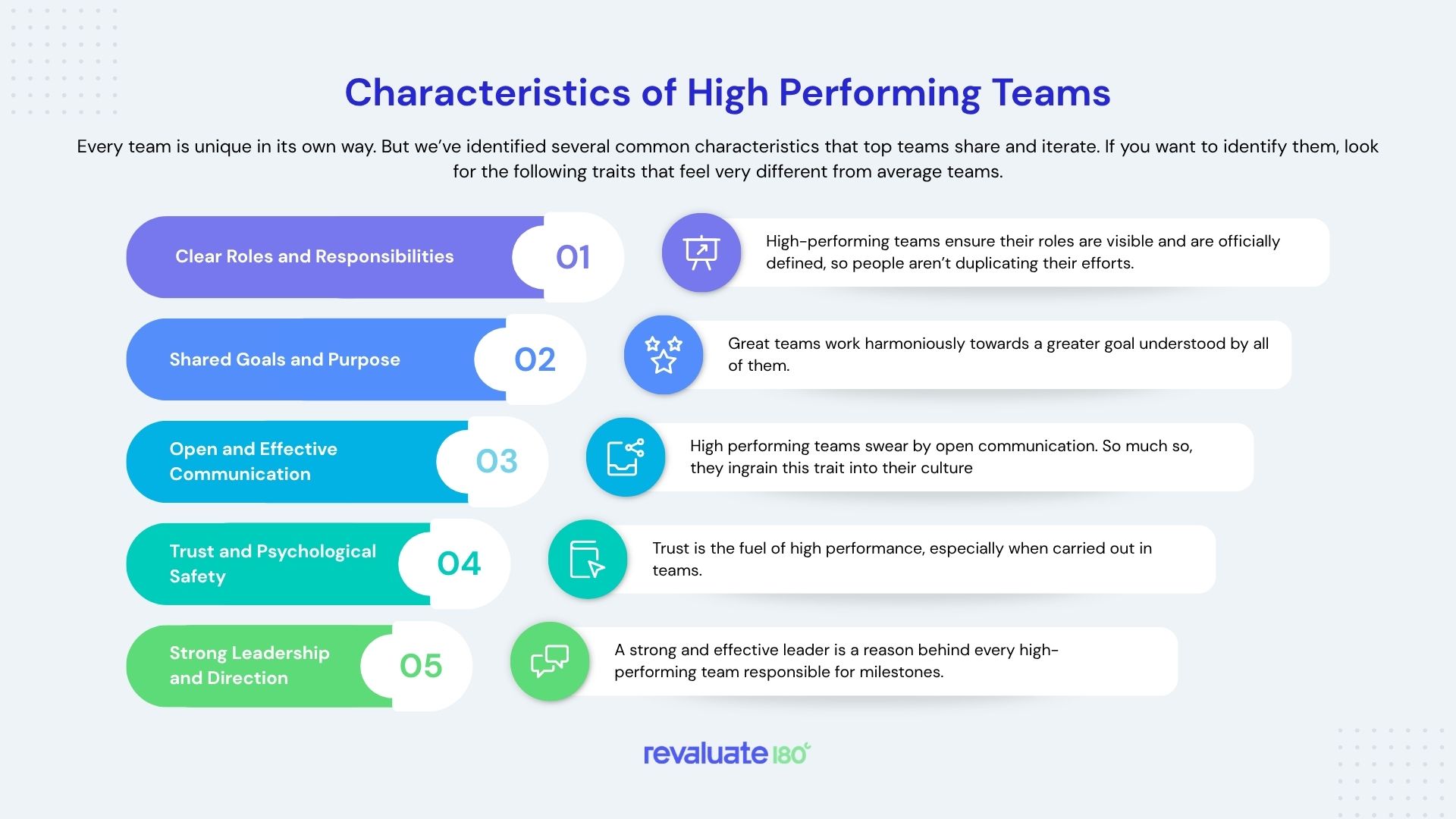
Every team is unique in its own way. But we’ve identified several common characteristics that top teams share and iterate. If you want to identify them, look for the following traits that stand out from average teams.
Clear roles and responsibilities
Every team member understands exactly what they are accountable for and how their work connects to the higher mission statement. High-performing teams ensure their roles are visible and officially defined, so people aren’t duplicating efforts or bringing each other down.
Every task must be done collaboratively. When your responsibilities are clear, the team can reduce confusion and delays, so work can feel natural.
Shared goals and purpose
Great teams work harmoniously towards a shared, understood goal. A clear, inspiring purpose aligns everyone’s efforts towards a common direction. For instance, high-performing teams can answer questions like, "Where are we going?" Why does it matter? And how can we define the goal post for this project?
They do not just answer these questions but challenge them more often. These specific goals tie them back to the organization’s objectives, enabling the team to prioritize them effectively.
Open and effective communication
High-performing teams swear by open communication. So much so, they ingrain this trait into their culture. They establish reliable communication rhythms through daily stand-ups or weekly syncs so everyone stays informed in the loop.
More importantly, they create an environment where honest dialogue is encouraged and normalized. Team members routinely exchange updates and feedback in real time, so they don’t have to worry about letting issues slide under the table. Instead, they tend to raise concerns early and act on them.
Trust and psychological safety
Trust is the fuel of high performance, especially when carried out in teams. Members genuinely respect each other’s abilities and intentions. There is a certain level of confidence that every member will hold up their end of the bargain, which means people bring their full selves to work every day, take smarter risks, and admit mistakes when they occur. These traits become foundational to the company’s long-term success.
Psychological safety also plays a vital role, as people can speak up without fear, and teams encourage them to voice ideas or disagreements without hesitation. This loop of growth prevents many misunderstandings, builds trust, and gives them the motivation to overcome any obstacle in their way. Without it, disengagement is bound to occur, leading to a dramatic drop in performance.
Strong leadership and direction
A strong and effective leader is a reason behind every high-performing team responsible for milestones. This doesn’t mean a micromanager, but someone who defines the conditions for success. A strong leader influences a team to be more ambitious by setting realistic goals, removing obstacles, and modeling the behaviors they expect. Without direction, teams may fall apart easily and lack accountability in every phase.
They keep the team focused on the vision but also empower them to make informed decisions that are liable to take the company towards innovation. Leaders of high-performing teams also invest in one-on-one communication to listen to each person’s intent and provide guidance that strengthens their trust and engagement.
Accountability and ownership
High-performing teams are motivated to go beyond their paychecks and task delegation to establish clear ownership intertwined with their work outcomes. Accountability in the process ensures that every role contributes to team goals, reducing ambiguity and eliminating performance gaps.
Instead of assigning generic responsibilities, effective teams define ownership at the role level. By linking KPIs such as output quality, efficiency, and long-term impact, you ensure no spoonfeeding or micromanagement, fostering a self-regulating environment.
Continuous feedback and improvement
Continuous feedback loops offer so much more than periodic check-ins. High-performing teams integrate this system into their daily workflows. This enables real-time performance optimization through consistent, data-driven insights.
This feedback-oriented mindset is multidirectional among managers, peers, and other members to identify gaps, reinforce strengths, and find solutions without wasting time on limited resources.
Adaptability and problem-solving
Adaptability is a fuel for problem-solving, especially for high-performing teams navigating uncertainty and responding to challenges with strategic solutions. Such teams rely on structured problem-solving processes that are much more effective with the insights gathered.
Instead of reacting to decisions, effective teams use frameworks such as root cause analysis and hypothesis-driven strategies to identify and solve ongoing issues before they cause damage. Cognitive diversity within the team greatly enhances problem-solving by bringing different ideas to the table. While this is also an essential part of DEI hiring, using the internal knowledge, strong situational awareness, and the ability to define success criteria helps sustain the team’s performance even in a rapidly changing environment.
Essential Steps to Build a High-Performing Team
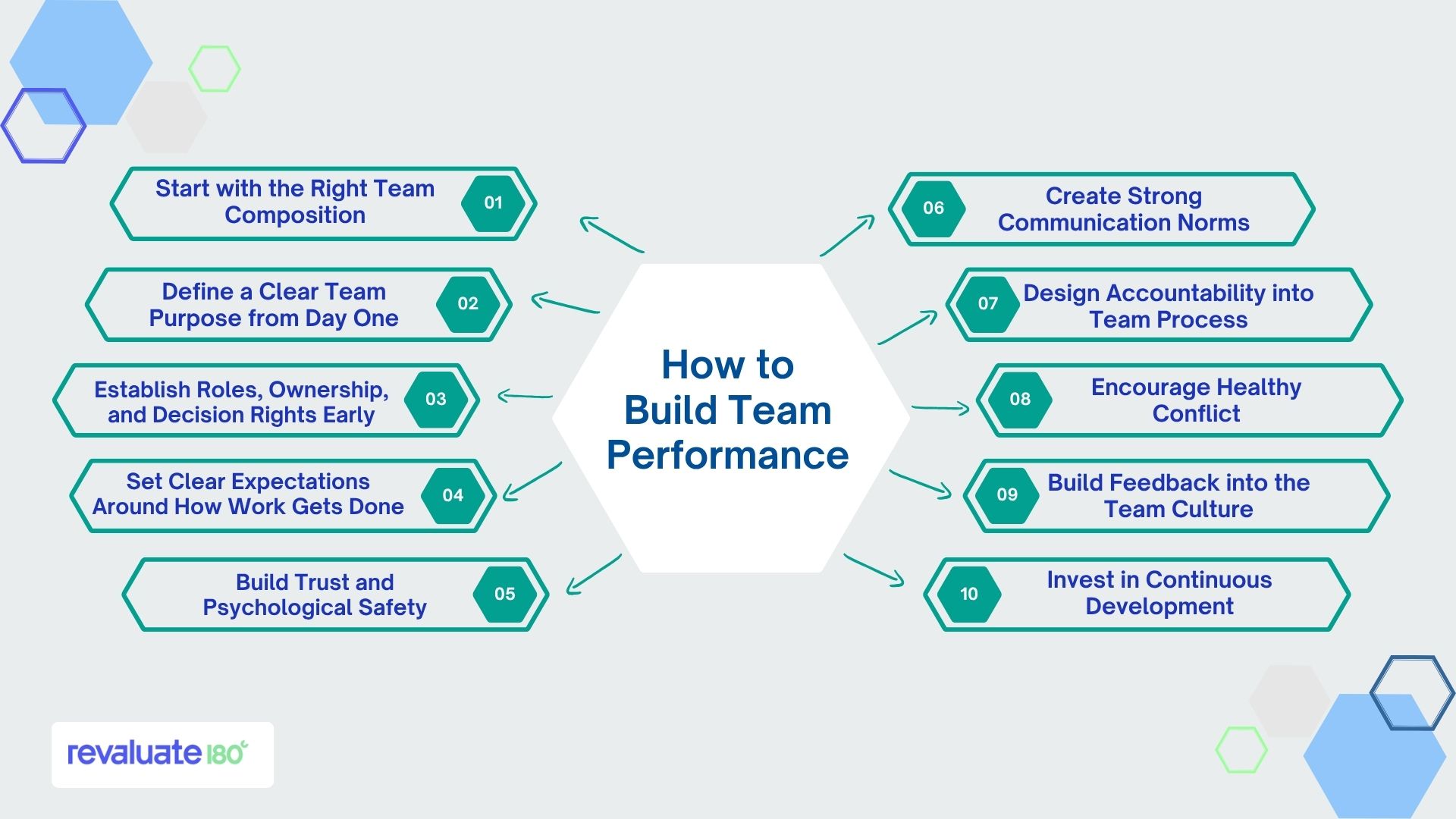
Building a high-performing team doesn’t happen in an instant. It starts from the day you prioritize long-term growth through team evaluation and needs. Below are the practical steps to set a team on the path to peak performance:
1. Start with the right team composition
Don’t just hire team players. Make sure to hire those whose work style and values complement the existing team and mission. If this method is ignored, hiring someone who doesn’t fit the team can create tension through dragged-out meetings and communication gaps that ultimately make teams suffer.
In contrast, teams that prioritize fit are often more resilient and productive, no matter the circumstances, because members understand how to support each other. Using structured assessments of culture and personality fit can greatly improve retention and engagement.
This might mean using behavioral profiles or work-style inventories during hiring, for instance, if your team already has many big-picture ideators, you might seek someone detail-oriented who ensures follow-through, because objective team tools reduce bias to help balance your team’s diverse personalities.
2. Define a clear team purpose from day one
Give your team a clear mission that explains why they do what they do. Early on, make sure to co-create a mission statement or goal that connects to the company’s strategy. Every member should be able to articulate where the team is going. Ask questions like: Why does the goal matter, and how do we measure success in terms of company growth?
For example, a product team might adopt a purpose like delivering a market-leading app that delights users and grows revenue. When goals and metrics are specific and aligned with company priorities, teams know exactly how their work contributes.
3. Establish roles, ownership, and decision rights early
From the start, clarify who is responsible for what position. Define each member’s role and who has decision-making authority for the different aspects of tasks. High-performing teams minimize unnecessary conflicts by clarifying each person’s role and responsibilities.
This prevents unnecessary confusion and ensures everyone is on the same page and knows what they’re doing. Use tools like RACI matrices or even simple role charts; for instance, in a marketing team, designate one person to own the editorial calendar, another to own the analytics, and so on.
Clearly defined roles are like an orchestra where each musician knows their part and timing. When ambiguity is removed, the team can move faster and more proactively.
4. Set clear expectations around how work gets done
Agree on your team’s working style upfront. Doing this really defines the norms for communication, collaboration, and conflict resolution. High-performing teams tend to set clear expectations and establish effective communication channels.
For instance, you might decide that major projects will have weekly checkpoints with an agenda or notes shared later on. The goal here is to avoid confusion about the process work, so people can focus on completing the goal post with minimal distraction.
You must also recognize a healthy conflict by agreeing on how to have productive debates. For instance, encourage disagreement without being disagreeable. Use tools like parking lots or medians to surface issues constructively. Clarify these expectations early by establishing a stable execution framework.
5. Build trust and psychological safety
Trust is earned, and it must be intentionally cultivated. Encourage open narrative from the top, where leaders should share information, admit mistakes, and act consistently. Model vulnerability by showing that it’s safe to ask questions and own up to certain successes or failures.
You can integrate techniques such as one-on-one meetings, where team members do not hesitate to speak up, and activities that help the team get to know each other as people, not just workers.
No matter the size of your business, trust is a belief that you won’t be punished for taking a risk, and that becomes a top factor in team success. Without it, people hold back valuable ideas or concerns that shouldn’t be hidden otherwise.
6. Create strong communication norms
You must go beyond sharing information to create strong teams. Build habits that keep the team aligned. For instance, implement a daily check-in so everyone hears about key priorities. Use tools like Slack or Teams for quick questions, but also have weekly demos to understand the work dynamics and deeper discussions.
Agree on a single goal post for project status, like a shared roadmap, so nothing slips through the cracks. High-performing teams build a system of regular feedback loops, such as the SBI (Situation-Behavior-Impact) model, that encourages giving clear, specific feedback on current affairs.
7. Design accountability into the team process
Strong teams hold themselves accountable for the consequences, including successes and failures. Embed accountability through clear metrics and rhythms. For instance, publicly track key performance indicators (KPIs) on a team dashboard and review them weekly. Adopt a meeting agenda that includes a quick check on what is committed vs what is delivered.
Encourage peer accountability by having team members mentor each other when needed, and by using a mutual accountability framework. Also, address slippages early. If a deadline is missed, you must discuss it in the weekly review. This aligns with performance models like Katzenbach & Smith’s to ensure clarity and a mutually accountable framework.
If a deadline is thought to be missed, replan collaboratively. Ensure Lencioni’s famous model, which identifies avoidance of accountability as one of the top five team dysfunctions.
8. Encourage healthy conflict and better decision making
Don’t shy away from facing a conflict. When a variety of perspectives are come into action, decisions become even stronger and smarter. In a high-performing team, disagreements aren’t taboo, but they’re accepted wholeheartedly. If conflicts are managed constructively, they become a source of creativity and sharper decision-making.
Make it clear that challenging ideas rather than people is a usual part of success. Use rules of engagement, for instance, by allowing each person equal airtime in discussions, and explicitly seeking out discomforting opinions. Train the team on conflict norms, such as curb interrupting, and use digital polls if required.
When the team knows that diversity of thought is valued, people will feel safe to debate and create a strong, safe path towards new ideas and innovation. This kind of healthy narrative leads to better solutions that inevitably teach everyone to adapt to new challenges and never settle on limited ideas.
9. Build feedback into the team culture
Feedback is the breakfast of champions to sustain high performance in the long run. Set up formal and informal channels to give and receive constant feedback. For instance, hold regular one-on-one meetings where managers focus on development questions that support a helping narrative rather than just another project status.
Conduct peer feedback sessions or ad hoc retrospectives after major milestones are achieved. Encourage a confident narrative where workers don’t hesitate to answer anything thrown their way. This real-time feedback catches small issues early and helps everyone improve steadily. High-performing teams foster a culture of continuous improvement through open, constructive, two-way feedback.
10. Invest in continuous development and team growth
Treat your team as your child. High performers never stop learning. Plan ongoing training, cross-training, or stretch projects so members have space to experiment and develop new skills on the go. Encourage mentorship and peer learning on the team so they can easily reflect periodically on which processes or skills they’re lacking and fill those gaps with the right mentorship.
Make it easy for team members to pursue relevant courses or certifications, and reserve budget for team-building activities. Always remember, high-performing teams practice continuous learning by valuing feedback and investing in long-term development.
How Values and Behavioral Insights Help Build High-Performing Teams
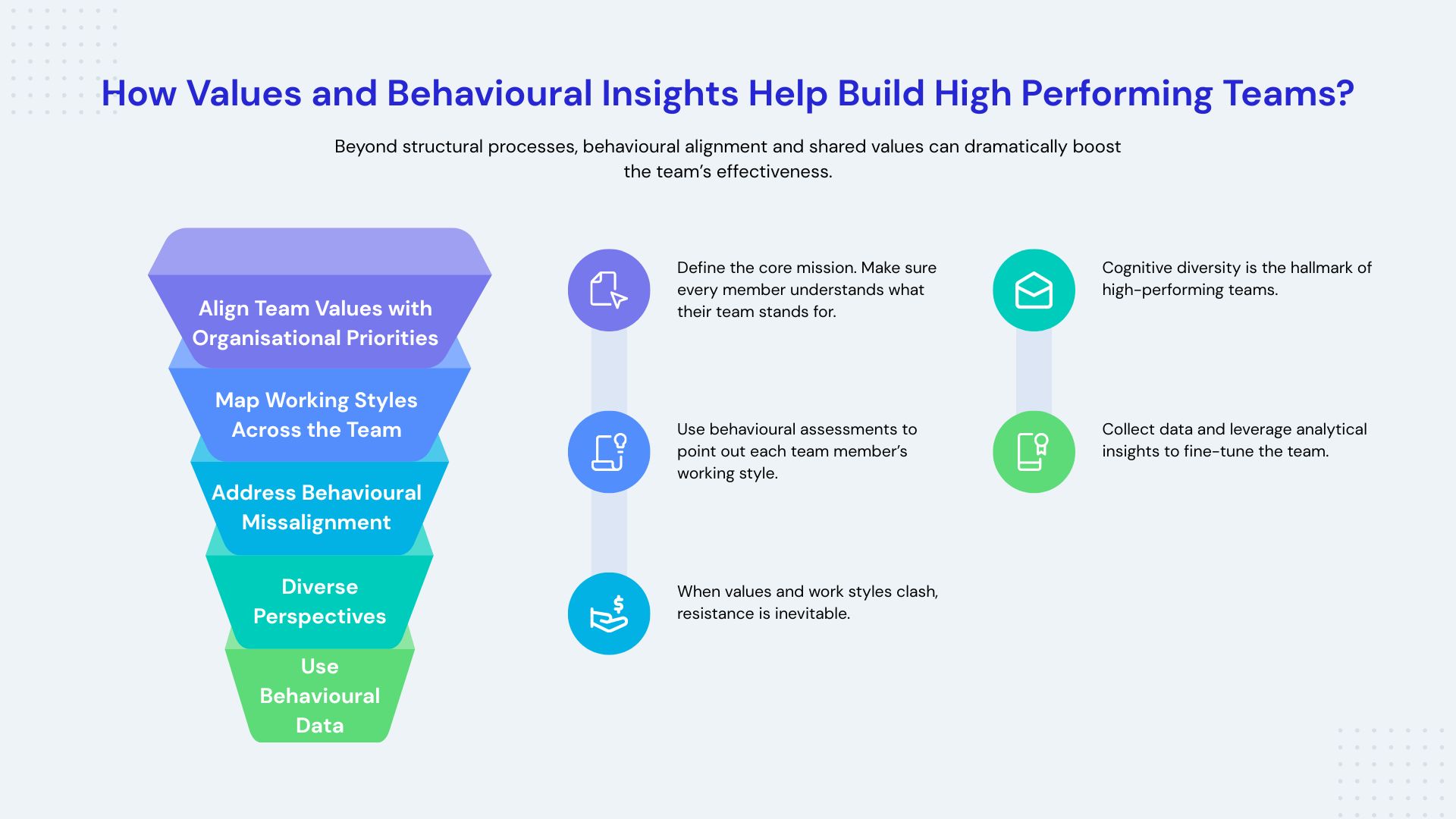
Beyond structural processes, behavioral alignment and shared values can dramatically boost the team’s effectiveness. When team members’ core motivations and work styles are seamlessly integrated, collaboration becomes smoother. Here’s how you can benefit from values and behavioral insights:
Align team values with organizational priorities
Define the core mission. Make sure every member understands what their team stands for. Discuss core values like honesty, innovation, and service, and then decide how they translate into everyday behavior. Teams that explicitly define and live their values report higher trust and cohesion.
High performers don’t just write values on sticky notes; they embody them every day at work. For example, if customer focus is a team value, processes might include consistently reviewing customer feedback or having a team member role-play as a customer in meetings.
By aligning values with the company mission, everyone understands what truly matters. When employees see that their personal and organizational values align, engagement rises to the top.
Map individual working styles across the team
Use behavioral assessments to point out each team member’s working style. Work personality is all about how someone prefers to work; for instance, while one member is a doer, another can be a coordinator or a pioneer. Each has their own preferences.
By mapping these archetypes in your team, you can spot imbalances. If everyone is a visionary, who will handle the execution? and so on. In other words, delegate based on each member’s strengths, since a data-driven approach to team design ensures that important work styles add value to the workplace.
Identify and address behavioral misalignment early
When values and work styles clash, resistance is inevitable. For example, a goal-oriented person who values speed might clash with a careful planner. If this misalignment isn’t fixed, these tensions can hurt performance.
Carry out a structured assessment, as it can identify misalignments before they become toxic. For example, surveys or tools that measure team communication style or conflict preferences can alert you if some members feel undervalued or overshadowed.
If that’s the issue, make sure you reassign tasks, provide coaching, or refine team norms to reduce friction. Taking these steps early to prevent even small misalignments can significantly improve morale and productivity in the workplace.
Strengthen decision-making through diverse perspectives
Cognitive diversity is the hallmark of high-performing teams. When you map out personalities and values, look for complementary skills and new individual perspectives. Teams that bring together analytical thinkers and creative minds approach challenges more vividly.
Ensure that decision-making includes voices from across the spectrum of work styles to spark new ideas and innovation. Integrate effective DEI (Diversity, Equity, Inclusion) practices to hire a diverse team, understand equality, and make seamless business decisions.
Use behavioral data to guide team design and development
To top it all up, collect data and leverage analytical insights to fine-tune the team. You can aggregate data on how team members interact and what motivates them. For example, pulse surveys or 360-degree feedback can reveal if trust is slow or communication is breaking down.
Analytics can help you flag emerging issues, such as sub-team isolation, and suggest necessary interventions to be pointed out early. Review team metrics periodically, like engagement scores, collaboration indices, or behavioral assessments, to find gaps and adapt the team composition and training accordingly.
Build Teams That Last Longer
High-performing teams don’t emerge by chance, since performance can fade over time if not proactively improved. They are carefully designed with intention and continuous effort for improvement. Start by hiring the right people who are not just talented but whose work styles also match the team’s mission statement.
Cultivate a culture of trust and open narrative where feedback flows freely, and mistakes don’t feel like a burden. The same goes for the leaders, so you can ensure they empower coaches who remove barriers and model transparency. We at Revaluate180 offer leaders visibility into both sides, helping them identify hidden strengths and misalignments in team dynamics. With meticulously collected insights, you can build a more cohesive, resilient team from the very first day.

Unlock AI-Powered Hiring Analytics
Transform the way you hire with insights that create aligned, collaborative, and high-performing teams.
- Smarter Hiring Decisions
- Reduce Expensive Turnover
- AI-Driven Insights
- Optimize Team Performance