You’ve double-checked the resume. The candidate aced the technical screen, made his way seamlessly across two panel interviews, and also charmed the leadership team. The offer went out on a Friday since the references have checked out well, but six months later, you’re starting the search all over again.
This is one of many mis-hire stories happening constantly, even with smart teams using solid processes who swear they won’t get burned twice. Here’s the problem no one’s telling you. It’s not what happens in the interview, but what gets lost between the interview and the offer.
TL;DR
- A mis-hire is someone who is unintentionally placed in the wrong role, team, or organization, even if their profile is perfect on paper.
- The cost of a mis-hire is more than 30% of their first-year earnings, which vary anywhere from 5-27x annual salary for senior roles.
- Most bad hires aren’t random accidents; they follow a predictable failure pattern rooted in misaligned values, unconscious biases, and a lost signal between interviews and decisions.
- Skills and experience are the easiest part since values, motivation, and behavioral alignment are where the most hiring processes fall apart.
- A data-driven model closes the gap by mapping what drives a person’s judgment beyond what their role actually demands, rather than just what’s on their resume.
What is a Mis-Hire?
You can’t simply call a mis-hire a bad employee. It’s just a misaligned position for someone who ends up in the wrong role, on the wrong team, or inside the wrong organization, despite looking excellent on their resume. There are two distinct types of mis-hires, and ignoring them can lead to unfortunate damages.
Skill mis-hire
This person simply lacks the skills required for the job. It can mean many things, including their lack of experience, capabilities, or the specific demands the role must meet. Most hiring processes are designed to capture this type of mis-hire.
Values mis-hire
This person has all the skills to do the job, but they won’t thrive in your organization due to the work culture, work pressure, or the team. For instance, a brilliant individual contributor who can’t function without clear top-down direction is joining a startup that runs on autonomous decision-making.
Or a high-relationship leader joining an organization where blunt, transactional communication is a work norm. They’re not the wrong people; the candidate is a poor fit.
These values mis-hires are far harder to detect, far more common, and far more expensive when they land. According to a LinkedIn study, 89% of hiring failures are due to poor culture fit rather than a lack of the technical skills required for the role. This number makes you rethink what you’re actually measuring.
The Real Cost of a Mis-Hire
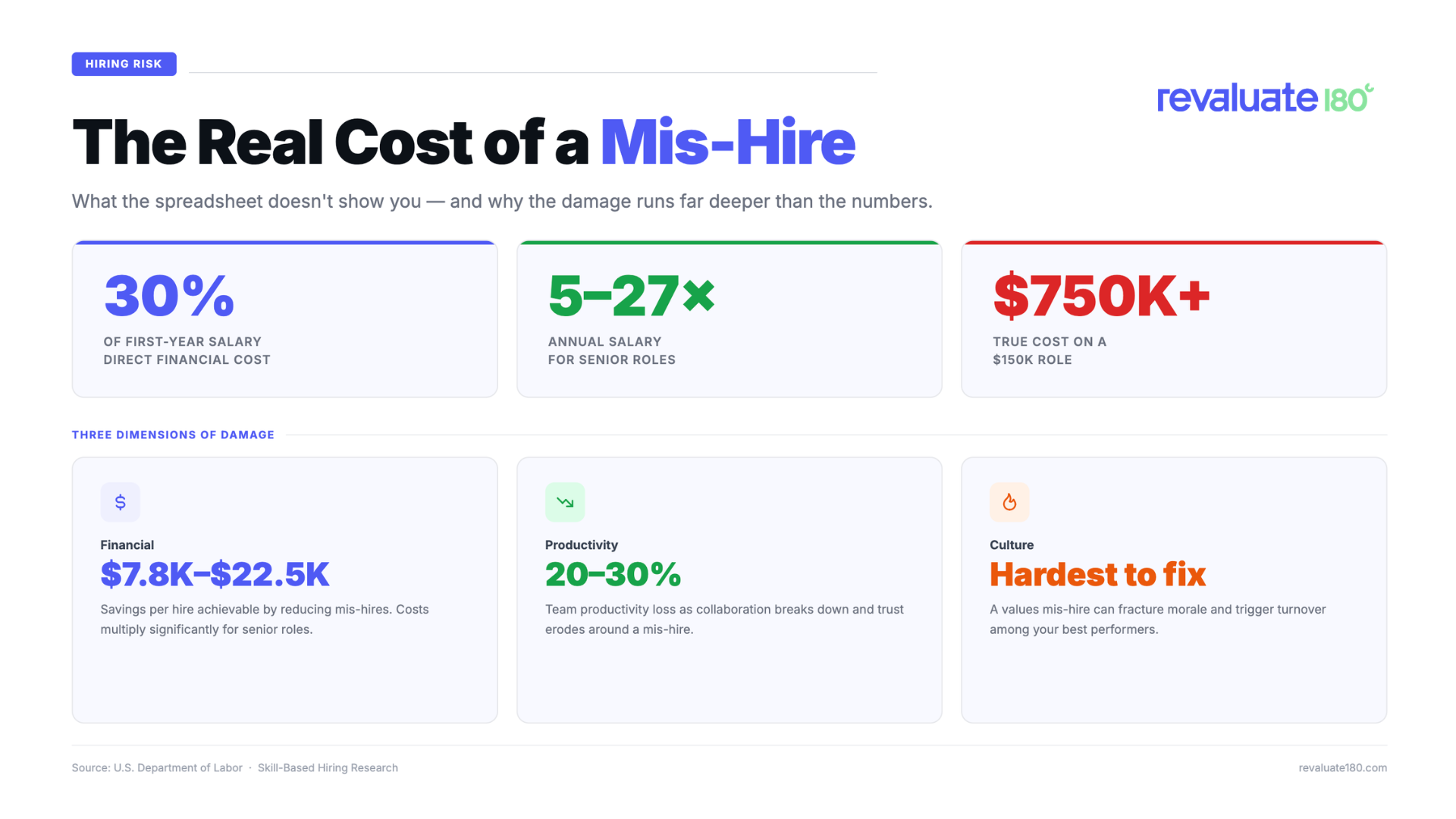
It’s very easy to underestimate the damage when you’ve never run the numbers on mis-hires at your organization. The U.S. Department of Labor cites at 30% of an employee’s first-year salary. This is just the direct, traceable financial cost, so it can range from 5x to 27x the annual salary for senior roles. Once you account for productivity loss, opportunity costs, team disruption, and replacement cycle time, it’s far more damaging than just the money.
Practically speaking, a $150,000 role gone wrong can cost a minimum of $45,000 and potentially over $750,000 when you factor in everything that you can’t see directly on the spreadsheet. Let’s break down the hidden costs across all the factors:
Financial cost
Recruiting fees, job board spend, recruiter time, hiring manager time, onboarding costs, potential severance, and the costs of restarting the process all over again. A skill-based hiring study estimates that companies spending $60,000 can save between $7,800 and $22,500 per hire by reducing mis-hires. These costs can rise significantly as per the senior roles.
Productivity cost
A mis-hire doesn’t just fail to contribute but actually drains the whole team around them. Work gets duplicated, gaps get covered by people who already have full plates, and the quality of output suffers while everyone waits for the situation to be resolved. This can drastically reduce the team productivity by 20-30% as collaboration breaks down and trust slowly erodes at work.
Cultural cost
This is the hidden cost no one talks about since it’s very hard to quantify, and yet the slowest one can recover from. A values mis-hire can fracture team morale, trigger turnover among your best performers, and fundamentally alter your company culture you’ve spent years building. This just tells how mis-hiring doesn’t just cost you their replacement, but the whole team around them.
Why Mis-Hires Keep Happening Even to Great Teams
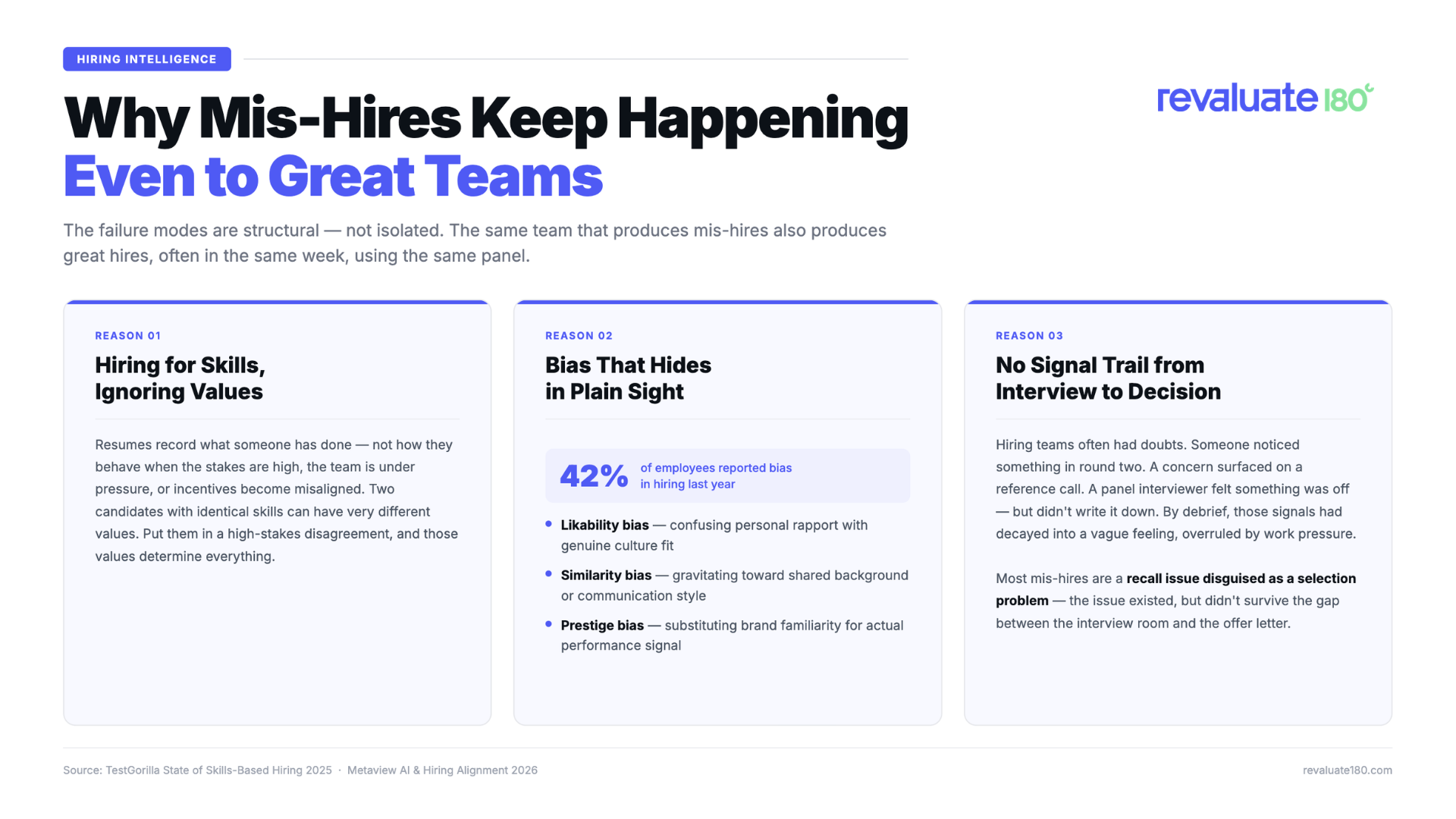
If these costs are very well-documented, why does it keep happening to teams that know better? It’s because the failure modes are structural and not isolated. Blaming the interviewer for their misjudgment is easy, but the same team that produces mis-hires also produces great hires. Often in the same week, using the same panel.
1. Hiring for skills, ignoring values
Resumes are a record of someone’s work, but they don’t tell you anything about how that person behaves when the stakes are high, the team is under pressure, incentives become misaligned, or the role evolves in ways no one anticipated. You don’t see these factors on a resume.
Most hiring frameworks are built around skills and personality, but the missing layer is values alignment, where you have to find the trade-offs by understanding what a person fundamentally prioritizes in real work challenges.
Team values are the core motivational driver. Two candidates can have identical skills on paper but very different values altogether. Put them in a high-stakes disagreement with a senior, and you’ll see how their values determine their decisions.
2. Bias that hides in plain sight
Unconscious bias can creep in unannounced. 42% of employees reported experiencing conscious or unconscious bias during the hiring process last year. This is, unfortunately, a consistently increasing trend that structured interviewing alone isn’t fixing.
Biases that are prone to mis-hire aren’t always the ones hiring teams are trained to watch for. Some of them include:
- Likability bias: Candidates who remind interviewers of someone they trust are easily confused with a genuine culture fit.
- Similarity bias: Gravitating toward candidates who share a similar background, communication style, or frame of reference.
- Prestige bias: Prioritizing candidates from a well-known company name or university in a way that substitutes brand familiarity.
Each of these biases produces a feeling of confidence during the hiring process that isn’t connected to how the person will actually perform.
3. No signal trail from interview to decision
This is arguably the most underrecognized reason for a mis-hire. Research from Metaview’s 2026 AI and hiring alignment reveals a pattern that will feel familiar to anyone who has debriefed a mis-hire. A hiring team often had doubts.
Someone noticed something in round two. A flicker of concern emerged in a reference call; a panel interviewer felt something was off, but still didn’t write it down. By the time these debriefs happened, the doubts had faded into a feeling overruled by work pressure.
These mis-hires are often a recall issue disguised as a selection problem for an issue that existed but didn’t survive the gap between the interview room and the offer letter.
A Data-Driven Framework to Avoid Mis-Hires
This isn’t about adding more steps to your interviews, but about building a process that captures, preserves, and uses the right information at decision time.
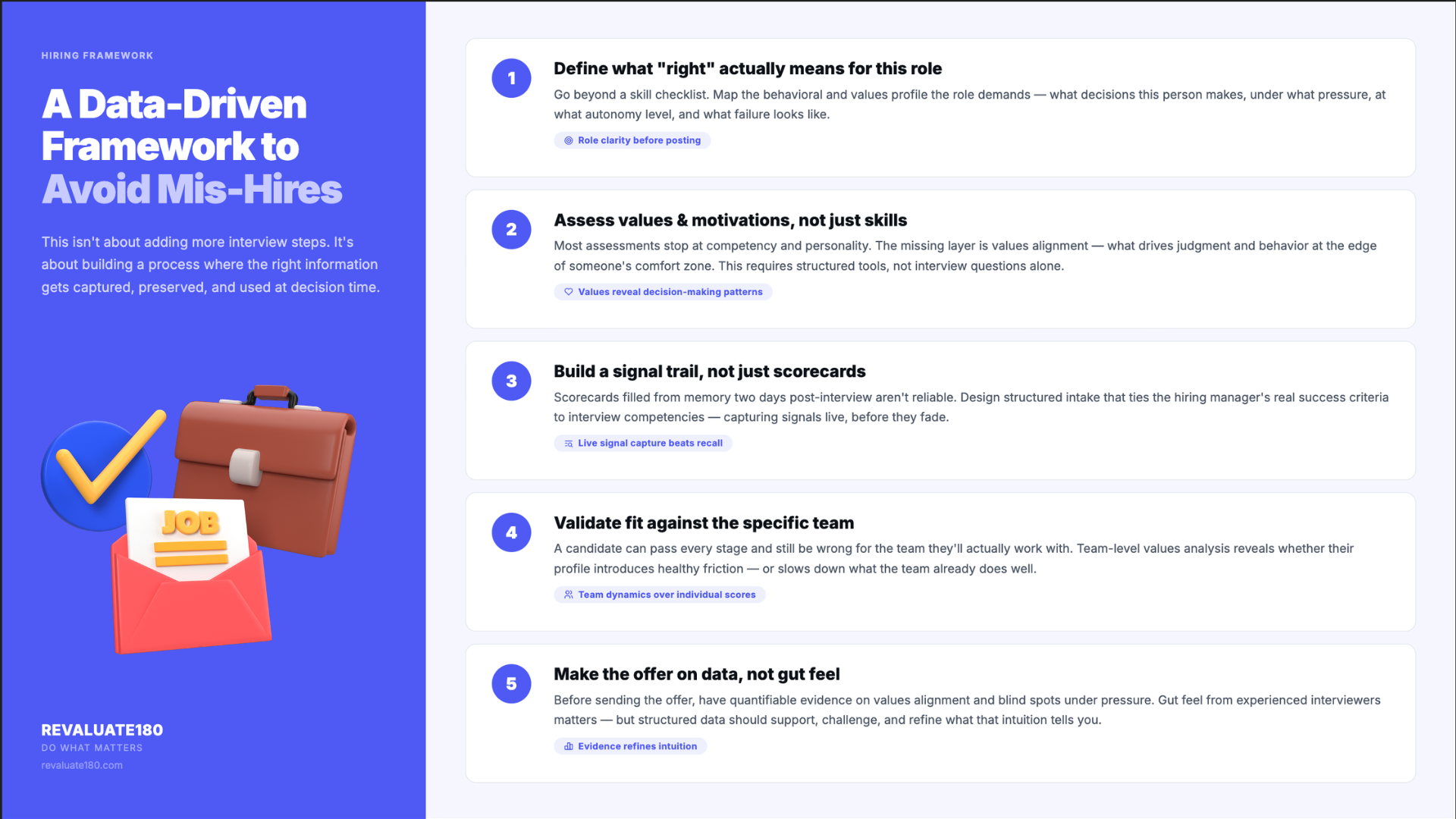
Step 1: Define what “right” actually means for this role
Before the job is posted, you must ensure you are clear about the behavioral and values profile the role demands, in addition to the skill requirements.
What decisions does this person make, and how often? Under what pressure conditions? What level of autonomy does he/she choose? And what does failure in this role look like?
This step is almost always ignored because a job description lists soft skills as bullet points. When the hiring managers say they need someone collaborative, it means different things to different people in the meeting. You can use this strategy to capture that specific operational meaning behind it.
Step 2: Assess values and motivations
Most structured hiring assessments stop at competency and personality. The critical missing layer is values alignment that defines the candidate’s fundamental priorities.
Values aren’t what someone says they believe in. They’re what drives their judgment and behavior at the edge of their comfort zone. This assessment has to go deeper than interview questions since it requires structured tools that reveal decision-making patterns.
Step 3: Build a signal trail, not just scorecards
You cannot completely rely on a scorecard filled out from memory two days after the interview. Asking for better interview notes isn’t the overall solution to this, but rather a well-designed process to capture signals when they exist.
Structured intake that ties the hiring manager’s actual success criteria to interview competencies. These live captures during interviews survive that 48-hour window between the final interview and debrief.
Step 4: Validate fit against the team
A candidate can clear every individual stage of the hiring process and still be a poor fit for the specific team they’re collaborating with. Team-level values analysis asks questions on a person’s profile for a healthy team friction or introduces friction that slows down what the team already does well.
The modern hiring strategies require having a clear picture of the existing team’s values profile. Building this picture can make this comparison highly likely.
Step 5: Make the offer on data, not gut feel
Before sending out the final offer, you must have clear, quantifiable evidence in hand that answers what the data says about this person’s values alignment and their blind spots when under pressure.
You don’t have to completely ignore your gut feelings either. Experienced hiring managers develop genuine pattern recognition over time. But gut feel without is where you get a financial hit. The goal is to have both the intuition of experienced interviewers and structured evidence that can support, challenge, and refine what that intuition is telling you.
Stop Hiring Blind
Most organizations have a reasonably solid process for evaluating skills for particular job roles. They’ve gotten good at assessing the candidate’s compatibility, but what they often lack is a structured way to assess values alignment, decision-making patterns under pressure, and the unconscious biases that shape hiring team judgment and slowly disrupt the company culture.
This is the problem Revaluate180 is built to resolve. R180's values and behavior-based assessment gives hiring teams a data layer they've never had before. Not personality scores, but quantifiable insight into what drives a person's judgment, what their blind spots are, and how they'll actually behave when it matters.
What to see what your next hire’s values profile actually looks like before sending them the offer? Book a 30-minute call with us!