When was the last time your team felt fully productive, collaborative, and motivated about what they’re building? Now think about how it feels when they disengage and disappear. That shift is known as low employee morale, and it’s one of the most damaging forces any organization can face.
The warning signs are subtle at first, but a few extra sick days can be indicative. A little less enthusiasm can be tolerated, but it can erode culture, accelerate turnover, and cost the business far more than just money if left unaddressed for a long time.
In this post, we’ll break down everything leaders need to know about recognizing early signs of low morale, the reasons it occurs, and how organizations can navigate it with the best strategies.
TL;DR
- Low employee morale is a state of constant disengagement, dissatisfaction, or disconnection at work.
- It shows up as increased absenteeism, missed deadlines, a negative demeanor, bare-minimum effort, and high levels of conflict every day.
- It’s caused by various factors like poor communication, lack of recognition, micromanagement, unclear expectations, and lack of opportunities for career growth.
- If it’s ignored long enough, it can drain your and your team’s productivity, increase attrition, and erode your company’s culture and reputation.
What is Low Employee Morale?
Employee morale refers to the collective mood, confidence, and spirit of a workplace. When morale rises, employees feel supported, heard, and valued at work. This results in them being genuinely invested in their work, taking the right initiatives, collaborating with teams, and going the extra mile without being asked.
Low employee morale happens when employees feel dissatisfied, underappreciated, and disconnected from the company’s mission. They often show up at work, but are not fully invested in their tasks. According to Gallup's 2025 report, 79% of employees are disengaged at work, while disengaged workers are roughly 18% less productive than their engaged peers.
Low morale isn’t a personality issue; it's a signal that something is wrong with the environment, company culture, and the leader who shapes them.
What Are the Signs of Low Morale?
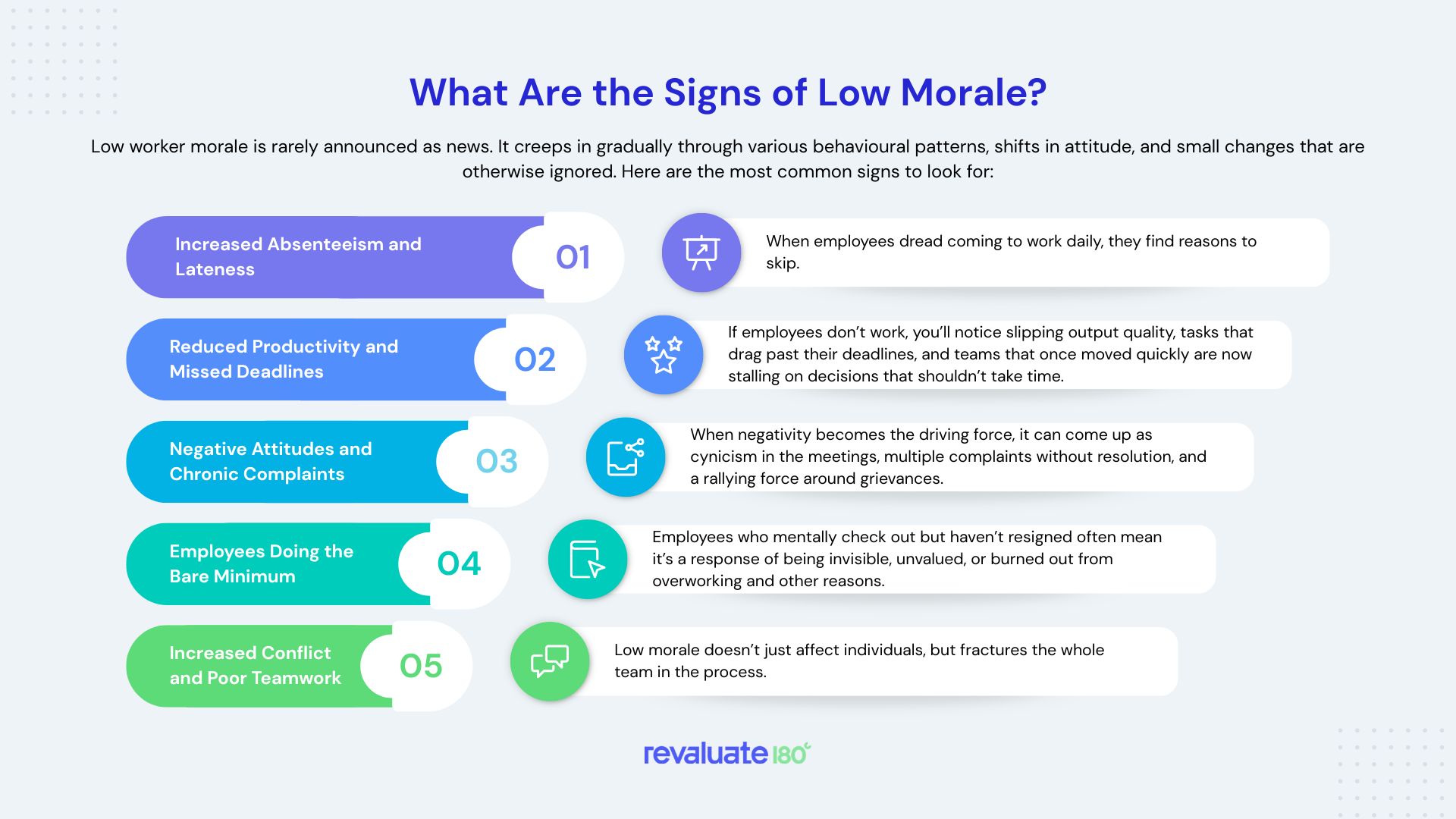
Low worker morale is rarely announced as news. It creeps in gradually through various behavioural patterns, shifts in attitude, and small changes that are otherwise ignored. Here are the most common signs to look for:
1. Increased absenteeism and lateness
When employees dread coming to work daily, they find reasons to skip. Frequent unplanned absences, late arrivals, and countless excuses to take leave are often among the earliest signs of disengagement. An employee who used to come early but is now often rolling in late is showing something you shouldn’t ignore.
There’s a difference between mishaps and intentionally repeated actions, such as increased absenteeism, late commutes, and excessive sick days. These follow similar repeated patterns that employees exhibit as a high operational cost of their own.
2. Reduced productivity and missed deadlines
Motivation and output go hand in hand. If employees don’t feel like working, you’ll notice slipping output quality, tasks that drag past their deadlines, and teams that once moved quickly are now stalling on decisions that shouldn’t take time.
It’s not that they’re lazy. It’s about disconnecting from work and not caring enough about the outcomes. When this happens, they don’t follow ownership, recognition, or purpose. All they do is push deadlines back, which eventually affects project decisions.
3. Negative attitudes and chronic complaints
Discussing workplace issues is healthy and must be addressed. But when negativity becomes the driving force, it can manifest as cynicism in meetings, multiple complaints without resolution, and a rallying point around grievances.
Here, look for the shift from constructive criticism to cloak cynicism. Someone who used to push back thoughtfully on ideas but now disagrees with everything suggests something is wrong and must be addressed immediately.
4. Employees doing the bare minimum
This is something called “Quiet Quitting” in the HR circles. Employees who mentally check out but haven’t resigned often do so because they feel invisible, unvalued, or burned out from overworking and other factors. So, they do what’s technically required and nothing more, like no extra initiatives, no volunteering, and no suggestions.
This is especially true among employees who used to perform at the highest level. When someone who once brought excitement and ideas to the table now suddenly goes quiet and compliant.
5. Increased conflict and poor teamwork
Low morale doesn’t just affect individuals, but fractures the whole team in the process. When people are resentful or disengaged, small misunderstandings can also become a big issue. Pointing fingers at each other becomes an alternative to solving problems, where people stop covering for each other and start sharing information and plans.
At first, it starts with less cross-team communication, more passive-aggressive emails, and a drop in sharing ideas or suggestions. If it keeps escalating, it can solidify into cliques, open more conflicts, and deeply damage a siloed culture that makes collaborating with others nearly impossible.
Leadership Insight:These five signs rarely appear individually but cluster together more often. So, when you see any one sign, make sure you look for more patterns across multiple segments.
Effects of Low Morale in the Workplace
The signs of low morale are easy to identify, but they tend to compound faster than most people expect. Here are the most obvious ones:
1. Declining performance and motivation
Morale multiplies performance, driving motivation. When it’s high, it amplifies clarity, accountability, and efforts across every team. But when it’s low, it creates friction in the form of delayed decisions, poor-quality work, and a gradual erosion of the standards that once defined the team as company morale.
2. Increased turnover and disengagement
Deficient morale is one of the leading drivers of voluntary turnover. When employees feel undervalued or stressed, they don’t usually make a fuss about it publicly; instead, they quietly update their resumes. By the time they hand in their notice, they’ve often been mentally away for months.
It costs so much more than you think. Companies in the top engagement quartile experience 25-65% lower turnover than those in the bottom quartile. It simply means that, beyond direct replacement costs, departing employees take institutional knowledge, client relationships, and team chemistry with teams. If this persists, you must run engagement surveys and ask the right questions to them to get more insights.
3. Poor collaboration and communication
Teams that demoralize each other don’t just work more slowly; they also communicate less. They start to disengage from meetings and stop reaching out to their peers for help. This results in a communication breakdown that is otherwise crucial to organizational growth and kills innovation in the long term.
4. Higher stress and burnout
There’s a counterintuitive dynamic at work as low morale often increases stress. When people are disengaged but still expected to deliver, they often strain to show up without caring. Add in poor management, unclear expectations, or heavy workloads, and you’ll have a fast-track solution to burnout.
5. Culture erosion and trust breakdown
We believe the most lasting effect of low employee morale is on the company culture. Research has proven that a toxic work environment emerges from prolonged low morale, making their employees ten times more likely to quit. Most importantly, it erodes long-term trust in leadership, making it hard to reverse.
What Causes Low Employee Morale at Work?
Low morale is almost a management issue, not a people problem. Let’s understand the root causes of at work:
1. Poor communication and lack of transparency
When employees aren’t kept in the loop, rumors fill in the gaps through the form of anxiety and repulsion. A CultureWise survey found that 80% of workers want greater visibility into decision-making so they feel more involved and honest.
2. Lack of recognition or appreciation
Feeling invisible is one of the fastest routes to damage morale. Around 79% of people who leave their jobs cite a lack of recognition as a contributing factor. It doesn’t always take award programs to fix this; rather, a genuine, specific thank-you note or certain employee benefits can make a huge difference.
3. Micromanagement and lack of trust
Micromanagement is also another of the most reliably cited causes of poor morale. A Baylor University study found that it undermines confidence and creativity. Basically, micromanagement communicates a lack of trust, which is otherwise essential for long-term growth, and employees feel this clearly in every meeting.
4. Unclear expectations and shifting priorities
Most people work better under pressure, and even if they don’t, a clear goal can still be pursued. What they struggle with is ambiguity. When priorities keep changing without notice, or conflicting directions build frustration over time, it can be hard to stay focused. It’s the leadership’s responsibility to make it right and on point.
5. Limited growth opportunities
Stagnation isn’t just demoralizing but career-damaging. When employees don’t see a path forward due to a lack of skills, no roles to grow into, or no challenges, they begin to disengage as a form of retaliation. Workplace stagnation is a significant cause of low morale, so people must feel they’re moving towards something and don’t feel stuck.
6. Unequal workloads or perceived unfairness
Ethics matter more when it comes to building a team relationship. When some people carry disproportionate workloads while others coast, resentment builds fast. Similarly, opportunities seem to follow favouritism rather than excellence; they’re bound to resent.
Employees are constantly comparing their work experience to that of those around them (consciously or not). When the perceived gap becomes too wide, trust in leadership breaks down.
7. Feeling unheard or undervalued
When employee feedback is consistently dismissed, people learn to stop giving it. Once someone stops contributing ideas or raising concerns about work, their investment in the organization feels less over time. Employees who don’t feel respected tend to intentionally reduce their work effort, spending less time on tasks, and the quality of their results deteriorates.
8. Atmospheres of blame or fear
People stop taking risks when the workplace punishes their mistakes rather than examining them. They stop experimenting and taking responsibilities when they have time to fix. Fear-driven environments produce a defense mechanism in which minimal effort is made. This, in the end, deeply damages morale.
9. Lack of respect and psychological safety
Psychological safety is the most crucial driver for long-term retention. It can mean feeling able to speak up, ask questions, and make mistakes without fear of ridicule or retaliation. This is foundational to a healthy respect. When employees don’t feel respected, they actively stop putting effort into or contributing with others.
How Can Leaders Improve Employee Morale?
Improving fairness and morale should be a long-term goal through sustained leadership practice. The following strategies are curated through our own experiences that can compound over time when applied consistently:
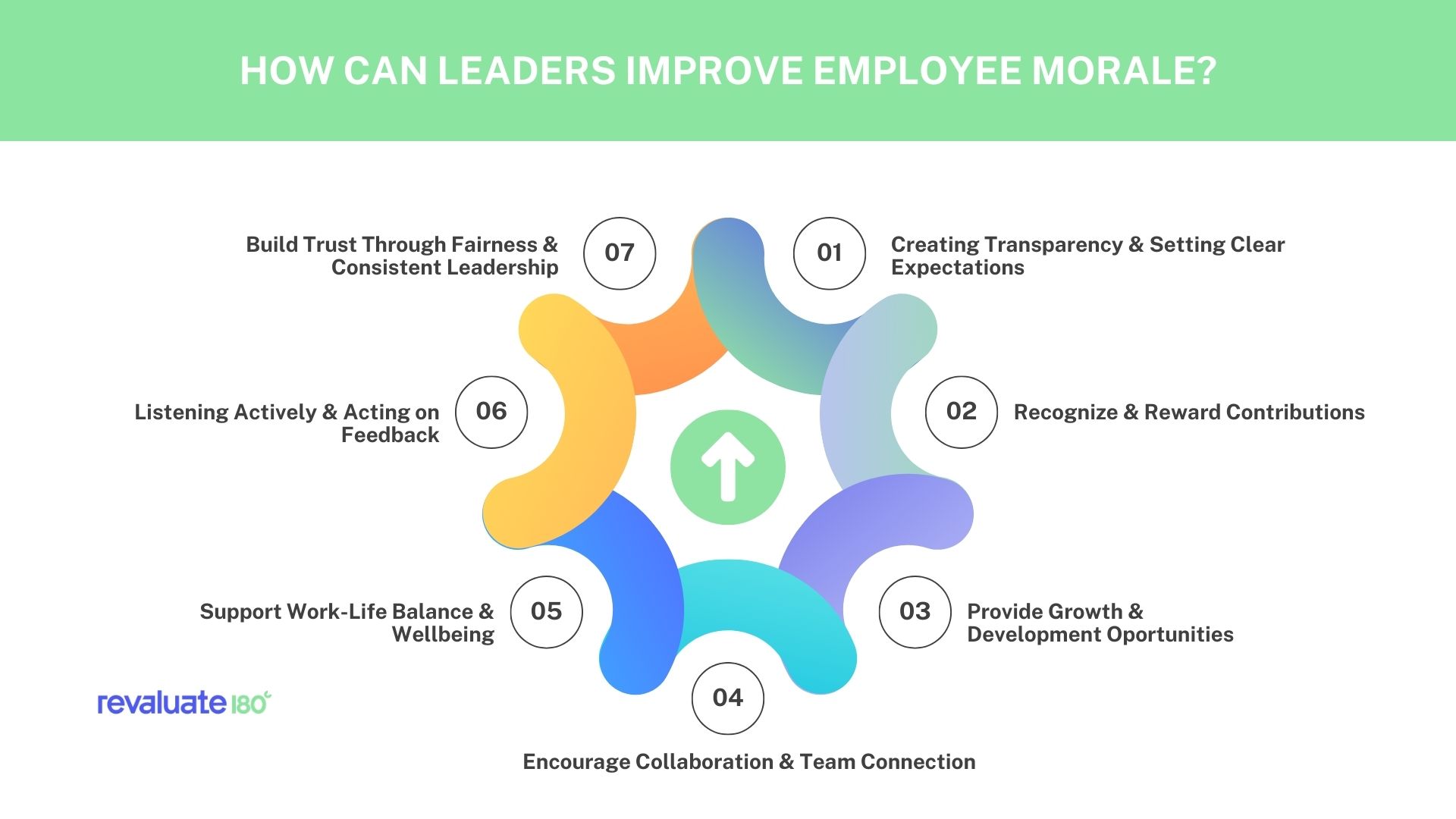
1. Creating transparency and setting clear expectations
Transparency starts even before onboarding anyone. Employees perform best when they’re on the same page with your mission. So, leaders must communicate openly and regularly by sharing their direction, rationale behind changes, and clear role-level expectations that maintain transparency. You can begin with what ‘good’ looks like in each position.
2. Recognize and reward contributions
Appreciation is one of the highest-leverage tools leaders have over their employees, but it is often underused. Recognition doesn’t always mean a financial reward, but rather a specific benefit, such as genuine verbal acknowledgment or, in some cases, career counseling.
Acknowledge their efforts and ensure they feel seen and heard within their teams and beyond. When they understand their work is valuable, they bring more to the table for both.
3. Provide growth and development opportunities
You can proactively address stagnation by investing in leadership and employee training programs, creating mentorship programs, offering stretch assessments, and helping them build career paths. Even small gestures like involving junior staff in decision-making, funding a relevant course, or creating space for someone to lead new initiatives can send a powerful message.
4. Encourage collaboration and team connection
Strong collaboration builds strong trust and interpersonal relationships. This helps immensely in making work more meaningful and resilient. Leaders can actively build team cohesion through real connections during team lunches, collaborative problem-solving sessions, cross-functional projects, or even informal social channels.
The goal here is to have fun without being forced. You can create conditions for genuine relationships to form, where people care about their peers and don't compete with them.
5. Support work-life balance and wellbeing
Workload exhaustion and burnout can directly lead to damaged morale. Leaders can prevent this by implementing healthy boundaries, respecting personal time, and genuinely adapting to the work styles.
The best things to invest in are wellness benefits, mental health days, and a culture that genuinely encourages taking time off rather than penalizes it.
6. Listening actively and acting on feedback
Feedback is what makes the culture breathe. Feedback culture starts with the credibility of your response to that feedback. It starts when you listen to the problems and actually make efforts to solve them. When employees see that raising feedback is disappearing into a void, the opposite happens. Even when you can’t fix everything, you can communicate them clearly and find a mutually acceptable resolution.
7. Build trust through fairness and consistent leadership
Trust fuels strong morale, and it’s a foundation. Managers should apply expectations, rewards, and consequences equitably across the team. It’s recommended to involve employees in key decision-making whenever possible. Give credit where credit is due, admit mistakes, and correct the course visibly.
Granting autonomy to employees and demonstrating the real-world consequences can directly lead to higher satisfaction and motivation to work beyond their paychecks.
Final Thoughts
Low employee morale isn’t just a standard issue but an organizational threat if ignored. It threatens overall productivity, quality of work, and the culture it creates. The good news is that you can still resolve it with the help of leaders who are honest and committed to their work.
Organizations that take morale seriously view it as a genuine business opportunity, not just another HR metric. They prioritize sustainable productivity through challenges that become the foundation for building a culture that becomes a competitive advantage for themselves.
If low morale is silently hurting your team, Revaluate180 is here to help uncover root causes and leadership strength. Contact us today and build a culture where everyone feels valued, engaged, and motivated to move forward.

Unlock AI-Powered Hiring Analytics
Transform the way you hire with insights that create aligned, collaborative, and high-performing teams.
- Smarter Hiring Decisions
- Reduce Expensive Turnover
- AI-Driven Insights
- Optimize Team Performance