
Teams mostly comprise individuals coming from diverse backgrounds, which uniquely shape their core values and beliefs. When working together as a team, these individual values can conflict with one another’s beliefs.
Here is where common team values can help unite team members to follow a set of core principles and practices that are important for working together. Team values are a shared set of best practices and working principles that all members must follow in order to achieve their shared goals.
But do all teams follow the same values?
Can these values really contribute to exceptional work performance?
How can leaders encourage their teams to make them a core part of their work life?
This guide will answer these questions and explain how shared values play an important role in shaping high-performing teams.
TL;DR
- Every team must have a set of core values that all members follow to ensure smooth functioning and task completion.
- Team values help members set aside individual differences and conflicting beliefs and focus on staying united to ensure their collective efforts yield success.
- Teams with values of trust, accountability, transparency, adaptability, integrity, ownership, and continuous learning achieve higher performance and productivity.
- Learn how individual values, along with team dynamics, help shape a team's core values.
What Are Team Values?
Team values are the core principles and practices that guide team members to work in unison, make informed decisions, and communicate and behave in ways that do not contradict or harm one another.
Teams must be built with strong team values that apply equally to all members. These values drive teams to perform better and engage with one another, naturally creating a great team culture.
Team values are ideally the same across all teams, regardless of the nature of the work or the goals they aim to achieve. This is why building teams with strong values is essential at all levels and across all divisions in an organization.
Why Are Team Values Important?
Teams comprise diverse members. Each one may come from a different ethnic background, speak different languages, follow unique cultural practices, and have different faiths. These factors play an important role in shaping employees' values and workplace culture, which can lead to differences among team members.
To avoid such differences and ensure harmony among team members, team values form the backbone of smooth team dynamics. Here are some of the direct benefits of team values:
1. Improves collaboration and trust: Trust is a crucial parameter for giving team members a safe space to share ideas, discuss challenges, seek help, and perform to the best of their abilities. When members trust each other and have the right opportunities to prove themselves, the results benefit the whole team as they work towards common goals.
2. Supports better decision-making: Having a systematic approach of gathering ideas, opinions, evaluating options, and arriving at a decision is crucial to avoid disputes while making decisions in teams with diverse members. Members mutually respect and value every opinion irrespective of its impact, giving everyone a fair chance to participate in the decision-making process.
3. Creates alignment around expectations: Collaboration among team members works best when each member is aligned with the expected business outcomes and quality of service to be provided. Unity among diverse members is possible when they are focused on the team’s goals and generate ideas to achieve them.
4. Strengthens accountability and ownership: Members taking accountability and collective ownership is an ideal team value over pinpointing members’ shortcomings. Handholding and supporting team members ensure work gets done faster rather than becoming a bottleneck for subsequent tasks in the work pipeline.
5. Helps shape team culture: A team’s work dynamics and work culture are shaped by the core values that all team members follow when working in the company. Right from accepting a new member to ensuring a smooth severance for a senior member, a team that functions consistently will meet business goals, irrespective of incoming challenges.
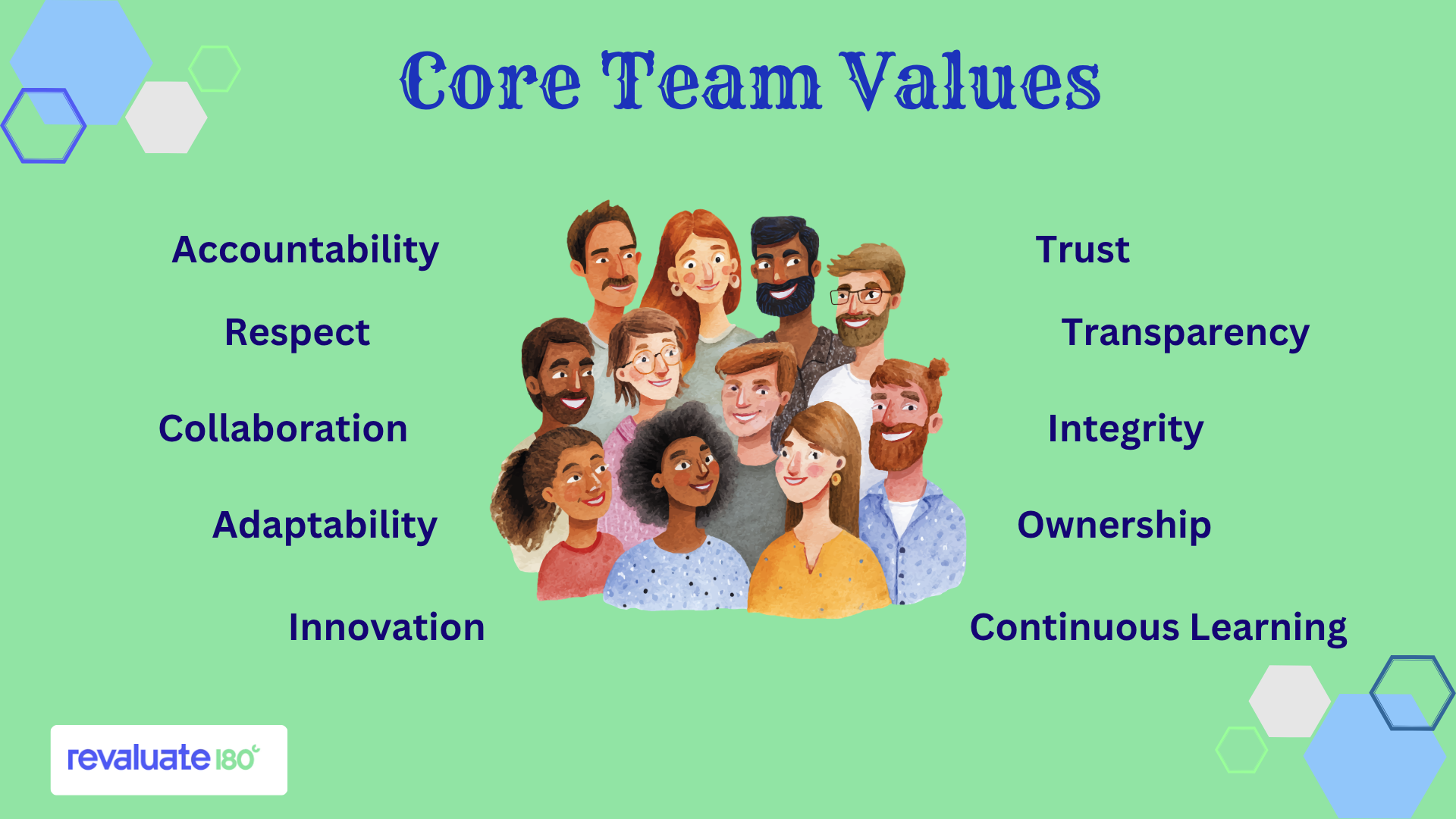
10 Examples of Strong Team Values
Teams function only when members put aside their differences and align with the common values that define their team. The following team values help teams progress in their work tasks while maintaining their unique skill identities, without clashing with other team members.
1. Accountability
Members must be accountable, i.e., take complete ownership and responsibility for the tasks they do. Taking responsibility is a powerful sign that employees will deliver their best in their contributions towards a business objective.
Accountable team leaders must set an example to their team members on how to collectively take ownership of failures or mistakes, and ensure the entire team is celebrated for their successes. Similarly, individual accountability allows team members to come out of their comfort zones and break boundaries to deliver better results every time.
2. Trust
Team members must believe in each other and their abilities to make significant contributions to every work task that leads to the final results. Belief in each other’s capabilities is crucial when planning project deliverables and distributing work based on individual expertise.
Leaders must set an example by giving team members sufficient autonomy to work productively in their own time. Moreover, mutual trust is a driving factor in improving team engagement.
3. Transparency
Teams often fail when members are unclear about any communications, decisions, or plans that few members alone are aware of. A lack of clarity or confusion often leads to arguments, disputes, rifts, and a breakdown of trust, ultimately causing a major setback for the team.
Transparency in communication, decision-making, reviews, and feedback is a mandatory team value that holds teams together at all times. Members feel part of the team only when they are involved in every process and activity within it. If you wish to create a team where members are treated equally, transparency is non-negotiable.
4. Respect
Every team has encountered situations in which members do not agree with one another’s theories or ideologies, creating friction in their relationships. A good team has members who respectfully disagree with others’ opinions, while continuing to foster smooth team unity.
Members must learn to respect every other team member, regardless of designation or background, and value their suggestions and feedback at all times. Leaders must facilitate transparent communication, ensuring equal opportunities for all team members so that no one feels left out or unheard during discussions or decisions.
5. Collaboration
Good teams consist of members with unique traits or skill sets who can make significant contributions to the team’s work targets. However, it is not a good practice to rely on one or more members to complete a task, as this can stall subsequent tasks under unforeseen circumstances.
Collaborative working and periodic knowledge sharing help team members understand how others work and solve technical challenges. The next time a similar task comes up and a key member is not present, the team can continue to function without excuses or failures.
6. Adaptability
Being part of a team calls for stepping out of comfort zones and eliminating any unconscious bias or preconceived notions that can affect collaborative efforts. Adaptability is that core team value that shows how an individual employee has transformed into a team member by prioritizing the team’s goals and principles over personal beliefs and practices.
Whether the team is working in an office or in remote locations, the team must always find a way to get the job done. The COVID-19 pandemic showed us how teams could continue to function effectively even when team members were restricted to their homes, yet still gave their best at work.
7. Innovation
A team’s performance is measured by how often the team exceeds its previous performance and comes up with out-of-the-box ideas that make a significant business impact. Team members must take it upon themselves to seek out the breakthrough idea or strategy that can take their team to the next level in the business.
Team members must encourage one another to develop creative solutions to every problem. From coming up with a tool that automates or simplifies day-to-day tasks, or a new strategy that provides business value, every idea must be valued and evaluated fairly.
8. Integrity
Integrity is a combination of being a responsible team member and an anchor when a team member needs support or assistance. Any discussions involving team members should ideally remain within the team and not be shared with other teams or peers outside the team.
Team integrity is a crucial value to ensure members trust one another. Honesty and adherence to the company’s core work policies help create teams that contribute at their best.
9. Continuous learning
Great teams have members who encourage each other to learn and grow in their careers. They see no ego in sharing their mistakes and findings with other members to prevent similar situations in the future.
Periodic knowledge-sharing sessions at the team level are now mandatory across teams, so that each member can teach others a new topic that will help them in their future endeavors. Such progressive teams are always sought after by new joiners when they enter a company.
10. Ownership
Failures within a team can happen due to one or more members, knowingly or unknowingly. However, good teams take collective ownership of mistakes and challenges rather than engaging in blame games or pinpointing causes.
Team ownership gives all members the opportunity to pitch in and execute tasks, even if not assigned to them. This team value is therefore a must-have for members to be accountable individually and as a team.
How to Build Team Values?
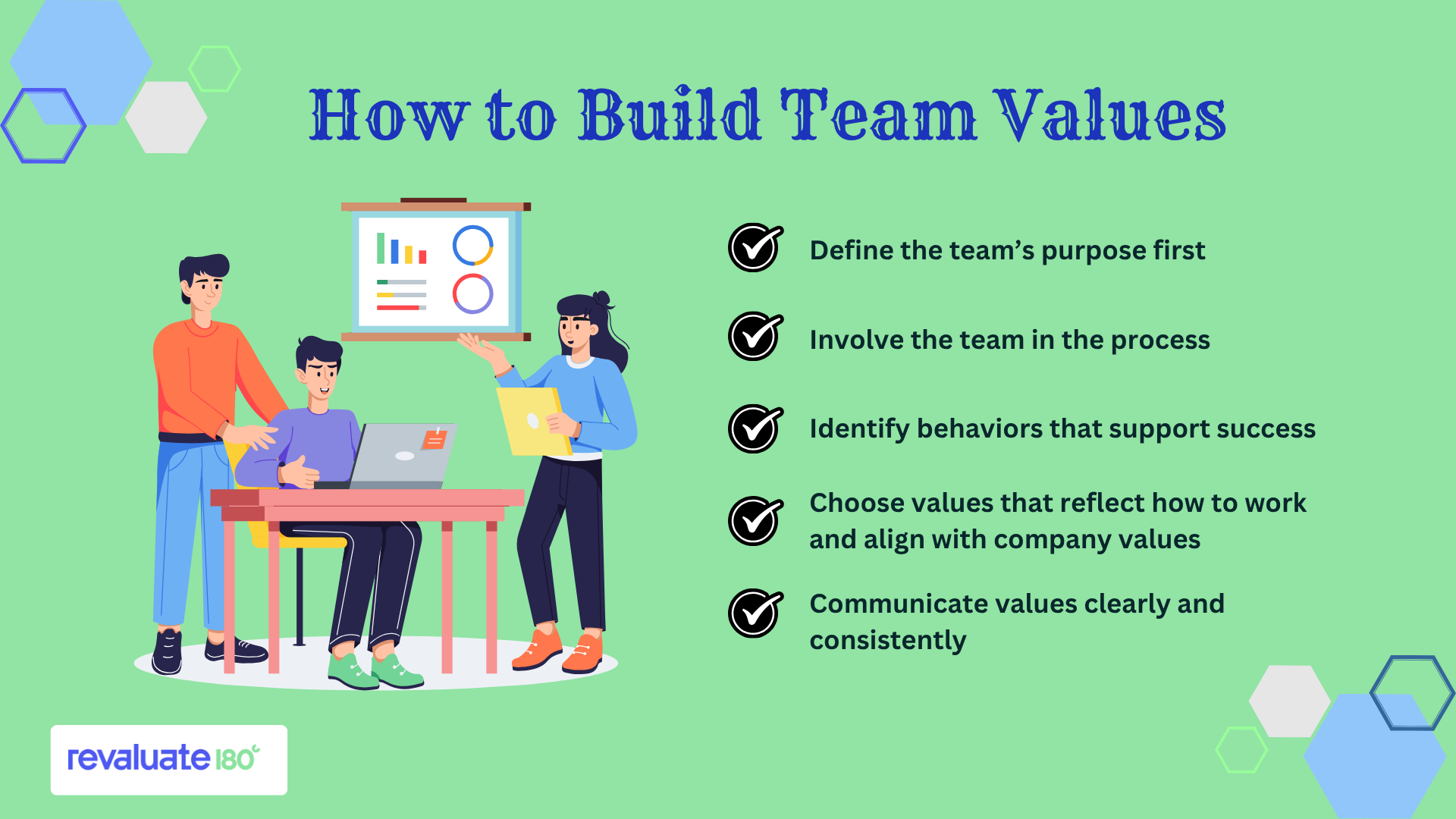
Creating a strong framework of values is a must to ensure team members remain focused on their work goals without getting distracted or confused on their path to progress. Here are some of the best practices followed by high-performing teams to build their core values.
1. Define the team’s purpose first
Depending on the goals to be met, teams must decide how they will work and what problem they will solve through their collaborative efforts. For instance, teams can be split into sub-teams, which can have their own sub-goals and tasks.
2. Involve the team in the process
Enforce transparency, mutual respect, and integrity within the team by mandating that all members participate in negotiations, discussions, and ideation sessions. Participation and involvement in all proceedings help members remain clear about any improvements and challenges, and to progress to subsequent tasks.
3. Identify behaviors that support success
Let us say your team has come up with a recreational activity that happens once or twice a week. After implementing such engaging activities, you find that your employees work more efficiently in meeting their weekly targets. Identifying such driving factors that contribute to improved team engagement and performance improvement helps shape your team’s core values.
4. Choose values that reflect how the team should work
Values like trust and autonomy are crucial for teams working in a remote setup, since members do not meet in person or sync up as they do in a physical office environment. Similarly, integrity is a crucial value in teams working on mission-critical projects without violating privacy considerations.
5. Align team values with company values
Every team in a company should ideally follow the same team values, which define the company's work culture. A team’s performance must be a direct reflection of its core values, while its working process aligns with the company’s goals and objectives.
6. Communicate values clearly and consistently
Team leaders must periodically review how their teams are in terms of their value profiles and work dynamics, so that they do not deviate or ignore any core team values. They must clearly communicate how team members must follow these values and avoid any past mistakes to perform consistently.
Closing Thoughts
Team values serve as bridges, enabling team members to communicate and engage smoothly with one another, regardless of their individual value profiles. Strong, high-performing teams stand out from the rest by adhering to these core values.
Clear communication, trust, accountability, integrity, mutual respect, and adaptability are core team values that all teams should ideally uphold. However, it can be difficult to uphold these values, especially within teams with members from diverse backgrounds and cultures.
Revaluate180 helps uncover these values, behavioral, and other dynamic factors that can be barriers to building strong teams. Our analysis and insights help determine whether team values are reflected in how teams operate, so leaders can build healthier, more aligned teams.
Connect with us if you are looking to build strong teams and track their value alignment, productivity, and performance.

Unlock AI-Powered Hiring Analytics
Transform the way you hire with insights that create aligned, collaborative, and high-performing teams.
- Smarter Hiring Decisions
- Reduce Expensive Turnover
- AI-Driven Insights
- Optimize Team Performance