We always emphasize hiring the right employees as a crucial parameter for a company’s growth. Your hiring process must be well-optimized to ensure you attract the best candidates in the job market for your roles.
Yet another area that has undergone significant change since the advent of AI is the many benefits it offers recruiters for improving the hiring process through data-driven analytics.
In this guide, we’ll learn about how you can optimize your hiring process with data-driven decision-making at each step to blend the latest job trends with your company’s hiring requirements.
TL;DR
- The hiring process includes finding candidates, screening, evaluating, selecting the best, and onboarding them to one or more roles within a company.
- Each stage of the hiring process requires strategic planning to ensure recruiters select the right candidates based on several performance indicators.
- Traditional recruitment processes are often error-prone, leading to many bad hires that cost the company.
- Understand how data-driven decision-making improves several steps of the hiring process to filter and arrive at the best candidates.
What is the Hiring Process?
The recruitment or hiring process involves several steps in finding, evaluating, and selecting the best candidates for a job role. Hiring right by strategically planning each step from advertising the job role to selecting the most qualified and culturally-fit candidates, is the first step to ensure long-term employee retention and engagement.
Improving your hiring process is a constant challenge, and employers must be aware of the challenges in the current job market. Therefore, it is necessary to leverage the latest trends and technologies to optimize each stage of the hiring process.
What Does an Effective Hiring Process Look Like
Hiring requirements vary depending on industry standards and job specifications. However, companies must follow a uniform hiring process or template to ensure their candidates have a smooth experience.
An effective hiring process includes the following action items, regardless of the role candidates apply for.
1. Clear ownership and accountability
Recruiters and employers must ensure transparent communication with potential candidates throughout the hiring process and after selection, addressing unresolved queries, maintaining ties with potential talent pools, and more.
2. Defined decision criteria
The recruiters must set accurate filtering or selection criteria for candidates to pass to the subsequent stages of the hiring process. The criteria must be free of unconscious bias and comply with cultural and psychological requirements to blend with a company’s work culture.
3. Consistent candidate experience
All candidates must complete the same tasks or skill assessments, judged by the same interview panel at each stage, ensuring uniform selection criteria for all to qualify for the next stage of hiring.
4. Measurable outcomes beyond time-to-hire
Recruiters must focus on the value new candidates will bring to the role through their work. Evaluating an employee's past performance, work history, time taken to deliver targets, and similar factors determines the quality of an employee more than the number of evaluation rounds.
12 Ways to Improve Your Hiring Process
Recruiters must assess their current hiring process and optimize each step to ensure no bad hires or misfit candidates qualify for subsequent stages. Since hiring is a process that requires human effort, it can be susceptible to errors and unconscious biases that arise at different stages.

Here are some of the latest hiring improvements that many companies have incorporated to attract the best candidates.
1. Start with the real hiring need
The first stage of hiring involves creating a clear strategy, with recruiters having answers to important questions - the hiring requirement, the importance of hiring for the role, the number of hires required, mandatory skillsets, evaluation criteria, time period to fill the role, number and type of evaluation rounds, selection panel, and others.
This stage also includes analyzing why a particular job role went empty. Deriving analytics from past hiring experiences for a job role helps recruiters understand how to ensure long-term retention of the new candidate joining the team.
2. Define clear, non-negotiable hiring criteria
Apart from highlighting the mandatory skills required for a job in your industry, employers must mention the ideal characteristics and working styles that they prefer from their candidates. For instance, if a job role requires candidates to come to the office every day, ensure that it is mentioned in the job description.
Non-negotiable criteria can be altered from past hiring mistakes. For instance, if a role saw candidates leaving within a short span because they could not learn a particular skill, you can consider adding the specific additional skills required to help candidates bag the role.
3. Write job descriptions candidates actually understand
Writing clear and precise job descriptions must not just describe a job role, but also give a sense of what a candidate can expect when joining a new team in the company. Most job descriptions miss out on this “cultural fitness” and the company’s overall work culture.
Unclear descriptions or failing to mention mandatory and negotiable job characteristics often create gaps between a candidate’s expectations and reality when joining a company. AI recruitment tools are useful for crafting clear job descriptions that reach the right talent pool.
4. Hire for role fit, not resume keywords
The hiring process improves significantly when recruiters hire the right team members who exhibit team-player characteristics and align with the organization’s goals and policies. Most bad hires often clash with the team's working style, leading to poor engagement and lower overall team productivity.
Individual character assessment and value profile creation are, therefore, a mandatory step to be included in the hiring process, whose importance weighs more than skills and descriptions in a candidate’s resume.
5. Use fewer, better sourcing channels
While it is true that candidates for a job role can come from different channels, it can be difficult for recruiters to filter and select a handful of eligible ones in a fair manner. That is why companies must initially focus on a few verified sources of talent pools that have yielded good hires for them in the past.
Targeting authentic sources of skilled talent reduces the effort required to conduct basic eligibility tests and screenings. This way, all candidates who apply get a fair chance to be selected or are rejected for concrete reasons.
6. Standardize application screening
The mundane tasks of screening numerous resumes for a job are a recruiter’s worst nightmare! This mundaneness is also a reason this process is highly error-prone. Many recruiters turn to parsers to check if resumes contain the required keywords of the skill sets mentioned.
Now, AI-based resume screeners go beyond keyword matching to semantically evaluate a profile's worthiness based on skills, background, work experience, and qualifications. Using such tools helps standardize the screening and selection process so that no eligible profile misses out.
7. Use structured interviews
Most technical evaluations in the hiring process lack a standardized scoring method for candidates. Also, different interviewers place different weight on different aspects of a technical skill, making it difficult and unfair to compare candidate scores for further selection.
All interviews and evaluation stages must include a standard set of questions and scoring methods that all interview panel members must follow. Also, the scoring and selection process must be uniform and include tie-breaker criteria to ensure the right candidates progress.
8. Measure what actually predicts success
Recruiters must consider a holistic evaluation of a candidate when deciding on their fit for a role, beyond just skill set and years of experience.
For instance, a candidate applying for a managerial position may not be as skilled with the latest technology as someone who’s more “fresh.” But their role requires them to navigate challenges, negotiate the resources and time required to complete tasks, and delegate tasks to the team with fairness and responsibility, rather than being an expert in ground-level tasks.
9. Reduce bias with data-backed decision tools
More and more workplaces are hiring candidates from diverse backgrounds to ensure that no single group holds a majority presence in a company. This goal can be achieved through an optimized recruitment process that eliminates unconscious bias at every stage of hiring.
Data insights from past hiring data and current employee records help recruiters ensure that candidates from all kinds of backgrounds have a fair chance of selection based solely on their eligibility, value profile, and performance scores.
10. Align hiring managers before final decisions
The hiring process often involves selection and evaluation panels composed of experts from different areas. Different interviewers often bring in unconscious bias in the hiring process, making them favor a particular candidate over another.
To avoid such unfair selections based on preferences and gut instincts, it is important to align hiring managers, target team members, and managers to decide on the ideal candidate they require. Here again, data-driven insights from candidates' past behavioral patterns help make an ideal choice rather than relying on instincts.
11. Speed up decisions without rushing them
In a hurry to fill a critical job role, recruiters often skip essential hiring and onboarding processes and checklists to get them working on the required targets quickly. Such a practice is a key challenge for retaining employees in the long term.
Does that mean the hiring process must always go at a snail’s pace? Not at all.
With the right strategy and structured processes, hiring a candidate is possible within the estimated time frame. Thanks to data insights from past hires and exit interviews, recruiters can resolve any confusion and hire the perfect candidate without any doubts or intuitions.
12. Treat hiring as the first step of retention
The experience candidates have during the hiring and onboarding process shapes their first impression of their journey in the company. A well-structured hiring process, along with a wholesome onboarding with the team and the company, helps in long-term retention.
Ensure you incorporate compelling insights and analytics from your past hiring experiences, feedback from engagement surveys, retention surveys, and exit interviews, so that your new hires are highly effective from the start.
Common Hiring Process Mistakes to Avoid
As we mentioned earlier, the hiring process requires substantial human effort at each stage to ensure the right candidate does not miss out on an opportunity in an unfair manner.
Human evaluations and interventions are often fueled by biases, preconceived notions, and past experiences.
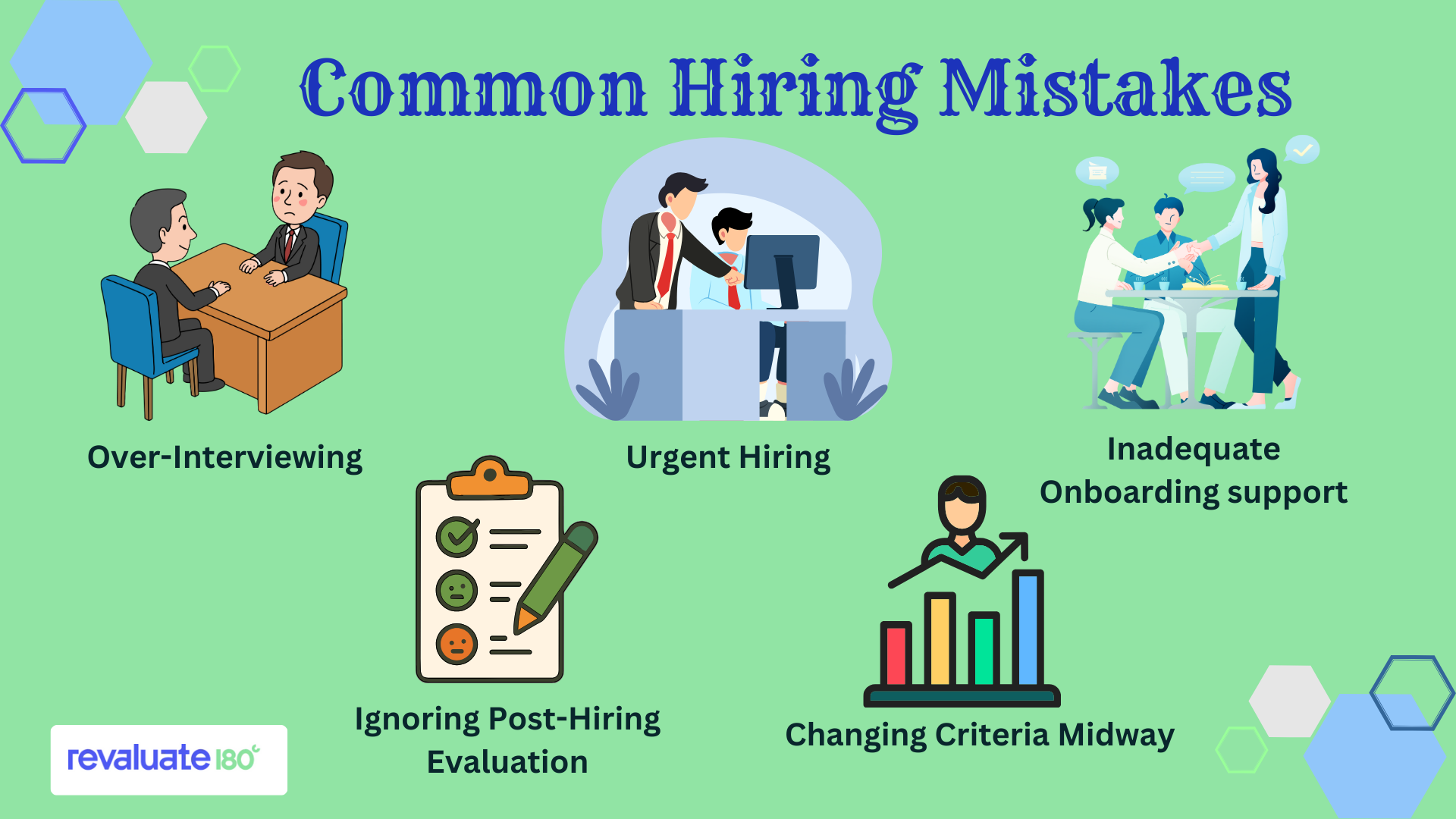
Here are some of the common areas where recruiters often go wrong in the hiring process.
1. Over-interviewing
Interviewers who do not follow a standard or structured questioning pattern are often anxious about making hiring mistakes and go by their gut instincts. As a consequence, they ask more questions to potential candidates to validate better, but it frustrates them in this process. Similarly, having multiple rounds of interviews to repeatedly evaluate the same skills on different instances or scenarios often frustrates candidates who leave interviews midway.
2. Changing criteria mid-process
A lack of or improper synchronization between the recruitment team and the target work team often leads to reevaluation of selection and requirement criteria during the hiring process. Naturally, candidates get frustrated, as many start to feel they are no longer relevant for that role.
3. Hiring for urgency instead of fit
The classic case of fetching bad hires with a minimum retention guarantee arises when hiring in a hurry to fill roles. Not considering a candidate's overall value profile and their fitness to work in a team while blending with the company’s work culture can often lead to repeated hiring cycles for the same role.
Improve Your Hiring Decisions With Revaluate180
To summarize, you can improve your hiring process by incorporating data-driven decision-making at each stage of candidate selection and evaluation, while maintaining clear hiring criteria and structured interviews.
Hiring involves evaluating candidates beyond just resumes and interviews, so that you get long-term company assets who will help your company scale to greater heights. That is precisely why data-driven hiring insights are becoming more common among companies striving to hire the right people for the right jobs.
Revaluate180 supports sustainable hiring by helping organizations avoid costly mis-hires. Using behavioral and value-based analytics, we match an individual’s Value Profile with the requirements of the role, team, and organizational culture to generate quantifiable insights.
These insights help predict the best-fit candidates from your talent pool, those aligned with role expectations, team dynamics, and personal motivations. As a result, organizations can reduce early attrition, improve hiring quality, and build stronger teams.
If you’re looking to review your hiring process or structure more effective evaluation frameworks, connect with Revaluate180 for expert guidance.

Unlock AI-Powered Hiring Analytics
Transform the way you hire with insights that create aligned, collaborative, and high-performing teams.
- Smarter Hiring Decisions
- Reduce Expensive Turnover
- AI-Driven Insights
- Optimize Team Performance