Imagine a hiring manager starting with two equally promising resumes. One candidate dazzled in interviews, and the other has a strong track record. Which one would you go with? The stakes are very high here, since a bad hire can cost thousands of dollars in direct expenses, and even greater intangible tolls that go beyond money.
In this guide, we’ll learn how to replace intuition with a structured process so you don’t have to rely solely on your gut. We’ll discover why hiring is a strategic commitment, who should be involved in the decision, the best curated methods for evaluating candidates with confidence, and much more.
TL;DR
- Hiring decisions are not just pick-and-skip, but rather a long-term strategic investment.
- Replacing gut instinct with a structured process can significantly improve your hiring quality and reduce bias.
- Clearly defined hiring criteria upfront can help keep your decisions aligned and factual at all levels.
- Structured interviews, scorecards, and consistent data analysis will help you improve fairness and predict job success.
- Great decisions balance the most crucial factors, including skills, growth potential, and values, that'll help ease your hiring decision.
- Reference checks are meant to uncover behavioral insights, not just for candidate verification.
- Your decisions should typically be made within 2-5 days, allowing you to maintain candidate engagement without sacrificing your company's reputation.
What is a Hiring Decision?
A hiring decision is not just a decision but a strategic investment. Recruitment experts report that hiring is a long-term commitment to your team and mission, where each step decides your company culture, affects how your team operates, and carries a substantial budgetary impact. Choosing the wrong person for the role can not just erode credibility, but also your judgment and modus operandi.
The hiring decision is the culmination of a process through job postings, interviews, and more, but deciding who to hire requires extra care. It matters deeply as new hires affect productivity, team morale, and foundational knowledge.
When done right, a hiring decision builds a high-performing team where you can gain all the strategic advantages of the opportunities gained through all quarters.
Who Makes the Final Decision in the Hiring Process
The decision-making process can vary by the company and its industry. But here are the most common approaches:
Hiring Manager Authority
Here, the hiring manager decides which candidate to choose. This process demands quick decisions and transparent accountability, but limits other perspectives that can lead to bias or the overlooking of candidate potential. This process is best for managers looking for smaller teams or specialized roles that require urgent hiring.
Committee Consensus
Here, a panel or hiring committee interviews candidates and reaches a consensus. This process demands multiple viewpoints to reduce blind spots, increase buy-in, and often improve diversity. The biggest cons are the slow decision-making process, the potential for compromised hires, and the complexity of the schedule. But you can make it useful if you’re looking for high-impact roles or organizations that value inclusive input.
Recruiter and Manager
Here, the recruiter and the manager share responsibility for selecting the candidate. Recuriter handles sourcing and screening, then recommends a shortlist to the manager, who later interviews and decides who to pick. This process requires effective communication and trust between the recruiter and the manager, but it also has a very efficient division of labor to leverage broad expertise and candidate pipelines. You can choose this process if you require fast hiring environments or high-volume roles.
Key Roles Clarified
Regardless of the kind of process, here are several roles that are typically involved:
- Recruiter/HR: Often designs and coordinates the process where they write job descriptions, screen resumes, run initial phone screens, and keep candidates engaged. They ensure compliance and can conduct reference checks if needed.
- Hiring manager: Defines job criteria, conducts deeper interviews, and assesses skills and culture fit motives. They are the ones who make the final decision on offer and take responsibility for making the hire succeed.
- Team members/peers: Colleagues who will work with the new hire prefer to interview them to ensure it’s a good fit in terms of collaboration and culture. They basically provide a frontline perspective, but typically don’t make the final call.
- Senior leadership: Executives may interview the finalists or, in this case, approve the offer. This is necessary, especially for critical roles.
How to Make a Great Hiring Decision
We’ve curated the best systematic 8-step process to guide your hiring decision, where each step replaces your instinct with evidence to ensure a fair and thorough evaluation. Let’s dive in:
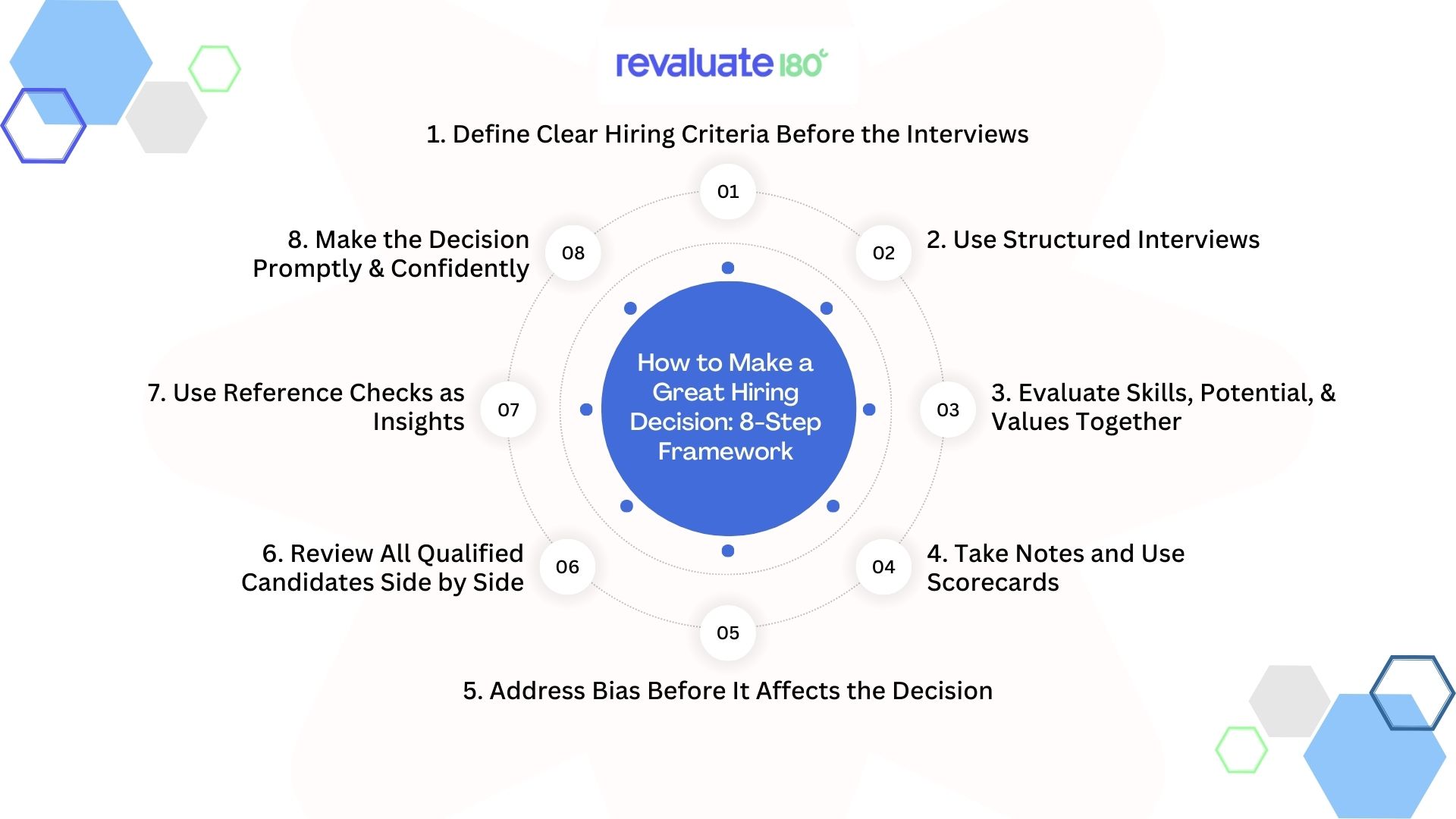
Step 1: Define Clear Hiring Criteria Before the Interviews
Before you interview your first candidate, you must clarify your company goals and what success means to your business. In practice, this means writing down concrete criteria and distinguishing between must-haves and nice-to-haves for a candidate.
At least, you have to list down the essential technical skills and experience required for the vacant role, for instance: A non-negotiable experience can be 3+ years of using Java & SQL, while a nice-to-have skill can be a little experience with AWS. Assign points to each so you and the interview team know what matters most to them for the required role.
These clear criteria keep everyone aligned and reduce unwanted bias. If you end up disagreeing with your choice, you can always refer back to these approved requirements rather than making it personal. It speeds decision-making if you include skills, cultural values, potential for growth, and logistical fits. A simple template is to list three to five technical skills and two behavioral traits as separate categories.
Step 2: Use Structured Interviews
Structured interviews are a key to maintaining fairness in the workplace. This means asking every candidate the same questions and using a standardized process to score answers, regardless of any bias.
This works best because studies show that structured interviews are nearly twice as predictive of job success as informal interviews. Before the interview, you can prepare a question guide that blocks out time, for instance: a 60-minute interview with 15 minutes of intro and 45 minutes for questions. Each question will include the skill or competency it assesses and a scoring rubric.
You can simply break down the 60-minute interview into a 10-minute rapport on background, 30 minutes of core questions mixed of situations and behaviors, and then 10 minutes of wrap-up. You can rotate multiple interviews if possible, but do ensure each person asks the same standardized questions to maintain consistency.
Step 3: Evaluate Skills, Potential, and Values Together
Ensure you do not judge candidates solely on one dimension. We recommend assessing three pillars: proven skills or experience, potential or growth mindset, and values or cultural fit.
Balancing these is very crucial as a candidate with strong technical skills but poor culture fit can disrupt the team in the long run. Similarly, a brilliant culture fit with no foundation in necessary skills might struggle with daily tasks. It’s in fact rarely black and white in real situations, so always tie back to the criteria from step one.
Step 4: Take Notes and Use Scorecards
Good notes and scoreboards are your smart investments. During each interview, you must document the evidence behind your opinions and use it later as your memory insurance. Start using a standardized scorecard to record each interview’s ratings for each criterion.
This matters the most because we usually forget the details quickly. Without notes, two weeks later you might not remember why you liked a particular candidate, so writing notes gives you something you can compare anytime and choose with all fairness and strategy.
A simple template with columns for each key competency, ratings, and space for comments can go very far. You can jot down key points next to each question during the interview and finalize each candidate's scores to make informed decisions.
Step 5: Address Bias Before It Affects the Decision
Bias is the most risky since it may creep in without knowing. Let’s understand the most common ones:
- Affinity Bias: Favouring candidates who share your background or hobbies can cause discrimination.
- Halo/Horns Effect: This happens when you let one trait, either positive or negative, color all impressions about them.
- First-impression Bias: Being well influenced by what happened in the first interaction.
- Confirmation Bias: Once you form an early opinion or perspective, you look only for evidence that confirms it and ignore the rest.
- Similarity Bias: Thinking someone will fit your company culture because they remind you of someone you liked in the past.
How do you mitigate these biases?
You can pre-brief interviewers by reminding them of these biases beforehand, use structured criteria, or perspective-taking, where you catch yourself leaning on affinity and make conscious decisions. You can also use post-interview calibration, where each interviewer ranks candidates independently before any group discussion. No process is bias-proof, so no need to be hard on yourself.
To further reduce unwanted bias, you can implement strategic DEI practices to ensure discrimination does not get in the way of your hiring decisions.
Step 6: Review All Qualified Candidates Side by Side
After all interviews are done, we recommend that you not evaluate one finalist at a time but rather the top candidates in parallel. This type of relative ranking prevents early bias toward whoever was the most recent and best suited to your needs.
To compare the finalists, you can compile all the scorecards and data to create a simple table or chart showing their scores for each criterion. In a candidate review meeting, it's more helpful to have a single facilitator who keeps the discussion on track.
Some teams use a weighted decision metric to assign weights to each requirement and multiply candidate scores and sums to finalize the total wins. This way, if a candidate ends up tied on the primary criteria, you can consider other factors such as availability, salary expectations, diversity, and more.
Step 7: Use Reference Checks as Insights
Reference checks can do more than just check marking. They are not just to confirm the dates and titles, but to gain deeper insights into the candidate’s ability and workplace behaviour.
You can treat them as an opportunity to ask purposeful questions that your interview doesn’t cover. You can start with specific scenarios, like how they handled tight deadlines or conflicts. Or what development areas did they have before?
You can always ask better questions, like which project had the most impact? Or at some point, they overcame a major obstacle? These questions shape your requirements and make hiring easy and confident.
Step 8: Make the Decision Promptly and Confidently
Once all inputs are ready, it’s time to decide. While deciding, try not to drag it out or rush things. Aim to complete the decision within a few business days after the interviews. Many recruitment experts make calls within 2-5 days, which is fast enough to keep candidates engaged and informed.
You can start by reviewing the data, then make a call, check logistics to ensure salary details and expectations, then pick the rightful candidate, and proceed with the offer.
Common Hiring Decision Mistakes and How to Avoid Them
1. Hiring for the present and not the future: Focusing only on immediate needs and ignoring long-term potential can become a long-term risk. You can fix this by prioritizing a growth mindset and a learning approach that leverages their current skills.
2. Letting one bad interview override everything: Dismissing a candidate after one clumsy answer isn’t the solution. You can fix this by understanding who was strong elsewhere and comparing performance holistically. If the candidate stumbles once, you can always revisit your data.
3. Confusing culture fit with people you like: Selecting candidates because you like them for shared hobbies or personality rather than their alignment with company values isn’t gonna be the best strategy. You can fix this by assessing values explicitly to notice the new perspectives they bring.
4. Unrealistic expectation: Requiring an almost impossible combination of skills or experience that are way beyond the role can put you on an unwanted list. You can fix this by distinguishing between absolute must-haves and general wants.
5. Rushing because the roles are vacant for too long: Panicking because of this, and shortening the interviews can put you at risk of ignoring the concerns just to fill the vacancy.You can avoid this by resisting knee-jerk decisions by searching for drags, step-backs, and process reviews.
6. Overlooking the red flags: Dismissing warning signs can cause a massive mistake in decision-making. Take note of every concern, and if multiple interviewers noted something, make sure you take it seriously.
When to Slow Down or Speed Up Your Decision
Knowing when to take your time versus when to make a swift decision is crucial in the hiring process. Consider these points when deciding how fast to move:
You should slow down your process when:
- There are warning signs that require explanation.
- Your process gaps occur during insight collection.
- It’s a high-stakes role that needs everyone’s affirmation.
Similarly, you can move fast with confidence when:
- You have a clear frontrunner and confidence in your collected data.
- Demand is increasing due to market conditions.
- It’s a lower-risk hire, typically for an entry-level position or a temporary need.
- You are 100% sure about the candidates, and your score cards are telling you the same.
You can expect to receive an offer letter within 4-5 business days of the final interview. Sometimes, it takes less time, but we suggest not rushing.
How Revaluate180 Helps Organizations Make Better Hiring Decisions
R180 helps businesses make smart hiring decisions by shifting beyond just evaluating resumes and references. We assess your candidate's personal profiles to uncover core values, decision drivers, and motivators that shape how they perform at work. We transform these signals into quantifiable insights and measurable data.
These value-based insights then enable us to predict long-term performance and engagement risk before a hiring decision is made. We also help identify early signs of disengagement that gradually lead to attrition. As a result, organizations can improve hiring quality, strengthen retention, and productivity over time.
A Final Word
Always remember that hiring is a rational and long-term commitment. The right hire can supercharge your team’s performance with innovative drive and strength, helping you evolve your workplace.
On the other side, a wrong hire can cost you far more than just money, as it distracts a high-performing team and sets back projects that’ll take so much to recover.

Unlock AI-Powered Hiring Analytics
Transform the way you hire with insights that create aligned, collaborative, and high-performing teams.
- Smarter Hiring Decisions
- Reduce Expensive Turnover
- AI-Driven Insights
- Optimize Team Performance