Team collaboration happens when people work closely together on a unified mission through combined efforts. It involves traits like clear communication, shared responsibility, and expertise, so that a group can accomplish more than individuals working in isolation.
In today’s workplace, understanding what team collaboration is and the strategies behind it, with real-world examples, can inspire your team to work towards shared goals for success. High-performing teams build trust, listen actively, and stay aligned on the mission that leads them towards better outcomes and results.
TL;DR
- Team collaboration means a group of people working together on a shared mission.
- Collaborative teams communicate better, innovate more, and solve real-world conflicts faster than those who don’t.
- The key benefits of effective team collaboration include improved productivity, shared institutional knowledge, better-informed decision-making, and faster, more effective problem-solving.
- Common issues in a poorly active team include weak communication, organizational silos, and internal conflicts. Awareness and clear processes help overcome these issues, giving your team a sense of control and the reassurance needed to manage challenges effectively.
- Strategies for effective collaboration include clearly defined goals and roles, encouraging trust and open communication, breaking down silos, using the right tools, and recognizing collaborative work to support diverse work styles within the team. This approach helps your team feel confident and capable in their collaborative efforts.
What is Team Collaboration?
Team collaboration is a dynamic process where a group works together to achieve a shared objective. It can mean multiple team members contributing their unique skills in designing, engineering, marketing, etc, to stay in constant contact, share feedback, and adjust plans as needed to achieve that goal.
For instance, a product team might hold regular stand-up meetings and use shared documents so everyone is aligned on progress and decisions. It basically combines everyone’s expertise in a seamless collaboration process rather than working in silos.
It’s all about creating a culture where team members trust each other through open communication and feel accountable for group success. Since two teams with the same technology can perform very differently depending on their habits and values, effective collaboration means understanding the right working dynamic to bring better outcomes.
Why is Team Collaboration Important?
When people collaborate effectively, organizations can reap the strategic benefits. Better communication and shared knowledge lead to smarter decisions that improve productivity and decision-making.
Collaboration also unlocks diverse perspectives, so fresh ideas from one person spark innovation in another. In fact, research shows collaborative environments boost results. A Stanford study has found that people in collaborative teams were 50% more productive than those working alone.
Moreover, teamwork effectively increases employee engagement and satisfaction, as employees feel heard and part of a team; they become more motivated and productive overall. For instance, collaborative workplaces built on trust see staff more satisfied with their jobs and experience reduced turnover and greater engagement.
What Are the Benefits of Team Collaboration?
Teams that are collaborative in nature tend to have many strategic benefits:
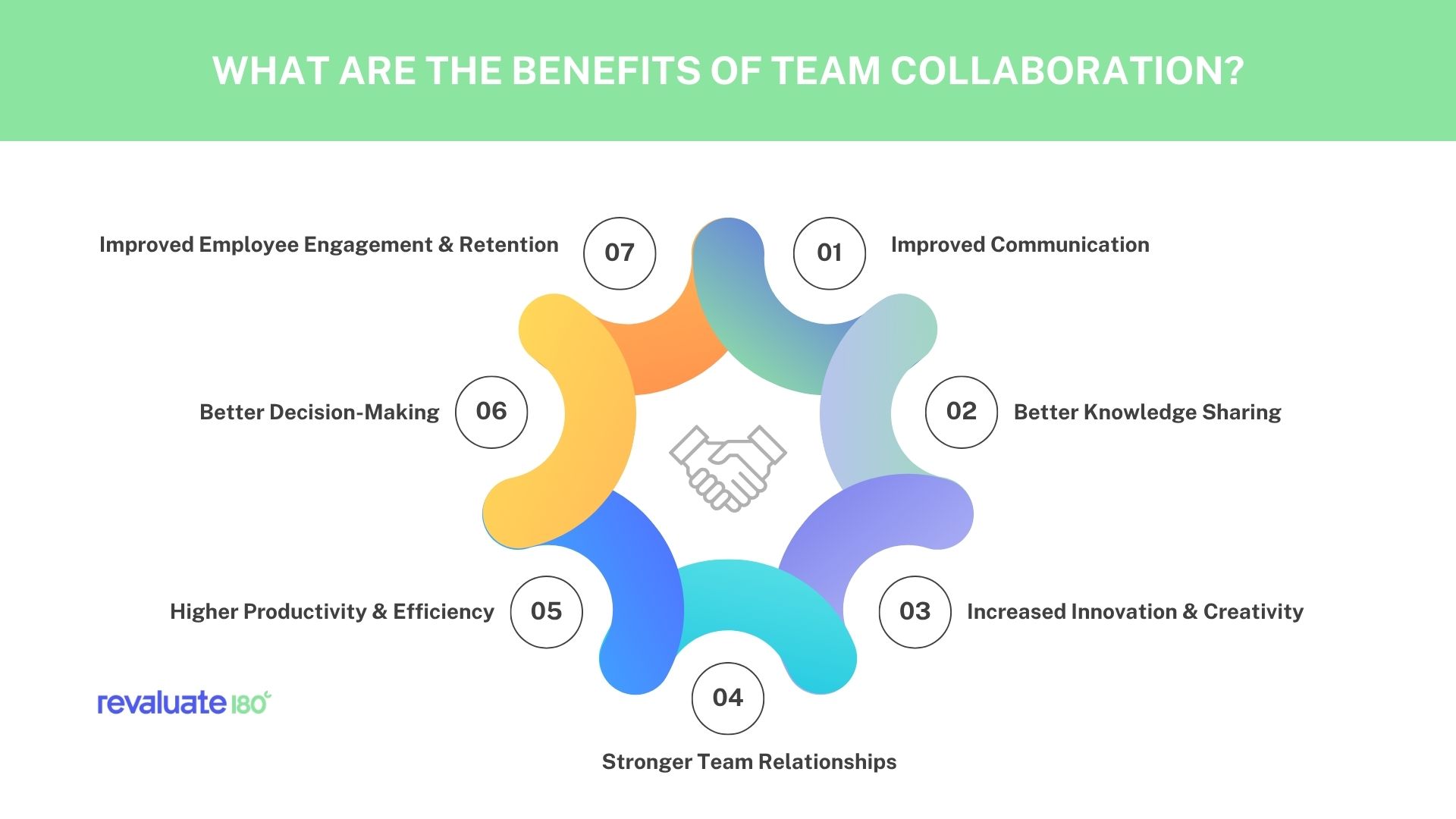
Improved communication
Collaborative forces are built through regular information exchange among all members. When team members share knowledge and communicate clearly what they want, there is a lower chance of misunderstandings and confusion on projects. Frequent updates through meetings, chats, and documents keep everyone on the same page about their unified goals, progress, and challenges.
Better knowledge sharing
In a collaborative team, valuable insights aren’t locked away. For instance, teams often document processes or hold peer demos so that what one person learns becomes institutional knowledge and a team asset. This prevents one-dimensional failures that occur when the whole team depends on a single person, so others can access the information when that person is absent.
Increased innovation and creativity
Diverse teams bring different perspectives to the table. Brainstorming sessions and open discussions generate ideas that no single mind would produce alone. By collaborating informally on side projects, employees can focus on building meaningful products. This collaborative culture fuels more creative solutions.
Stronger team relationships
Collaboration builds trust and respect in the workplace. When people work through problems together, they form stronger bonds that last. In a supportive team, members feel comfortable asking for help or offering constructive feedback that fosters growth. Leaders who practice transparency and listen actively model this behavior that encourages mutual respect. Stronger relationships mean people are willing to cover for each other and contribute freely.
Higher productivity and efficiency
When a team tackles a project, work is divided and parallelized into multiple tasks. Team members can cover each other’s blind spots and complete tasks faster. Collaborative teams also catch errors early through peer reviews. Data shows teams solve problems more efficiently, often cutting the project in half.
Better decision-making
More viewpoints improve choices and decisions. A collaborative process includes feedback loops and debate so teams can consider multiple angles before deciding. This reduces many mistakes. These meetings, for instance, help shape the organization and maintain its strong reputation.
Improved employee engagement and retention
When people collaborate meaningfully, they feel valued. Working together on success boosts morale since studies have found that engaged teams stay longer at companies. In fact, employees in collaborative groups report higher satisfaction and lower turnover in all quarters.
Examples of Team Collaboration in the Workplace
Collaboration can take many forms across contexts. Here are some of the most effective examples of team collaboration in the workplace:
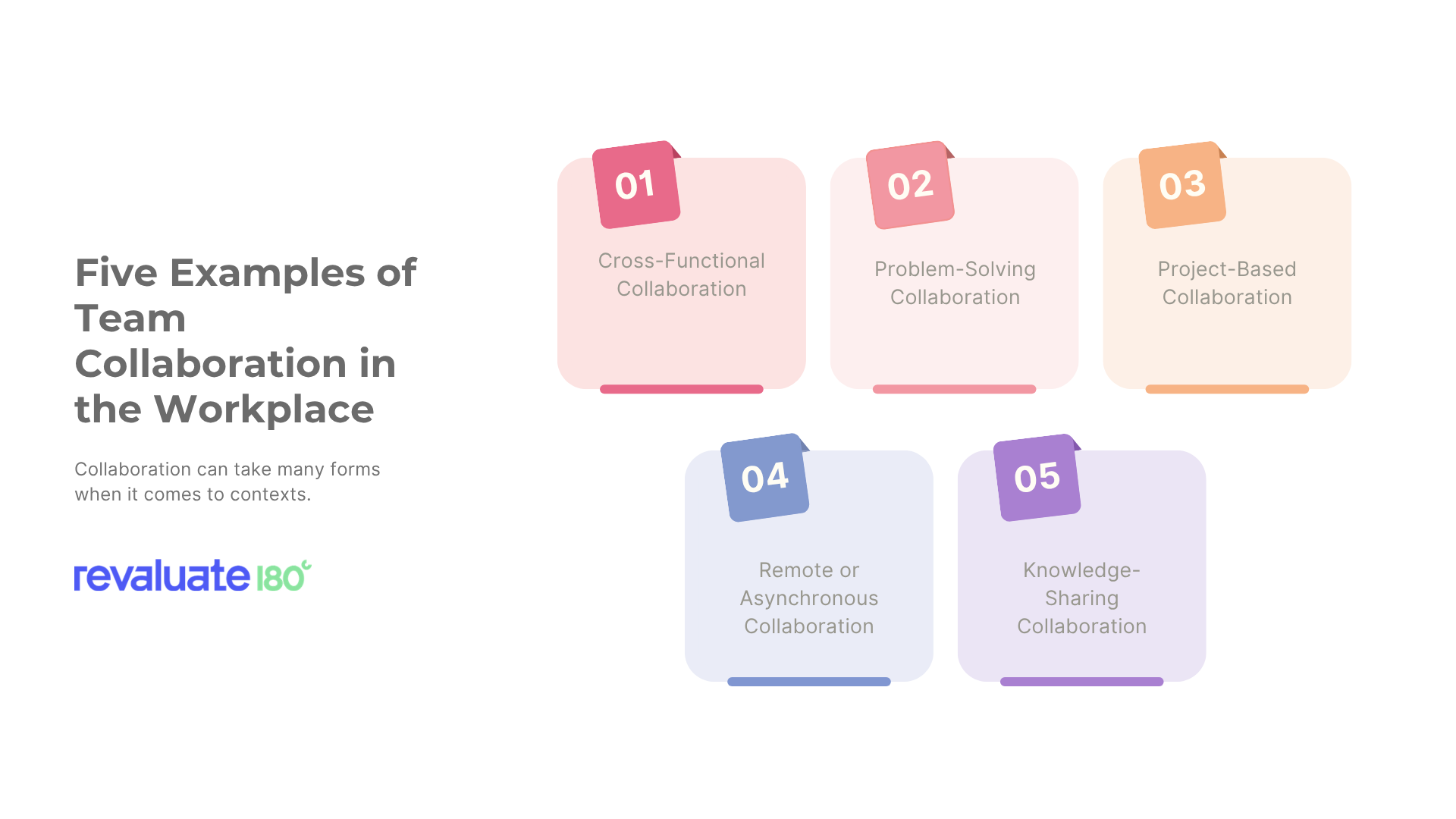
Cross-functional collaboration
This happens when members of different departments team up for a project; for instance, a product launch might involve marketing, engineering, sales, and design teams working in sync. Apple’s first iPhone development is a classic case of hardware, software, and design engineers collaborating equally over two years to build and launch the device that led to huge success.
Such cross-team efforts leverage diverse skills and keep everyone aligned on a common goal. Team members jointly plan timelines, test features, and craft messaging. Organizations move forward with one cohesive strategy when teams break down departmental silos.
Problem-solving collaboration
Teams often come together to tackle specific challenges. For instance, if a company notices a surge in customer support issues, an IT team might collaborate with sales and customer service to find the root cause. Suppose the IT department meets with other department heads to identify common conflicts; they can resolve the issues with greater clarity.
Together, they can create shared tutorials and FAQs, reducing repetitive support tickets and boosting overall productivity. By pooling their perspectives, they can solve the issue more efficiently than any one-dimensional team ever could.
Project-based collaboration
In project work, multiple team members contribute to shared tasks to be delivered. For example, in software development, designers, developers, and QA analysts might work closely on a release.
They hold daily stand-ups to coordinate, use shared task boards for transparency, and review each other’s work. This day-to-day teamwork ensures that deadlines are met and that interdependent tasks are properly aligned with the project.
Remote or async collaboration
Many organizations now have distributed teams, as collaboration across time zones, often not in real time, is one such case. For instance, a fully remote tech company like GitLab has team members around the globe and operates on a 24-hour clock. They rely on asynchronous tools like shared documents, recorded updates, and post-event agendas so everyone stays informed about the project.
This way, a team in NYC can hand off tasks to a team in Tokyo seamlessly and maintain the rate of progress. Remote teams often use video calls and collaboration platforms to stay connected. Tools like Slack, Google Docs, or Jira allow real-time communication so team members can contribute ideas and updates whenever they’re online.
Knowledge-sharing collaboration
Sometimes the goal is to spread learning across the organization; for instance, a company might hold lunch-and-learn sessions or maintain an internal wiki where each team contributes its best practices.
At Pixar, their braintrust meetings are a form of knowledge-sharing activity in which creative leads often host hackathons or peer-review sessions where engineers teach each other. This kind of collaboration ensures institutional knowledge grows and that innovations and ideas are captured and shared for the whole team’s benefit.
12 Strategies to Improve Team Collaboration
Improving how the team works together requires intentional, long-term, tried-and-tested strategies. Here are 12 proven ways you can find your work style:
1. Define a shared goal
Start every project by clarifying the team’s common objective. Make sure everyone understands what success looks like. Setting clear goals that align with efforts and keep people focused on the same outcome is the main mission of effective collaboration.
When goals are ambiguous, team members may work at cross-purposes since a well-defined target encourages individuals to coordinate rather than act in isolation.
2. Clarify roles and responsibilities
Assign specific tasks and ownership so that each person knows their role in the collaboration. Overlapping duties or unclear responsibilities often confuse, for example, by leaving unclear who will lead the research, who will compile the reports, etc.
Also, acknowledge each person’s strength. If Alan is great at data analysis and Bob is strong with design, pair them on a report so each can contribute their expertise. When people see that their unique skills are valued, they are more eager to contribute and more motivated.
3. Establish clear communication norms
Decide up front how the team will communicate. Will you have daily stand-ups, weekly email updates, or a shared chat channel for real-time connection? Set clear expectations, such as that team members should respond to messages within 24 hours or attend a set weekly meeting. Consistent norms, such as summarizing and asynchronous methods, ensure everyone can participate. Good communication practices are foundational to effective collaboration, so make use of them.
4. Encourage open and transparent communication
Create a culture where feedback flows freely without any internal politics or agendas. Leaders should model this by sharing information about the project’s status and any challenges it entails. Team members should feel safe to speak up if they spot a problem or have an idea.
Active listening is key because when teammates feel heard, they tend to contribute more than their pay grade suggests. It boosts their motivation and the benefits that come with the outcomes. One technique is to use shared agendas for meetings so anyone can add topics.
5. Build trust within the team
Trust is the most crucial factor in success since it’s foundational to collaboration. Foster it by being reliable and respectful to get the long-term benefits. Deliver your parts on time, and give credit to others when it’s due. Team-building exercises, such as casual virtual coffee chats or in-person icebreakers, can help people see each other as individuals, not just colleagues.
Personal bonding (even if it’s for a short-term role) makes everyone more comfortable collaborating. Also, encourage humility, where making a mistake doesn’t result in punishment. When trust is high, members will share ideas and help each other without fearing judgment or hesitation.
6. Break down silos between teams
Encourage inter-departmental communication when required. If different teams operate independently, organize joint workshops or regular check-ins. For instance, a product team could have monthly alignment meetings with marketing and sales. This avoids the situation where departments prioritize their own objectives over company-wide success.
Open up lines of communication across divisions so goals and information flow freely. Using collaborative software can also reduce silos by giving everyone visibility into each other’s work. Cross-training or rotating team members between departments can further integrate knowledge and break silos, ensuring all teams are on the same page.
7. Involve the team in decision-making
Instead of imposing decisions from above, solicit input from those doing the work. When team members help set strategies and solve problems, they feel more invested. For instance, when deciding on project features, hold a brainstorming session to gather ideas from each team member.
This buy-in makes execution smoother, as people understand and own the plan. Involvement also surfaces valuable on-the-ground insights that managers might miss at a glance. Empower teams to propose solutions and adjust their approach when needed. This participative approach often leads to better outcomes because it taps into the creativity of the whole group.
8. Use the right collaboration tools
Equip your team with software that matches your team’s and project requirements. Project management platforms like Trello, chat apps like Slack, and document-sharing apps like Google Drive or SharePoint are common examples.
More importantly, ensure everyone is comfortable using them by providing training if required. Good tools can automate repetitive tasks, keep files in one place, and show real-time project status. Modern collaboration tools should be user-friendly and reliably connect with the team.
9. Recognize and reward collaboration
It’s crucial to celebrate when teamwork leads to success. Publicly acknowledge collaborative efforts in meetings or company newsletters. For instance, praise a cross-functional team for solving a difficult issue together. Since rewards and recognition have been proven to boost employee morale and reinforce desired behaviors, effective collaboration is a byproduct of those efforts.
10. Support different working styles
Every individual has a unique way of working. Some prefer quick chats while others like writing detailed docs. Embrace this diversity by offering options and allowing flexibility in work hours, or by setting up remote/hybrid arrangements.
11. Address conflicts early and constructively
Collaboration isn’t conflict-free, but a quick resolution is always welcomed. Train the team in healthy conflict habits by focusing on ideas rather than individuals and listening to each other’s viewpoints.
For instance, if a debate becomes heated, pause and remind everyone of the shared goals. If required, bring in a neutral mediator to facilitate. Establish ground rules and ensure learning to work through differences through trust and collaboration.
12. Create opportunities for team connection
Make time for the team to bond. This could often be regular coffee breaks, quick icebreaker questions at the start of meetings, or periodic social events. Even simple rituals like a weekly round-robin update where everyone shares a non-work highlight can build the right camaraderie.
What Are Some Common Challenges in Team Collaboration
Even with the right intentions, teams can face hurdles as they learn to collaborate. Being aware of these can help you address them proactively. Here’s how:
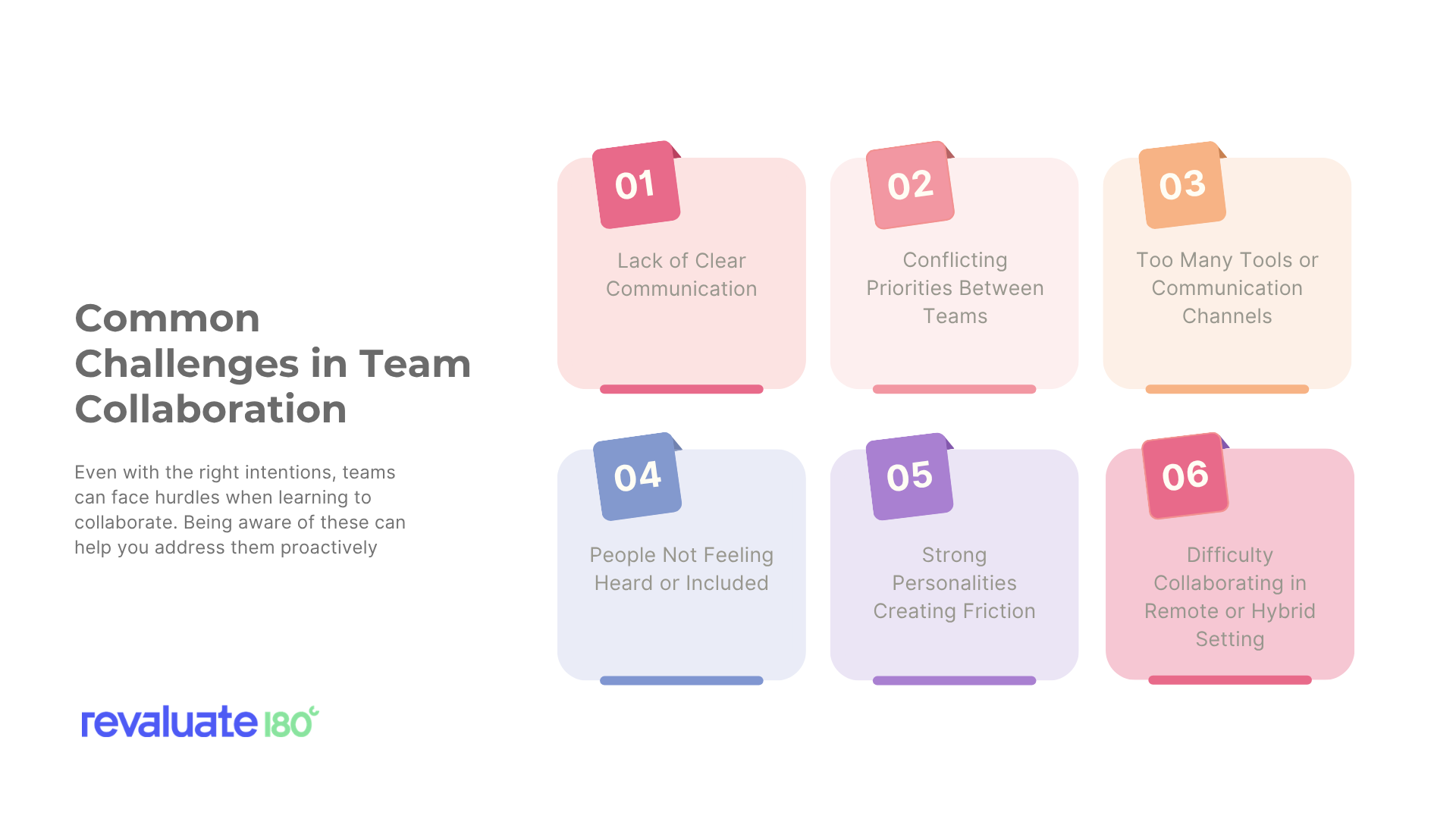
1. Lack of clear communication
Messages get lost without defined channels and communication norms. Some team members may not share updates often enough, or information stays trapped in emails. This, in fact, leads to massive confusion and duplication of work, so many teams struggle with miscommunication or inefficient workflows when collaborating.
2. Conflicting priorities between teams
Different departments may prioritize their own goals rather than a unified project mission. Such misalignment is a classic silo issue; for instance, if marketing is pushing one deadline while engineering is set on another, work could stall.
3. Too many tools or communication channels
Ironically, having all the tools can mislead collaboration dynamics. If the team uses Slack, email, project software, and texting without coordination, the process may be hindered, or, worse, the narrative may be scattered. Important decisions or documents might end up in the wrong channel, where they are overlooked.
4. People not feeling heard or included
Employee recognition is absolutely crucial for business growth. Sometimes quieter team members get overshadowed by loud personalities. Or remote workers may feel left out of office-side discussions. This, in fact, can lead to frustration and denial in participation in group activities. Lack of inclusion undermines trust and can easily break down collaboration if left unaddressed.
5. Strong personalities creating friction
Collaboration means melding different viewpoints, which can lead to massive clashes if not handled carefully. A dominating member might dismiss others’ ideas, whereas those members prefer to keep shut whenever they’re allowed to give opinions.
Good teams address this by focusing on data and shared goals without wanting to win every argument. If personality clashes persist, a team coach or leader might have to step in to mediate this matter and reinforce the respect every member deserves.
6. Difficulty collaborating in remote or hybrid teams
Teams split across locations often find more challenges in collaboration. Time zone gaps mean delays in getting answers. Technical glitches caused by poor connections or time zone mismatches can disrupt project flow. Moreover, the social cues of in-person work aren’t visible, so building trust takes extra effort. You can combat this by making remote teams over-communicate, documenting their work carefully, and using video calls to stay connected.
How Team Behavior and Values Shape Collaboration
Effective team collaboration isn’t a one-time fix with tools alone. It is shaped by the team’s culture and behavior, which takes time to understand and model fully. The same software stakeholder can yield very different results, often short-term. Here are some key factors on how team behavior and values shape collaboration:
Communication style
Teams that practice openly with two-way communication will collaborate more effectively than those where only top-down directives flow. Leaders play a crucial role in modeling consistency, open communication, and transparency.
Decision-making process
If a team decides by committee rather than by the leaders alone, collaborative results can vary widely. Inclusive decision-making encourages buy-in and diverse ideas. Conversely, authoritarian decisions can demotivate team members and stifle collaboration. Therefore, teams must choose the decision-making process through consensus or voting so they can match their company culture.
Accountability
In well-collaborating teams, members hold each other accountable rightfully when required. If someone misses a deadline, the team talks about how to get back on track rather than blaming each other. These clear agreements on deliverables and responsibilities create a sense of joint ownership.
Encouraged behaviors
Ask yourself if the team rewards creativity or risk-taking. Does it value punctuality and thoroughness? These behaviors are foundational to collaborative success, so make sure they become the norm. For instance, a team that celebrates creative solutions and tolerates mistakes fosters a more innovative environment than one that penalizes mistakes.
Guiding values
Shared values unify the team like no other. When values emphasize cooperation and empathy, collaboration becomes the byproduct of efforts. Teams with misaligned values may find it hard to work together without any unnecessary conflicts.
Closing Thoughts
Team collaboration is foundational to workplace success. If you follow the above effectively, it turns diverse individuals into better coordinators and a creative force like no other. Challenges are always on the rise, but you can mitigate most of them by facing them directly together.
Our team of experts at Revaluate180 helps leaders understand the behavioral and team dynamic patterns influencing collaboration, making it easier to improve how teams work together. Contact us today to accelerate innovation, boost productivity, and foster a more engaged workforce.

Unlock AI-Powered Hiring Analytics
Transform the way you hire with insights that create aligned, collaborative, and high-performing teams.
- Smarter Hiring Decisions
- Reduce Expensive Turnover
- AI-Driven Insights
- Optimize Team Performance