An employee stays late at work and delivers what they believe their manager requested, only to learn it still isn’t right. This situation is not a lack of competence but a lack of clear expectations. Unclear expectations at work are quietly becoming one of the most damaging forces in organizations.
There can be many reasons why, but mostly because of the slow, daily accumulation of confusion, lots of second-guessing, and wasted effort. In today’s workspace, most workers across genders, departments, and age groups are reporting unclear goals as their top source of workplace stress, yet the problem persists.
In this post, we’ll break down why unclear expectations cause so much stress, how they can turn into burnout, and what leaders and employees can do about this issue.
TL;DR
- Unclear expectations leave even hard-working employees stressed out, confused, and burning energy on the wrong tasks.
- Gradually, the chronic stress of not knowing what good and right looks like turns into exhaustion.
- Common triggers of stress include unclear goals, conflicting directions, no boundaries at work, and mid-project scope changes.
- This fallout impacts overall productivity, trust, innovation, and engagement simultaneously, often with the risk of stunting organizational growth.
- Leaders can fix this with clear communication, ranked priorities, realistic deadlines without micromanaging, and a culture that welcomes questions and curiosity.
What Are Unclear Expectations at Work?
Unclear expectations are often ignored until the damage is done. They rarely show up as managers and are clueless about what they want from their teams. From the worker’s side, it may sound like a meaningful goal, but without clear, measurable outcomes, a deadline without any priority ranking, and a role description that overlaps with three other people’s tasks.
At its core, unclear expectations mean employees don’t have a solid answer to the following three questions:
- What exactly do I need to deliver in this job?
- How is success defined through this task?
- What should I prioritize right now?
When these answers are missing or constantly forced to ask yourself, something interesting happens. People don’t often think their managers have informed them incorrectly, but they look down on themselves and start questioning what they’re missing, misheard, or worst, doubting they’re incapable.
This confusion leads to stress and anxiety that destroys confidence and the capability of managing uncertainty, and a sure exhaustion in the end. Psychologists describe this as decision fatigue combined with chronic low-grade tension. So, you either end up doing everything or you freeze up doing nothing. Both are worse and unhelpful.
Examples of Unclear or Unrealistic Expectations at Work
Vague expectations can take many forms. Some seem unclear due to poor communication or unclear goals, while others cross into completely unrealistic expectations during the briefing. Let’s go through the most common patterns of unclear and unrealistic expectations at work:
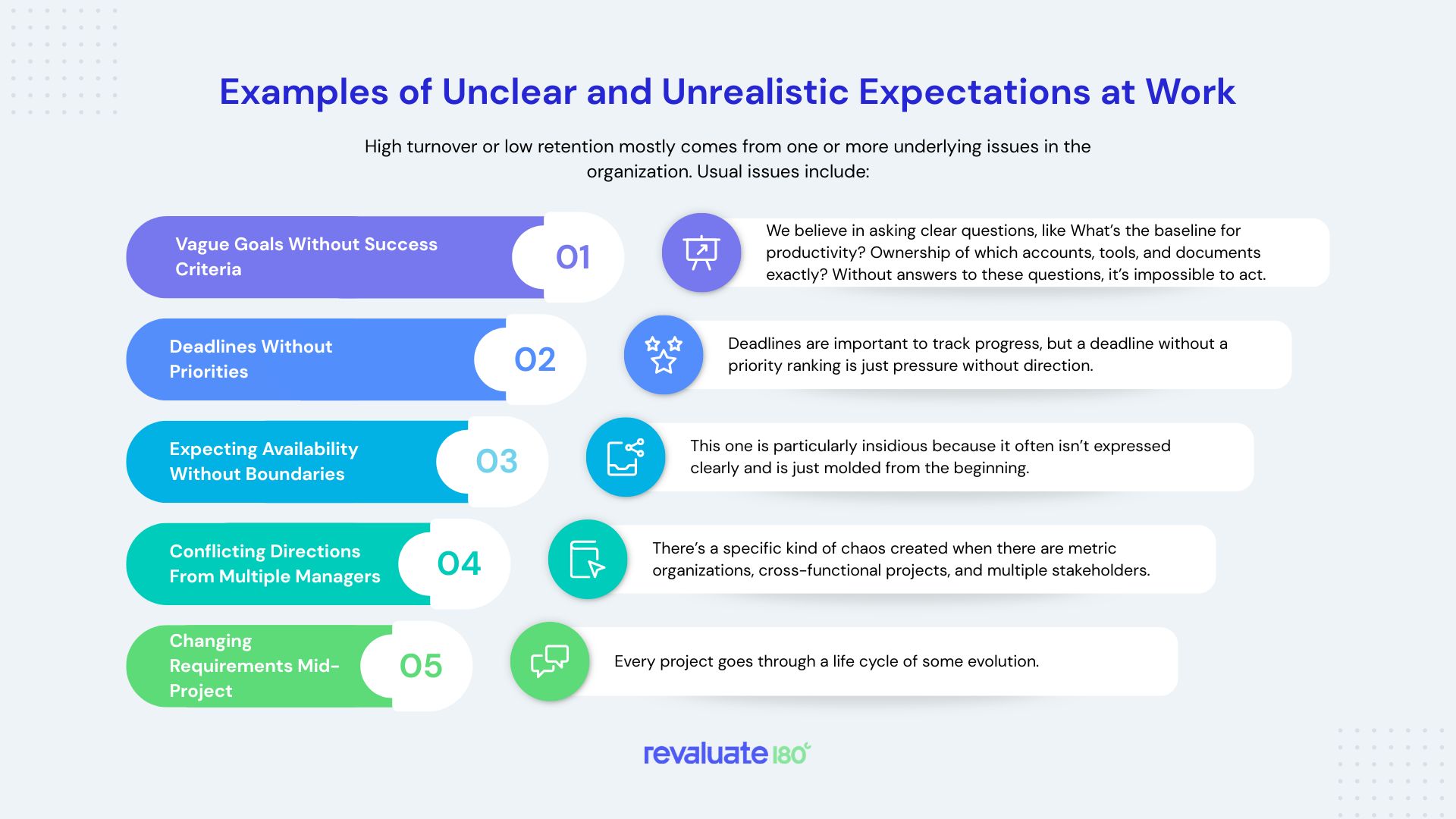
1. Vague goals without success criteria
“Be more productive”, “Improve team productivity,” “Take more ownership.” Do these phrases sound reasonable but vague without clear expectations?
We believe in asking clear questions, like: What’s the baseline for productivity? Ownership of which accounts, tools, and documents exactly? Without answers to these questions, it’s impossible to act. And because everyone interprets them differently, almost nobody hits the invisible target on time and with precision.
It’s clear that vague and ambiguous goals lead to crippling anxiety because people genuinely don’t know how to proceed. Therefore, they end up either doing too much, exhausting themselves in trying to cover every possible interpretation, or being paralyzed by the lack of direction. Either way, the frustration bubbles up in the end, which leads to disengagement.
2. Deadlines without priorities
Deadlines are important to track progress, but a deadline without a priority ranking is just pressure without direction. When every task is marked as urgent, employees have no idea how to make rational trade-offs. They scramble across everything at once, end up doing surface-level work, and frequently miss the thing that actually mattered the most (even if they’re competent otherwise).
A study found that 31% of U.S. employees identify unclear expectations from managers as the single most stressful factor at work, due to workplace changes and vague, ambiguous deadlines. The irony is that it takes just minutes to communicate clear priorities and save hours of misdirected efforts.
3. Expecting availability without boundaries
This one is particularly insidious because it often isn’t expressed clearly and is just molded from the beginning. A manager who emails at 10 pm isn’t really expecting you to respond now, but the implicit message lands anyway.
When availability without boundaries becomes a cultural norm, employees never fully have time to unwind. Every notification is a potential obligation. Every day off feels undone and carries unwanted stress. Research shows that 43% of workers under stress have reported feeling pressured during vacation. This kind of always-on culture is a direct path to burnout, even when someone genuinely loves what they’re doing.
Unreasonable expectations at work don’t have to be explicitly written in a policy document to be real; rather, think of them as unwritten rules for a thriving workplace!
4. Conflicting directions from multiple managers
There’s a specific kind of chaos created when there are matrix organizations, cross-functional projects, and multiple stakeholders. They create competing instructions from people who have all the authority over your work.
For instance, a writer receives one creative direction from the brand team, and a completely different suggestion pops up from the product team. Now, both tasks are top priority and require approval from both sides, so this chaos can easily become demoralizing. If this continues, the designer never wins, regardless of their choices.
Unclear ownership means no accountability, and unclear accountability means that when something goes wrong, it’s the person at the bottom who finds all the blame, and they lose the power to reconcile.
5. Changing requirements mid-project
Every project goes through a life cycle of some evolution. But what’s not normal is that burnout is caused when requirements shift so frequently that employees never get the satisfaction of finishing anything.
This particular kind of exhaustion comes from a perpetual, almost-done mentality. When the goalpost keeps moving just as you approach it, you don’t just lose the pace and enthusiasm, but the psychological reward of getting it done, which is highly necessary in employee development and growth.
Over time, people stop investing fully because of the lingering feeling that it won’t matter anyway, so why proceed? Some might call this laziness, but that’s a learned response to an unreliable system that doesn't get you anywhere.
The Impact of Unclear Expectations on Performance and Engagement
Sustained ambiguity is rarely a personal conflict because its consequences are organizational, and they compound over time into something worse and hard to resolve:
1. Increased rework and productivity loss
When people don’t know the definition of “done”, they often finish the wrong version of it. This results in numerous reworks that not only consume more time but also cost productivity. It strips out workplace morale because employees who work hard and still miss the mark begin to doubt their own competence and fall into an endless pit of embarrassment.
A Gallup study on employee expectations found that teams in low-clarity environments tend to waste significant time on avoidable rework that can be prevented by a single alignment conversation. This misalignment compounds at all levels of organization.
2. Burnout from overcompensating
High achievers respond to such ambiguity by doing beyond their paycheck. When you don’t know if you’ve done enough, doing more feels like the only right thing at the time. This might look like an external motivator, but deep down, it’s the anxiety-driven overwork that is highly unsustainable long-term.
This depletion is real, and it’s growing rapidly if we don’t do anything. Grant Thornton’s 2024 State of Work in America survey found more than 51% of employees experienced burnout in the past year (a 15-point jump from last year).
With a mental and emotional stress like that, uncertainty-driven overwork is one of the most direct contributors to this trend that keeps on growing. These unclear expectations and shifting priorities create cognitive overload that gradually turns into chronic exhaustion if not addressed early. It’s definitely not something that’ll resolve with a long weekend.
3. Reduced innovation
Creativity requires a strong psychological safety to risk confidence that won’t result in punishment. In unclear conditions, this safety net disappears completely. If the goal post keeps shifting, employees stop experimenting with new ways and just play defense. They stick to the known path because at least that’s defensible for them.
This results in an organization that says it values innovation but creates unnecessary conditions that undermine its own vision. When people are just trying to survive the ambiguity, they don’t have the bandwidth for bold ideas that drive growth.
4. Lower trust in leadership
Trust is built through predictable ways and consistent follow-ups with teams. When expectations aren’t defined properly or constantly keep shifting, employees think about leadership competence or hidden intent. Either managers don’t know what they want, or they know and aren’t sharing it. Both interpretations are problematic.
Over time, a team that keeps misinterpreting and is stressed with unclear expectations stops giving the benefit of the doubt, and oversighted communication gets filtered through skepticism. It’s a very hard dynamic to reverse, especially when trust is eroded.
5. Quiet disengagement
Quiet disengagement is an indirect way to quit one’s job and harm productivity. It’s in fact the most dangerous way to lose profits. Employees stop volunteering for extra projects, they answer questions but don't ask any back, they don’t do anything beyond their paychecks, and they save their energy for life outside work.
This quiet withdrawal is often unnoticed until you lose something significant. And it’s almost always the downstream of a sustainable feeling of confusion, misalignment, and the feeling that putting effort doesn’t reliably lead to any kind of recognition. You can’t blame an employee for rationing investment in a system that keeps moving the goal post. You can deal with this issue by understanding how to re-engage your top talent and prevent burnout.
How Leaders Can Set Clear, Achievable Expectations
None of it is bound to happen since leaders who communicate with intention and consistency can completely reverse the experience of their teams. Here’s what it looks like:
1. Define outcomes, not just tasks
There’s a meaningful difference between telling someone to prepare a report and requesting a two-page summary of Q1 client feedback by Thursday EOD so we can decide on the Q2 budget.
The second version of the request is more valuable because it provides proper direction on what, when, and why of the process. This is particularly helpful because employees can make good independent decisions along the way without having to be constantly checked on.
When employees understand the outcome they’re working towards, they don’t need to be spoon-fed. They own the work confidently and more efficiently, which becomes the primary motivator of growth.
2. Clarify priorities and success criteria
At the beginning of any project, you must ensure two things:
- What matters the most?
- How will you know when it’s finished?
It sounds very obvious, but that’s also why it’s often ignored. Defining what done looks like can prevent so many mishaps. Ranking priorities explicitly can prevent teams from spreading themselves across everything, and both parties can agree on the same thing with the right sense of resolution.
A Gallup report shows that employees who have confidence and strongly say their managers help them set their priorities straight and performance goals are eight times more likely to succeed than those who don’t.
3. Break big goals into actionable chunks
Ambitious goals are sure to be motivating, but in practice, they’re overwhelming before you start. Especially when they’re not clearly defined. A six-month product launch with no interim checkpoints is just a call for hope, not a proper plan.
Since hope doesn’t drive numbers, breaking large goals into smaller steps with their own mini-deadlines makes work approachable and easy. It creates natural alignment moments and provides employees with the psychological reward of completing tasks. Progress makes you hope for meaningful career growth.
4. Align deadlines with real capacity
Deadline alignment requires honesty. It includes the kind of honesty that pushes back on pressure from the issues above. Deadlines that are thrown off by actual team capacity fail to drive strong, sustainable performance. In fact, it mostly finds shortcuts, burnouts, and quite a bit of resentment till they actually quit.
Involve your team in defining the timeline. Ask how long certain tasks realistically take to complete and report. And it’s even better if you have the right insights that indicate the process is complete. Some people really perform better under pressure, but they can’t handle pretending everything is fine.
5. Encourage questions and feedback
You can make the most out of people by making them ask questions as a clear tool of communication. When employees think they already know the answer, or that asking will make them look unsure. ambiguity stays hidden until it becomes a drastic problem.
Managers can model this actively by asking clear questions themselves and exclusively inviting the team to push back on timelines or confusion. This helps respond to questions without impatience. The culture around questions is set almost entirely by how leaders respond in the first few, so integrate this into your high-performing team culture for an added boost.
6. Reconfirm expectations during change
Change is inevitable in any circumstances. The only mistake is assuming that the original expectations still apply after a paradigm shift in scope, staff, strategy, or deadlines.
When certain material changes occur, take a few minutes to restate the new goal, the new definition of reaching that goal, and whether priorities need to be rearranged. This isn’t bureaucracy; it's the difference between a team that adapts well and one that keeps executing against all odds and briefs because nobody told them otherwise.
Final Thoughts
Unclear expectations are rarely the result of intentional harm. They’re usually the result of moving unnecessarily quickly and communicating loosely with a lot of irrelevant assumptions that people know more than they do. But the cost of assuming things can translate into long-term stress, burnout, disengagement, and, most tragically, an erosion of trust.
Our team of experts at Revaluate180 helps you eliminate unclear expectations and identify misalignment. Through effective data-driven assessments, leadership training, and structured team workshops, you can actually define what success looks like to everyone in the organization. Connect with us today for a smooth resolution.

Unlock AI-Powered Hiring Analytics
Transform the way you hire with insights that create aligned, collaborative, and high-performing teams.
- Smarter Hiring Decisions
- Reduce Expensive Turnover
- AI-Driven Insights
- Optimize Team Performance