Employee disengagement is a common concern that companies are battling today. But have you ever wondered why employee concerns and frustrations often get overlooked?
When leaders fail to address workplace issues and employee concerns effectively, engagement levels drop, leading to toxic work environments and declining performance.
Leaders struggle with accountability when they lack training in supporting their teams, understanding employee pain points, resolving conflicts constructively, and ensuring productive collaboration.
In this post, we’ll explore why leadership accountability is essential at every level and how it creates a ripple effect that drives responsibility, engagement, and performance across the organization.
TL;DR
- Leaders are the most influential people in an organization who can take on and assign responsibility for several critical tasks.
- Leaders lack accountability when they are unclear about how to navigate the task at hand, do not seek to understand their employees’ capabilities and boundaries, and refuse to take collective responsibility when leading a team.
- A lack of accountability in leaders shows when they avoid clear conversations, defensively blame others, have inconsistent standards and biases when working with different employees, and only come forward to take credit despite having zero involvement.
- Learn how leaders can be trained to remain accountable for their actions and decisions at work, propagating a positive workplace culture where accountability is everyone’s collective responsibility.
What is Accountability in Leadership?
Accountability refers to taking responsibility for one's actions and decisions. In a work environment, leaders must be accountable to their superiors, work partners, or clients for the quality of work their team delivers within a given timeframe.
Accountable leaders represent all members of their team. If one member performs poorly or lags in completing their work, the leader takes responsibility for addressing the concern and getting the team back on track.
Accountability is one of the most important leadership traits that defines an ideal leader who inspires everyone in the team and company to take responsibility for their actions. In short, an accountable leader celebrates when team members exceed expectations and takes responsibility for even the smallest failures or delays caused by the team.
Why is Accountability in Leadership so Important?
Although every employee must be accountable for completing their work on time and meeting quality expectations, accountability is an even greater responsibility for leaders at all levels of a company.
Accountability in leadership impacts several aspects of a company and its employees:
- Better team connections: Accountable leaders ensure the entire team is involved in decision-making and delivering the desired results. This process ensures everyone connects and shares progress.
- Improved work culture: Leaders ensure that everyone is accountable for the tasks they do, while themselves being accountable for the progress of their teams and reportees. This collective accountability contributes to a positive work culture across the organization.
- Clear communication: Ambiguity in any instance is a barrier to a team's progress, and failing to be accountable for providing clarity affects a team's work dynamics.
- Personality development: The act of owning up to a team’s failure and striving to deliver better is the best sign of an ideal leader, inspiring several others to follow suit.
- Improved crisis management: Being accountable rather than defensively blaming helps leaders understand what went wrong, process stakeholder feedback, and take the necessary corrective steps to prevent future mistakes.
- Improved trust in leadership: Employees always seek leaders who take responsibility rather than those who avoid it out of fear of blame. Accountable leaders from the lowest level to C-Suite members build employees' trust that their leaders will always support them and help them succeed.
What a Lack of Accountability Looks Like at Work
Accountability is a huge responsibility that reveals how a leader is willing to take ownership of the task at hand, regardless of progress, pace, or the quality of service provided.
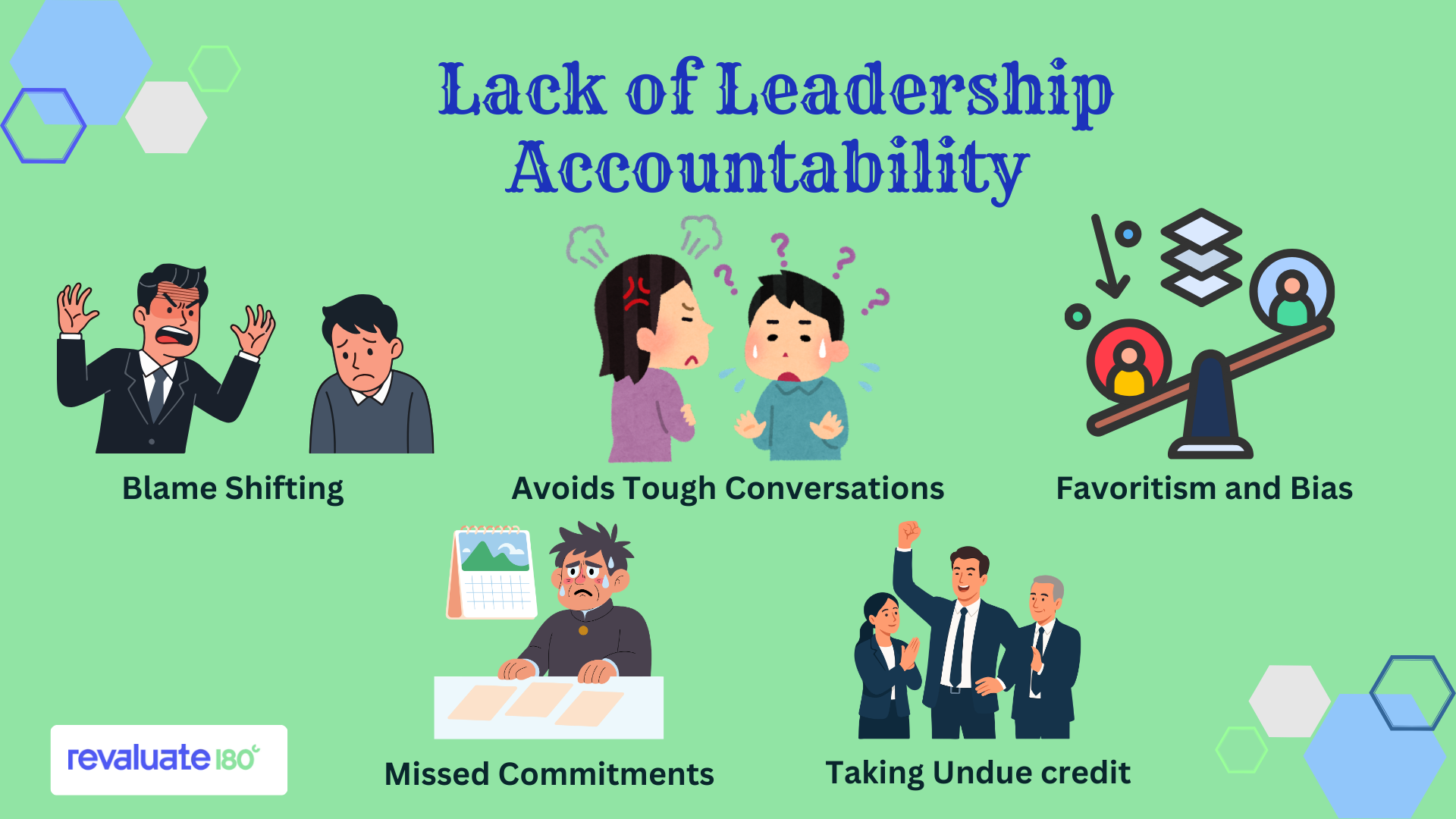
Here are some visible signs that help detect a lack of accountability in leaders:
1. Blame shifting and defensiveness
A wrong decision at work and its consequences often lead to the leader who approved the decision. When leaders avoid taking responsibility for the consequences of poor decisions, they shift the blame to other employees. Moreover, they try to aggressively highlight the scenarios and defensive data that led them to make such decisions.
A study of over 1,000 employees revealed that 26% witnessed blame-shifting behavior, including managers blaming others for their mistakes. Such toxic work practices directly affect employee engagement levels, slowly leading to disengagement and turnover.
2. Avoiding tough conversations
Communication is a crucial part of a leader’s work. A study shows that 86% of employees feel that communication failures impact their work and consistent progress. Leaders who do not practice transparent communication with their team or subordinates often create ambiguities and confusion in work assignments, deadlines, and dependencies.
Some leaders often act as “bridges” between their superiors and subordinates. They divert or re-route conversations and concerns from employees to their superiors and vice versa, without trying to share their views or putting effort into resolving concerns on their own.
3. Inconsistent standards and favoritism
Favoritism is a common workplace concern, especially when leaders prefer one or more employees over others in exchange for additional favors. The cause of favoritism often stems from shared backgrounds, preconceived notions, and unconscious biases that lead leaders to value factors like common background over talent, work quality, and professional ethics.
iHire’s 2025 Toxic Workplace Trends Report shows that unfair treatment of employees contributes 67.5% of a toxic work culture. Favoritism and bias are poor leadership traits that eventually cause employees working under such leaders to quit and seek better opportunities.
4. Missed commitments and no follow-through
Although leaders assign task responsibilities to several team members with timelines and deadlines, they must also track progress and provide regular feedback. Failing to follow up, identify sudden blockers that hinder progress, and continuously support their employees in working more effectively are clear signs of a leader lacking accountability.
Leaders who are not syncing with their teams and are unaware of progress status clearly show they are not motivated to honor deadlines and quality commitments. When questioned about the same by their superiors, they directly route the conversation to grassroots employees or workers, rather than serving as the team’s representative and voice.
5. Leaders taking credit but not responsibility
A common toxic sign of leaders who lack accountability is taking undue credit for success in which they had no role. The team members who toiled hard to ensure success are often sidelined or kept out of the limelight by such leaders, causing employees to lose trust in them.
A survey shows trust in immediate managers dropped from 46% in 2022 to 29% in 2024. A loss in trust is accompanied by lower employee engagement levels, impacting the company’s overall work environment, quality of service, and business deliverables.
What Causes Lack of Accountability in Leadership?
We have seen what a lack of accountability looks like from certain traits exhibited by leaders. Now, let us understand why leaders refuse to take accountability, or why certain leaders suddenly shift from their responsible selves to avoid taking accountability.
1. Leadership-related causes
Most first-time leaders, or those new to a role with management responsibilities, often avoid accountability. Such leaders are often apprehensive about taking accountability due to the following reasons:
- Fear of conflict and difficult conversations: Those who have been star performers as individual contributors may suddenly start fearing navigating daily management tasks and team communications, as well as tough questions and settling disputes among members.
- Confusing responsibility vs accountability: Fulfilling leadership responsibilities is different from being accountable for the results delivered by the team. The results cannot always be under the leader’s total control, which is why leaders must track progress and proactively take charge of the team’s work at any given time.
- Lack of leadership training or coaching: Not having sufficient experience managing people and trying to keep up with expectations of being an ideal leader often causes leaders to avoid taking accountability when things go wrong.
- Protecting authority or reputation: Even the most experienced leaders often make hasty decisions or play the blame game just to avoid being pointed out for delays in work, arguments within the team, or the inability to meet client expectations.
Leadership accountability can be reinforced by encouraging such leaders to pursue the right training programs and coaching from senior leaders within the company to gain first-hand experience. Experiences and evidence-based decision-making help leaders avoid confusing their responsibilities with being accountable.
2. Organizational Causes
When the company’s top management and C-Suite leaders are themselves unclear about the direction in which the company is heading, other leaders remain unclear about their roles and shifting priorities.
- Unclear roles and shifting priorities: Leaders are unsure of their superiors' expectations and lack experience delegating tasks fairly across the team.
- Weak feedback and communication loops: The company does not provide sufficient channels and tools for leaders to communicate with team members and facilitate members to engage with one another to resolve issues and task blockers.
- Inconsistent consequences: A lack of clarity about expected work results and deliverable quality often leads leaders to continually adjust task pipelines and strategies for team members.
- Lack of transparency in decisions: Leaders make decisions without concrete evidence and data backing, and often keep them ambiguous to escape blame in the future.
- Overload and unrealistic expectations: A sudden increase in management responsibilities, while also fulfilling goals related to individual career growth and development, often influences leaders to be less accountable for a team’s concerns.
Leaders must provide the right work pathway for their team, with clear descriptions of the quality of work expected. However, when the consequences are inconsistent with expectations and leaders themselves lack clarity on the next steps, they shift to safeguarding their reputations rather than providing useless clarifications.
How to Improve Accountability as a Leader
Accountability is not rocket science; it requires serious learning and analysis. It comes from simple practices in the day-to-day activities that leaders pursue, influencing others to follow.
Here are some common practices that help leaders hold themselves accountable to their team members and to their superior leaders.
1. Set crystal clear expectations and ownership
Clarity in communication and negotiations is the first step toward accountability as a leader. Leaders who set clear standards and expectations for all their team members leave no room for bias or unfair treatment.
It is also important for leaders to maintain clarity across all stages of work tasks, follow up with relevant stakeholders, prepare reports, and plan next steps with precision.
2. Make commitments visible and measurable
Leaders must ensure that each team member honors the commitments and deadlines assigned to them. Creating task cards, progress trackers, and routine status updates helps everyone on the team stay aware of the work being done.
Transparency in work progress helps everyone on a team understand each other’s performance. Leaders can identify task blockers or employees who require additional support and provide the necessary assistance.
3. Follow through consistently
Consistent follow-ups with each team member on their work progress help leaders understand concerns at the ground level. This understanding is crucial to resolving any larger problems that may arise later, providing them with the right reasons to navigate the situation rather than blaming their team.
Leaders must also ensure that work distribution is fair, so no one remains overburdened with responsibilities. Most companies encourage leaders to interact with their team members to understand their satisfaction with the work they do.
4. Give timely, specific feedback
Yet another practice leaders must follow to avoid ambiguity and confusion among their employees is to provide clear feedback on the work they do. Such timely feedback assures employees of the importance of the work they do and how they can improve.
Leaders must spend time talking with their employees, recognizing their significant contributions, and highlighting areas for improvement. Such conversations show that leaders are accountable for their employees' growth and want them to do better.
5. Admit mistakes and model ownership
A leadership position does not indicate foolproof decision-making. When a decision, small or big, backfires, leaders must learn to accept it rather than spending time reasoning and blaming. Discussing mistakes with the team members ensures that none, including the leader, repeat the same pattern in the future.
Leaders who model ownership of mistakes set an example of a strong leader who is not afraid to take risks. Taking end-to-end responsibility for tasks involving multiple stakeholders is one of the signs of an accountable leader.
6. Reward accountability and address avoidance
Accountable leaders must first recognize accountable employees, those who take responsibility for the work assigned to them and deliver exceeding expectations. When accountability is recognized from the beginning, employees who later become leaders do not shy away from taking on bigger tasks and responsibilities.
Similarly, leaders must also recognize employees who are not working to their full potential and find ways to prevent or divert them from their assigned tasks. Identifying avoidance signs at the initial stages helps prevent them from happening as employees progress and grow into leaders.
7. Create safe spaces for speaking up
Leadership accountability is about seeing each employee’s problems and concerns as their own. Leaders need to be people employees can look up to and reach out to with any concerns at work and beyond, so leaders are aware of any hindrances to their performance.
Moreover, leaders must put themselves in their employees' shoes, understanding how their backgrounds influence how they work and how leaders can leverage this knowledge to help them perform better.
How to Hold Leaders Accountable
Leaders can guide employees on accountability. If leaders themselves lack accountability, it can hamper the team and the company’s business. Here are some best practices that HR professionals and company leaders can use to empower their leaders and build their confidence.
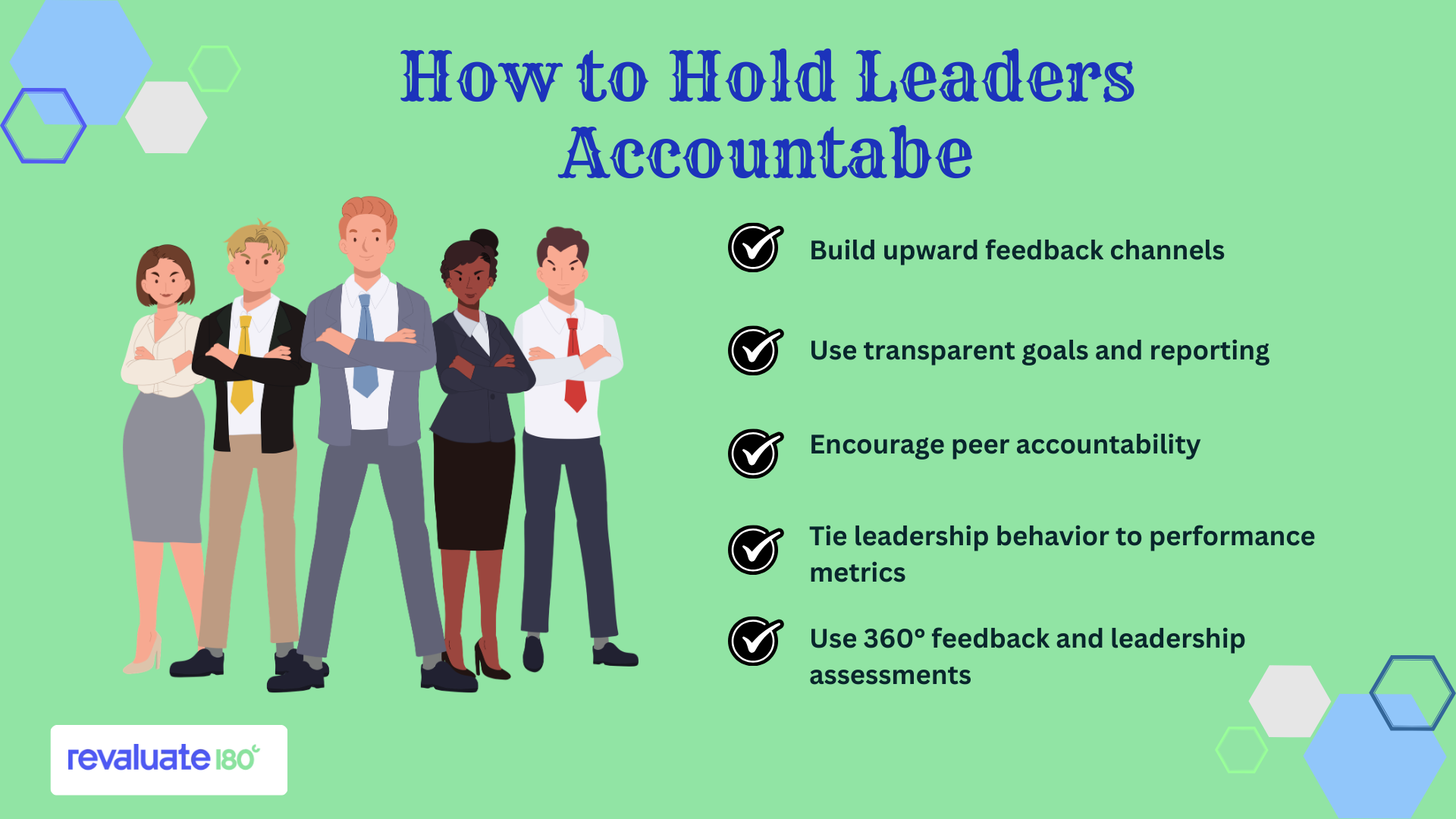
1. Build upward feedback channels: Gather employee feedback about their managers, their leadership style, and how they handle crises through several feedback surveys, engagement, and retention surveys.
2. Use transparent goals and reporting: Setting clear performance goals and expected outcomes helps leaders remain clear of ambiguities and confusion. Encouraging leaders to report to their superiors and meet their reportees frequently ensures higher clarity and fewer assumptions.
3. Encourage peer accountability: Leaders working on the same level in a company, handling different teams, can connect with each other to discuss their progress status, challenges, and how to overcome them. Seeing peers function with accountability motivates new or growing leaders to follow the lead.
4. Tie leadership behavior to performance metrics: Evaluating leaders must not just be based on the quality of work output, but also involve evaluation based on their leadership traits. Their performance metrics must include features such as taking ownership, being accountable to superiors, representing the entire team, and taking accountability for the team’s performance.
5. Use 360° feedback and leadership assessments: 360° assessments involve collecting accurate feedback and evaluation from all those connected to the leader - their reportees, peers, and higher supervisors. Assessing and matching the results across all these categories provides a clear depiction of the leader’s traits and how they can be better coached.
Final Thoughts

Being an accountable leader is mandatory for anyone stepping up to lead a group and make decisions that support the team’s long-term growth. A lack of accountability among leaders often stems from a poor understanding of their responsibilities and a lack of the right experience to handle the increased workload.
Revaluate180 helps uncover blind spots that hinder a leader's effectiveness in managing their team. Our assessments provide data-driven insights and customized development strategies to build accountability-driven work cultures through focused leadership coaching that drives sustainable growth.
If your organization is struggling with leadership accountability, connect with us for expert guidance and support.

Unlock AI-Powered Hiring Analytics
Transform the way you hire with insights that create aligned, collaborative, and high-performing teams.
- Smarter Hiring Decisions
- Reduce Expensive Turnover
- AI-Driven Insights
- Optimize Team Performance