Employee disengagement is a loss of enthusiasm or interest that causes employees to disengage from their work by avoiding responsibilities, failing to connect with team members, becoming absent, and steadily moving towards quitting.
Every employee joins a company hoping to give their best. However, for various reasons, some employees become disengaged, feeling they have no meaningful purpose at work.
Disengagement can be a significant roadblock for companies striving towards progress, especially when employees begin extending deadlines, compromising work quality, and spending more time in conflict with leaders and peers.
In this guide, we’ll explore the reasons for disengagement, how to identify its early signs, and how to prevent disengagement from spreading within a company.
TL;DR
- Employee disengagement refers to an employee losing motivation or purpose in their job role for one or more reasons.
- Such disengaged employees may be detected by patterns such as withdrawal from team activities, increased absenteeism, delay in completing work tasks, and more.
- Common reasons for disengagement include organizational decisions, job role ambiguity, a lack of learning opportunities, poor work-life balance, or a toxic workplace culture.
- Disengagement is contagious and can spread across the company if not detected and combated early.
- Learn how you can uncover disengagement risks early through data-driven decisions, from hiring to retention.
Who is a Disengaged Employee?
A disengaged employee is one who shows a lack of commitment to their work. They show minimal or no enthusiasm in participating in team/company tasks or activities. Such behaviors often result when managers, leaders, or HR partners fail to consider the concerns of these employees and provide amicable solutions.
Disengagement is the lowest level of employee engagement, characterized by constant frustration with the company, team, or HR team. This behavior is also accompanied by quiet quitting - employees withdrawing from work tasks and looking for the best opportunity to leave their current job.
What are the Signs Of Disengaged Employees?
Disengagement does not happen overnight. It is a slow, cumulative process in which employees lose motivation due to collective incidents. Thankfully, such behaviors among disengaged employees can be easily detected through feedback and performance evaluations.
Here are the common signs exhibited by disengaged employees before they consider giving an ultimatum:
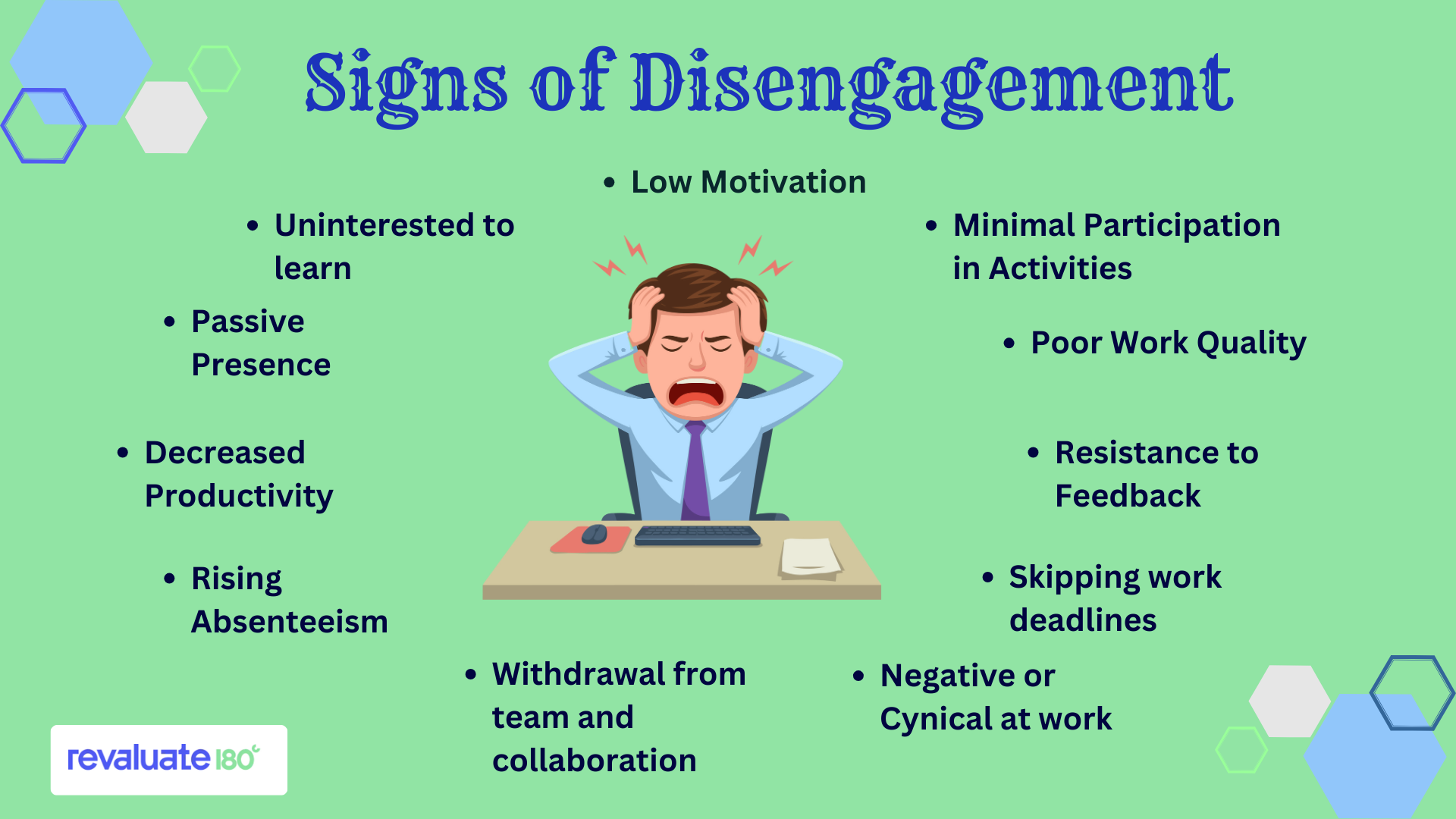
1. Drop in motivation and initiative
Employees who were initially actively engaged or prominent team members suddenly become passive, less responsible, or unwilling to volunteer for team or work activities.
Such a loss of motivation can be detected when they are no longer proactive in learning and completing tasks and require handholding, micromanagement, or stepwise instructions to get a job done.
2. Minimal participation in meetings and discussions
Members who were once active or neutral team members are now avoiding team meetings and bonding sessions, citing one or more reasons.
Forceful attendance often happens just for name's sake, where such employees do not voice their views or opinions.
3. Decreased productivity or inconsistent output
Employees who excelled in performance evaluations and technical interviews can suddenly start to exhibit a decline in work standards or quality.
Such employees often require excessive handholding and reminders, yet deliver results below expected standards, requiring rework by another team member. Consequently, the entire team's work timeline is affected.
4. Rising absenteeism or “quiet presence”
The most common way for an employee to show their displeasure at work is to be absent, especially when their team needs them most.
The days when they are present often go by doing tasks that are least significant, trying to avoid taking on responsibilities, giving silent treatment to other team members, and affecting the overall mood and team dynamics.
5. Missed deadlines or reduced work quality
Disengaged employees often require multiple reminders to complete their assigned work. Moreover, irregular attendance at work and more absences often result in delays in completing tasks before the due time.
One missed deadline disrupts the chain of interdependent tasks the team is working on, ultimately affecting the team's overall work quality.
6. Withdrawal from teammates and collaboration
Not participating in discussions, taking part in team gatherings, skipping work meetings, and engaging in other informal activities can be clear red flags that an employee is disengaged at work.
Moreover, no amount of persuasion or encouragement from team members, leaders, and HR professionals can change the minds of such employees, who turn a deaf ear.
7. Resistance to feedback or change
Disengaged employees often know that they are causing a ruckus at their workplace in several ways, which is noticeable by other employees. Their leaders often share feedback and concerns from other employees about how their behavior affects everyone’s work.
However, such employees never change in response to feedback, remain adamant about their poor engagement, and are not willing to work as before.
8. Indifference toward growth or learning opportunities
If employees do not show interest in learning or in seizing new opportunities, it can be an alarming sign of disengagement from the company.
It means the employee does not wish to remain in that work environment, even while receiving opportunities to grow and work on areas that once interested them.
9. Negative or cynical attitude toward work
Disengagement is often accompanied by a pervasive negative attitude and cynical traits. Such employees often find reasons to pick fights, criticise the company for every issue, and try to spread their influence to others.
Rather than meeting deadlines, they look for reasons to avoid or skip deadlines, affecting the overall dynamics within a team.
10. Lack of ownership or accountability
If employees who once took on responsibilities and achieved them to the best of their ability look for reasons to pin the blame on others and refuse ownership, it can indicate growing disengagement.
Such employees often refuse to take accountability for any tasks they perform, giving excuses or making others take responsibility in their place.
What Causes Employee Disengagement?
The signs of disengagement we discussed earlier often show up gradually. Initially, it may seem as if the employee is having a bad day or a bad week for personal reasons. But soon, it can begin affecting work deadlines and quality.
Such an impact often occurs due to one or more of these reasons.
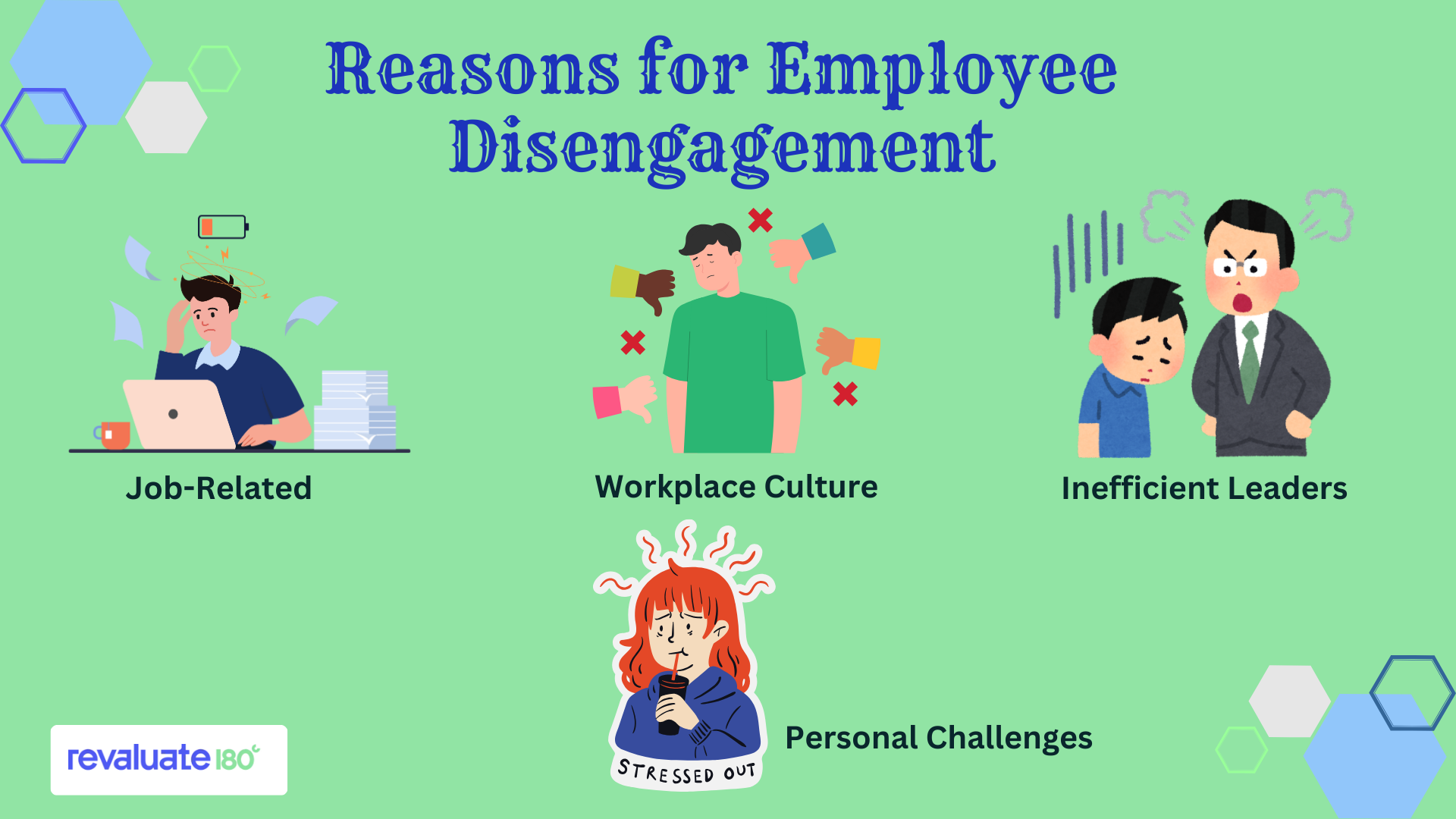
1. Organizational causes
The way a company treats its employees, values their concerns, and provides clarity about its vision for the future affects employee engagement levels. When organizations fail to support employees during crucial situations, they begin to dissociate from their commitment to the company’s vision and goals.
Common organizational blocks that affect employee engagement include:
- Poor leadership that makes bad decisions relating to work allotment, holds biases, does not communicate effectively, or makes judgments based on preconceived notions.
- Weak management practices that fail to value employee feedback and to resolve concerns.
- Lack of trust and transparency makes employees feel psychologically unsafe.
- Unclear company direction and frequent changes in leadership decisions show an unstable organization where employees cannot sustain for long.
Impact: When employees sense these patterns, they slowly begin to disengage from contributing to the company and look for every possible opportunity to quit.
2. Job-related causes
Employees often lose motivation and enthusiasm for their work when their jobs are not challenging or interesting enough. This realisation can happen at any time, from the first day or week at work to the first few months or years of their professional journey in the company.
- Most often, employees start distancing themselves from their work when they find the work they do not in line with what they had expected while applying for the job role.
- Ambiguity in job roles and unclear expectations often cause employees to leave their new job as soon as possible.
- Repetitive or unchallenging work over prolonged periods can make employees feel less skilled than their peers.
- Evaluating employees on a different skill set and assigning entirely different responsibilities creates a mismatch that confuses employees when they join the team.
- Not providing sufficient resources or training materials to help employees adapt to job needs can make employees feel less skilled.
Impact: Job-related disengagement often manifests as prolonged absences, nonparticipation in work discussions, attempts to avoid responsibilities, and passivity.
3. Culture and environment causes
Culture refers to the overall work dynamics and engagement levels exhibited by most employees in the company. A company with a large number of dissatisfied and disengaged employees can never be warm and enthusiastic in welcoming new employees; rather, it spreads a negative vibe.
Here are some common concerns that contribute to a toxic workplace culture:
- A lack of recognition and appreciation for the work they do makes employees feel they are not meeting expectations or that they do not belong here.
- Exclusions from discussions and feedback collection due to factors such as work experience and background can make employees worry about bias.
- Poor communication across teams often creates misunderstandings and disputes.
- Dictatorial leadership and management do not provide sufficient channels for employees to voice their concerns.
Impact: Cultural disengagement is contagious and can spread quickly across teams and levels within a company. This can be marked by constant negative conversations among employees, accusing leaders, comparing with peers, being cold or unwelcoming to new joiners, leading new joiners to leave soon, and more.
4. Personal and human factors
Despite the company's best efforts to help employees, resolve their concerns, and provide the right assistance, an employee’s limitations can also contribute to disengagement.
Most common reasons for disengagement stemming from an otherwise smooth professional journey include:
- Burnout or chronic stress due to incidents in personal life, such as ending a relationship, losing a loved one, moving to a new city, or other reasons.
- A lack of work-life balance due to additional responsibilities at work, becoming a new parent, or taking up caregiving duties.
- Being in a phase where employees feel undervalued or unheard at work or outside.
- Developing interests in new areas and losing interest in the current job.
Impact: Disengagement due to personal reasons outside the scope of the work environment can be hard to address. The symptoms can cover most of the signs we discussed earlier, often requiring a deeper conversation to understand the reason for disengagement.
Impact of Employee Disengagement on Organizations
Every sign of disengagement ultimately affects the team's and the company's work quality and timelines. Disengagement among employees is enough to undermine a company’s entire work culture and business progress.
Here are some of the visible aftereffects of disengagement:
1. Lower productivity and performance
Disengagement makes employees perform worse than they did earlier. Active performers who once excelled in their tasks take a back seat, delegate their responsibilities to others, unbothered by the loss of quality. External sources of encouragement and peer talks hardly make any changes.
2. Higher absenteeism
The common impact of feeling disengaged is that employees do not turn up for work and come up with excuses to avoid showing up. This response comes from a sense of feeling that their work hardly makes a difference to the company’s business, and leaders will eventually find a way to get someone to do their job. However, this behavior can further trigger more team members to do the same, leaving team leaders and managers in a fix.
3. Increased turnover and replacement costs
Employees who show signs of disengagement often leave the company, in turn luring others to follow their lead and causing significant turnover. Disengagement is one of the biggest challenges of retention, occurring at least once a year during different periods. The avalanche costs of hiring and rehiring can drain a company’s finances and the effort put in by several teams to hire candidates.
4. Declining morale across teams
Disengagement is contagious, and often one negative employee is sufficient to worsen the mood of several teams, both at work and outside. Constant talks with a disengaged employee often make the listener resonate with their experiences and feel the same way. Moreover, comparisons with peers in different companies can make several employees feel they deserve better for the work they do.
5. Poor customer experience and brand damage
Disengaged employees do not bother showing off their attitude to clients and customers, often damaging their company’s brand image. A company’s employees' attitude can give a clear picture of how it would respond to and support its clients. A bad employer can never be branded as customer-friendly.
6. Reduced innovation and creativity
With more time spent dodging responsibilities, procrastinating on tasks, and being absent, disengagement reduces the rate of innovative and creative idea flow within teams. Leaders and managers spend more time resolving employee concerns than providing pathways for ideation and learning. Naturally, the company's overall work culture remains focused on settling disputes and arguments rather than on discussing growth and development.
How to Address Employee Disengagement With Practical Solutions
Employee disengagement is undoubtedly an elephant in the room that organizations must address, regardless of their current engagement levels. As always, we will focus on preventive measures followed by suggestions to improve engagement levels.
1. Rebuild clarity around roles and expectations
When you hire the right person for the job role, you ideally do not have to worry. However, it is crucial to attract the right people to apply for your job roles and ensure they are skilled and psychologically fit for those roles.
When candidates have a clear understanding of their expectations from the company and what they get in return, they are better prepared to apply for the role. Here are some interesting strategies to improve the hiring process and hire the right person.
2. Improve manager capability and accountability
A 2025 survey shows that 88% employees quit their jobs due to their managers and their attitude. Traits like poor communication, favoritism based on unconscious biases, exclusion of employees, and a lack of appreciation for work done often cause employees to feel they cannot work under such leaders for long.
Managers, first-time leaders, and senior leaders must undergo periodic training and workshops where they learn more about people management and effective communication. They must be responsible for resolving genuine employee concerns at the earliest possible time.
3. Create consistent feedback loops
Employee engagement and retention work only when the company understands employee concerns and develops initiatives that best address them. Online feedback channels, engagement surveys, retention surveys, and other sources of feedback help companies to read employees’ pulse and their concerns.
Feedback channels must facilitate two-way communication between employees and management. Every issue raised by employees must be addressed through any company initiative or communication, such as survey results.
4. Recognize and reward achievements
Employees always yearn for appreciation or a token of encouragement from their peers and superiors for the work they do. Failing to recognize employees for their timely contributions often leads them to lose motivation to work harder.
Several employee engagement solutions have a dedicated portal to manage rewards and recognition, encouraging peers to appreciate employees and provide rewards with different options.
5. Invest in development and growth paths
Employees must be aware of the company and its business goals and work to align with them. Similarly, a company must support employees in achieving their professional goals and provide opportunities to learn and grow while working for the company.
Companies can sponsor distance education programs, on-the-job technical training, and skill development workshops to help employees remain relevant in the talent market. Fair appraisals with salaries on par with industry standards assure employees that they are in a safe place.
6. Strengthen communication and trust
A lack of transparent communication is the main reason why several employees begin to disengage from work. Miscommunications or not communicating the right message at the right time often create confusion, leading to assumptions about the work to be done.
Clear communication of work requirements and timely feedback from employees are crucial to fostering healthy engagement in the company. Moreover, companies must have a strong internal communications channel to ensure all employees stay updated on the latest happenings.
7. Act on employee feedback
Surveys and feedback channels provide companies with the actual concerns that prevent employees from being their best at work. In response, the company must take sufficient steps to resolve genuine queries and concerns so that work can proceed without any hassles.
Acting upon feedback swiftly is a positive sign that shows the company really cares for its employees and wishes to support them in their professional journey.
Final Thoughts
Employee disengagement is a cautionary sign for employers that they need to step up and take the right steps to help their employees become more productive and committed to their work goals. Solutions to employee disengagement include implementing initiatives that make employees happy to come to work through the right mix of direct and indirect compensation.
Ideally, companies must avoid employee disengagement and act on the slightest signs of disengagement. Even before these signs start manifesting, it is possible to detect risks of disengagement among employees and teams.
At Revaluate180, we help organizations uncover disengagement risks early on. We help align people to the right roles through insights from values and behavior-based assessments, and build workplaces where employees stay engaged and perform at their best.
Want to know about how our model works? Connect with us if you notice any signs of disengagement among your employees and want to know how to address them.

Unlock AI-Powered Hiring Analytics
Transform the way you hire with insights that create aligned, collaborative, and high-performing teams.
- Smarter Hiring Decisions
- Reduce Expensive Turnover
- AI-Driven Insights
- Optimize Team Performance