Your 2020 workplace ethics no longer exist. The implicit contract between employers and employees has been revised due to hybrid work negotiations, AI-driven reforms, and economic turbulence.
If you’ve faced talented people going quiet in the meetings, declining participation, or good performers suddenly doing just enough to avoid scrutiny, you’re not overthinking. Global engagement data suggests only 20-30% of employees report being actively engaged in their job.
While numbers can vary by region and turnover, most leaders treat disengagement as a motivation problem when it’s clearly a lack of diagnosis. In this article, we’ll discover the actual causes of disengagement in 2026 and how we can fix what’s broken through a strong framework that works when the stakes are high.
TL;DR
- The disengagement crisis is real and measurable: When the majority of employees are disengaged, the goal is to understand the core causes of disengagement, as it will have a significant impact on your organizational productivity and retention if ignored.
- Drivers of company failure include poor leadership and communication, lack of recognition, limited growth, and work overload.
- The overlooked causes are strategic: Broken promises, feeling unsafe to speak at work, resentment, organizational rigidity, lost purpose, and AI anxiety often contribute to disengaged employees.
- Re-engaging employees requires a systematic approach that accounts for root causes and restores trust in people. Start by running rapid tests to identify high-risk terms and then prioritize the most important issues first. You can build strong engagement by improving manager practices as core leadership patterns shaped by daily employee experience.
What is Employee Disengagement?
Employee disengagement is a workplace dynamic where employees are emotionally, mentally, or behaviourally disconnected from their work. They often lack the motivation, commitment, and curiosity needed for organizational growth. It becomes a measurable impact of reduced growth and productivity due to:
- Discretionary efforts
- Emotional withdrawal from organizational goals.
- Diminished voice in decision-making.
- Weakening alignment with the company’s mission.
What the above looks like in practice:
- Repeatedly missing deadlines that previously weren’t an issue.
- Minimal contributions in team meetings (Depends on their personality).
- Declining participation in voluntary collaboration or teamwork.
- Showing up often but not being present in the moment.
- Formal role boundaries, they don’t want to cross.
Disengagement isn’t about bad days or temporary stress, but more about the consistent decline of voluntary contributions required for organizational growth.
What Causes Employee Disengagement in an Organization
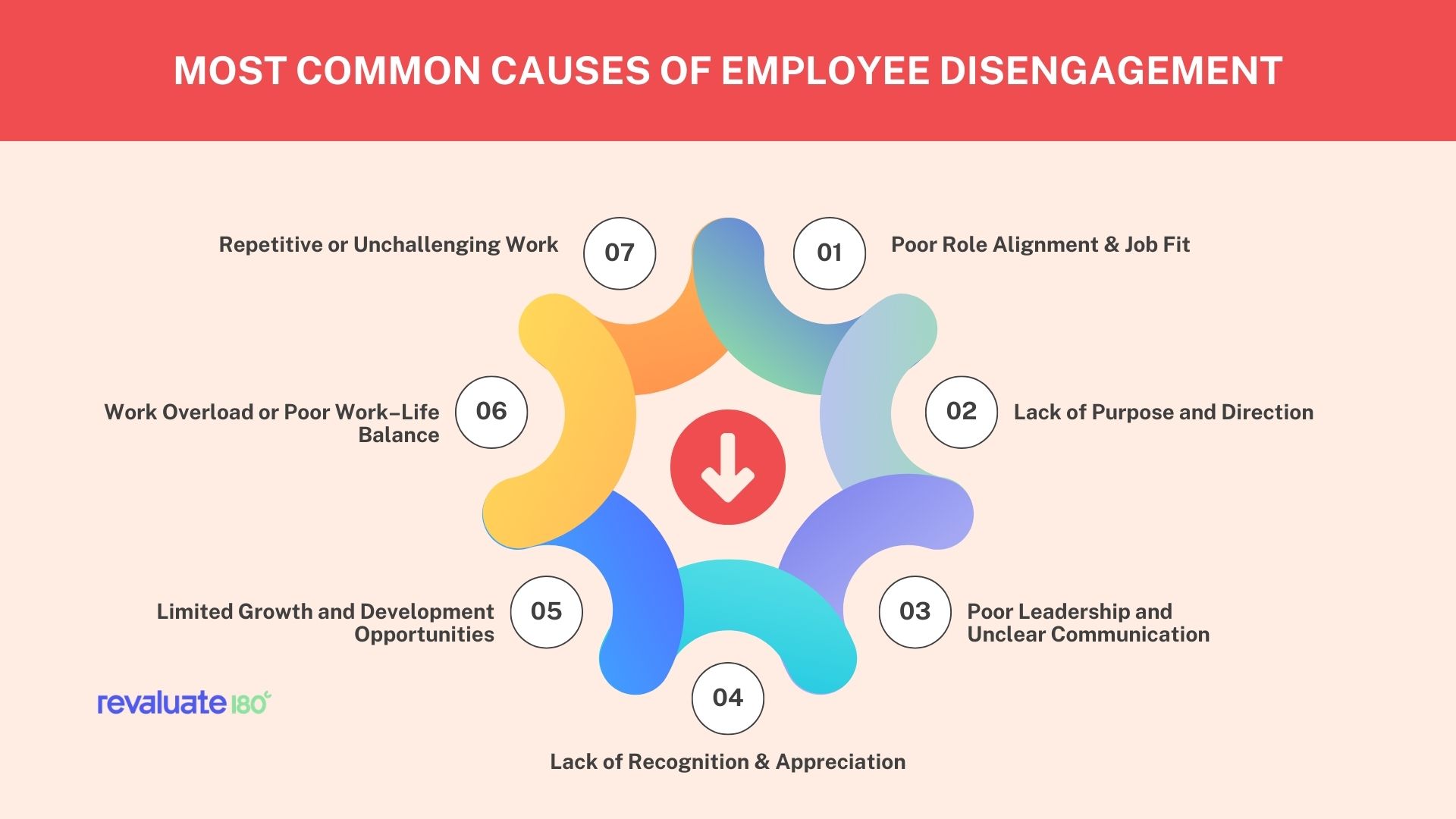
Various reasons can cause disengagement. But the most common ones are pervasive:
1. Poor role alignment and job fit
Disengagement often starts before an employee’s first day at work. Happens mostly when companies hire for availability rather than fit. Such decisions made under pressure particularly contribute to future disengagement.
Hiring in 2026 made misalignment more likely despite the AI advancement and remote roles. AI-powered applicant tracking systems sometimes screen out potential candidates because of the biased data they’re trained on. This results in more hiring mistakes and disengagement.
You can fix this by creating a structured hiring process and prioritizing fit over speed because the cost of bad hires can far exceed the cost of a delayed hire.
2. Lack of purpose and direction
Employees need to understand why they do what they do. They complete tasks without understanding how these tasks contribute to larger goals. This disconnect shows up clearly in disengaged employees who stop asking strategic questions that lead.
The post-pandemic era has fundamentally shifted how employees think of the company’s mission. Economic uncertainty throughout 2024 and 2025 has forced many companies to make rapid strategic pivots, leaving employees confused about why they’re doing it. EY global integration reports that more than 50% of workers disengage due to a lack of purpose.
You can fix this and rebuild purposeful connections by explicitly integrating individual work and organizational impact, and by providing regular opportunities for employees to hear directly from customers about their products and services.
3. Poor leadership and unclear communication
Leadership quality directly impacts engagement levels across the organization. When leaders fail to communicate clearly, employees operate in uncertainty. This communication vacuum forces employees to make assumptions, often the wrong ones, that lead to frustration.
The remote and hybrid work environment has exposed and amplified leadership deficiencies in 2026. Managers who relied on physical proximity and conversations now struggle to connect with teams. The accelerated pace of change driven by AI, economic volatility, and shifting market dynamics has changed the way we pursue work.
You can solve this issue by addressing poor leadership through heavy investment in leadership development that is pivotal to the technical skills and emotional intelligence.
4. Lack of recognition and appreciation
Recognition isn’t about participation trophies; it's about acknowledging efforts and celebrating progress. It’s all about showing employees that their contributions (big or small) matter most. When companies often fail to recognize good work, employees begin to question their purpose and lose interest over time.
In 2026, the recognition gap has widened, particularly due to remote and hybrid work, where informal acknowledgement opportunities have disappeared. Gallup research shows that remote employees report feeling 31% less recognized than their in-office counterparts, even when performance metrics are identical.
You can fix this deficit by building structured recognition programs into regular workflows rather than treating it as a liability in your list. Implement peer-to-peer recognition systems that allow colleagues to acknowledge one another's efforts, fostering a culture that appreciates each other’s work.
5. Limited growth and development opportunities
Ambitious employees don’t just want jobs; they want long-lasting, growing careers with a clear path forward. When companies fail to provide learning experiences or development opportunities, engagement is bound to decline.
Professional development has fundamentally shifted by 2026 due to rapid changes. Employees now expect continuous learning opportunities, with 74% of workers reporting they’d leave an organization that doesn’t help them develop skills.
Address this issue by creating transparent career paths with multiple progression routes beyond traditional advancement. This also includes lateral moves, specialized counseling, and opportunities for project leadership.
6. Work overload or poor work-life balance
Chronic overwork destroys productivity as much as boredom does. When employees are overburdened, exhaustion will inevitably replace their enthusiasm. These conditions create a lot of misunderstanding and fundamentally undermine motivation.
The boundary between work and personal life has become dangerously blurred today. Studies have repeatedly shown that remote employees now work on an average of 2-3 hours more per day than they did in the office. This can seriously harm the company culture in the long run.
You can fix this by establishing clear boundaries for work hours and clearly communicating expectations. Conduct an honest workload assessment and identify where demands have become unsustainable.
7. Repetitive or unchallenging work
Human beings fundamentally crave new challenges and variety in their work. When a job becomes monotonous, with the same tasks repeated endlessly without variation or intellectual stimulation, even the best employees lose motivation and disengage.
By 2026, automation and AI will have created a paradigm in workplace challenges. While it can potentially eliminate some repetitive tasks, it has also been reported to reduce work fulfillment simultaneously by the International Journal of Information Management.
You can address the challenge of a skills deficit by regularly rotating assignments and responsibilities so employees gain broad exposure to different aspects of the business and develop varied skill sets.
What are the Root Causes that Leaders Often Overlook
While most leaders recognize the obvious reasons for disengagement, many go unnoticed until they’ve damaged engagement across teams. Let’s uncover these drivers:
1. Disengagement caused by misaligned hiring decisions
When organizations hire for:
Common drivers of this disengagement include hiring solely based on technical ability without considering culture fit, rushing recruitment to fill seats, or overlooking soft skills that fuel collaboration. Misaligned placements can cost both productivity and morale, making it critical to focus on fit as much as skills.
- Availability rather than fit.
- Priority credentials over culture alignment.
- Oversell roles to attract the candidates.
They set the stage for eventual disengagement because the employees' prior expectations didn’t align with the promises made during hiring.
You can fix hiring misalignment by slowing down your selection process and bringing a revised hiring criterion that is consistent across all candidates. We recommend that you read our guide on how to make the right hiring decisions in the modern workplace, so you don’t lose money and time in lost productivity.
2. Poor onboarding and early role confusion
The first 90 days determine whether an employee develops strong engagement or starts disconnecting from daily tasks. Poor onboarding leaves new hires feeling lost, overwhelmed, and uncertain about their expectations.
This ambiguity creates stress and makes employees question their decision to join the organization in the first place. You can fix this by extending programs to at least 90 days with structured pointers throughout. You can also use our free template for our latest onboarding survey questions to help you clear the confusion.
3. Managers promoted without people and leadership skills
This is the most destructive yet common cause of widespread disengagement. Technical expertise doesn’t directly mean people leadership. It takes skills that make someone more excellent at executing work, which differ dramatically from the skills needed to guide, put in the work, and inspire new leaders.
The shift to remote and hybrid work in recent years has brutally exposed managers lacking people-leadership skills, as they are used to managing through proximity that no longer prevails. You can change this by starting with assessing leadership potential and interest before promotion, rather than assuming all high performers.
4. Ignoring early disengagement signals until it’s too late
Leaders often notice the signs of low engagement but try to rationalize them away or assume they’ll resolve on their own. Early disengagement can often look like the following if other reasons don’t make sense:
- An employee who used to volunteer for projects has stopped doing so.
- Some who used to contribute actively in meetings have grown quiet.
- Doesn’t feel motivated enough to present or contribute to new ideas.
- Enthusiasm visibly declines.
There can be many early signs that signal a false alarm, but investigating each one to ensure they’re indeed signs of disengagement is equally crucial. You can take your best shot by training managers to recognize specific behavioral changes that indicate these early signs.
How to Re-Engage Disengaged Employees?
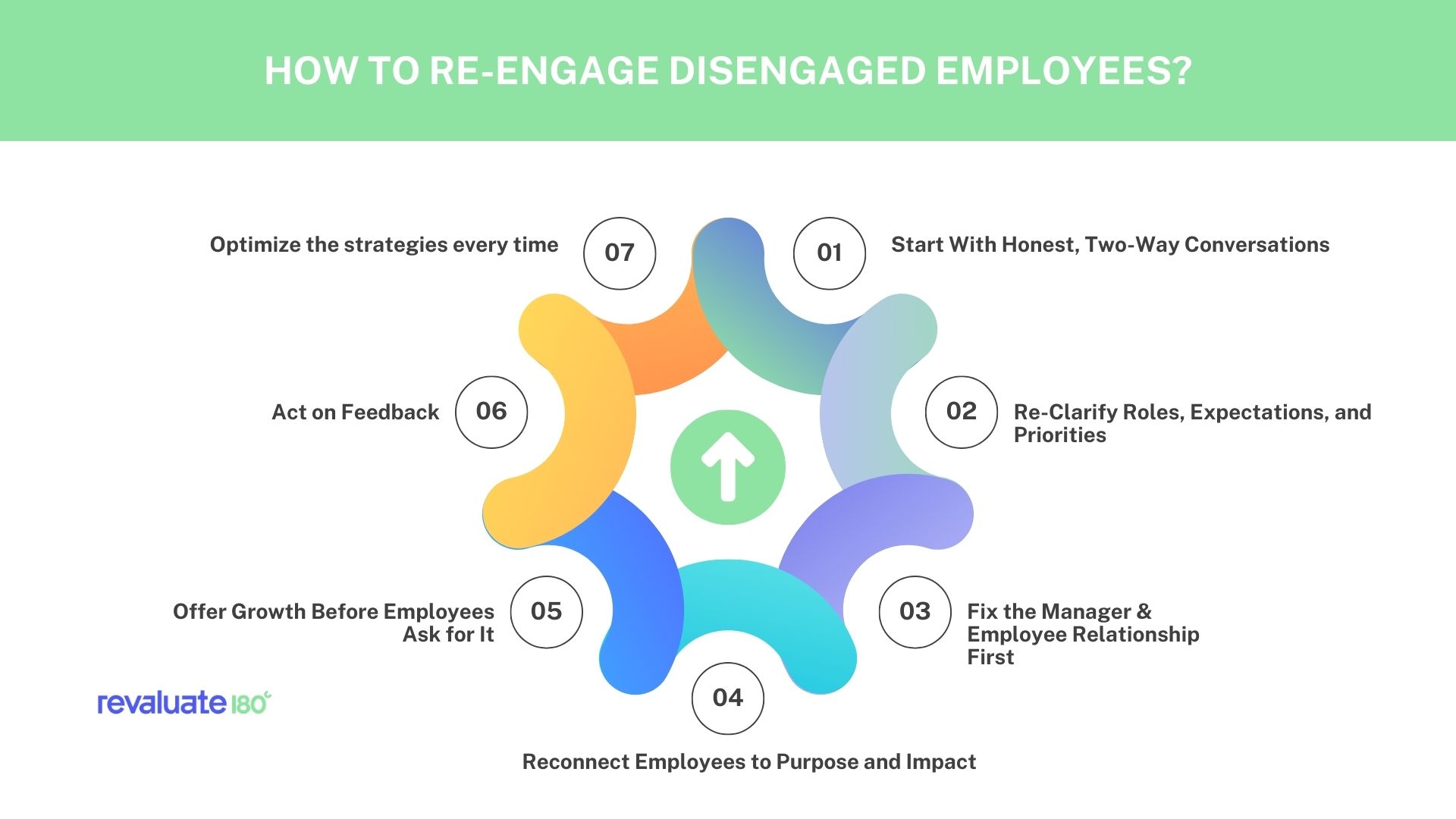
Re-engaging your employees requires consistent, long-term efforts. While prevention is easier than cure, organizations can successfully reverse employee disengagement before it becomes a complete mental check-out at work. So, rather than applying superficial fixes, we’ve addressed the root causes and the way to get around them:
1. Start with honest, two-way conversations
Re-engagement begins with understanding what actually causes the disconnect. Leaders must ensure they create a workspace where honest dialogue feels safe and well-expressed. If someone is frustrated, disappointed, or concerned without fear of retaliation, they have the right to speak up and feel heard.
2. Re-clarify roles, expectations, and priorities
Many disengaged employees struggle with confusion about what success looks like in their roles. Re-engagement requires establishing transparent expectations with measurable criteria and priorities that eliminate confusion.
Role clarification should address authority levels, decision rights, and boundaries so your employees know exactly where they have autonomy and where they require approval.
3. Fix the manager and employee relationship first
Since poor leadership ranks among the primary causes of disengagement, reversing it often requires a solid restructuring of the manager-employee relationship. It demands acknowledging past failures and owning the mistakes that contributed to disengagement.
When the manager-employee relationship is irreparably damaged, the most honest solution is to transfer the employee to a different team or manager. This shouldn’t be seen as a failure, but a recognition that employee engagement matters more than solving the irreparable conflict.
4. Reconnect employees to purpose and impact
Why they do matters more than what they do. Re-engaging your best ones requires helping them reconnect to the company mission by showing how their efforts contribute to the success. Purposeful connection works best when it’s specific rather than generic.
You can show the individual employees how their contributions are valuable, and reshaping their responsibilities can create better alignment between what matters to them and what they do every day at work.
5. Offer growth before employees ask for it
Waiting for disengaged employees to request development opportunities doesn’t solve anything. As a leader, it’s crucial to know that proactive re-engagement is about identifying opportunities through new skills and challenges to lead in new projects, and offering them before employees have to advocate for themselves.
6. Act on feedback
Nothing reinforces a withdrawal faster than soliciting employee input and ignoring it. The most vital part of re-engagement isn’t just listening to their problems; it's proactively asking for and acting on their feedback in visible ways.
When employees raise concerns that can’t be addressed immediately, leaders should explain the reasons and what’s being considered for the foreseeable future. The most powerful re-engagement sign is when employees see their input driving real change through process improvements informed by their valuable insights.
7. Optimize what works
Collect data on which strategies work best and optimize them with a better approach. Each employee is unique, so a consistent effort to serve their needs can only bring out the best when they’re optimized at each step.
Final Thoughts
Fixing disengagement requires disciplined leadership and effort. Start by rebuilding trust by acknowledging broken commitments because nothing else works without credibility. Invest heavily in managers since they shape the daily workplace experience. Equip them with potential training and tools for meaningful conversations and hold them accountable for engagement outcomes.
Leaders must address the root causes through structural changes. Measure what people do, how they do, and why. You can integrate behavioral indicators like participation and collaboration. When you notice early signs of a checkout, you must act quickly by running diagnostics and implementing the appropriate actions.
Want to re-engage teams before it becomes turnover? At Revaluate180, we help organizations identify early attrition risk and align people with the right roles to restore engagement. Contact us today to create environments where employees thrive.

Unlock AI-Powered Hiring Analytics
Transform the way you hire with insights that create aligned, collaborative, and high-performing teams.
- Smarter Hiring Decisions
- Reduce Expensive Turnover
- AI-Driven Insights
- Optimize Team Performance