Your star performers build their reputation through consistent, visible efforts and results that drive your company's success. When problems or unforeseen situations arise, they consistently rise to the challenge, take calculated risks, and deliver exceptional results.
When these high performers suddenly lose their spark and become withdrawn, disengagement has set in. The very employees who once carried the team through tough times become unpredictable and distant, negatively impacting work timelines and quality.
Let's explore the most common reasons why good employees disengage at work and how companies can address these issues before it's too late.
TL;DR
- High-performing employees can suddenly disengage at work, showing signs such as passive or limited participation, avoidance of responsibilities, and a loss of overall enthusiasm and motivation.
- Good employees disengage at work for several reasons, such as limited learning opportunities, strained relationships with managers or peers, burnout, poor compensation, or a lack of purpose and alignment with company values.
- Disengagement is preventable through a well-planned strategy that identifies what motivates employees to perform better and grow consistently with the company.
- Data-driven insights help companies implement best-in-class engagement initiatives to help employees overcome disengagement and return to their original form.
1. Lack of Recognition and Growth
A Gallup survey shows that only 28% of employees felt their most memorable recognition came from their manager. Even with competitive pay packages, a lack of recognition or appreciation for their work can make employees feel low.
Good employees often focus on the work at hand and continue working, unmindful of recognition. But over time, this method can change, especially when they see their peers or other team members getting their due credit while they are being disregarded.
Failing to provide timely appreciation to employees whose work has made a difference ultimately shows in reduced active engagement, minimal participation in ideation and creative discussions, unwillingness to take on mentoring responsibilities, and more.
2. Poor Leadership and Management
Several studies and surveys show that the best employees begin to disengage at work when their relationship with their immediate supervisors or leaders is strained.
Poor leadership qualities, such as a lack of transparent communication, bias towards a few employees, preconceived notions, failure to provide the right feedback and encouragement, and similar traits, make employees feel they do not need to put forth their best effort.
An ideal company management team periodically acts on employee feedback and provides the right support initiatives that help employees work better. Failing to listen to employee demands, not connecting with employees across all levels, ignoring red flags in the company’s work culture, and continuing to retain highly toxic leaders and managers force employees to resort to quiet quitting and eventually leave the company.
3. Burnout and Poor Work-Life Balance
Good employees always find a way to get the work done, no matter the urgency or strict deadlines. However, in a work environment always filled with strict, short deadlines and high-priority tasks, employees slowly start to lose their spark.
With all their energy focused on work and hardly any time to take a break and spend with their loved ones, employees feel burned out. This burnout at work slowly takes a toll on their physical and mental well-being and strains their relationships outside of work.
Burnout also occurs when managers cannot effectively delegate work to all their team members, leaving a few good performers overloaded. A LiveCareer survey shows 77% of employees are asked to take on extra work, and 93% report burnout from working beyond their limits.
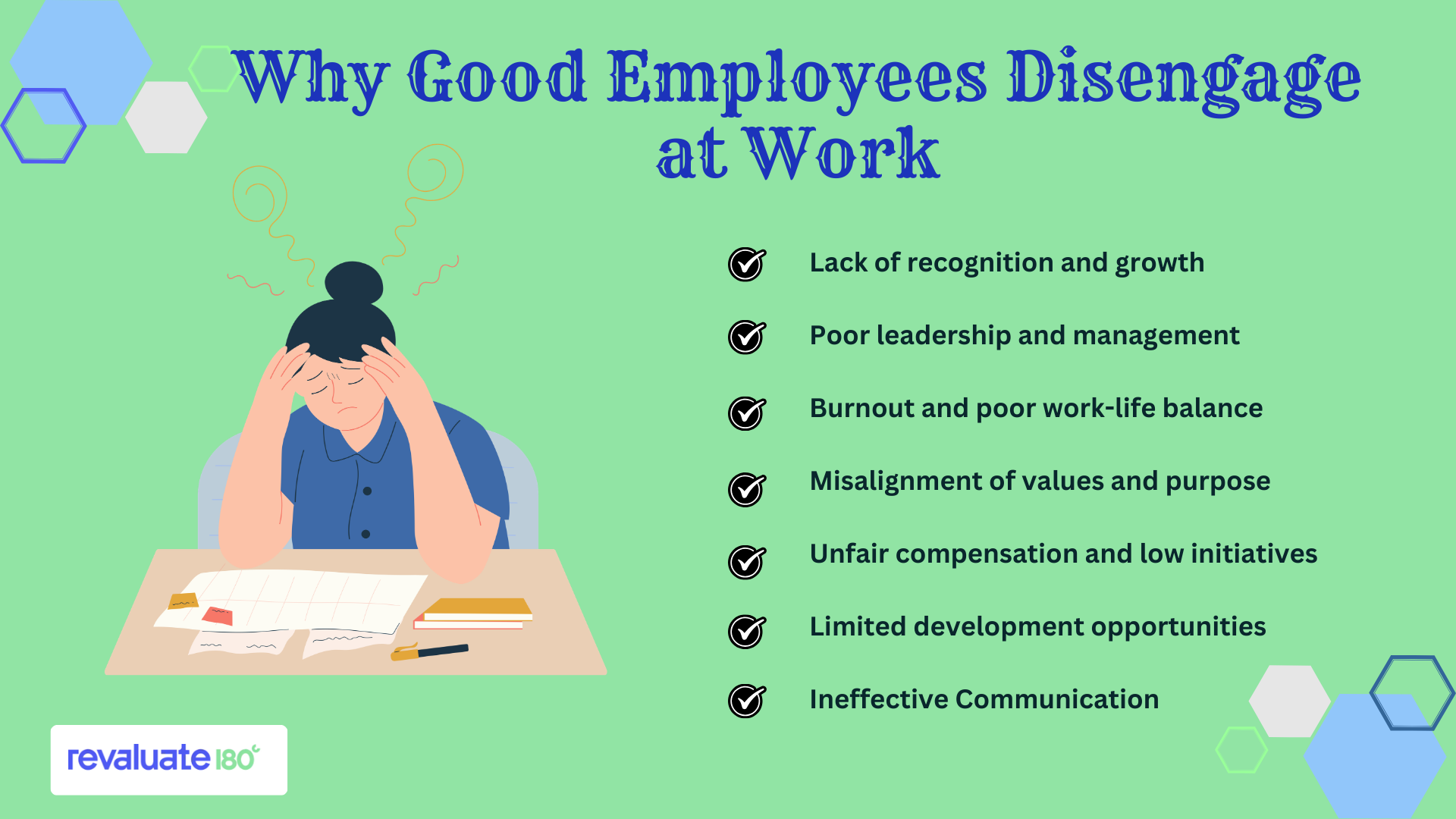
4. Misalignment of Values and Purpose
Good employees are more inclined to feel a sense of purpose when they believe their work impacts the company’s business. This purpose fuels them to perform better than any other incentive or initiative could.
When the work they do has no significant impact, or when they end up doing work that was not part of their job description, such employees can become misaligned with their original work purpose. Gradually, they no longer wish to continue working in a job that does not deliver what was promised.
Additionally, a lack of alignment between an employee’s personal values and the company’s core values indicates they are no longer a good fit for the company.
For instance, a company that once promised remote or hybrid work suddenly mandates full-time office presence, citing quality concerns. This abrupt policy shift can cause remote employees to disengage, as they feel the company has broken its trust in their ability to work flexibly while maintaining quality.
5. Unfair Compensation and Low Initiatives
Good employees remain engaged with the company as long as their basic needs are met and the company supports them to balance their work and personal life. If the company fails to keep up with changing times, inflation, and other employee demands, most employees are bound to lose interest in their work.
87% of employees consider working in a job worthwhile only if their compensation packages live up to the cost of living. Apart from monetary benefits, employees seek several indirect compensation initiatives, such as health and wellness programs, insurance policies, PTO, childcare support, learning and educational programs, and much more.
Failing to keep up with the latest provisions for job offers and to revise pay packages in line with industry standards and inflation often causes many employees to first disengage, then quit en masse.
Similarly, not coming up with the right initiatives that benefit employees and sticking to outdated benefits that no longer serve any purpose can prompt employees to leave the company for better opportunities.
6. Limited Development Opportunities
A new employee joins a company after signing up for the required responsibilities and fulfilling the desired skill sets. As time goes on, they wish to perform better as they progress up the corporate ladder.
Not getting the right growth opportunities on time or a staggered growth trajectory can impact the productivity of a well-performing employee. Gallup’s State of the Global Workplace report states that 41% of employees leave a job due to a lack of career development.
Most good employees try their best to find opportunities within the company, speak to their superiors about a role change, or switch teams internally. When none of these work, they start to disengage and take no responsibility at work. Eventually, they actively seek opportunities outside where they can get the growth and opportunities they want.
7. Ineffective Communication
Transparent communication at the right time and through the right channels is often not a high priority for many companies. They feel employees will listen to them no matter what, or that employees have no say in the decisions they make. Such communication gaps often give rise to anxiety, further leading healthy and actively engaged employees to start disengaging.
A robust internal communications system, powered by several feedback channels, forms the backbone of strong communication in a company. This system ensures that all employees receive timely information and have the opportunity to share their feedback. Further, companies must evaluate employee feedback and adjust their decisions and initiatives to better support employees.
When employees feel their voices are not heard or valued, they do not express their views, even when leaders ask. Passive presence and subsequent absence by such employees is often an alarming sign that employees are disengaged.
What Are the Signs of Disengagement Among Top Performers?
Employee engagement is visible in day-to-day behavior, especially among top performers who consistently demonstrate enthusiasm and commitment. When these employees begin to disengage, the shift is noticeable. They gradually withdraw and show marked changes from their usual high-performing selves.
Here are some common signs of disengagement that signal your top performers need help.
1. Reduced enthusiasm for new initiatives
The ones who were initially proactive, suggesting the best ideas and exceeding expectations at work, suddenly become passive. They no longer participate in company initiatives or demonstrate the ambition and energy that once defined their performance.
This passive presence gradually turns into absence or into a practice of avoiding taking on new responsibilities.
2. Less collaboration and idea sharing
The employees who were once the best innovators and progressive thinkers suddenly run out of solutions for even the smallest challenges at work. Once perceived as the team’s magnets who could get all members to work together amicably, such employees now avoid working with the team.
Lesser participation in work and recreational activities is a clear sign that employees are starting to disengage from their workplace.
3. Doing the job well, but nothing extra
Your best performers always went that extra mile, took up work tasks voluntarily, and put in their best efforts to exceed expectations. But then, all of a sudden, they become like robots, doing exactly what is told, requiring stepwise instructions, and only providing what is expected.
This sign of doing the bare minimum of a job is often a sign that the employee is working just for the paycheque and is not engaged in learning and growth.
4. Increased emotional distance from team culture
When a team’s work culture is bad, it can start affecting employees. Good employees try to remain emotionally invested in the team by engaging with team members beyond just work tasks. But when team members are biased or fail to include everyone, it can leave others feeling emotionally distant from the team.
Such emotionally distant employees, though performing well at work, often remain secluded and realise they need to move to a better place where they will be better accepted.
5. Declining curiosity and learning interest
Good employees never leave any stone unturned in learning a new skill or getting better at their art. Even during dull phases of work, such employees engage themselves in upskilling and research. But when such employees feel disengaged, they lose their curiosity to learn and become less inclined to stay occupied.
A lack of interest in switching teams, taking up a change in role, or any other initiative within the company clearly indicates that the employee is disengaged beyond control.
How to Prevent Future Disengagement Among Top Talent
Disengagement among good employees who are consistent performers is easy to detect, especially when they go completely opposite to their usual selves at work. However, companies must never let disengagement set in among their best employees in the first place.
1. Build growth pathways before employees feel stuck
Career progression and development must occur fairly across the company so that all eligible employees receive their due at the right time. The appraisal process should be free of bias and supported by sufficient data to inform appropriate succession and compensation strategies.
2. Track engagement signals, not just performance metrics
The definition of a good employee must not just be restricted to their work quality and skill proficiency, but also measure their engagement levels at work. The enthusiasm an employee shows at work, the ability to collaborate with team members and peers, and bonding with co-workers beyond work show how an employee sees the workplace as an extension of their personal space.
3. Develop managers to support high performers effectively
Managers must not use high performers solely for last-minute challenges or burden them with additional tasks. They must recognize their potential and ensure their additional effort is appropriately compensated. Leaders must support the timely recognition, appreciation, and career growth of good performers in each team so that others get motivated to follow their track.
4. Create psychological safety and feedback loops
Psychological safety at work is the shared belief that team members can take interpersonal risks, such as speaking up, admitting mistakes, asking questions, or proposing new ideas, without fear of punishment, humiliation, or retribution. When employees feel that their genuine concerns and feedback are heard by the company, and that the company responds with the right initiatives to support employee well-being, they do not feel the need to disengage or quit.
Feedback surveys, engagement surveys, and retention surveys provide valuable information about employees’ needs and expectations, enabling them to remain consistent performers.
Final Thoughts

Employees disengage when they feel the company no longer supports their interests or addresses their genuine concerns. Their disappointment manifests as a gradual withdrawal from the active engagement that once defined their work.
Regardless of the cause, disengagement among top performers directly impacts project timelines, team morale, and business outcomes. Fortunately, companies can track engagement levels and alert leaders to declining motivation before the damage becomes irreversible.
Revaluate180 helps companies better understand their employees and create a work culture where the company’s vision and goals align with personal growth and development. Our data-driven insights help leaders make evidence-based decisions, avoid past mistakes, and implement the right initiatives to support employee wellness and productivity.
Get in touch with us if you are noticing any signs of disengagement setting in among your employees and need the right support.

Unlock AI-Powered Hiring Analytics
Transform the way you hire with insights that create aligned, collaborative, and high-performing teams.
- Smarter Hiring Decisions
- Reduce Expensive Turnover
- AI-Driven Insights
- Optimize Team Performance