Employees' behavioral personalities can have a significant impact on the teams they work in and on how they navigate day-to-day workplace activities. While the DISC personality assessment is a great tool for classifying employees by their dominant behaviors, it can be frustrating when it fails to provide the right insights at the right time.
Common frustrations with DISC assessments include:
- PDF reports containing employee assessment results that are filed away, mostly forgotten, and left with no practical use.
- People with the same or similar DISC classifications performing differently than expected.
- DISC results not serving as reliable benchmarks for hiring decisions.
If DISC tells us how someone behaves, how do you determine whether that behavior actually aligns with your team or organizational goals?
Let's look at alternative assessments and strategies to evaluate behavioral personalities across several decision-making scenarios.
TL;DR
- The DISC assessment classifies employees solely by their dominant behavior and does not account for their alignment with company values or team dynamics.
- HR leaders often consider alternatives such as Myers-Briggs, Hogan Assessments, CliftonStrengths, the Big Five, and Team Dynamics for a more comprehensive, scenario-relevant evaluation of employee personalities.
- Assessments should go beyond classifying employees into specific categories. They should also help refine and strengthen employees' contributions to their teams over time.
- Learn how to choose the right personality assessment strategy for your organization and how to derive actionable insights for long-term relevance.
What DISC Actually Measures and What It Doesn’t
The DISC assessment is based on the book “Emotions of Normal People” written by William Moulton Marston. This test helps determine a person's behavioral patterns by examining how they communicate with others, handle relationships, and approach tasks in a professional setting.
DISC classifies behaviors into four major categories and assigns a behavioral personality indicator based on these patterns:
- Dominance - level of focus and authority in making decisions
- Influence - persuasiveness and impact on socializing circles
- Steadiness - support and reliance in communication and decisions
- Cautiousness - attention to detail, precision, and staying informed
What is DISC useful for?
DISC results identify the dominant traits of employees. These results make it easier for HR leaders and recruitment professionals to design appropriate training and workshops for improving communication, team bonding, and onboarding.
DISC results also help identify root causes when handling conflicts within a team, making it easier to provide solutions that align with the conflicting team members.
What DISC doesn’t tell you?
It is very common for two people with the same DISC profile to perform very differently within the same team or across different teams. This is where DISC assessments create ambiguities, making it difficult to align dominant behavioral traits with team values and goals.
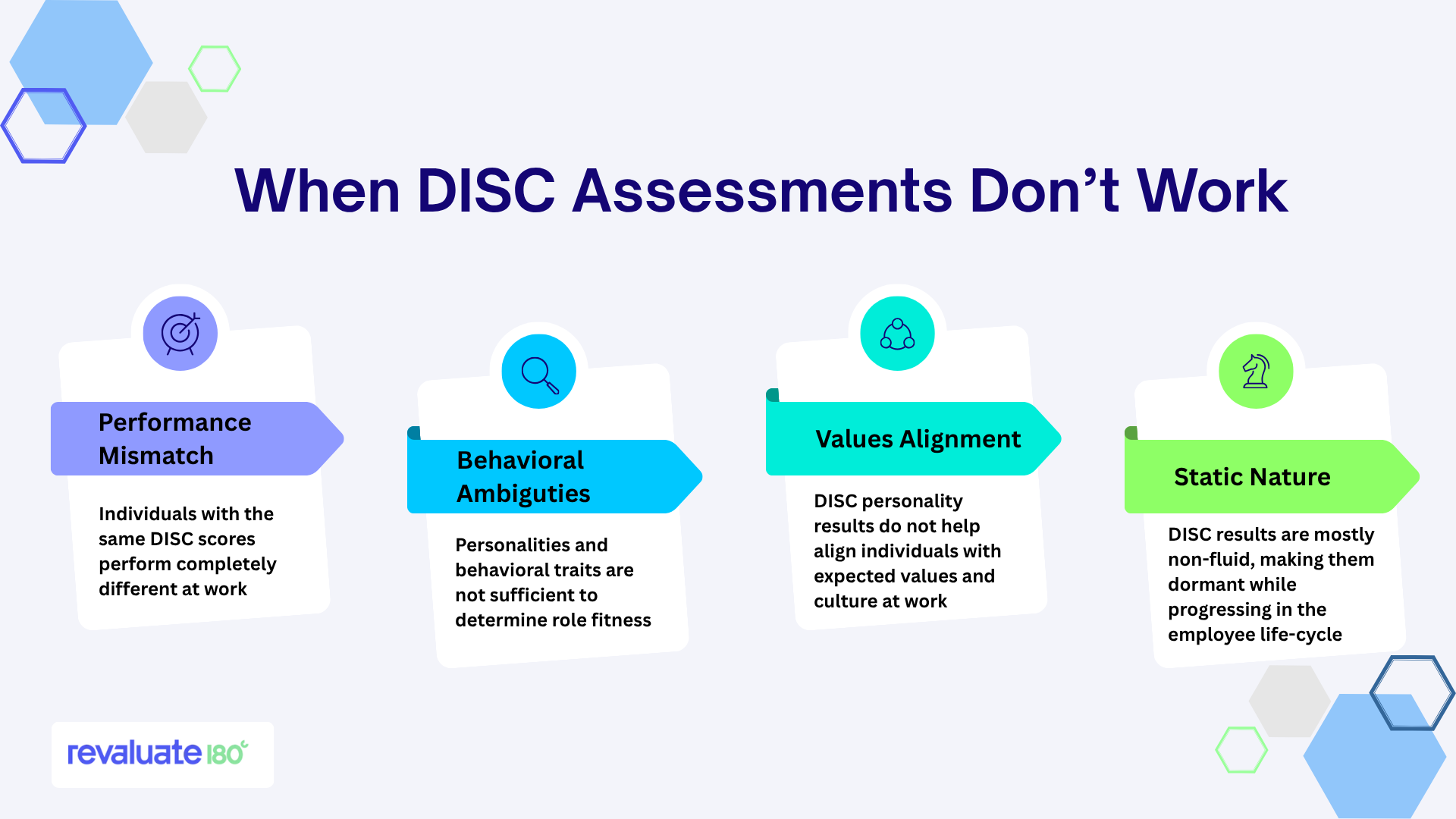
In short, DISC shows "how a person behaves."
What it does not reveal is: "Will their innate values contribute to or align with your company's work culture or team culture?"
The Top 5 DISC Alternatives HR Leaders Use
While DISC tests remain relevant for onboarding, training, and improving communication, leaders and HR professionals are increasingly using other personality assessments for various workplace scenarios.
Here we have compiled some trending DISC alternatives in no particular order, showing which works best for different workplace requirements.
1. Myers-Briggs (MBTI)
The Myers-Briggs Type Indicator (MBTI) is a psychological assessment based on Carl Jung's theory of psychological types. It categorizes individuals into 16 personality types based on preferences across four dimensions: extraversion/introversion, sensing/intuition, thinking/feeling, and judging/perceiving.
MBTI Advantage
MBTI goes deeper than DISC behavioral assessments by exploring psychological preferences, fostering greater awareness among employees of their own personalities.
MBTI Use Cases
- MBTI tests are highly suitable for improving communication and identifying leadership styles, and can help determine which employees would be a good fit under a particular leader.
- Teams with misaligned members can use the MBTI to identify areas of improvement and attend targeted workshops accordingly.
- MBTI results help leaders bring together members with the right psychological traits to tackle tight deadlines and critical work tasks.
MBTI Limitations
- MBTI is often criticized for being culturally biased and failing to consider the test taker’s diversity and background.
- MBTI results should not be used as reliable indicators for hiring decisions, career promotions, or other high-stakes decisions.
- Classifying individuals into 16 personality types can still be limiting when two employees share the same type but display different levels of alignment and performance.
2. Hogan Assessments
The Hogan Assessments comprise five personality assessment tools that deliver reliable insights into employee personality traits for leadership development. Their scales and scoring parameters are backed by scientific research, making them a more trustworthy option for HR leaders worldwide.
Hogan advantage
The Hogan Assessment tools are great aids across the entire employee lifecycle and are not static like DISC assessments. Each test takes less than 20 minutes to complete, and the results can help with several decisions, from hiring and training to career development and risk identification.
Hogan Assessments use cases
- Suitable for employee personality and leadership assessments across all kinds of industries.
- Scoring scales are highly precise in determining whether a new employee is a good fit for a company or whether existing employees are ready for career progression.
- Helpful in aligning employee development plans with organizational growth goals.
Hogan Assessment limitations
- Hogan Assessments cannot predict job performance with certainty.
- The assessment suite requires a premium subscription and a certified administrator to interpret insights for HR leaders.
- Does not provide insights into the cultural values that shape behaviors and personalities.
3. CliftonStrengths
Also known as StrengthsFinder, the CliftonStrengths assessment is better at identifying the specific areas where employees excel, such as brainstorming, gathering insights, working independently, and more. This test measures your innate patterns of task execution, influence, relationship building, and strategic thinking, and categorizes them into 34 talent themes.
CliftonStrengths advantage
This assessment is not just for employees; it can also work well for student trainees, managers, and team leaders to assess strengths and areas for improvement. Teams can benefit significantly from the strengths mapping and gap identification provided by the assessment scorecard.
CliftonStrengths use cases
- Understanding team members' diverse strengths helps with strategic task allocation during critical work phases.
- Helps individuals and teams focus on their strengths rather than fixating on weak areas, keeping development targeted and enabling more specific role assignments.
- CliftonStrengths is ideal for increasing self-awareness among individuals and teams to better understand their current team dynamics.
CliftonStrengths limitations
- The test suite charges a fee per employee taking the test, which may be unaffordable for several small and mid-sized companies.
- Individuals may feel restricted if not encouraged to explore and improve in areas other than their projected strengths.
- Does not predict employees' cultural fitness when joining an organization.
4. Big Five (OCEAN)
The Big Five Assessment is one of the most scientifically validated personality tests, encompassing traits of Openness, Conscientiousness, Extraversion, Agreeableness, and Neuroticism (OCEAN). They are among the most sought-after tools for HR leaders looking to build teams with the right people from the beginning.
Big Five advantage
Unlike DISC assessments, the Big Five model offers an in-depth, research-backed approach to understanding which employees will thrive in a given workplace. Insights drawn from real-world data, cross-cultural relevance, and broad-spectrum analysis provide accurate results on workplace behaviors.
Big Five use cases
- Recommends the right employee development programs based on individual strengths, for instance, communication support for those scoring low on openness.
- Highly preferred for structured hiring and progressions at a prescribed timeline.
- Helps assign appropriate roles to team members for tasks such as brainstorming, client-facing discussions, and presenting outputs.
Big Five limitations
- The assessment overlooks factors like emotional intelligence, cultural background, situational factors, and motivation.
- Not well-suited for industry-specific roles, as it does not measure traits like adaptability and resilience that are critical in many fields.
- Results can be oversimplified, increasing the risk of bias and stereotyping over time.
5. TeamDynamics
Unlike other assessments that focus on individual behavioral traits and personalities, TeamDynamics helps assess a team’s working prowess. The assessment focuses mainly on team-building parameters, such as communication and collaboration.
TeamDynamics advantage
Rather than labeling individuals with personality tags as DISC does, TeamDynamics focuses on resolving collaboration gaps within teams. Moreover, the survey questions are more about how each member perceives the team’s practices and work dynamics.
TeamDynamics use cases
- Highly suitable for teams that regularly collaborate and partner on shared goals.
- Assists with new hire onboarding by bridging the gap between a newcomer's expectations and the existing team culture.
- Helps identify communication lags and gaps in remote teams where in-person interaction is limited.
TeamDynamics limitations
- Not a reliable parameter for making hiring decisions, since individual behavioral traits give a better view of a candidate's profile.
- The assessment does not provide insights into team diversity or help identify the root causes of a toxic work culture.
- TeamDynamics can be a costly investment if your teams are restructured frequently.
But, here is what none of the above tools assesses
Most of the DISC assessment alternatives listed and compared above evaluate an individual's personality and behavioral traits. However, none of them provides a clear picture of the following:
- Whether an individual's behaviors and innate psychological traits align with the organization's culture and business goals.
- Whether the assessment results help overcome the hiring team's biases that distort hiring decisions.
- Whether the assessment results help individuals grow in spaces without being confined or restricted by personality traits.
The values alignment gap
Consider evaluating employees using the Big Five OCEAN parameters. A high extraversion score, for instance, does not validate problem-solving capabilities, which may be a core requirement for all members of certain critical teams. Similarly, a high D or low S score in DISC says nothing about the alignment between an employee and the company's values.
The evaluator gap
Most assessment tools are not straightforward to interpret and require a certified moderator to analyze results and provide meaningful insights to team members, covering areas like individual growth, hiring strategy, and career progression.
Most of the time, the interpreter may bring their own conscious or unconscious biases while presenting the results to HR leaders, making such assessments a risky foundation for significant employee decisions.
Where does this matter most?
Behavioral assessments have a significant impact on executive hiring decisions, leadership alignment, and team building. HR professionals and leaders place high stakes on these assessments to reduce the risks of mis-hires.
Yet most of the time, hiring decisions supported by such personality assessments lead to high disengagement, despite strong individual scores.
This is where R180 steps in, mapping values alignment, surfacing value blockers, and identifying where an evaluator's innate bias may be distorting hiring decisions.
Which Assessment is for Which Situation?
Several assessments, based on various scientific and psychological references, help companies better understand their employees and guide them on the right path in the workplace. HR leaders must be vigilant in choosing the right assessment for different scenarios, such as hiring, training, career progression, and more.
Here are some common workplace scenarios where HR leaders would require the best personality assessment tools.
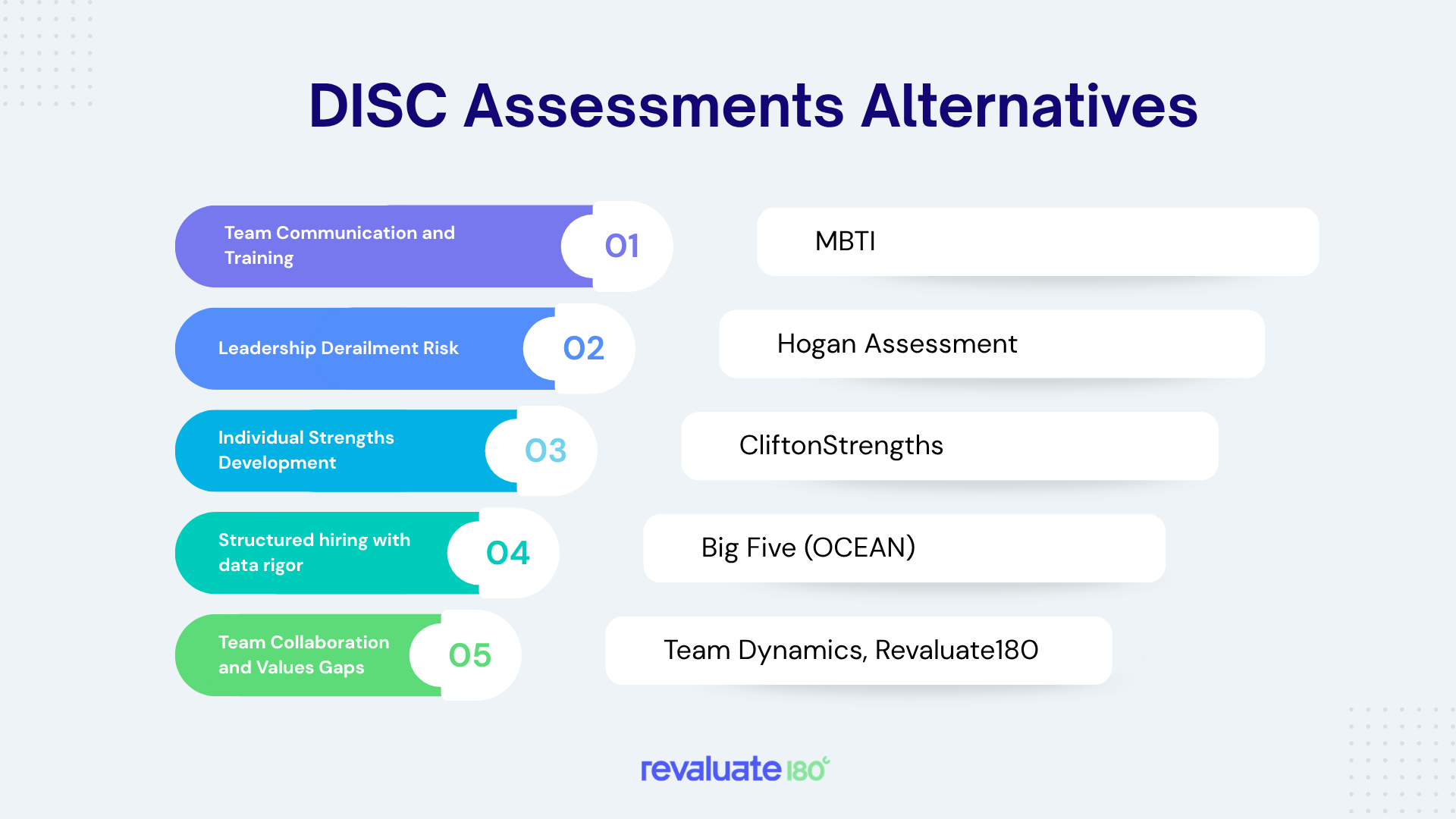
1. Team communication training: Communication involves understanding the key behavioral traits of team members so that leaders can communicate more effectively for better mutual understanding within the group. To improve communication within a team, leaders should consider DISC or MBTI assessments, which provide concise behavioral profiles for each team member.
2. Leadership derailment risk: New leaders are often susceptible to neglecting their additional responsibilities and showing a lack of accountability without recognizing their areas for improvement. The Hogan Assessment helps identify derailment traits and behaviors early on, so leaders can receive timely guidance on managing their "dark side" traits.
3. Individual strengths development: Employees can take self-assessments at any stage of their careers to understand their strengths and find ways to build on them. The CliftonStrengths assessment, developed by Gallup, is widely recommended for identifying employee strengths and allocating work tasks accordingly.
4. Structured hiring with data rigor: The Big Five (OCEAN) assessment stands out for its strong empirical support, backed by extensive scientific research. These data-driven insights are valuable for strategizing at different stages of hiring, making it one of the most reliable personality assessment tools in the hiring pipeline.
5. Team collaboration gaps: For team-related collaboration and communication challenges, TeamDynamics is a worthwhile option to explore. Unlike DISC and its alternatives, which focus solely on individual behavioral traits, TeamDynamics is designed specifically for team dynamics, asking questions about an individual's perception of the team rather than just personal tendencies.
6. Values misalignment, disengagement, hiring, and reducing mis-hires: For organizations looking beyond traditional personality labels, Revaluate180 takes a values-first approach to align individuals with team and organizational values at every stage of the employee lifecycle. From reducing mis-hires to boosting long-term engagement and retention, R180's proprietary model goes deeper than behavioral profiling to uncover what truly drives people at work.
The Real Question Isn’t “Which Assessment?”
Every personality assessment has a definite purpose, which is why HR leaders continue to rely on them. DISC, MBTI, Big Five, and every other assessment remain widely sought after, proving that no single assessment can fulfill all behavioral evaluation needs.
Today's workplaces demand cultural and values-based alignment, which is a crucial factor for higher retention, improved workplace engagement, and reduced turnover. R180's values-based assessments address these alignment gaps by providing a deeper understanding of team dynamics, decision patterns, and workplace behaviors beyond personality style alone.
Feel free to connect with us to learn how our values assessments, merging individual profiles with team values, have helped companies achieve their business goals and improve employee engagement.
Unlock AI-Powered Hiring Analytics
Transform the way you hire with insights that create aligned, collaborative, and high-performing teams.
- Smarter Hiring Decisions
- Reduce Expensive Turnover
- AI-Driven Insights
- Optimize Team Performance