
Employees choose to work in a company not just for compensation packages and other indirect benefits. The company's work culture, team dynamics, and several other factors play a huge role in attracting employees and keeping them loyal to their employers for a long time.
Toxic work environments are direct contributors to low engagement, low morale, and high turnover. A toxic workplace takes a serious mental toll on employees by creating unwanted, stressful situations that leave them completely drained.
Leaders need to understand the common signs and practices of a toxic workplace and recognize that improving the work culture is a collective responsibility of both leaders and employees.
TL;DR
- A toxic work environment is a common cause of employee disengagement, affecting workplace performance and productivity.
- Common signs of a toxic workplace include dealing with a bad leader or manager, having co-workers with negative influences, unclear roles and expectations, favoritism, poor communication, and a lack of motivation at work.
- Fixing a toxic workplace environment involves identifying the root causes of employee frustration and disengagement, followed by strategies to eradicate misunderstandings, conflicts of opinion, and unconscious biases, and to facilitate proper communication.
- Learn how changing a toxic work environment is about more than policies and programs it involves the active effort of accountable leaders and employees of the company.
What is a toxic work environment?
A toxic workplace environment is one where employees feel vulnerable all the time due to a psychological fear of any impending harm from their co-workers, work dynamics, and work policies. Working in such a company directly affects employees' abilities to be at their productive best.
In such environments, employees spend most of their time navigating meaningless conflicts, misunderstandings, and repetitive, unproductive work. Engagement levels are most affected when employees are often at loggerheads, take no accountability, and always look for ways to escape blame and responsibility.
A toxic work environment consistently ranks among the top reasons employees leave a company. That is why companies must prioritize removing toxic elements from their workplaces so that the business is not affected by a few negative factors.
What are the signs of a toxic work environment?
A recent iHire study on toxic workplace trends shows that every 3 out of 4 employees have worked in a toxic environment, highlighting several factors that made them identify the toxicity.
Some of the common reasons employees find a workplace toxic include the following:
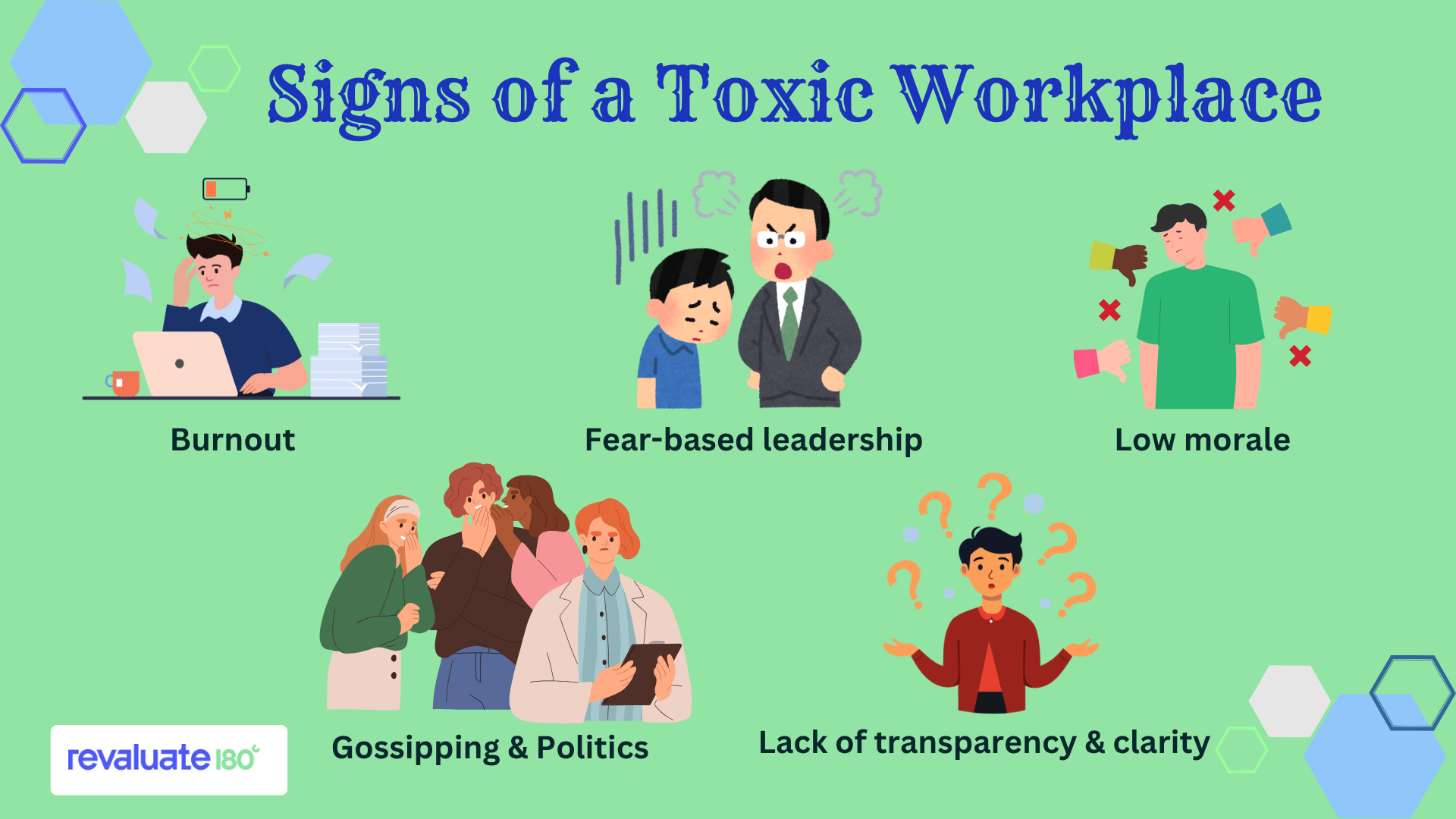
1. Fear-based leadership and lack of psychological safety
Leaders must be the first representatives employees can reach out to with any concerns, queries, or suggestions. However, leaders remain a common reason employees remain voiceless, fearing how they will influence their appraisals and career growth in the company.
This leadership fear at one or more levels is the top contributor to a toxic workplace, where genuine opinions are often brushed under the carpet, leading to growing disengagement and dissatisfaction in the company.
2. High turnover and disengaged employees
When several employees leave en masse in a short period, it is a clear sign that they are not happy working at the company. They begin to develop apprehensions about their future in a place where employees no longer wish to work.
Such apprehensions about a progressive future at the company leave employees feeling disengaged from their current team members and peers. A lack of meaningful workplace relations and diminishing purpose creates a grim workplace environment.
3. Gossip, rumors, and internal politics
Let’s admit it. We have all witnessed or been a part of workplace politics. A case where a team sidelines an employee just because they don’t fit in the team’s “vibe”. Or a baseless rumor affecting an employee’s progress without any clarity, we would have read a lot.
A hostile workplace environment that encourages gossipmongers and ignites politics is a direct barrier to productivity. Employees who value productive work and career growth often detect such toxic signs early, distance themselves from them, or leave the company for better prospects.
4. Lack of transparency from leadership
Company decision-making and communication must always be two-way, i.e., involve discussions and employee input. Leaders who lack clarity in their decisions and disregard concerns create an unhealthy workplace where employees’ voices go unheard.
A lack of accountability among leaders is often a common reason for leaders to be less transparent about their decisions, leading employees to fear how the company will treat them in the future.
5. Poor communication across teams
A lack of clarity about the work to be done, biased opinions, and other confusion arise from poor communication among work teams, clients, and business partners. Bad communication practices often lead to work being redone several times, resulting in wasted time and resources.
Teams that fail to communicate clearly and on time to get the right work requirements and resolve concerns at the earliest often create toxic work dynamics within the team, which propagates throughout the company.
6. Unclear roles and expectations
It is a very common concern employees face in toxic work environments, where the work they actually do is in no way related to what they applied for and got selected for. This role mismatch often leads employees to feel that the company will not provide the opportunities they expected when joining.
Also, having employees work on additional or irrelevant tasks beyond their role may leave them feeling disoriented at work.
7. Micromanagement and lack of trust
Leaders who do not trust their employees and team members who keep checking on their co-workers without giving them the autonomy to complete their assigned tasks are common propagators of a toxic work culture. A lack of autonomy makes employees feel that their team members and leaders do not trust their work abilities.
A lack of trust from their team members makes employees feel they are not suited to work in the company, prompting them to seek better opportunities at the earliest.
8. Burnout and poor work-life balance
Burnout with an overload of tasks is a clear sign of a toxic work environment. Such burnouts occur when team members are not assigned tasks fairly, with one or two key members overburdened with most of the work.
Employees who overwork or are critical resources in a team often have very little time outside work to spend on themselves or with their loved ones, pushing them to a state of mental depression.
9. Favoritism or inconsistent decision-making
Who has not witnessed a leader/manager’s favorite enjoying perks or benefits? Common backgrounds, such as attending the same alma mater, speaking the same language, or other factors, often lead one employee to be favored, consciously or unconsciously.
Such favors often create inconsistencies in how a team makes decisions, leading to a workplace that functions poorly and lacks productivity.
10. Low morale and lack of motivation
When all employees in a company have low morale and remain demotivated most of the time, they will never welcome new joiners or be nice to them. Sometimes, the immediate reaction to new joiners is to ask why they came here in the first place.
An environment filled with demotivated employees who just propagate more negativity and lower others' morale can never qualify as a good workplace.
How to fix a toxic work environment
Workplace dynamics play a crucial role in shaping employees’ engagement and productivity. A toxic work environment can distract employees from worrying about uncertainties and stressful situations.
Here are some ways to clear a toxic workplace and create a safe space for employees to learn and grow.
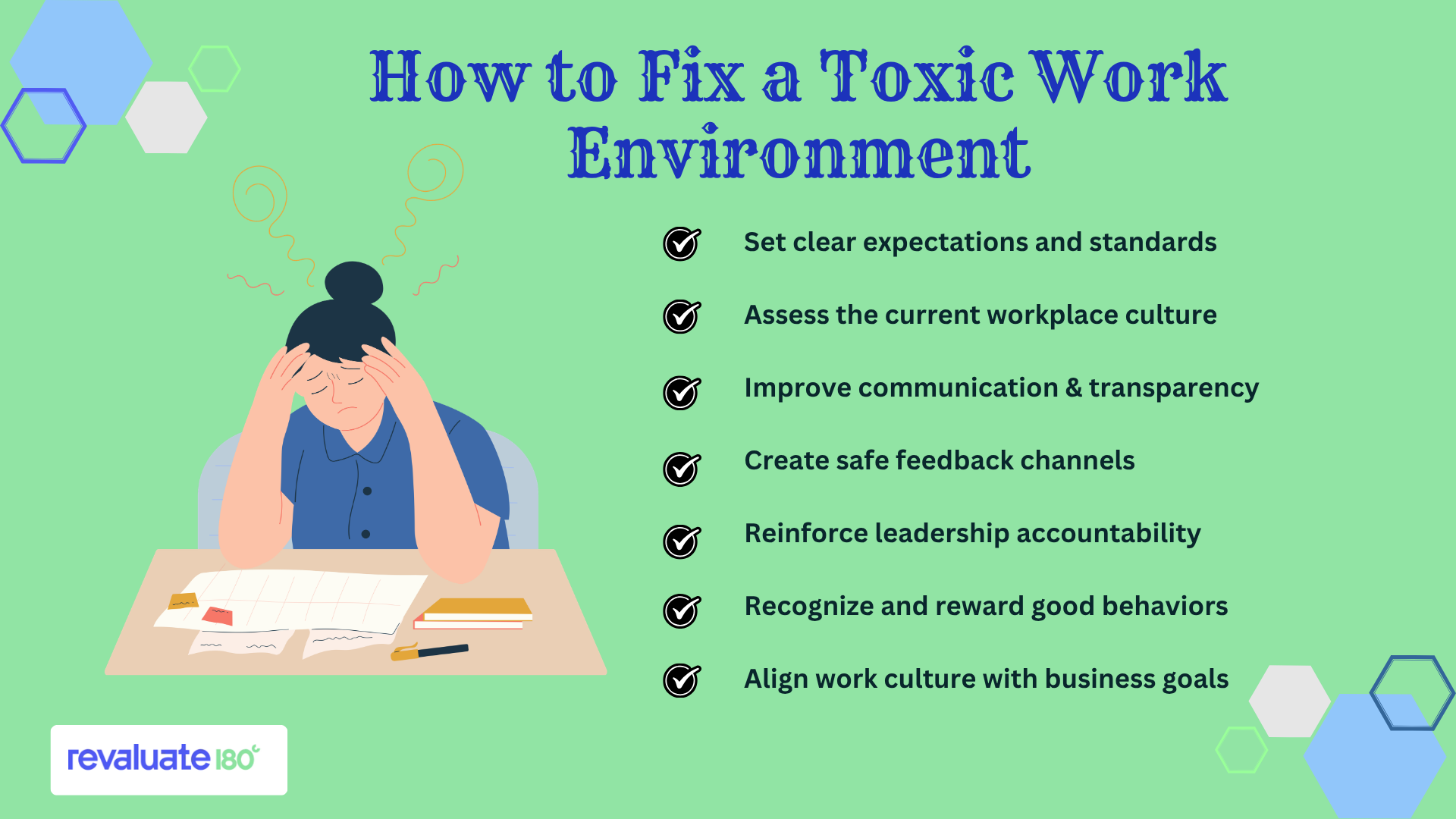
1. Start with an honest assessment of your workplace
Culture assessments help understand engagement levels across teams, groups, and the company as a whole. Engagement surveys, retention surveys, and other feedback surveys help leaders and HR professionals assess how their employees feel about the company and its culture.
2. Address leadership behavior first
Leaders must have a periodic evaluation process in which their reportees provide honest feedback on their leadership style, behavior, accountability, and problem-solving capabilities. This must be followed by management holding leaders accountable for any inappropriate behavior, failures to fulfill their duties, and other issues.
3. Set clear expectations and standards
Job role clarity and clear workplace policies help employees to rightfully distinguish between cultural norms and toxicity. Clear DEI policies and POSH guidelines are among the recent standards set by companies around the world, so that vulnerable opinions cannot be considered casual jibes or comments.
4. Improve communication and transparency
Have a robust internal communications system with a feedback channel so that all company-wide decisions and information reach all employees. Similarly, encourage leaders to have open communication with all team members while making task decisions and discussing ideas for improvement.
5. Create safe feedback channels
Companies must have more than one channel for employees to voice their concerns and opinions, so that even if they don’t feel comfortable approaching their manager or HR partner, they can reach out to other SPOCs or forums in the company. Such reliable channels help improve trust in the company and make employees feel that their concerns are valid.
6. Reinforce accountability across all levels
Accountability is not just a leadership trait. All employees in the company must be held accountable for their actions and opinions, ensuring that none give rise to baseless rumors or gossip. Evidence-based decision-making must be a core policy that all employees must adhere to.
7. Address conflict early and directly
Do not ignore small conflicts that may seem insignificant within the team or group level. Understand the concerns of both parties and have leaders address them promptly without delaying any truces or agreements. Mainly, ensure the mediator remains unbiased and does not unfairly favor any side.
8. Recognize and reward positive behaviors
In addition to rewarding employees for their timely contributions, leaders must encourage recognition for employees who exhibit desirable behaviors, such as motivating others, resolving disputes amicably, showing patience during stressful times, and actively engaging with their team. Such ideal behavior rewards motivate other employees to follow suit, creating a happy workplace where everyone thrives.
9. Support employee workload and wellbeing
Leaders and HR partners must consistently monitor how employees balance their work and personal time. Ideal workloads must ensure a fair distribution of work tasks among all team members and prevent burnout-prone schedules. Leaders must also encourage their members to take PTO and to engage in team activities to improve wellness and recreation.
10. Align culture with business goals
Achieving business goals must not mean employees need to burn out or go to any lengths to achieve the desired results. Ethical work practices must allow employees to be at their best in terms of health and productivity while delivering business results, while also pursuing a healthy life outside the workplace.
Why fixing toxic culture is not only an HR problem
Toxic work environments and efforts to improve them are often treated as HR issues. However, signs of a toxic work environment often stem from:
- Leadership decisions
- Team dynamics
- Communication patterns
- Accountability systems
Therefore, fixing toxic culture requires involvement from leaders at all levels and not just HR policies and programs. Encouraging leaders to take accountability and be responsible for their team's collective wins and losses is crucial to creating a healthy workplace environment.
When employees feel safe communicating with their leaders, and vice versa, it is a clear sign of a progressive workplace where transparency and clarity win over apprehension and uncertainty.
Additionally, team members must identify barriers to free and open communication within and between teams. Clear communication and embracing diverse opinions while learning to disagree respectfully are ideal behaviors to remove toxicity from the workplace.
How values and behaviors shape workplace culture
Toxic workplace environments are not created in a day or by just one or two persons. It builds gradually over time due to a large scope of workplace patterns, such as:
- How leaders communicate with their teams and grassroots employees
- How is the decision-making process
- How employees and leaders enforce accountability
- What behaviors are tolerable and what is not acceptable
Many organizations define values but struggle to ensure they are reflected in daily behavior. Revaluate180 helps leaders assess values alignment and behavioral patterns across teams, making it easier to identify the root causes of toxicity and improve workplace culture.
Since workplace culture is a direct result of behavioral patterns, R180 provides data-driven insights into the behavioral initiatives and practices that best suit individual teams and improve their team dynamics.
Closing thoughts
Toxic work environments are easy to detect thanks to an increasing awareness of the signs to look out for. Upon getting the smallest signs of toxicity, most employees today do not hesitate to switch jobs or companies, even if it means settling for slightly lower pay packages.
Growing employee toxicity is a warning for company leaders and HR managers, and it is important to prioritize aligning your work culture with your business goals.
If your organization is facing cultural challenges, Revaluate180 helps uncover the values, behaviors, and team dynamics shaping your workplace so you can make informed decisions to improve culture and performance.
Connect with us to understand how simple behavioral changes, supported by individual assessments, workshops, and role-plays, can transform your team and help it exceed expectations.

Unlock AI-Powered Hiring Analytics
Transform the way you hire with insights that create aligned, collaborative, and high-performing teams.
- Smarter Hiring Decisions
- Reduce Expensive Turnover
- AI-Driven Insights
- Optimize Team Performance