Team dynamics might not seem like the core issue at first, but it’s the invisible force that defines how every team member communicates, collaborates, and performs in harmony. Their strengths include everything from building long-term trust to managing conflicts and preventing people from disengaging and damaging their reputations, which are built on that trust.
This guide explains the actual meaning and importance of team dynamics and breaks down the key elements of a strategically performing team. We’ll also make sure you catch the early warning signs of dysfunction and provide practical strategies with clear examples, data-driven insights, and an actionable checklist that can be useful not just for leaders but also for managers and HR professionals to build a high-performing team.
TL;DR
- Team dynamics is a psychological mindset that influences how each member interacts with others to strategically leverage skills to improve overall performance.
- Poor dynamics can lead to work delays, while high turnover can leave leaders feeling overwhelmed and cause disengagement that often ends in quiet quitting.
- Understanding how factors like a lack of trust, unresolved conflicts, and role confusion can help recognize these signs early and build confidence in proactively addressing the issues.
- You can improve your strategy by defining custom RACI charts and regular retrospectives to set common goals for everyone. You can use OKRs and KPIs to establish communication norms to build long-term psychological trust. Recognition and fulfillment often help create an overall feedback system that’ll be essential for resolving everyday conflicts and fostering a sense of confidence among all team members.
- Effective teams with defined strategies tend to be more productive, innovative, and engaged with the company's mission.
What Are Team Dynamics?
Team dynamics are the underlying behavioral process that governs how collective work impacts business growth. In simple terms, team dynamics define how team members interact, communicate, and collaborate to resolve conflicts, while their personalities, work styles, and relationships shape their overall performance.
Do not misunderstand team dynamics with group dynamics since a group can be any collection of individuals, but a team is a strategic choice made to achieve a shared goal. In a group, people work in parallel, while a team depends on each other to become a cohesive, high-performing unit.
What is the Importance of Team Dynamics
Team dynamics are crucial to business outcomes since teams working together matter more than the raw talent of individuals. High-performing organizations have discovered that even with top talent in the house, mediocre dynamics can stagnate the growth potential and stall productivity.
On the bright side, think of a team like a beehive building a honeycomb. Working together and fostering the right dynamics can bridge the gap between individual talent and greater results.
Here’s what makes team dynamics so crucial to the company:
1. Impact on productivity and performance: Teams with clear roles and communication make informed decisions faster and minimize friction caused by wasted effort. For instance, Gallup found that teams that focus on their strengths every day are significantly more productive than those that don’t. Simply learning and integrating one’s strengths boosts individual productivity by about 7.8%.
Teams that communicate well and leverage each person’s strengths tend to make fewer mistakes and have more room for innovation because of diverse perspectives.
2. Influence on communication and collaboration: Team dynamics set the tone for how information flows when shared proactively. Members ask questions, raise concerns, and keep each other updated. Team members listen actively and seek to understand one another to appreciate different perspectives. Collaboration happens seamlessly when people ask for help, share credit, and smooth out handoffs.
Effective communication norms, such as deciding when to chat, email, or meet, are key to healthy team dynamics. Multiple sources singled out open and honest communication as a core factor of strong decisions.
3. Role in employee engagement and retention: When people feel their contributions are valued and they trust their colleagues and leaders, they are far more engaged. Engaged teams also tend to have higher discretionary effort, better morale, and lower absenteeism. Teams with positive dynamics retain more people compared to those that don’t.
A supportive team environment also sustains learning and growth as employees are more likely to learn from mistakes and innovate when they feel safe. Do you want to know how team dynamics are affecting your retention rate? Use our free retention rate calculator to use the right strategies.
4. Effect on decision-making and problem-solving: Healthy teams encourage each member to share their own ideas so decisions are considered from multiple perspectives. If some voices dominate or others stay silent, the team misses valuable insights. For instance, if the team relies on one personality type, it can impede progress. When well-balanced, collective decisions lead to better outcomes.
Teams that handle conflict well make smarter and stronger decisions. Teams with psychological safety share knowledge freely and engage in constructive conflict, thereby enhancing decision-making and problem-solving.
What are the Key Elements of Effective Team Dynamics
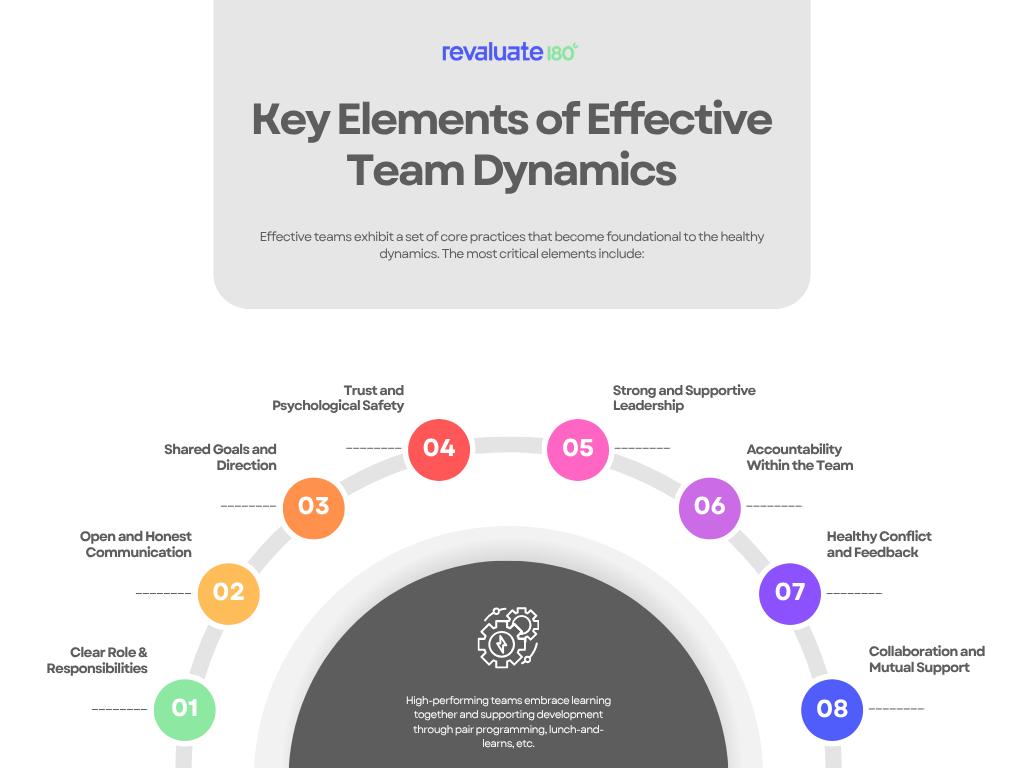
Effective teams exhibit a set of core practices that become foundational to the healthy dynamics. The most critical elements include:
1. Clear roles and responsibilities
Each person must be aware of their responsibilities and how their role contributes to the company’s mission. Ambitious roles lead to duplication or gaps. Tools such as a RACI (Responsible, Accountable, Consulted, Informed) matrix are often used to record who owns specific tasks and decisions.
You know roles are clear when team members take ownership of their work, everyone knows who to reach out to when issues arise, and, most importantly, people can focus confidently on their tasks. Shared goals lead to higher engagement and clarity, starting with understanding who does what.
2. Open and honest communication
Relevant updates, data, and feedback flow across the team, keeping the information freely flowing. Members listen to understand, not just listen. Studies on communication styles note that teams that build shared language, such as using personality or strength assessments, have fewer misunderstandings.
Teams confirm that they have the same understanding of plans, and quality standards must become a workplace norm to avoid confusion or loss of messages.
3. Shared goals and direction
Effective teams rally around shared goals and clear direction. Each member understands the team’s core objective and how success is measured, and how their individual work connects to the bigger picture. They know why they are doing what they’re doing, so it consistently provides the required motivation and focus.
Frameworks like OKRs (Objectives and Key Results) or project charters can formalize these unified goals. Leaders must ensure these goals are communicated and visible so the team can continually revisit and refine them, maintaining alignment even when circumstances change.
4. Trust and psychological safety
Trust is the most crucial part of business, since it is the foundation for everything else. Psychological safety is a byproduct of trust where people feel safe to take interpersonal risks like asking questions, voicing concerns, and admitting mistakes without fear of embarrassment or retaliation.
Research highlights that psychological safety is strongly linked to better team performance overall. You achieve this dynamic by acting on commitments, giving credit more often, treating errors as learning opportunities, and having strong leaders who are empathetic, supportive, and willing to be vulnerable.
5. Strong and supportive leadership
Leaders shape how teams work together. Effective leaders set the tone to create a transparent environment where managers can share information without any fear. They facilitate rather than micromanage, as a participative leadership style empowers team members.
Leaders should coach to strengths, set clear expectations, and foster accountability in every situation. When conflict or confusion arises, effective leaders steer the conversation constructively rather than avoiding it. They build team capabilities through feedback and development, with frequent conversations and recognition.
6. Accountability within the team
Shared accountability means each member takes ownership of their commitments and holds others constructively accountable. Agree on how progress will be tracked through KPIs, scrum boards, or team OKRs, and review them regularly.
Encourage teams to check in on each other; for instance, if one team member doesn’t post daily updates, anyone can ping them with a supportive reminder. When something slips, focus on solutions instead of finger-pointing. Teams with good dynamics acknowledge and correct mistakes as a group.
7. Healthy conflict and feedback
Constructive conflict is a sign of a healthy team dynamic. Invite dissenting opinions in brainstorming sessions, and make sure the internal conflict is about ideas, not people. Occasionally, a third party or peer facilitator can help keep tough conversations productive.
Feedback should stay continuous and specific. Regular retrospectives, one-on-ones, or regular feedback sessions let issues be fixed early. If something goes wrong, teams can discuss how to improve collectively rather than just make mistakes. This mindset resolves most conflicts and builds strong resilience.
8. Collaboration and mutual support
Effective teams must go beyond just doing their own tasks. They must help each other succeed by willingly sharing skills, templates, and contacts. A sense of camaraderie motivates people to converse for each other when needed. Teams with strong dynamics celebrate milestones collectively by reinforcing unity.
While recognition can be formal and effective, informal gestures like gratitude notes also go a long way. High-performing teams embrace learning together and supporting development through pair programming, lunch-and-learns, and more.
What are the Signs of Poor Team Dynamics?
Dysfunctional dynamics often creep in subtly, but they can easily derail performance if ignored. Some red flags include:
- Siloed information: Team members don’t share updates and key decisions, and knowledge stays within subgroups.
- Frequent misunderstandings: The same issues keep recurring, and people nod in the argument in meetings, but then try to cover up.
- Role confusion: Workers don’t know their responsibilities, and the tasks slip through cracks.
- Low meeting participation: Meetings have only one or two voices throughout, while the rest remain silent. Little debate occurs, or people email in questions instead of speaking up.
- Lack of trust: Colleagues hesitate to admit mistakes and don’t follow through on commitments. Team members fear the authority, so they may speak behind others’ backs rather than addressing issues openly.
- Dominating personalities: A few individuals dominate decision-making, while others are sidelined. This is when ideas of quieter, more introverted members never surface.
- Avoidance of conflict: Disagreements are swept under the rug, and problematic behaviors are tolerated until resentments seep into their work.
- Missed deadlines and inconsistency: Commitments frequently slip with no accountability at all. Workers come up with excuses instead of resolving the conflict.
- Negative outlook and cynicism: Team communications feel tense or sarcastic. People may complain about each other to outsiders, creating a negative outlook.
- High turnover and absence: Team members start leaving for other opportunities, with many unexplained absences.
How to Improve Team Dynamics
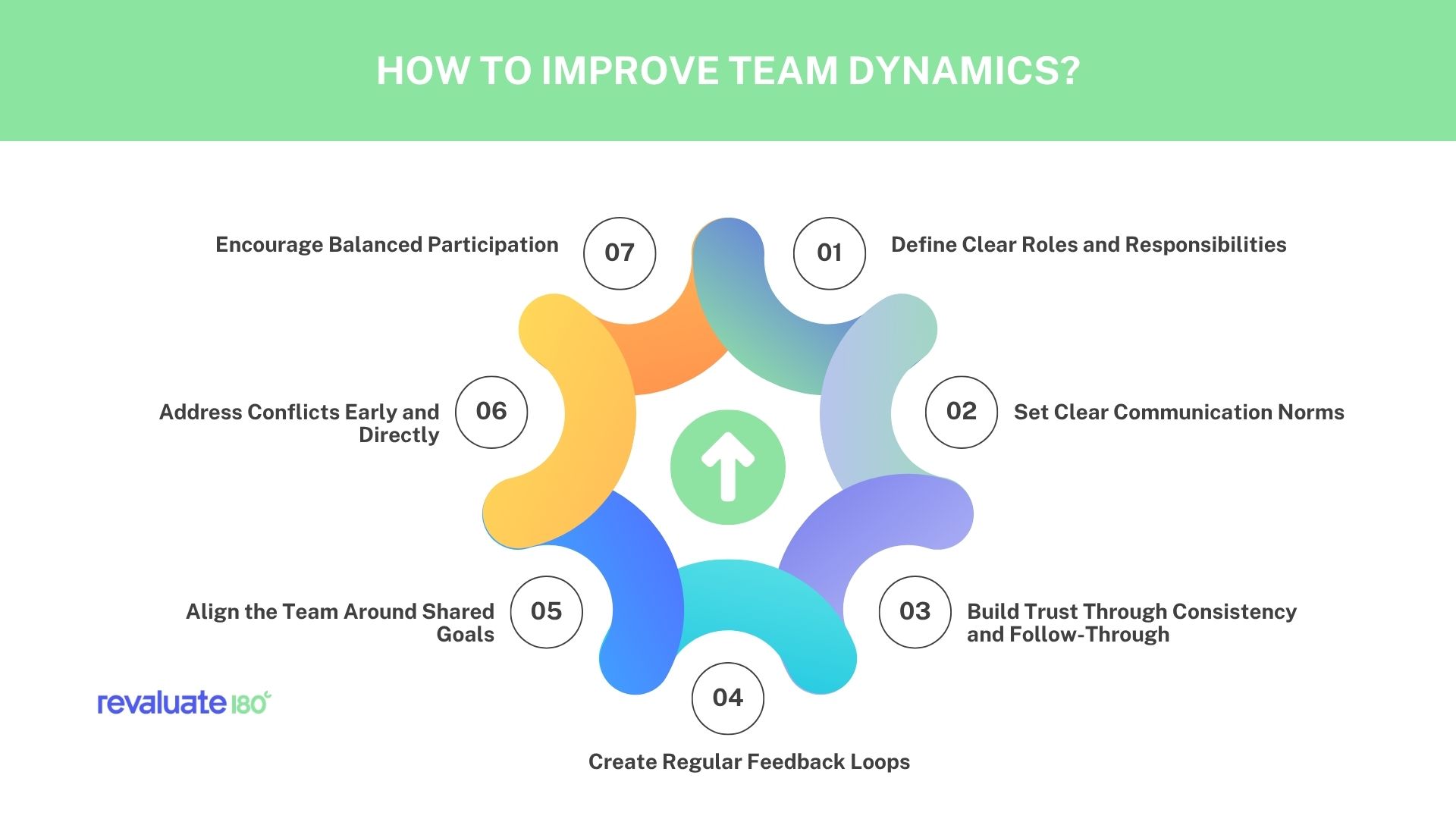
Improving team dynamics is a continuous process and not a one-off fix. Let’s look into practical steps teams can take:
1. Define clear roles and responsibilities
Explicitly document who is RACI (Responsible, Accountable, Consulted, and Informed) for each major task or deliverable. If something falls through the cracks, revisit and assign ownership. Wherever possible, assign roles to people whose skills match your goals.
And most importantly, don’t assume teammates know each other’s roles. Conduct team kickoff or onboarding sessions in which each person explains their role and responsibilities.
2. Set clear communication norms
Decide how the team communicates. Use agendas and time limits for in-office teams, and encourage the use of cameras to maintain remote team engagement. Maintain a shared space where key decisions, project plans, and updates are stored so people can refer to them. Encourage team members to paraphrase important points and ask questions to confirm understanding.
3. Build trust through consistency and follow-through
If you say you’ll do something by the said date, do it or renegotiate early. Consistency builds credibility and long-term trust. Regularly give positive feedback and constructive feedback because, over time, this signals the team as honest and supportive.
Admit when you don’t have all the answers. Solicit input openly through humility. Leaders and teammates alike should set small, achievable expectations and meet them. It’s better to under-promise and over-deliver rather than the opposite.
4. Create regular feedback loops
Periodically hold a reflection meeting to discuss what’s working well and what isn’t. What should be improved and documented so we can revisit them? Encourage managers to have regular one-on-ones with each team member. This can surface individual concerns that might not come up in the group.
Use tools like Slack reactions, quick polls, or pulse checks at the end of meetings to gauge how they feel about today. If some topics are sensitive, allow anonymous suggestions through surveys and a feedback box.
5. Align the team around shared goals
Establish common objectives to ensure everyone knows the team’s top priority through OKRs, KPIs, or a project charter. Use a dashboard or scoreboard to show progress toward goals. This will ensure everyone is focused on the unified mission.
Whenever you assign work, explain how it contributes to a larger goal. This context motivates people to maintain productivity and enthusiasm. When circumstances shift, realign quickly so the team isn’t working at cross purposes.
6. Address conflicts early and directly
Don’t ignore tensions. If you notice any conflicts, make sure to surface them as part of the challenges. Frame conflicts around work facts, not personal shortcomings. Use ground rules for difficult discussions. If you need to bring in an impartial facilitator for particularly heated issues, do it!
Sometimes teams benefit from a conflict-resolution process like a checklist:
- Describe the issue.
- Each person states their perspective.
- Identify the common ground.
- Agree on a solution or the next essential step.
7. Encourage balanced participation across the team
Invite everyone to meetings with round-robin check-ins so quieter members get space. Let different team members run retrospectives or stand-ups. This builds engagement and leadership skills. Some people contribute better in writing. Allow multiple input formats, such as post-meeting notes or shared documents.
If someone stayed quiet, ask them privately if they have thoughts. Sometimes people need encouragement. When forming teams, make sure to mix personalities and expertise so no one person thinks alike. Find the right balance and bring new ideas to the table.
How Team Dynamics Impact Team Performance
The correlation between team dynamics and performance outcomes is dramatic. Here’s where strong dynamics lead to:
- Higher productivity: Teams that trust each other and leverage each member’s strengths overcome more challenges.
- Greater innovation: When people don’t hesitate to share ideas and challenge others, more creative solutions emerge.
- Higher engagement: As noted, engaged teams are more likely to be emotionally connected to the cause, with higher motivation and purpose that drive performance across all metrics.
- Lower turnover: Talented team members stay longer when the environment is positive and supportive.
- Better decision-making: With healthy debate and collective input, decisions are more robust.
- Scalability and resilience: Good team dynamics mean new members can be onboarded with a seamless experience, so the team can handle pressure without falling apart.
What Teams Often Overlook About Team Dynamics
Many teams assume that structure solves everything. But two teams with the same structure and resources can perform very differently because of how the people interact in the situation. Here are some blind spots:
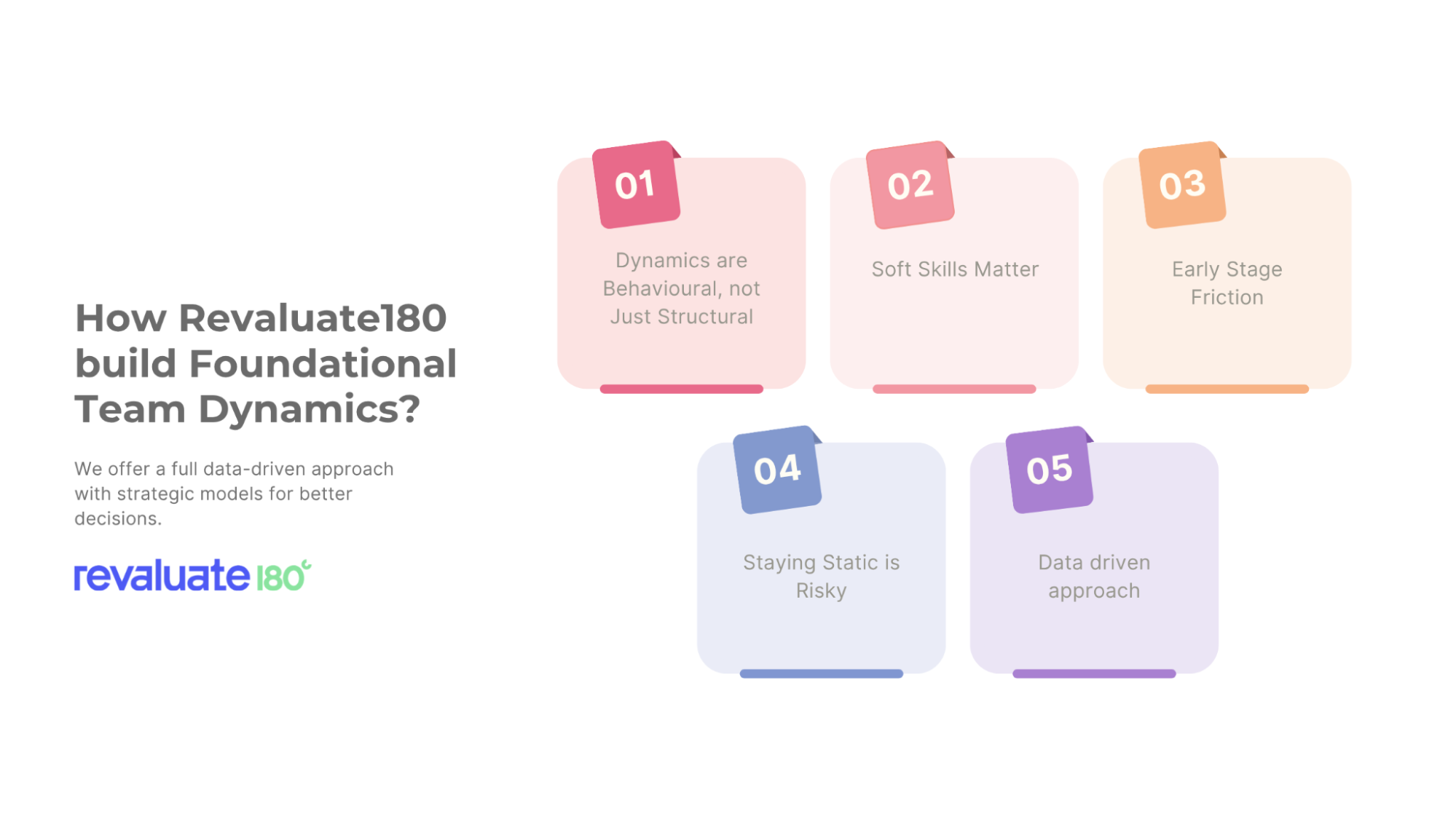
Dynamics are behavioral, not just structural
A well-organized team can still falter if people aren’t communicating effectively or trusting one another. It’s the human pattern that counts. For instance, both teams may have daily stand-ups, but if one team plays the blame game while the other is collaborative, the outcome depends on those circumstances.
Soft skills matter
Teams often focus on technical skills and roles but neglect soft aspects like empathy, listening, and adaptability when required. These are the most essential skills, as they show that unity is the greatest strength when working together.
Early-stage friction
Research indicates that many team failures occur early on. Teams often rush into work without establishing what is normalized among the members, so they struggle later. Invest time in forming the team on a core mission and normalize taking risks, asking questions, and standing up for each other so it pays off collectively.
Staying static is risky
Team dynamics are versatile. People change with new hires, promotions, departures, and so do projects. Teams should routinely recalibrate, as small issues keep accumulating if they never reflect on how they work. Emphasizing individual targets can also undermine team cohesion. Overlapping or conflicting objectives breed competition rather than collaboration at all times.
Teams sometimes confuse harmony with health. It happens if no one speaks up, so leaders may think everything is fine. But this is more often due to teams going silent and disengaging from work. Toxic positivity also overlooks real issues. Teams must deal with such conflicts because avoiding them can cause even more damage.
How Revaluate180 Can Build Foundational Team Dynamics
Modern solutions provided by our experts recognize that subtle patterns underlie the core versatility of teams. Two teams with identical goals might differ drastically because of how they communicate, their decision-making styles, feedback loops, and more.
Here at Revaluate180, we use data-driven insights to uncover these patterns by identifying and qualifying invisible aspects through value- and behavior-based assessments. We identify biases or voices that are consistently muted so leaders can get actionable insights into what’s helping or hurting their team dynamics.
Conclusion
Team dynamics are the behavioral forces that shape interactions from communication style and trust to conflict handling and leadership influence. It directly impacts productivity, performance, and retention and governs the engagement metrics.
The key elements of team dynamics include clear goals, open communication, trust, strong leadership, mutual accountability, healthy conflict, and strong collaboration. You can use practical tools like RACI charts, setting communication norms, building trust through consistency, regular feedback loops, balanced participation, documenting the resolution process, and making it foundational.
By being intentional in every phase of growth, managers and teams can bridge the gap between talent and outcomes, ensuring team performance will keep flowing.
Unlock AI-Powered Hiring Analytics
Transform the way you hire with insights that create aligned, collaborative, and high-performing teams.
- Smarter Hiring Decisions
- Reduce Expensive Turnover
- AI-Driven Insights
- Optimize Team Performance