Companies can tolerate temporary losses in profits, but are never ready for sudden, sharp spikes in employee turnover. Employees leaving the company, despite receiving attractive pay packages and benefits, can be a significant blow, given the recurring costs of hiring and onboarding.
The youngest members of today’s workforce are increasingly becoming retention outliers, with more millennials and Gen Zs seeking meaningful work and opportunities to learn and develop themselves.
So, where exactly do companies face challenges in retaining their workforce? In this guide, we’ll learn about the key employee retention challenges and how companies can implement proactive measures to prevent sudden turnover that can affect their business.
TL;DR
- Employees leave a company when they feel that the company no longer addresses their genuine concerns and requirements.
- Common retention challenges include inadequate compensation, limited opportunities for learning and development, work-related burnout, and a toxic work culture.
- Failing to develop adequate retention initiatives can result in recurring, compounding costs of hiring, onboarding, training, and severance.
- In this guide, we explore some of the latest strategies that help companies retain their workforce and improve productivity.
Why is Employee Retention Important?
For a company to function smoothly and achieve its goals, it is important to have a skilled workforce that is aligned with the company’s goals and policies. Failing to have a consistent workforce that knows exactly how to achieve the desired results can hamper the long-term development of the company.
Following the COVID-19 pandemic, employee retention has become a significant challenge for companies worldwide. A Gartner survey reveals that only 29% of IT employees intend to stay with their current employer.
This effect has mainly been due to the need for employees’ flexibility during the pandemic to care for family and friends. This need is now a mandatory requirement for many seeking employment. A lack of human-centric policies and benefits is now fuelling resignations worldwide.
As a backup plan, most employees have more than one job offer when they decide to join a company, and leave it as soon as possible if they do not like their initial experience there. For companies, this can lead to wasted time and resources spent on hiring and training employees, as well as a gradual decline in growth and productivity.
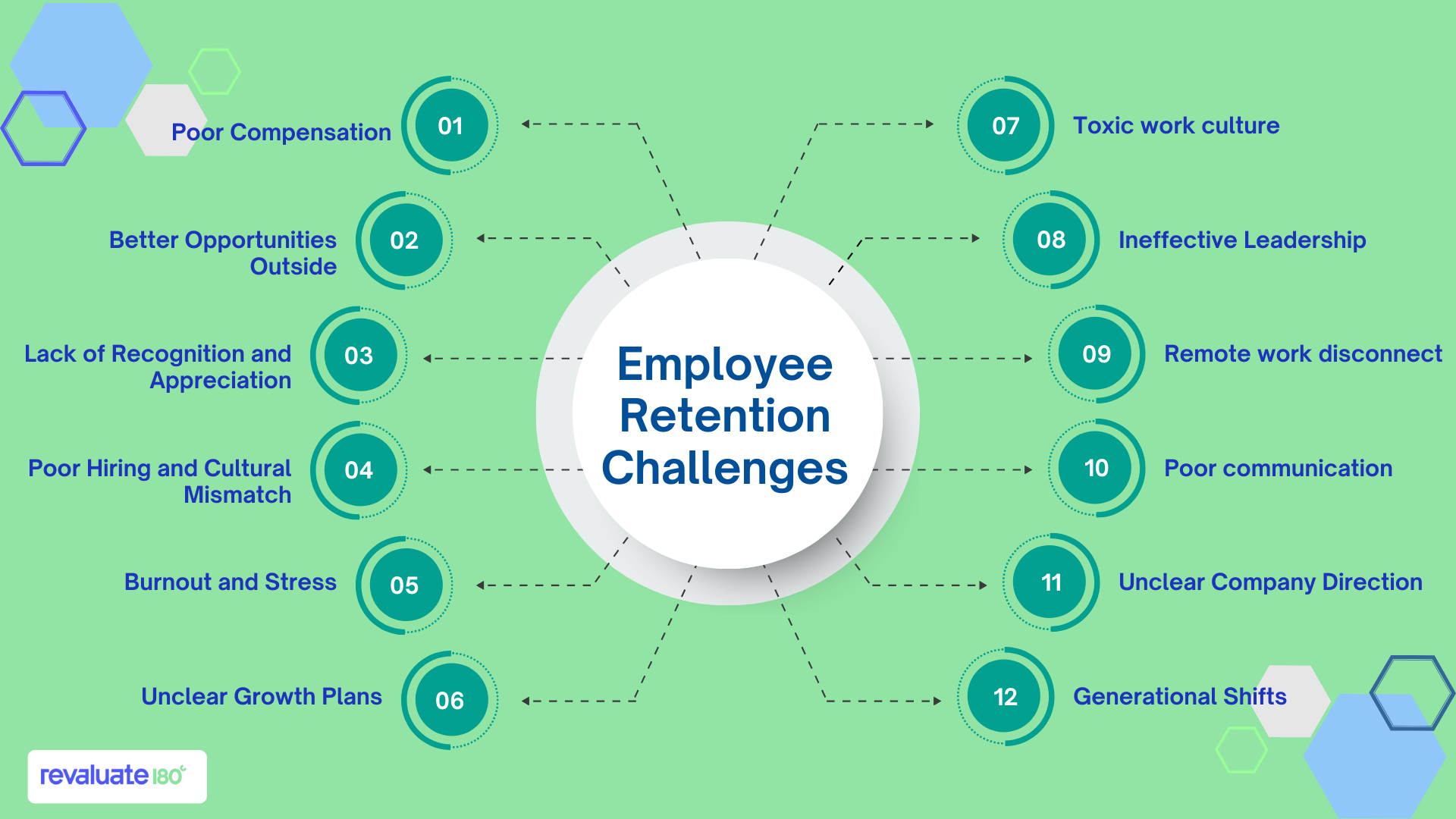
12 Employee Retention Challenges Companies Face Today
Some reasons are classic and everlasting, while others are relatively newer, emerging from new entrants in the workforce. Let’s examine the top reasons that make employee retention troublesome for companies.
1. Compensation dissatisfaction in a competitive market
Even if companies provide pay packages in accordance with industry standards, several indirect benefits and employee-centric perks can be a deciding factor for an employee to remain in a company or leave for better offers. For instance, a company providing a premium health insurance plan for free would be a natural choice over one that doesn’t.
In today’s competitive job market, companies are finding it challenging to offer satisfactory benefits and pay packages that lure the best talent and retain them. Furthermore, dissatisfaction during yearly appraisals and corresponding salary increases is another factor contributing to the poor retention of experienced employees.
2. Better opportunities and aggressive poaching from competitors
Several companies offer attractive referral perks, encouraging their employees to bring in peers from other companies. Employees often engage with their peers and end up comparing what each other receives from their respective companies.
Such engagement often leads one to feel that the other company provides better services, luring them to ask for a peer referral and join the other company. Many companies engage in such aggressive poaching activities online and offline through peer engagement, which can be detrimental to other companies that are doing their best for their employees.
3. Lack of recognition and appreciation
A few words of appreciation or a small token of reward can boost employees’ morale multifold, especially when it comes from the right person at the right time. This recognition is valued more than a paycheck, as it showcases an employee’s technical prowess to the entire team, group, or company.
Companies that do not encourage their teams to have regular appreciation sessions often find their employees longing for an opportunity where they will be valued and appreciated. A long wait for such opportunities often results in them leaving for a better place with a robust rewards and recognition culture.
4. Poor hiring and cultural mismatch
Recruiting employees with a different role description and landing them in jobs that do not match candidate expectations can be a strong reason for growing dissatisfaction, and ultimately, turnover. Not hiring the right employees for the right job often confuses the moment an employee onboards to a new team.
Such problems often occur when teams fail to clearly communicate their requirements to the hiring department. Additionally, team members often do not participate in hiring rounds to assess whether a candidate would be a good fit for their team’s culture and work dynamics.
5. Burnout, stress, and employee well-being issues
Failing to manage the assigned workload effectively or the inability of team leaders to distribute work fairly among all team members often results in employees feeling burned out. A new study shows that 66% of employees are experiencing some kind of burnout at work.
The Return to Office (RTO) drive, encouraging employees to reduce their days of working from home, has brought back work-related stress and other issues related to employee well-being. This factor has, in turn, encouraged a set of resignations where employees switch to companies offering more flexibility and remote working options.
6. Limited career development or unclear growth plans
One of the most frequently cited reasons for low retention in companies in recent times is the lack of opportunities to learn and grow within a job role. As we discussed at the beginning of this guide, retention outliers primarily exist because they do not find their jobs to be meaningful and sustainable.
Employees often feel dissatisfied when they remain stagnant in a job role for an extended period and do not find the right direction for advancement within the company. A lack of proper career guidance and support from managers and leaders is the primary reason employees feel uncertain about continuing to work at the company.
7. Toxic or misaligned work culture
The workplace environment plays a significant role in determining employees' longevity within a company. Failing to prioritize the safety and wellness of employees, overlooking their emotional needs and dependencies, fostering biases among team members, and lacking transparent communication practices all contribute to increasing disengagement among employees.
Such poor workplace practices often lead to prolonged periods of employee absenteeism, which can ultimately result in resignation. Furthermore, a lack of belonging or inclusivity in a team due to diverse backgrounds also makes employees feel unheard or left out, fueling their decision to move to a different workplace.
8. Weak or ineffective leadership and management
A Gallup study shows that 42% of employees felt that their managers and leaders did very little to retain them in the company when they shared their decision to leave. This alarming number highlights the potential of leaders to prevent avoidable turnovers.
Leaders and HR business partners must be available for their reportees to reach out to them for any concerns. Failing to provide solutions within a given timeline and not having transparent communication and feedback sessions often becomes the cause for quiet quitting and turnover.
9. Hybrid and remote work disconnect
Collaborating with team members directly regularly often helps improve employee productivity, as work gets done faster and concerns are resolved more easily. Working in a hybrid setup would mean fewer connections with workmates, often leading to employees feeling disconnected from their actual workspace.
Additionally, employees working remotely often lack opportunities to meet their team members in person and engage with them in non-work or recreational activities. A lack of such engagement opportunities often makes them feel disconnected from their team, leading them to seek a place where they can connect more effectively.
10. Lack of communication and transparency
Employees contribute to a company in the hope of knowing their work makes a difference. When companies fail to share timely updates on their business performance, recognize contributors, ignore employee feedback, and make hasty and baseless decisions, it can make employees feel anxious about their future there.
Miscommunication occurs when there is a lack of strong internal communication networks between company leaders, management, and employees. When leaders make decisions without consulting employees or receiving their feedback, employees lose trust in the company.
11. Resistance to change or unclear organizational direction
Employees expect companies to communicate with them during times of industry crises, pandemic situations, and similar events to understand how the company is prepared to face challenges in the near future. A failure to share a clear plan of action from time to time, particularly during emergencies, makes employees feel anxious and uncertain about how the company will treat them.
For instance, companies that failed to adopt flexible working and full-remote work initiatives during the COVID-19 pandemic experienced significant turnover, as many employees prioritized being near their loved ones over reporting to work. In contrast, companies that embrace changes in line with trends tend to have higher retention rates than those that don't.
12. Generational shifts and evolving workplace expectations
A significant challenge to retention is when companies experience high variance in expectations across different employee age groups. For instance, Gen X employees often find purpose as they ascend the corporate ladder, whereas Gen Z shows the least interest in reaching leadership positions.
Millennials and Gen Z employees are increasingly showing interest in companies that offer wellness initiatives and purposeful job roles. They are becoming more conscious in avoiding burnout situations, which sometimes leads them to be at loggerheads with their leaders.
What Are the Costs of Employee Turnover?
Replacing a departing employee costs almost twice the employee’s pay package, and the cost increases more when experienced employees and team leaders decide to leave.
Here are the areas where employers see recurring costs when their recruits leave before providing any significant contributions:
1. Recruiting and hiring expenses
The costs incurred on the recruitment pipeline, from partnering with recruitment agencies to establishing a specialized team to handle application shortlisting, filtering, interviewing, and evaluation, can seem never-ending if done frequently for the same job vacancies.
2. Productivity loss and disruption
A constantly vacant job role or a role with frequent employee turnover would mean that the respective team remains less productive. This is because most of the time and effort go into training and transferring knowledge to recruits, only to see them leave and get replaced, repeating the cycle again.
3. Drop in team morale
Seeing employees being replaced frequently can lower the overall engagement level in a team, as they may find the process of welcoming and engaging with a new member to be futile. This pattern can also motivate loyal team members to consider leaving for better opportunities.
4. Knowledge drain and slower operations
Poor retention and continuous employee turnover make the overall job of the HR team monotonous and draining. Onboarding sessions, company-level induction programs, and feedback collection, when done repetitively, lead to an overall knowledge drain, distracting the company from its business goals.
Solutions to Overcome These Employee Retention Challenges
Turnover can get out of control when a company experiences it significantly. However, with proper proactive monitoring of employee satisfaction levels and sufficient retention initiatives, you can avoid such situations from reappearing.
Let’s examine some doable solutions to combat employee retention challenges.
1. Build a competitive compensation and benefits package
Several retention platforms help determine the best package and benefits plan for different job roles within your organization, after thoroughly analyzing the data prevalent in your industry. Such data-backed insights can help companies offer employee-friendly benefits plans that are highly relevant to current job trends and employee expectations.
2. Improve onboarding and role clarity
Ensure employees resolve all their concerns and queries related to their job roles and requirements within the first few days of joining. Onboarding surveys conducted at various stages of an employee’s induction into the company can help organizations collect accurate feedback and develop the most effective support to ensure their long-term retention within the company.
3. Implement ongoing recognition programs
Have a dedicated section in your company’s intranet portal or a separate thread encouraging peer recognition. Several HRIS platforms and retention software have a specialised rewards and recognition portal where managers and leaders can instantly reward employees with points, coupons, cash, or vouchers.
4. Provide structured learning and career paths
Provide access to sufficient e-learning portals and in-office training that employees can utilize whenever they have time away from their work tasks. Managers must act as coaches to help their teams work more effectively, while also supporting individuals in their career and personal growth. Adequate one-on-one sessions with managers and HR business partners can help employees share their career aspirations and the support they expect from the company in meeting their goals.
5. Strengthen Leadership Development
Strong and agile leaders can help change the minds of employees who are considering leaving the company. Train your leaders regularly to ensure they are well aware of current retention challenges and how to handle employees across generations. Encourage top C-suite leaders to engage more often with all levels of employees to understand their concerns at the grassroots level.
6. Offer flexible work options
Flexible working hours are no longer optional, especially during times when families require both partners to work and take turns to manage childcare and household responsibilities. Ensure you have strict policies on the minimum required core working hours. Productivity must not be valued solely by the number of hours worked, but must also consider the effort and skills that employees put into their work during their working hours.
7. Create Continuous Feedback Loops
Conduct periodic engagement surveys, retention surveys, and pulse surveys to continuously monitor employee concerns and collect data for deeper analysis and insights. Frequent one-on-one sessions and check-ins by managers and HR partners can help easily detect if an employee shows signs of dissatisfaction and disengagement at work.
8. Promote a healthy workplace culture
The evergreen solution to achieve maximum employee retention is to build a workplace where employees feel valued and are treated as the most critical assets. Employees and companies must learn to work together to fulfil the company’s business goals while also supporting individual professional journeys. Employee-centric policies and initiatives that align with current trends and needs can help improve retention rates in a short period.
How Revaluate180 Can Help Predict and Solve Retention Challenges
Understanding turnover patterns, identifying their causes, and implementing the right retention strategies can be challenging for HR leaders and organizations. With data-driven insights and expert guidance, companies can learn from past turnover trends and retain their best talent more effectively.
Revaluate180 is a data-driven consulting service that uses advanced analytics to identify early signs of disengagement through feedback surveys and other employee data sources. Our AI-powered models predict turnover risk by analyzing current workforce trends and comparing them with historical patterns.
Through our retention programs, we create tailored talent development pathways that help employees advance in their careers while making meaningful contributions to organizational goals. We also coach leaders and provide actionable insights into team dynamics and engagement.
Our curated workshops and training sessions strengthen retention by applying behavioral intelligence and employee lifecycle analytics.
If you’re facing employee retention challenges, Revaluate180 can help you transform data into action and build a stronger, more committed workforce.

Unlock AI-Powered Hiring Analytics
Transform the way you hire with insights that create aligned, collaborative, and high-performing teams.
- Smarter Hiring Decisions
- Reduce Expensive Turnover
- AI-Driven Insights
- Optimize Team Performance