Employee retention and employee turnover may sound like two sides of the same coin, but they measure different aspects of the same space, revealing distinct problems and helping to inform decisions based on their outcomes.
For HR teams and business managers, this is the best way to understand the difference in diagnosing workforce ability, predicting potential risks, and taking action to avoid them.
This guide breaks down both metrics in simple terms, shows how you can calculate them yourself, and explains how to utilize these metrics to build a strong and resilient workforce.
TL;DR
- While retention measures the number of employees who stay, turnover represents the number of employees who leave. They’re related terms but not simply inverses.
- Both are equally crucial for business health as high retention and lower turnover correlate with better productivity, profitability, and customer loyalty.
- Track both metrics to identify turnover trends and spot immediate issues, such as a sudden spike in a specific department, while using retention to gauge overall stability.
What is Employee Retention?
In simple terms, employee retention refers to the effectiveness of an organization in retaining its employees over a specific period. A higher retention rate means your people stay, grow, and remain engaged, and continue to develop. A low retention rate signals dissatisfaction, poor management and leadership, limited growth opportunities, and cultural misalignment.
What does retention tell you about an organization?
Here’s what you can find using the right retention metrics:
- Whether your employees feel valued and supported.
- How effective your leadership and culture are.
- Whether their career development and compensation meet their expectations.
Retention is one of the clearest indicators of an organization's overall performance. It doesn’t just rely on who stayed but tells whether employees want to build their future with you.
Why retention matters to business outcomes?
A strong retention rate means:
- Lower hiring costs
- Higher productivity and performance
- Better customer support and experience
- Stronger company culture and collaboration
Research from Gallup shows that replacing an employee costs up to twice their salary, and that’s just one aspect taken into consideration. This is why retention is becoming one of the most financially impactful priorities.
What is Employee Turnover?
Unlike retention, employee turnover measures the number of employees who leave during a specific period. Turnover highlights the potential loss that has occurred (voluntary and/or involuntary). A high turnover rate signals issues regarding your employee lifecycle.
What does turnover reveal about your organization?
Unlike retention, it exposes:
- Unhealthy manager-employee relationships
- Poor hiring decisions
- Compensation gaps
- Toxic culture pockets
- Burnout and workload imbalances
- Involuntary separations through performance issues or restructuring
Turnover is a reactive signal that employees have already left. When analyzed correctly, it becomes a predictive factor to save future talent.
Types of Turnover
There are essentially two types of turnover metrics:
- Voluntary Turnover: Employees choose to leave their positions through resignation, acceptance of better offers, or personal reasons.
- Involuntary Turnover: The employer initiates separation through performance issues, layoffs, restructuring, or other reasons.
Tracking both metrics will help distinguish between the two and diagnose the root causes more precisely.
Employee Retention vs Turnover: Key Differences Explained
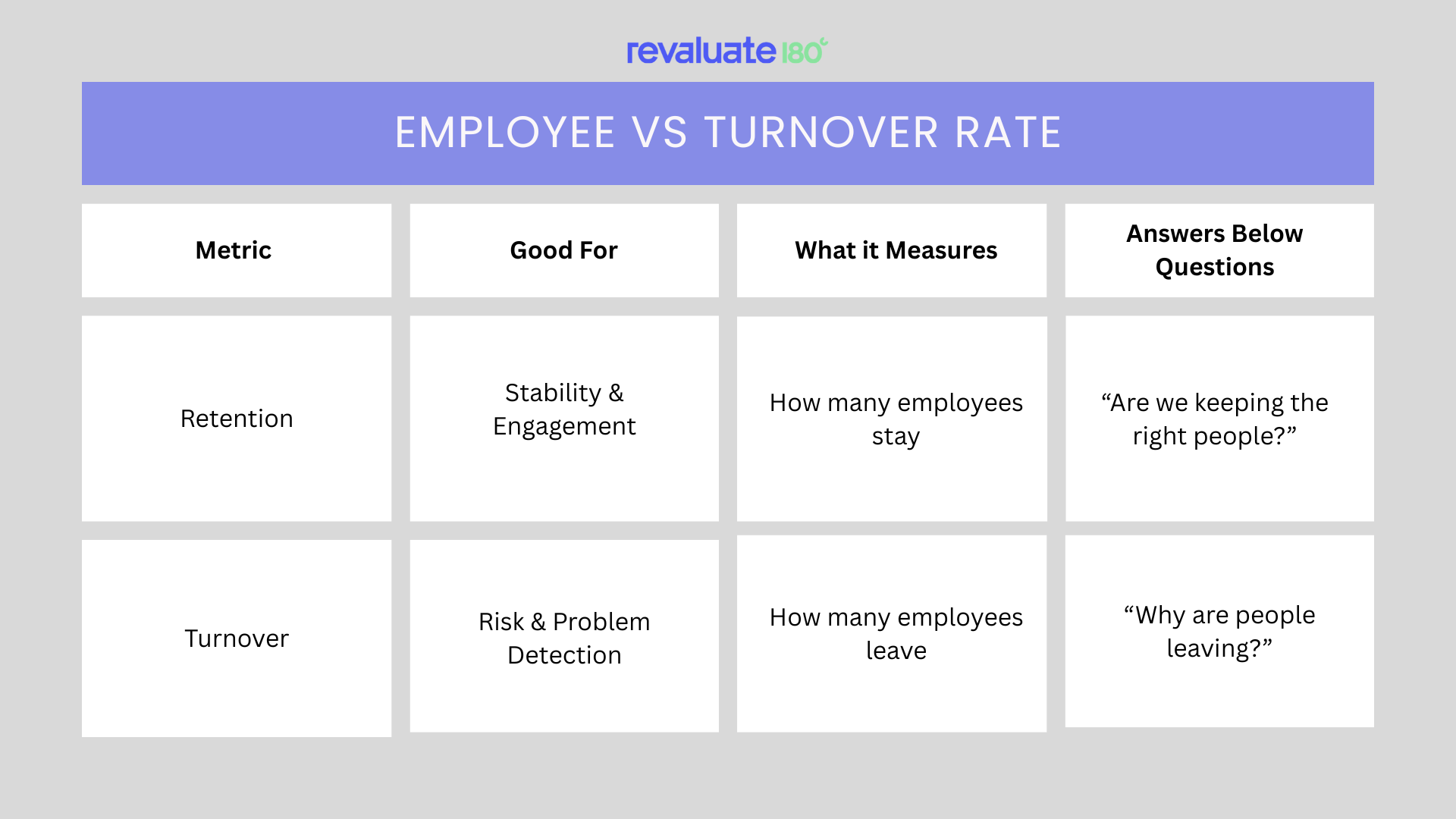
Retention and turnover measure opposite outcomes for the same workforce. While retention is all about who stays, turnover is about those who leave the organization. However, they are not always just mathematical opposites because they can have different rules and foundations.
For example, retention rate typically counts only the employees who were there at the very start and stayed till the end of the defined period. The turnover rate, on the other hand, typically counts all separations during the period and often includes new hires as well.
Why are they related but measure different things?
You can have high retention and high turnover since it’s common in large companies with strong long-term staff, but you have experienced many short-term exits. Low turnover but low retention means that few people will stay longer if a few people leave. Each metric tells a different story about your employee experience.
When each metric is utilized chiefly, you can use retention to understand long-term engagement and turnover to identify immediate issues, systematic problems, or management challenges.
Why Measuring Both Retention and Turnover is Important?
If you’re only calculating retention, you’re missing the reasons why people leave your company. Similarly, if you’re only using turnover, you’re ensuring whether people will stay long-term. Together, they provide a comprehensive picture of workforce health.
Business Impact
High turnover and low retention cost more than you think. Recruiting and training new staff requires time and money, as a study earlier has reported that replacing an employee costs one-half to two times the employee's annual salary. Additionally, constant turnover hurts productivity, as it can take a new hire months to become fully productive. On the other hand, teams with high retention and low turnover tend to perform better.
Senior leaders view retention as a key business metric, not just another “good to have” liability. Tie it to business outcomes to get the right ROI. A sudden spike in turnover in a particular department or declining retention trends warrants immediate investigation.
To avoid any unexpected barriers, we recommend monitoring both metrics together. If turnover spikes even if the retention rate seems decent, leaders must look for the root causes. Perhaps a toxic team culture or ineffective process is halting your growth?
Red Flags to Detect
Let’s understand the highs and lows with what they may indicate:
- Low retention + high turnover = systemic cultural issues.
- Low retention + Low turnover = Stagnation or disengagement.
- High voluntary turnover = Leadership or pay concerns.
- High involuntary turnover = Hiring or performance management issues.
How to Calculate Employee Retention and Turnover Rates
Employee Retention Rate Formula
Retention rate is calculated as:
Retention Rate = (Employees who stayed the entire period / Employees at the start of the period) × 100
This will help you count how many of your total employees remain (including the new hires), and divide by how many you began with. For instance, if you began the year with 100 employees and 10 of them left in that defined period, the retention rate is 90%. The retention rate = (90 / 100) * 100 = 90%.
Retention rate = (90 / 100) × 100 = 90%
Calculate your retention rate to find out the real reason why your employees stay.
Step-by-Step
- Choose a time period: Retention is typically calculated annually, but you can also use shorter intervals, such as quarterly, by department, or other relevant divisions.
- Count starting employees: Record how many employees were on staff at the very beginning of the year.
- Count who stayed: Of those original employees, count how many decided to stay and include those who were hired during that period. We recommended counting all those present for the entire period.
- Apply formula: Divide the number who stayed by the starting count, and multiply by 100.
Common Mistakes to Avoid
A frequent error is inadvertently including new hires in the calculation, as this inflates the denominator and yields a falsely low retention rate. To avoid this issue, explicitly exclude the employees who joined during the period, and also be consistent in choosing your time frame and definition for precise results.
Employee Turnover Rate Formula
Here’s how you can calculate the turnover rate to find out why your employees leave.
Turnover Rate = (Number of separations / Average number of employees) × 100
In this case, separations include all employees who left (voluntarily and involuntarily) during the defined period. The ‘average number of employees’ is usually the average headcount over that period.
For instance, if over a year your average headcount was 100 and 15 employees left, your turnover rate = (15 / 100) × 100 = 15%. You can also calculate turnover monthly or quarterly to see short-term trends.
Step-by-Step
- Choose a period: We recommend an annual period, but 1 month or 1 quarter is also acceptable.
- Count separations: Total all departures in that period to track voluntary and involuntary separations separately for deeper insights.
- Calculate average headcount: You can take a sum of the monthly ending headcounts and divide by the number of months.
- Apply formula: Divide separations by average headcount and then multiply it by 100.
Common Mistakes to Avoid
The most common mistake is using the total or end-of-period headcount instead of the average headcount. If your workplace grew in size, using only the final number makes turnover seem defacto. Be clear, even when calculating total turnover or voluntary turnover.
What Causes High Turnover and Low Retention?
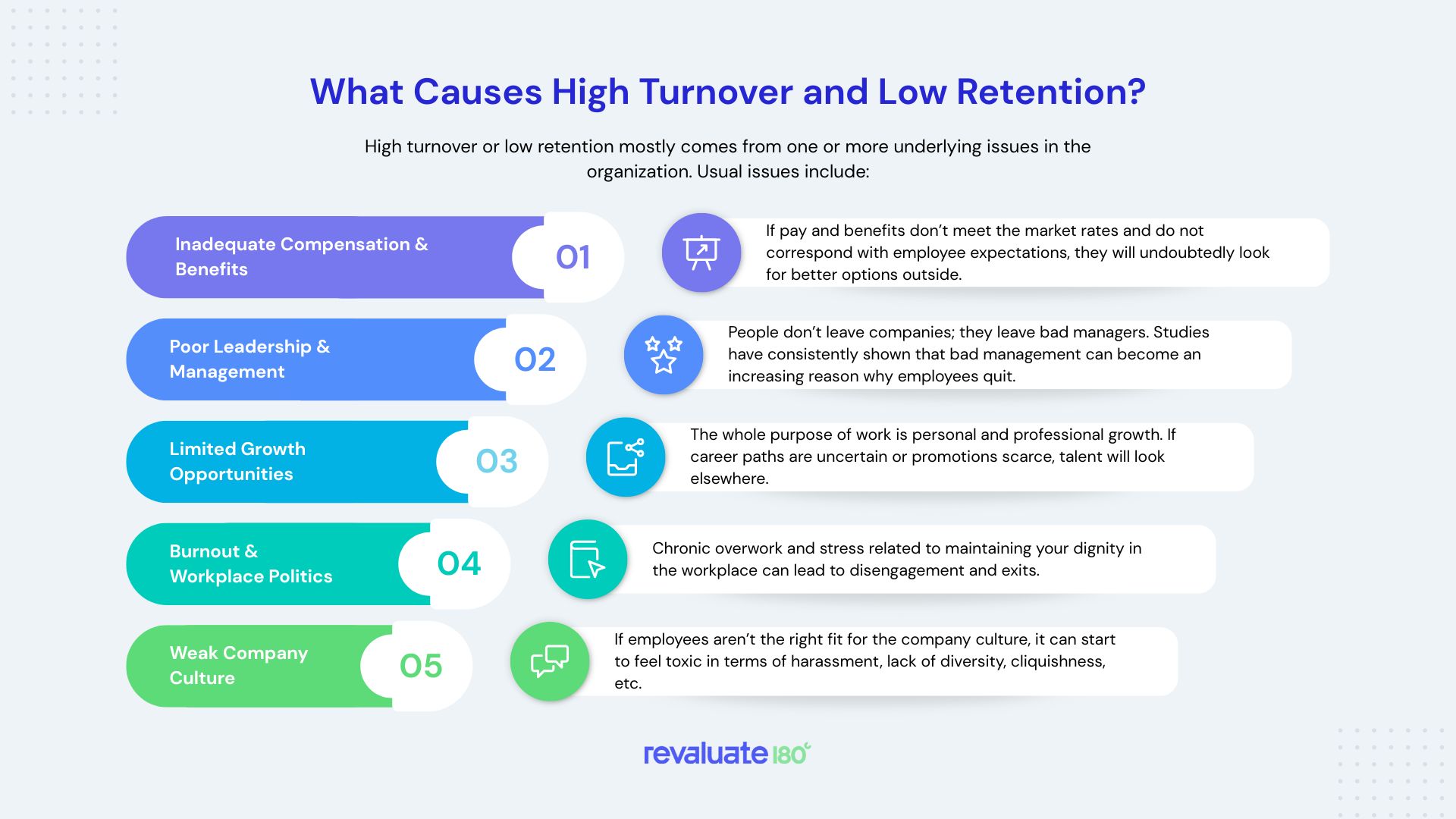
High turnover or low retention often stems from one or more underlying issues within the organization. Usual issues include:
1. Inadequate Compensation and Benefits
If pay and benefits don’t meet market rates and do not align with employee expectations, they will undoubtedly seek better options elsewhere. Total rewards matter, and we’re not only talking about salary but also bonuses, healthcare, flexibility, and appreciation.
2. Poor Leadership and Management
People don’t leave companies; they leave bad managers. Studies have consistently shown that poor management can become a significant reason why employees quit. Weak or micromanaging supervisors often drive away top talent. On the other hand, strong managers who provide effective feedback and support have the highest potential for maintaining high employee retention.
3. Limited Growth Opportunities
The whole purpose of work is personal and professional growth. If career paths are uncertain or promotions scarce, talent will look elsewhere. Lack of growth has been identified as one of the top reasons for leaving. You can avert this by offering training programs, career guidance, mentoring, and challenging projects.
4. Burnout and Workload Issues
Chronic overwork and stress related to maintaining your dignity in the workplace can lead to disengagement and exits. Additionally, a poor work-life balance is also a key reason for turnover. You can address this by monitoring workloads, encouraging employees to take time off, and supporting mental health initiatives. Taking one positive step at a time can bring about significant change.
5. Weak Company Culture
If employees aren’t the right fit for the company culture, it can start to feel toxic, characterized by harassment, a lack of diversity, cliquishness, and other issues. A misaligned culture leads to decreased engagement, which in turn increases turnover rates. You can start by creating an inclusive and respectful environment, as well as implementing DEI training to address these issues.
6. Bad Hiring Decisions
Bad hiring decisions are one of the biggest yet most often overlooked drivers of both low retention and high turnover. If you're continuing to hire candidates only by skills and not considering the most crucial behavioural traits, values, and motivations, you'll be bound to underperform in the market. Mis-hires can potentially increase workload, weaken team cohesion, and create ongoing performance issues that surely compound over time.
To avoid this hazard, we at Revaluate180 use data-driven insights to assess candidate-role fit upfront and analyze their behavioural patterns to finalize the candidates that are well-suited for a specific position.
Who is Responsible for Retention and Turnover?
HR is not the only person responsible for retention and turnover. It’s a shared responsibility among leaders, managers, and employees to improve it.
- HR / People Ops: HR and People Ops are responsible for tracking the precise metrics, quantifying them, and analyzing trends to alert the leadership on issues and pointers. Considering these factors, they design programs for onboarding, engagement surveys, and exit interviews to recommend policies that enhance retention.
- Managers: By far the single most significant influence on both retention and turnover comes from the management. This means that strong management skills are needed at times, so managers can utilize training programs, people skills, and accountability to make informed and effective decisions.
- Leadership / Executives: Responsible for culture and resources, leaders set strategic priorities to understand where to allocate the budget for retention initiatives. This is where competitive pay, training, and wellness programs come to the rescue.
- Employees: Retention is not a one man’s job. Workers themselves must take ownership of their careers by clearly communicating their needs, actively engaging with development opportunities, and providing constructive feedback. A culture where employees feel empowered to speak up about their issues can help address them before they contribute to increased turnover rates.
How to Improve Retention and Reduce Turnover?
We’ve curated the best evidence-based strategies to improve retention while keeping the turnover at a minimum:
1. Hiring for Role Fit
Start the retention process early by hiring candidates who will fit both the role and the culture. We recommend using structured interviews and team-based hiring to minimize mis-hires. If you think it’ll take longer than you think, you’re right. It’s better to take a little longer to find the right person than to lose on so many factors after a wrong person is hired.
2. Competitive Compensation and Benefits
Review your total rewards model to ensure your salaries and benefits are competitive with the market. Always remember to consider total rewards, not just cash. You can prioritize flexible schedules, healthcare benefits, stock options, professional development funds, verbal appreciation, and many more. We recommend benchmarking your annual pay and supplementing it with perks that actually matter to your employees.
3. Build Clear Career Growth Pathways
Implement formal career ladders and development plans for potential growth. Employees who see a path upward are more likely to stay with the company. Invest in training programs, stretch assignments, and leadership development even if promotions aren’t immediately available. Showing them you really care about their professional growth will help them understand you and your company’s goals.
4. Improve Managers' Effectiveness
Train and support your managers as they’re the backbone of your workplace. Since they heavily influence retention, equip them to coach, listen, and give feedback effectively. The best way to create strong management is by offering them leadership training workshops and holding managers accountable for their teams’ engagement scores.
5. Use Continuous Feedback
Implement frequent check-ins, pulse surveys, stay interviews, and not just annual reviews. Exit interviews are helpful, but that’s too late. They are certainly a great tool if your retention rates are declining and you want to know why. But continuous listening programs catch issues early.
6. Support Work-life Balance and Mental Health
This can bring the most significant strategic benefits in terms of business growth. You can prioritize employees’ mental health and well-being by offering them remote/hybrid work options, flexible hours, mental health days, and comprehensive well-being programs. This will maintain high productivity and strong consistency in the workplace.
7. Act on Exit and Stay Interview Insights
Don’t just keep the records in the file; identify the recurring themes you’ve captured in the stay and exit interviews to know why people leave and take concrete action. By closing the loop, you’re letting your employees know that their voices matter and will help improve both engagement and retention.
8. Quick Wins and Long-term Strategies
If you want to achieve strategic results within three months, we suggest launching recognition programs, sharing metrics with managers, addressing any glaring salary gaps or policy inconsistencies, and initiating regular manager check-ins. These can have a temporary but immediate morale boost in the workplace, and you’ll understand the massive potential of these retention strategies.
If you are dedicated to developing a long-term (6-12 months) retention plan, develop managers over time, and implement a formal career development framework. You can redesign the hiring process and possibly revamp your company culture initiatives. They require long-term efforts but create a lasting foundation for retention over the years to come.
Using Data-Driven Insights to Strengthen Employee Retention
Here at Revaluate180, we believe in organizations shifting from reactive to proactive employee retention efforts. Our data-driven strategies are powered by quantifiable analytics that analyze patterns in engagement, performance, turnover, and behavior. Advanced models can identify employees at risk of leaving before disengagement progresses to actual turnover.
Our team of experts combines behavioral science with AI-driven insights to deliver early and accurate assessments of long-term role and cultural fit. By continuously learning from employee data throughout the entire lifecycle, our tried-and-tested systems help leaders transition from guesswork to targeted and preventive retention strategies. Contact us today and start making more intelligent people decisions with confidence.

Unlock AI-Powered Hiring Analytics
Transform the way you hire with insights that create aligned, collaborative, and high-performing teams.
- Smarter Hiring Decisions
- Reduce Expensive Turnover
- AI-Driven Insights
- Optimize Team Performance