Business development and employee wellness must be equal priorities for a company, as the latter directly contributes to the former. A significant part of a company’s brand reputation hinges on how it treats its employees, and above all, how long employees remain satisfied in their roles.
Employees stay with a company when they have good relationships with their team, managers, and peers, and are actively committed to the work they do. This engagement, in turn, contributes to higher productivity and company growth.
In this guide, we’ll learn how to enhance employee engagement and retention, reaping numerous benefits for your organization.
TL;DR
- Employees choose to work for a company, hoping to give their best in return for the right compensation, opportunities for growth, and benefits from the company.
- Not finding purpose at work, a toxic work culture, negatively influencing peers, and overall disengagement are common reasons for employees to quit their jobs.
- Creating a work culture where employees stay satisfied and committed to their work can help companies improve their employee retention rates.
- Discover how creating an employee-focused work culture and implementing data-driven engagement initiatives enables companies to consistently improve.
What is Employee Retention?
Employee retention refers to a company's ability to keep its employees working with it for the long term while maintaining their happiness, satisfaction, and productivity at work.
Companies with high retention rates are often pioneers of a great working environment and workplace culture, where employees take pride in their work.
Why is employee retention important?
Retaining employees is beneficial for several reasons, primarily for avoiding the losses that a company incurs when constantly hiring, training, and replacing employees. Continuous phases of employee turnover also lead to slower productivity within work teams and stagnant phases at work.
For these reasons, companies must establish a robust employee retention program that fosters employees’ long-term growth and development within the company from the day they join.
What is Employee Engagement?
Engagement refers to the level of commitment and enthusiasm that employees display towards their work tasks, workplace relationships, alignment with company goals, and the integration of personal development with the company’s growth.
Active employee engagement is a result of employees participating in and utilizing company initiatives that aim to promote employee well-being and satisfaction. Engagement at work fosters a vibrant environment where employees genuinely look forward to coming to work every day.
Why employee engagement matters?
“Employee engagement is an investment we make for the privilege of staying in business.”
– Ian Hutchinson
Initiatives for employee engagement help companies manage their employees while seeing several benefits, such as:
- Improved retention due to higher employee satisfaction.
- Boosting the morale of employees to work in a highly positive work culture.
- Increases revenue in business due to higher productivity and regular attendance at work.
- A constantly evolving workforce that is continuously learning and growing in their careers.
The Link Between Employee Engagement and Retention
Out of the three types of employee engagement, negative engagement or disengagement is often a common cause for employees to exhibit absenteeism and eventually leave the company for other opportunities.
Companies strive to develop effective retention initiatives to address employee concerns as soon as possible. However, when employees do not find a true purpose at work, it can result in low engagement levels that spread across all levels in the company. Without the right engagement, it can be challenging to get the expected outcomes from retention initiatives.
Therefore, employee engagement levels serve as an indicator of a company's success in retaining its employees. Engagement initiatives, along with employee retention initiatives, go hand in hand to help employees find true purpose at work and create an environment where employees yearn to be a part of.
Core Drivers That Improve Engagement and Retention
Engagement initiatives aim to target improved employee participation and involvement in the workplace, which in turn contributes to their prolonged tenure within the company. Here are some key factors to consider when developing retention and engagement initiatives.
1. Meaningful work and role alignment
Hiring the right person for the right job ensures that employees feel comfortable in their new roles from the start. This strategy ensures no concerns arise due to finding themselves misfit for a job, not getting to work on what they expected, and other reasons.
Systematic work tasks with achievable targets and a gradual increase in challenging work help employees grow within the company, to learn and develop themselves.
2. Recognition and appreciation
Rewards and recognition are a great way to boost the morale of employees among their peers for any significant contributions made in their work tasks. Even a few words of appreciation can make employees feel valued and set benchmarks for everyone to exceed expectations in a healthy manner.
Providing rewards with flexible options for extraordinary work contributions, such as coupons, vouchers, cash, discounts, and more, assures employees that the company rewards them fairly and on time.
3. Growth, learning, and career progression
One of the common reasons for not remaining in a job role these days is the lack of sufficient opportunities to learn and grow. Employees often compare themselves with peers in other companies and how their careers have progressed.
Finding themselves lagging behind their peers often causes employees to lose motivation, engage less, and ultimately choose to quit their jobs for better opportunities. Sufficient opportunities for growth within their work team, between teams, or divisions in the company are, therefore, a crucial factor to help retain employees.
4. Leadership and manager effectiveness
The relationships and attitudes of team leaders, managers, division heads, and C-Suite executives toward employees can significantly impact an employee's decision to stay in a company or be a strong cause for large-scale turnover within the organization. This phenomenon is quite common when leadership changes occur at different levels.
Training your leaders to effectively manage employees and be good listeners is a mandatory program that companies must undertake to achieve better engagement and retention.
5. Well-being and work-life balance
The physical, mental, psychological, and financial wellness of an employee can directly affect their engagement level at work. That is why several companies are developing employee wellness initiatives to ensure employees can remain at peace while working.
From providing flexible working hours and remote working options to providing comprehensive health benefits, travel allowances, PTO, and several other benefits, companies are increasingly focusing on employee wellness to promote engagement and retention.
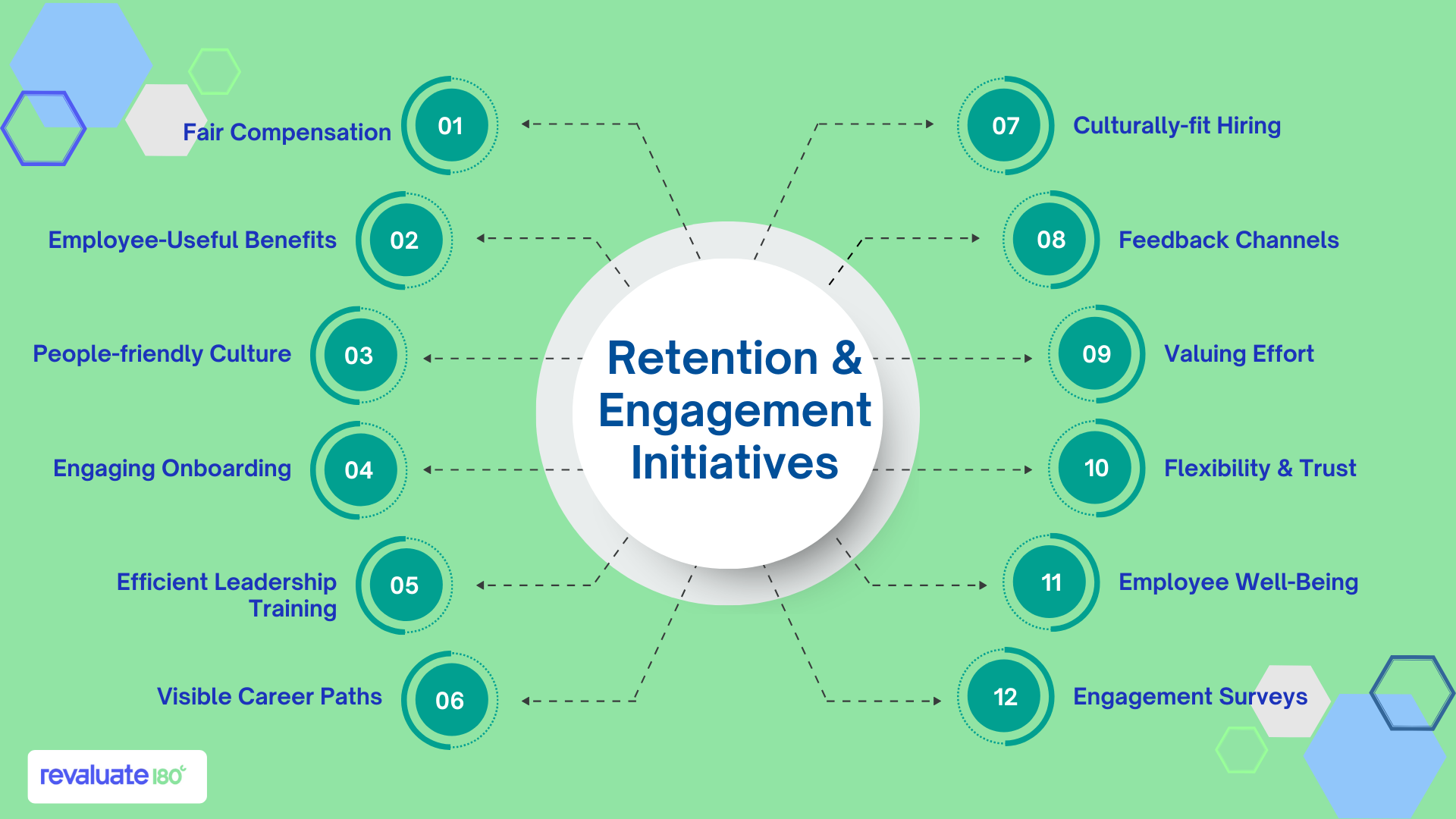
12 Strategies to Improve Employee Engagement and Retention
You may often find a significant amount of overlap or similarity among initiatives aimed at employee engagement and retention. This is because both are aimed at keeping employees satisfied and believe that the company will do its best to resolve valid employee concerns.
Listed below are some strategies that help companies target improvements in both employee engagement levels and retention rates.
1. Offer fair, competitive compensation
Turnovers often occur when employees discover that their peers in the same job roles are receiving better compensation packages. Fair yearly appraisals and consistent hikes are also reasons for employees to switch to other companies.
Several HR platforms help companies revise their compensation packages to align with current prevailing industry standards. Revising pay packages is crucial for retaining top talent and preventing sudden turnovers.
2. Build a benefits package employees actually use
Benefits like health insurance, travel allowance, paid leave, remote work setup benefits, and many more must be introduced or revised from time to time, depending on employees’ requirements. Benefits that are no longer relevant or useful for employees often cause employees to feel disengaged at work.
Engagement surveys are innovative tools that help companies understand how employees feel about the current benefits they receive and how these benefits can be improved to better support them.
3. Create a culture people want to stay in
The workplace culture is a crucial factor that decides the retention rate of a company. An inclusive workspace, comprising employees from diverse backgrounds, makes employees feel comfortable and welcome at all times.
Creating a work culture that fosters transparent communication, encourages open and constructive feedback, prioritizes overall employee wellness, and promotes equal and fair treatment for all makes a workplace highly desirable.
4. Improve the onboarding process
Did you know that a company’s retention initiatives start right from the onboarding phase of new recruits?
Surveys indicate that an employee’s first few weeks on the job can significantly influence their perception of the company. This impression often leads them to decide whether they wish to work here for a long time or leave as soon as possible.
Keeping the onboarding process with formal orientation sessions, informal ice-breakers, and team connect sessions helps improve employee engagement right from the time of joining.
5. Train managers to lead people
Relationships with managers play a crucial role in determining both employee engagement levels and retention rates. Special leadership training and sessions to make leaders better coaches, help them improve the enthusiasm and morale of employees working under them.
Leaders must also be encouraged to have frequent one-on-one sessions to directly gather feedback from employees regarding work tasks, company initiatives, or any other area where they wish to see changes that benefit them.
6. Create visible career paths
Long-term retention and active engagement occur when employees perceive themselves as growing within the company at regular intervals. Role changes, promotions, and becoming new leaders are often seen as visible indicators of growth within a company.
Companies must update their policies and promotion rules so that everyone gets a fair chance to grow based on their contributions. Removing biases and maintaining transparency is essential when helping employees advance in the corporate ladder.
7. Hire for alignment, not just skills
Hiring candidates for a job role must involve more than just matching skill sets. Candidates must be tested to assess how well they will be able to integrate with the team they will be joining. That is why the evaluation process must include team members and leaders in search of an ideal candidate.
Also, ensure that your candidates are aware and ready to align with your company’s work culture. Hiring a culturally-fit candidate is a crucial factor to avoid unexpected exit during the onboarding phase.
8. Build feedback into everyday work
Two-way feedback channels are essential to ensure that communication reaches all employees and also allows for honest feedback. Feedback must become a norm at the team, group, or company-wide level in all aspects, including work progress, leadership style, opinions on policies and benefits, and many more.
Feedback surveys, including engagement surveys, retention surveys, pulse surveys, and annual comprehensive surveys, are essential tools for gathering employee feedback regularly. If you wish to avoid any sudden turnover or combat erupting signs of neutral or negative engagement, never ignore the power of collecting feedback.
9. Recognize effort, not just outcomes
Evaluating employees during appraisals or promotions requires analyzing individual effort and comparing it with their previous performances. For instance, an employee who has just returned from maternity leave cannot be evaluated based on another peer’s work contributions.
When effort is not valued, employees tend to lower their engagement levels, ultimately deciding to leave their jobs. Fair appraisals, adequate compensations, and supportive benefits must be given to those who put in their best effort, irrespective of their situations outside of work.
10. Prioritize flexibility and trust
Flexible work hours and the option to work from home are increasingly sought-after benefits, particularly since the COVID-19 pandemic. More employees are switching to companies that offer work flexibility over highly attractive pay packages.
The core principle behind flexible working involves the company trusting its employees to get the work done, irrespective of where they work from. Several companies have incorporated flexible working arrangements into their retention programs.
11. Invest in employee well-being
Engagement is a direct consequence of employee well-being at the workplace and outside work. Teams must make it a regular ritual to bond with each other to understand collective strengths and how they can be leveraged for betterment.
Companies must encourage employees to take sufficient paid time off so that they get a well-deserved break before they resume work. Recreational areas at work, fitness club memberships, sponsored annual health checkups, and other benefits from companies help employees focus on their wellness and improve their productivity at work.
12. Use engagement surveys
Engagement surveys are excellent feedback tools that help companies understand how employees perceive their engagement initiatives. The more positive responses an initiative receives, the higher its success rate in improving active employee engagement.
Employee engagement survey questions encompass several areas, including job satisfaction, team dynamics, leadership style, work-life balance, well-being, and communication. Surveys are effective only when the results are discussed with employees, and companies develop alternative initiatives to address employee concerns.
Improving Your Employee Engagement and Retention Strategy
Employee engagement and retention are not optional initiatives. They are core leadership priorities that require alignment across teams and leadership. When implemented thoughtfully, these strategies create shared value for both employees and organizations.
Retention improves when employees feel seen, supported, and aligned with the organization’s values and direction. Engagement levels serve as a strong indicator of how connected employees feel to their work, teams, and leadership.
Data gathered from engagement surveys, feedback tools, and one-on-one interactions with leaders and HR partners provides valuable insight into workforce sentiment. When analyzed effectively, this data becomes the foundation for sustainable, data-driven engagement and retention strategies.
Data-powered engagement and retention analytics help organizations address challenges early and prevent unexpected turnover. Revaluate180 supports organizations in strengthening engagement and retention through behavioral analytics and long-term workforce insights.

Unlock AI-Powered Hiring Analytics
Transform the way you hire with insights that create aligned, collaborative, and high-performing teams.
- Smarter Hiring Decisions
- Reduce Expensive Turnover
- AI-Driven Insights
- Optimize Team Performance