No company ever admits to facing a sudden turnover or a period of quiet quitting among its employees. However, a company’s poor employee retention becomes palpable when you can see constant hiring drives and job openings on several social media platforms and job portals.
In today’s global work scenario, millennials and Gen Z employees are no longer willing to spend years working hard in a company, unlike the generations before them. Loyalty is therefore becoming a challenging task for employers across every industry.
Can a solid employee retention program help improve employee loyalty, engagement, and workplace satisfaction to some extent?
In this guide, we’ll attempt to understand why every company, regardless of its size, needs a customized employee retention program that helps keep its employees satisfied with their workplace and win their trust in the long term.
TL;DR
- Companies must have a strong employee retention program to ensure their employees remain satisfied and engaged at work without considering opportunities outside.
- Retention programs help companies save costs and resources required for frequent hiring and training of new employees, while also improving productivity with a consistent workforce.
- Customized retention programs in companies help employees benefit from flexible working arrangements, wellness programs, learning and mentorship opportunities, family support programs, and various other benefits.
- Learn how data-driven insights can help you zero in on the right initiatives for a customized employee retention program for your company.
What is an Employee Retention Program
Retention programs or solutions help companies create strategies, policies, and initiatives to keep employees happy and content with their workplace, so that they do not consider leaving the company due to unresolved concerns.
If your company does not wish to spend on recurring cycles of hiring and training, only to have employees leave elsewhere eventually, it is essential to create a strong employee retention program to help retain your talented workforce.
Companies design retention programs by understanding their employees’ concerns and developing initiatives to meet their expectations. Such initiatives are primarily aimed at enhancing overall employee welfare and growth, enabling them to remain productive and contribute to the company’s business.
Furthermore, companies must periodically revise and review their employee retention programs to ensure they are updated to meet the changing requirements based on employee needs and industry trends.
14 Best Employee Retention Programs With Examples
Employee satisfaction and wellness at work encompass several aspects, including physical and mental wellness, harmonious relationships at the workplace, peer engagement, work-life balance, and more. Different employees exhibit varying priorities towards these factors, which can impact their work approach.
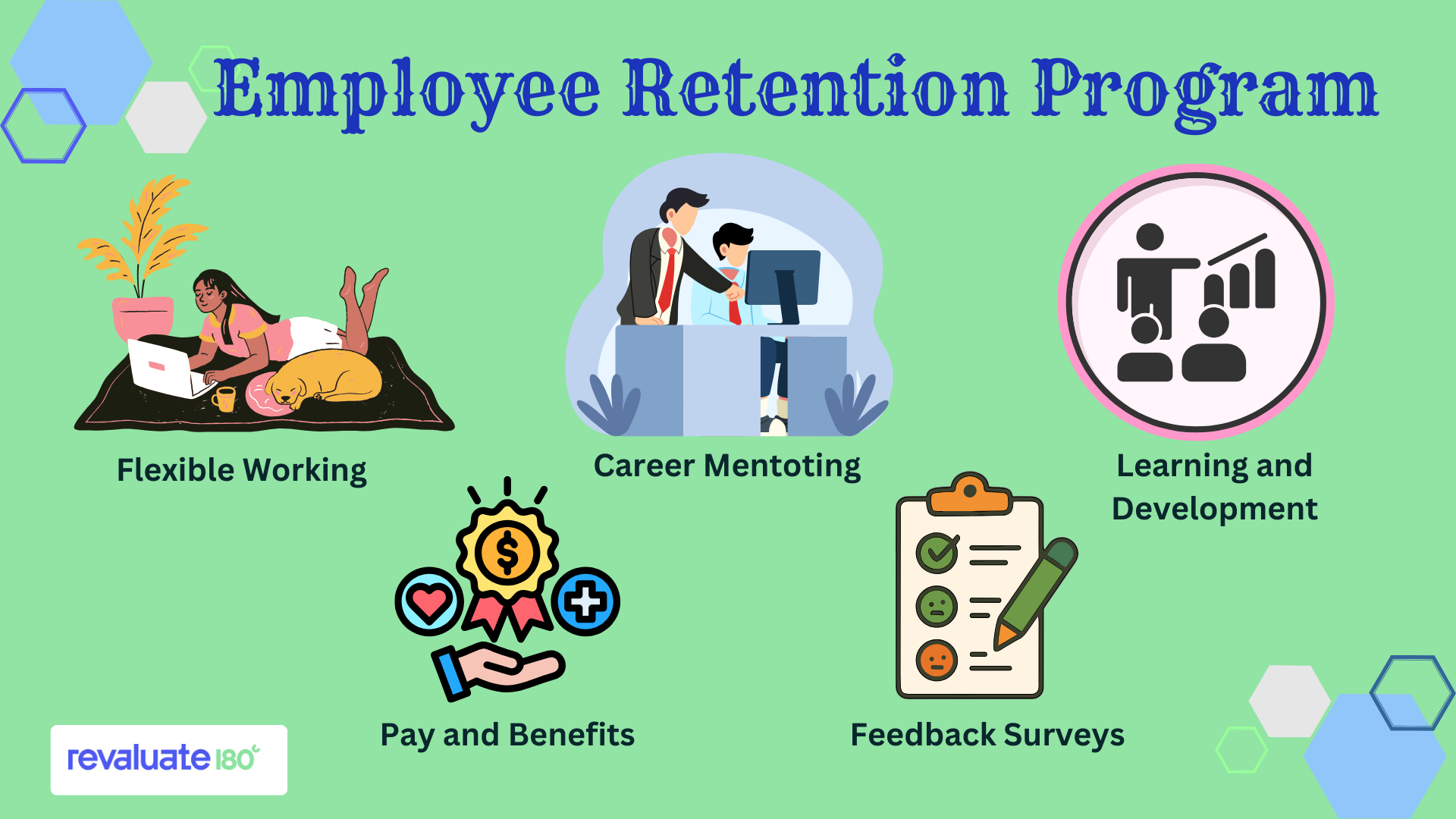
Here are some of the latest initiatives under different categories to help retain your employees by offering them the best benefits.
1. Flexible Work and Hybrid Programs
One of the top requirements of employees following the COVID-19 pandemic has been the benefit of working from home, allowing them to work productively at their preferred time. Increasingly, companies are adopting remote-first and flexible working policies.
Such policies empower employees to plan their office attendance and manage other work tasks from home or any convenient location. The latest flexible working policies enable employees and their teams to plan their work schedules in accordance with their personal commitments.
Examples:
- Airbnb has a fully remote working provision for its employees with no difference in compensation packages. Additionally, they have a monthly “gathering week” during which employees meet regularly to engage with team members, discuss strategies, and assess their progress at work.
- Atlassian has been pioneering a hybrid and remote-work model, facilitating distributed teams since 2020. Employees meet every quarter, can spend 90 days working abroad from their office location, and do not have any mandated office days for daily attendance.
- Several tech giants, including Google, Microsoft, and Meta, among others, have a hybrid working policy that allows employees to choose between working from the office for a fixed number of days each week or month.
2. Wellness and Mental Health Programs
Since employees are valuable assets for a company’s growth, employers must invest in a wide range of initiatives to focus on employee wellness. From insurance policies with extended coverage for the employees’ immediate families to providing sufficient mental health assistance at work, there are several ways to focus on an employee’s overall health.
Examples:
- Many office spaces are incorporating provisions for fitness enthusiasts, such as well-equipped gyms, group exercise classes, hobby areas, and more.
- Special counselors and psychologists are readily available in the office or online to help employees address burnout situations at work or stressful life events that are impacting their performance.
- Monthly meetups in the office, recreational areas, or outside the office help employees unwind and engage with each other beyond the workplace.
- Offer health stipends when remote or hybrid employees enroll in a workout regimen, participate in marathons, achieve desired results in their annual health check-ups, and more.
3. Learning and Development Stipends
A largely unnoticed yet significant reason for many employees to silently quit and leave their jobs is the lack of opportunities to upskill and develop themselves at work. Access to e-learning portals and skill training sessions helps employees stay relevant and grow in their careers.
Several companies are now introducing mandatory learning and development programs covering technical and behavioral topics. These sessions help employees learn beyond course materials and books and engage in healthy debates and discussions with their peers.
Examples:
- Companies like LinkedIn and Webflow provide their employees with a continued learning and education stipend of up to $5000 per year.
- Create peer communities within your company where employees with similar interests take up the same learning courses and certifications.
- Work teams can take up a learning assignment every quarter. Every member learns a topic and shares their insights with other members, allowing them to collectively complete their assignment without compromising on work tasks.
4. Mentorship and Career Pathing Programs
Employees expect handholding and additional support at different stages of their journey while working in a company. Technical assistance, knowledge transfer from experts, blending with a team’s work dynamics, and climbing the corporate ladder are some areas where employees often seek help from an experienced peer or mentor.
Several companies have established mentorship programs, where employees are assigned mentors to assist them in various areas. These mentor-mentee pairs can log their insights and learnings in tools that help companies measure the effectiveness of their mentoring, and get them recognised for their service.
Examples:
- King Games offers a special mentorship program for women and non-binary employees to foster a sense of inclusion and confidence. The participation of women and non-binary individuals in technical and leadership roles helps make the gaming industry more diverse for all genders.
- Cruise Automation utilizes a mentorship platform to automatically pair mentor-mentees, ensuring that every new hire is matched with the right senior engineer who can guide them from the outset of their tenure.
5. Recognition and Rewards Marketplace
All employees have preferences on the kind of rewards they wish to receive for any appreciation and felicitation at their workplace. Some prefer cash, while others prefer coupons, vouchers, reward points, or gift hampers.
Repeatedly receiving vouchers or coupons that serve no use to them often makes employees compare how other companies reward their employees with flexible options to choose from. This can also be a deciding factor for employees to consider switching to other companies in case they receive an offer.
Examples:
- Utilize an interactive rewards and recognition platform to manage the distribution and reimbursement of various rewards.
- Employee retention software solutions provide interactive portals for peer recognition and appreciation, while also fostering active employee engagement.
6. Employee Feedback and Survey Programs
The best tool to ensure stable employee retention is having a strong feedback channel that allows employees to share their concerns about any issues they encounter at work. Feedback surveys and one-on-one sessions with managers and HR business partners are extremely helpful in gaining insights into pressing issues that the company must address.
Insights from employee feedback form the base of data-driven decisions that provide fool-proof results for companies.
Examples:
- Conducting frequent employee engagement surveys and retention surveys helps measure employee satisfaction levels across different workplace perspectives.
- Exit interviews can be helpful in understanding the reasons why employees leave and provide insights into preventive measures to take in order to stop similar turnover.
- Have a dedicated team to handle internal communications and corresponding employee feedback to ensure transparency between employees and management.
7. DEI-Focussed Retention Programs
Companies that do not have a global footprint often find it challenging to manage hires from a global marketplace. In addition to hiring without any unconscious bias, it is essential to hire from all kinds of backgrounds so that diverse employees feel a sense of belonging when in the company.
Similarly, retention initiatives must focus on making diverse employees feel included, not just those from a clear majority. Several workplaces are now implementing specific initiatives targeting underrepresented genders, including new mothers returning to work, and so on.
Examples:
- KPMG has a reverse mentoring program where senior leaders are paired with junior employees of a different gender, ethnicity, or sexual orientation to understand how their opinions and decision-making are influenced by their life experiences.
- ViacomCBS is one of the top companies with a large number of women in its C-Suite team and other senior managerial roles, thanks to its DEI programs aimed at improving female representation in technology.
8. Financial Wellness Programs
Most employees, especially in recent times, have been quitting their jobs due to concerns that they are not making enough money. However, poor financial planning is the primary reason why any pay package seems insufficient for such employees, and constantly jumping between companies for higher pay packages isn’t going to help them in the long run.
Financial wellness initiatives are a win-win for both companies and their employees. When employees learn the basics of financial discipline, they often feel that they do not need better pay packages to improve their quality of life, thus focusing on their work and productivity.
Examples:
- Financial wellness programs include portals that help employees automate emergency fund transfers from paychecks, in addition to providing useful resources on financial discipline.
- Hire financial consultants to conduct regular training sessions on topics such as household budgeting, surviving recessionary times, and investing in futures.
- Conduct surveys to understand the financial awareness of your employees and identify gaps where they require additional assistance and guidance.
9. PTO and Sabbatical Programs
Sometimes, even companies with the best work culture face situations where employees need to work beyond their usual hours to meet business deliverables on time. For such reasons, companies need to give Paid Time Off (PTO) to their employees.
Every company has its own policies related to PTO, which may include additional benefits such as a monthly day off/menstrual leave for women, bereavement leave, childcare leave, and others.
Some companies also offer sabbaticals during periods of prolonged employee absence, such as taking up a course in a different city, traveling to different countries, childbirth and postpartum care, caring for family members, and similar reasons.
Examples:
- PTO Calculators help employees plan their leaves to align with their work schedules, ensuring they are present during busy workdays.
- Bubble, Boston Consulting Group, and many other companies offer their full-time employees a fully paid 5-week sabbatical for every 5 years of service. They also receive unlimited PTO and paid parental leave.
- Many companies offer at least 26 weeks of paid parental leave, providing parents with sufficient time to transition from the newborn phase.
10. Internal Mobility and Job Rotation Programs
Before employees consider leaving a company, they must ensure that they get the right opportunities within the company. Issues such as entering the wrong team as a fresh graduate, being assigned to a disengaged team, or having a manager with poor leadership and communication skills should not be a threat to retaining other talented employees.
Similarly, being stuck in the same job or doing the same kind of work tasks can make employees feel they are not growing. Job rotations or taking on different roles within their team, group, or company division can help them take a break, try something new, and return to their usual routine.
Examples:
- Most companies have an internal job portal where employees can apply for positions in other teams and groups within the company.
- Caterpillar offers an engineering rotational development program that allows new graduates to learn about product development, welding, and materials engineering over a 12-month period, after which they can decide their area of interest.
- Mastercard’s Management Associate Program offers an 18-month rotational program for MBA graduates, featuring six-month assignments in various business units.
11. Leadership Development Programs
An employee’s transition from an individual contributor to a leader managing a set of employees can be challenging to navigate. Experiences are the best teachers for helping leaders, but certain behavioral aspects can be a reason for low retention within a team or group.
Special leadership training programs and sessions can help new leaders and experienced leaders adapt to current trends among employees and their behaviors. Leaders can make more informed decisions with the correct exposure and data-driven insights from past employee experiences.
Examples:
- Leadership transformational programs in companies like KPMG help leaders navigate new challenges, such as facing a pandemic, meeting innovation demands, and adapting to industry disruptions.
- Marriott’s Voyage Leadership Development Program provides graduates with leadership training right from the beginning of their careers to reach a management role with ease.
12. Engagement and Team-Building Programs
Employee engagement forms the core principle for employees to sustain and work productively in a company. Not feeling included in decision-making, not receiving proper support, or being part of a team with negative or procrastinating peers can erode an employee’s morale.
To get the best out of employees, companies must develop healthy initiatives to help them engage with their team, leaders, and peers, enabling them to co-learn, co-work, and remain productive.
Examples:
- Team-building activities can be inexpensive and conducted in small to medium-sized groups to encourage healthy engagement.
- Companies can utilize employee engagement solutions to manage various employee engagement activities, including conducting surveys, monitoring work tasks, tracking attendance, managing rewards, and more.
- HR teams can suggest the best engagement initiatives for companies, depending on their size, current engagement levels, and employees' areas of interest.
- Companies are now developing remote-engagement activities to help employees stay engaged while working in a hybrid or remote work setup.
13. Family Support Programs
Twenty-four hours a day may be sufficient time for professionals to balance their work and life, but this is never applicable to parents. There can be several instances where working mothers and fathers have too many chores to attend to, which can significantly disrupt their work schedules and productivity.
That is why, in addition to paid leave for child care and family support, companies develop resources and support programs to help employees reduce stress about their loved ones and focus on their work.
Examples:
- Many companies offer an in-house creche or daycare facility for working mothers to leave their children in the care of professional caregivers while they work in peace. If not this, companies offer allowances to parents for enrolling their children in secure day-care centers that partner with them.
- Appraisals of new working parents should be tailored differently and not compared to those of their peers.
- Flexible work timings, which allow employees to tend to a family member, attend events at kids’ schools, and participate in other activities, help them balance their work and family life much better.
14. Data-Driven Retention Programs
Retention initiatives are most effective when they meet employee expectations. That is why data from employee engagement surveys, retention surveys, and manager feedback form the base for leaders to decide on the right retention programs.
Several AI-powered technologies help accelerate retention in companies through highly accurate insights from their employee data and past turnover experiences.
Examples:
- Utilizing data-driven consulting services and AI recruitment software for hiring helps your company attract the right person for every job role, reducing the need for frequent and recurring hiring drives.
- Tracking the causes of loss in job satisfaction helps provide accurate insights on how the company can avoid sudden employee turnover.
- Providing employee development programs and tracking their progress at every stage, from onboarding to the company, helps companies derive key data that influences their retention.
Benefits of Implementing an Employee Retention Program
Creating a wholesome employee retention-focused program is always beneficial for companies in many ways. Here are some tangible ways to measure the success of your retention program:
- Reduced hiring and training costs due to lower turnover.
- Higher employee engagement with active engagement levels across the organization.
- A stronger employer brand as a reliable employer providing a great place to work.
- A highly stable workforce that consistently helps improve your business and exceeds existing productivity benchmarks.
- Improved employee well-being where the company meets all their valid needs and expectations.
- Long-term business growth owing to the real-time experiences and insights of employees who have seen the company grow through thick and thin.
How to Create an Employee Retention Program
At the beginning of this guide, we mentioned how companies require customized employee retention programs that exclusively cater to their employees. Here are the key factors to consider when designing a retention program that benefits your employees.
1. Analyze Your Current Retention Challenges
Understand what is making your employees change companies. Exit interviews conducted with employees who are leaving can highlight areas where your company can improve. For instance, new mothers may consider switching to another company that offers better daycare allowance or has an in-house daycare setup.
2. Measure Your Retention and Turnover Rates
Calculating retention and turnover rates gives a clear picture of how your company is faring in retaining employees. A significant difference between turnover and retention rates, where the turnover rate is higher, indicates that the company must act immediately to retain its remaining employees.
3. Identify What Employees Actually Want
Conduct regular retention surveys to identify the pressing concerns that affect your employees. Find out how you are faring in terms of policies, company culture, inclusivity, pay packages, benefits, work flexibility, and other areas.
4. Design Retention Programs Around Real Data
Hire a retention consultant to identify areas for improvement that will help you retain employees for a longer term. Derive accurate insights from surveys using data-driven services that can help support your decisions to create the retention program.
5. Secure Leadership Buy-In and Budget
Explain the challenges in retention to your leaders and other C-Suite members, along with the survey data and insights. Ensure they provide their full commitment to the support initiatives by allocating the proper budget and approving the proposed program timeline.
6. Communicate and Launch the Program
Announce the various initiatives aimed at engaging your employees through your internal communications broadcast channel, as well as to leaders and managers. Managers must play an important role in encouraging employees to utilise the benefits and initiatives provided through the retention programs.
7. Track, Measure, and Optimize
Use the right tools to measure how employees utilize the retention initiatives. For instance, you can track the number of hours employees spend taking online courses on various portals to measure efficiency. If employees are unable to redeem reward coupons on time, consider extending the redemption period for improved usability.
How to Measure Your Employee Retention Program
Measuring the overall effectiveness of your employee retention program is crucial to ensure that you are doing it right. Here are some statistical parameters that help analyze how your company is performing in terms of retention compared to previous periods and how stable you are in comparison to your competitors.
- Employee retention and turnover rates
- Engagement survey results
- Performance and productivity trends
- Indicators of absenteeism and burnout in your employees
How Revaluate180 Supports Long-Term Employee Retention
Creating an employee retention program requires a thorough analysis of existing concerns related to employee retention within a company. Then, the HR team and other C-Suite executives must debate and decide on the initiatives that will most benefit the employees and help them stay happy.
These tasks are easier said than done, especially analyzing the concerns and feedback of all the employees. Favoring one set of employees and ignoring others’ requests without valid reasons can further fuel employees' desire to consider leaving the company.
Data-driven retention services from companies like Revaluate180 help guide you through challenging situations where deciding on the right retention initiatives is difficult. Our predictive analytics helps you identify retention risks from the early stages of an employee’s lifecycle.
We delve into behavioral insights to understand what motivates employees to stay with the company and what factors might prompt them to switch companies. Our Employee Development Program helps individuals plan their growth from the moment they join the company, providing leadership development and support with psychology-backed data.
Furthermore, we track and provide quantifiable data insights to supplement human judgments, resulting in the right congruence of initiatives and a custom retention model aligned with your business goals.
Reach out to us if you wish to develop a robust employee retention program that effectively meets your desired retention goals.

Unlock AI-Powered Hiring Analytics
Transform the way you hire with insights that create aligned, collaborative, and high-performing teams.
- Smarter Hiring Decisions
- Reduce Expensive Turnover
- AI-Driven Insights
- Optimize Team Performance