Getting a dream team at work is on everyone’s wishlist, whether you are an employee, manager, or group leader. After all, teams with the brightest minds who understand the problem statement and deliver beyond expectations can be the best resources for a company’s growth.
But do such teams with ideal performers just happen to fall into place like that? Not at all.
Team performance improves gradually when members understand their individual strengths and skills, communicate effectively, and develop strategies to collectively leverage them for the team’s benefit.
In this guide, we will learn how diverse teams can unite to work together and how to make teams more productive with proven strategies.
TL;DR
- Effective and productive teams are the building blocks of an organization that contribute to business growth and succession in a competitive industry.
- High-performing teams do not happen by chance. Team performance relies on several factors that help individuals adapt and strive for collective improvement.
- Clear goal alignment, unambiguous task ownership, consistent management, improved communication and collaboration, regular feedback, and retrospection are some methods to enhance team performance.
- Understand the importance of behavioral insights and analysis in shaping decision-making patterns to improve team performance.
What is Team Performance?
Team performance refers to the strategy and dynamics of a group of people working together. A team’s performance is measured not just by its deliverables and the quality of its results, but also by how its members come together, strategize, communicate, resolve conflicts, and overcome challenges to meet expectations.
A good team focuses on exceeding its own benchmarks rather than resting on its laurels. Such a consistently performing team has the following characteristics:
- Each member is clear about their role and how to get the work done.
- Members are aware of each other’s strengths and skill potentials.
- The team’s work dynamics are built on strong trust, autonomy, accountability, and co-ownership.
- Effective communication fuels team coordination, enabling each member to share their opinions and provide timely feedback.
Why is Team Performance Important?
A team’s performance is crucial to determine how its members are committed to their work goals and, consequently, improve a company’s business. Here are some tangible reasons why a team’s performance matters, regardless of size or requirements.
Improves productivity and efficiency
Some of the best teams have members who are actively engaged and enthusiastic about working together. Increased employee engagement is proven to be a direct contributor to higher productivity, both for individuals and for the team.
Ideal teams understand that productivity is a combined effort and isn't sufficient if just a few members are actively engaged.
Reduces execution delays and confusion
Teams that communicate effectively and are aware of the flow of work tasks ensure smooth and synchronous work processing. This ensures that each task and sub-task follows the scheduled timelines while also accounting for sudden changes and additional requirements.
Such teams with consistent performers ensure that those who are struggling to meet deadlines and complete tasks catch up to their pace with timely support and encouragement.
Strengthens collaboration and team trust
It is a misconception that most high-performing teams have members from the same ethnic or linguistic backgrounds who understand each other better and collaborate effectively. Today, more and more inclusive teams have diverse members from different genders, ethnicities, and geographical locations, united by values that adhere to the company’s business goals.
These common values and mutual understanding, which honor every member's individual values and beliefs, form the foundation of a trustworthy team.
Impacts employee engagement and retention
Teams that actively collaborate, have healthy discussions on work and beyond, and encourage each other to grow together show signs of active employee engagement. Members working in such a growth-focused environment are hardly anxious about their future in the company, knowing that they have a supportive team that will always assist them.
Naturally, when people love their work and have great relationships at their workplace, a company’s overall retention rate improves, reducing the burden of repetitive hiring and training.
Drives overall business performance
One of the best parameters to measure the effectiveness of a team’s performance is the value of their contributions to a company’s business growth. Time taken to deliver, quality of service, improved customer satisfaction, and handling complexity are some of the areas directly impacted by a team’s performance efficiency.
Team unity and performance are, therefore, a key area of focus for company leaders and HR professionals.
10 Tips to Improve Team Performance
Making a team more effective involves restructuring the core building blocks and values that support a healthy work culture. Maintain this checklist when creating or restructuring your teams regularly.
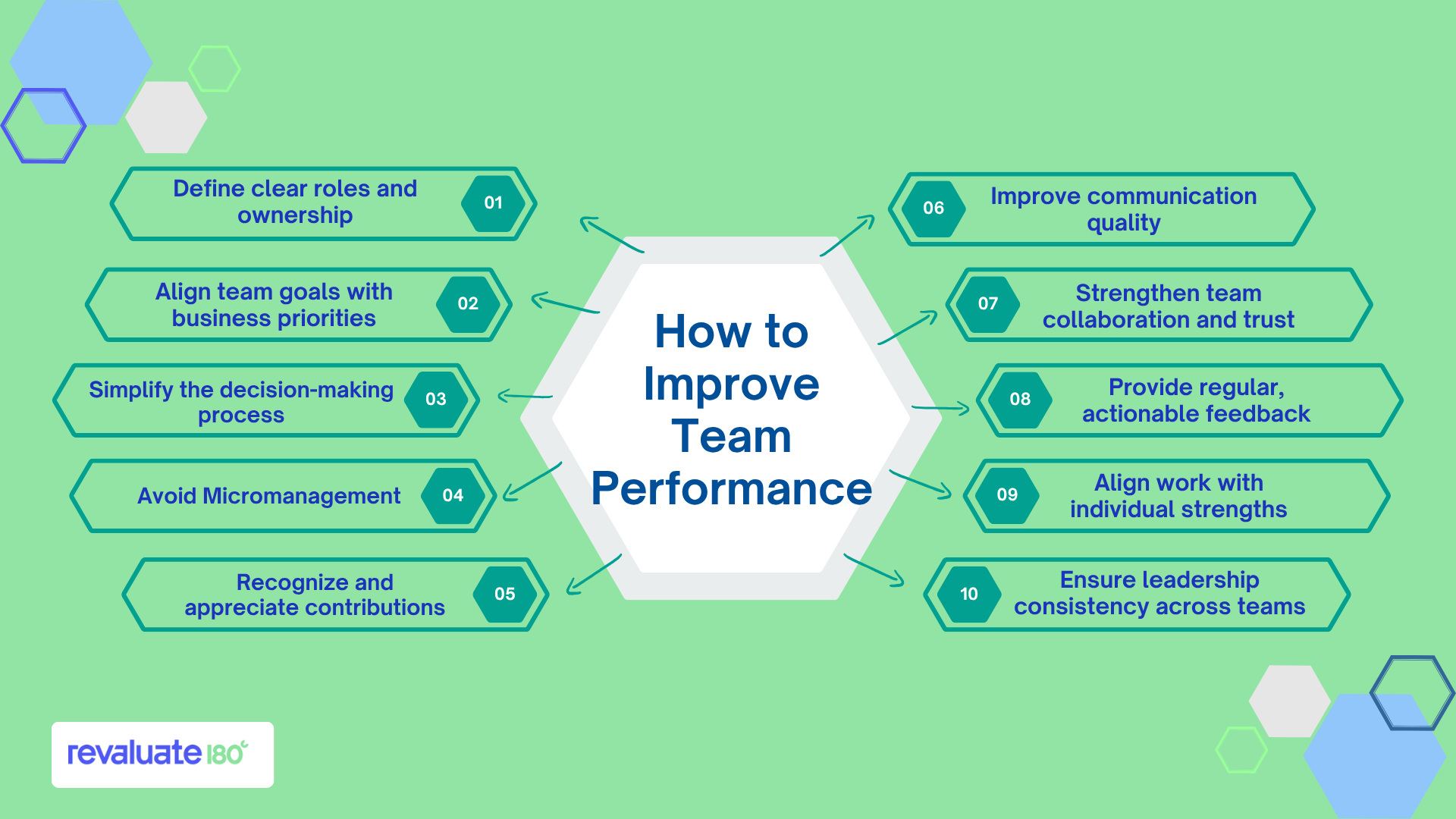
1. Define clear roles and ownership
Right from the hiring process, companies must be clear about what is expected of candidates joining a team. The skill sets required, non-negotiable work rules, core values to abide by, and the ability to adapt and grow are some of the prerequisites to consider before selecting a new team member.
Even after hiring, the team members must be clear about their roles and responsibilities at all times. Clarity in job roles helps team members to be more accountable for their work and take end-to-end ownership of their work tasks and results.
2. Align team goals with business priorities
Teams must adapt and function in ways that best serve their business requirements while also accommodating members’ genuine expectations. For instance, a team can set their core work hours that mandate everyone’s compulsory presence during times when they are expected to discuss with their leaders/clients, and work together on dependent tasks.
A good team culture begins when every member is united by common goals to improve their overall output and productivity.
3. Simplify decision-making processes
Teamwork often involves negotiations and discussions to arrive at the best solution. However, spending too much time on negotiations can delay tasks and impact team performance. That is why evidence-based, insight-backed decisions must be compulsory for team members to follow in any decision-making process.
Team members must also be given greater autonomy to make decisions without going through multiple rounds of approval, so work can happen faster and more effectively.
4. Avoid micromanagement
Apart from leaders, team members must avoid frequently monitoring their peers for instant updates or immediate feedback for every small action item. This constant micromanagement becomes the root cause of trust-related issues, causing members to feel anxious and slowly disengage from work.
Team performance improves in a highly cohesive workplace where teams believe in every member’s individual skill strengths and abilities.
5. Recognize and appreciate contributions
Team members and leaders are the first to notice significant contributions or pathbreaking transformations by other team members. They are often seen as extended families that encourage and support one another. That is why team-wide recognition and appreciation can automatically improve employee morale.
Several employee engagement platforms include a dedicated peer recognition portal where team members can appreciate their peers for noteworthy contributions, big or small.
6. Improve communication quality
A crucial parameter that significantly enhances team performance across all teams is effective communication. Team leaders and managers are chosen for this very skill, which helps them understand and share requirements and challenges with the whole team.
Effective communication helps members be clear about their roles and task schedules, clear up any confusion or misconceptions among team members, and help resolve challenges at the earliest.
7. Strengthen team collaboration and trust
Teams function smoothly when they are aware of each other’s strengths and areas of improvement. This awareness helps members help each other during challenges and face them together as a team, improving overall trust within the team.
Several employee engagement activities serve as icebreakers to help team members overcome preconceived notions and biases and collaborate more effectively.
8. Provide regular, actionable feedback
Communication can improve team performance only if it is two-way. For instance, a leader must be open to receiving opinions from each team member when making a crucial decision that affects a team’s progress or the quality of a deliverable task.
Similarly, leaders and other team members must provide timely feedback to help their peers perform better or function more effectively, benefiting the entire team.
9. Align work with individual strengths
Leaders must allocate tasks effectively within the team so that no one member is left with excessive critical work. Work distribution must be fair and aligned to suit individual skill strengths and abilities.
Fair work distribution is crucial to prevent burnout at work and also prevent unnecessary delays due to one or more members. Periodic knowledge transfers ensure that the absence of crucial members does not affect a team’s productivity.
10. Ensure leadership consistency across teams
Teams often lose motivation with an ineffective leader. Their enthusiasm further diminishes when they find other teams performing better under more capable leaders. That is why companies must train leaders to be consistent and lead by example to everyone in the workplace.
Leaders must be trained to be good coaches and mentors who first see themselves as part of the team and get their feet wet like any other work.
How to Measure Team Performance
Companies must have sufficient metrics to ensure that all their teams are putting effort into improving their performance and productivity. Several metrics provide insights into how a team is performing and come up with impressions on the scope of improvement, such as the following:
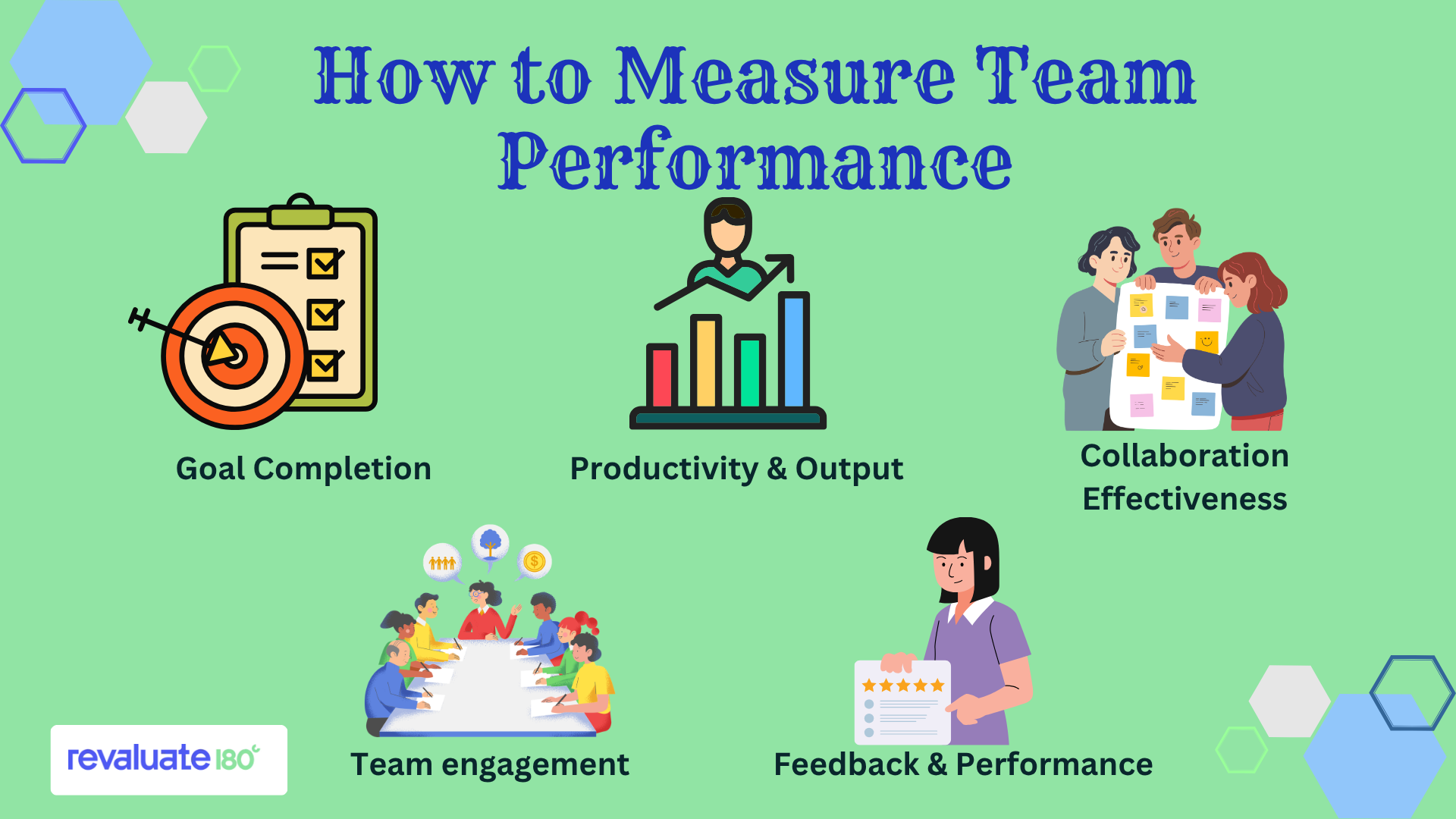
1. Goal completion
One of the most obvious indicators of a team’s performance improvement and progress is its ability to complete tasks that boost team dynamics. Some examples can be:
- Attending mandatory knowledge transfer sessions every quarter.
- Going out together as a team once a month for recreational breaks.
2. Productivity and output
Results and their quality are the ideal indicators of how a team is performing within the time given by the clients/leaders. Some productivity measurement parameters include:
- Delivering business results that match or surpass existing quality standards and profit benchmarks.
- Members are learning new courses and skills and achieving academic excellence.
3. Collaboration effectiveness
Collaborative efforts are direct indicators of how effectively team members work together. Some examples of measuring collaboration could be:
- Members of different linguistic backgrounds are working and delivering the expected results.
- Comparing outputs of homogeneous teams and teams comprising members belonging to varied genders and ethnicities.
4. Team engagement levels
Measuring enthusiasm levels within a team can reveal how proactive employees are in working with the team. Some parameters to measure active engagement within a team include:
- Regular attendance at the workplace and consistent work timings.
- Enthusiastic participation in team activities at work and recreational team activities.
- Focused on innovation and ideas that contribute to overall business growth.
5. Feedback and performance
Feedback and suggestions from team members can help teams assess how they are performing and identify areas for improvement. Some tools to fetch and process feedback include:
- Feedback surveys, retention surveys, and engagement surveys with questions to help employees rate how satisfied they are with their leaders and company initiatives.
- One-on-one sessions with team leaders and key team members to help discuss concerns and challenges.
Using Behavioral Insights to Improve Team Performance
A team’s performance is not just about the processes followed, the results delivered, and the task schedules. Performance relies heavily on how the team works together, handles adversities, and accepts one another for their individual strengths.
Misalignment and a lack of clarity in communication, decision-making strategies, and individual working preferences can affect performance, even when companies implement the best team-building initiatives.
Revaluate180 is helping organizations understand the behavioral dynamics that affect a team’s overall performance. Our assessments and insights help identify hidden performance barriers to improve alignment across teams. This awareness leads to more consistent and sustainable performance outcomes.
Connect with us if you want teams to improve their performance benchmarks. We’ll help identify the root cause through behavioral insights, leadership alignment, and a deep dive into team dynamics. These data-driven insights allow leaders to improve collaboration, strengthen execution, and build high-performing teams.
Unlock AI-Powered Hiring Analytics
Transform the way you hire with insights that create aligned, collaborative, and high-performing teams.
- Smarter Hiring Decisions
- Reduce Expensive Turnover
- AI-Driven Insights
- Optimize Team Performance