Hiring the wrong person costs more than just money. A bad hire can cost organizations anywhere from 30% of an employee's first salary to several times the role’s annual compensation, once you account for lost productivity, onboarding, disrupted teams, rehiring expenses, and delayed business outcomes. This can have a vast impact on your budget, but cultural and operational impacts are often more than money.
Yet many financial decisions are still made based on resumes, gut feeling, and unstructured interviews. That’s a real problem. When traditional interviews are notoriously unreliable, psychometric assessments become a core part of modern recruitment strategies.
Since psychometric testing helps organizations move beyond surface-level impressions, companies can break down candidates using structured, measurable insights into how they think, act, and collaborate with individuals to solve problems under pressure.
But most companies miss the crucial step, often struggling to explain whether someone will stay engaged and aligned with the team or thrive within the organization long term. Let’s understand what psychometric assessments are, how they work, why companies use them, and where they fit within organizations that should add them if they require their hiring decisions to hold over time.
TL;DR
- Psychometric assessments help us measure cognitive abilities, personality traits, behavioral tendencies, and decision-making style.
- They help organizations predict job performance more accurately than just traditional interviews alone.
- Standardized interviews can reduce unconscious bias and improve hiring quality for all individuals.
- Common assessment types include cognitive tests, personality queries, situational judgment tests, and emotional intelligence assessments, with values-based assessments included.
- Many psychometric assessment tools fail to measure value alignment, which is the strongest predictor of engagement and retention.
- The best hiring systems combine psychometric testing with structured interviews, along with other pointers such as work samples and values-based analysis.
- Organizations that prioritize both candidates’ capabilities and motivations make stronger, long-term decisions that keep the talent in the game.
What is a Psychometric Assessment in Recruitment?
A psychometric assessment in recruitment is a standardized test designed to measure candidates’ mental, behavioral, and personal capabilities. Employers use these assessments to evaluate how candidates think, solve problems, and interact with the challenges they face every day.
Instead of relying entirely on resumes or interviews, companies use measurable data to compare candidates on dimensions linked to workplace success. You can define the word “psychometric” in two terms:
- Psyche: means mind
- Metric: means measurement
While a coding challenge measures programming ability, psychometric assessments aim to understand the underlying patterns influencing workplace behavior over time.
For example:
- How fast can you process information?
- What is your decision process?
- How do you handle pressure?
- Are you naturally collaborative or independent?
- How adaptable are they to change?
- Do they prefer structure or autonomy?
These insights help employers predict not just immediate performance, but also a broader fit for the position. Today, psychometric testing is used across industries and company sizes, and large enterprises use it to efficiently screen thousands of candidates, while smaller ones use it to mitigate hiring risks that affect their budgets.
These techniques are especially common in leadership hiring, graduate, sales, and technical recruitment, customer service hiring, management development programs, and high-volume hiring. But to understand psychometric testing, it’s crucial to understand the different types of assessments organizations use in your domain.
Types of Psychometric Assessments Used in Hiring
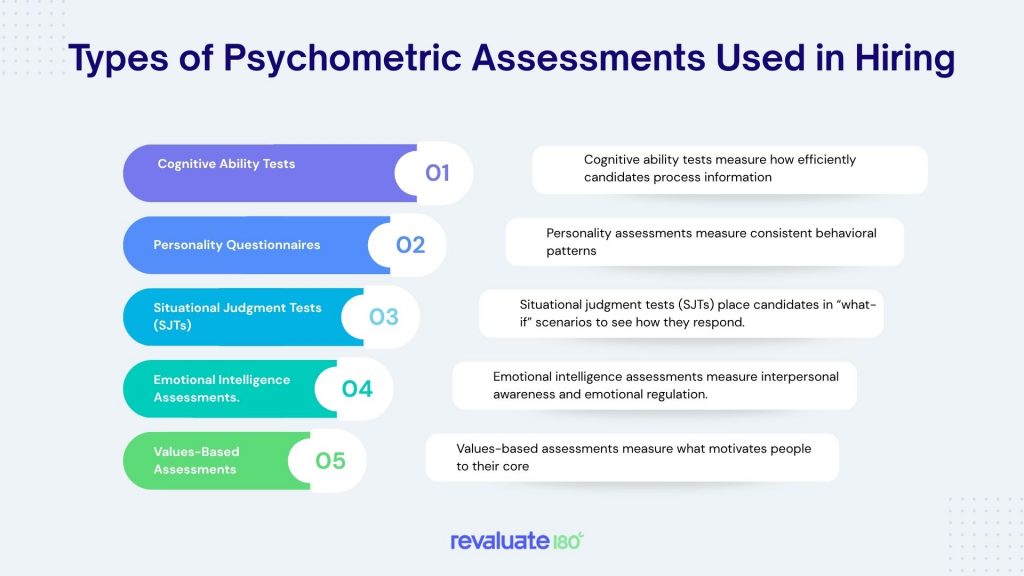
Not all psychometric assessments measure the same pointers. Different tests evaluate different dimensions of workplace behavior and capability. The best hiring system chooses assessment types based on the actual demands of the required role. Let’s see all the types:
Cognitive ability tests
Cognitive ability tests measure how efficiently candidates process information to solve everyday workplace challenges and learn new ways to address them. These assessments are widely considered among the strongest predictors of job performance, especially for roles that require adaptability when new problems arise.
Cognitive tests commonly measure factors such as numerical, verbal, and logical reasoning; abstract and critical thinking; pattern recognition; and information processing speed.
For instance, a numerical logic test may assess how effectively a candidate interprets percentages, graphs, and financial data, or how well they navigate unfamiliar problems. Organizations use cognitive assessments because modern jobs increasingly demand learning agility. Employees constantly adapt to:
- Latest systems
- Latest technologies
- Rapidly changing workflows
- Cross-functional collaboration
- Rapid business shifts
Companies always value the ability to learn and think critically over a static mind map alone. Research by industrial psychologists Frank Schmidt and John Hunter found that general cognitive ability remains one of the strongest predictors of job performance across various industries.
It doesn’t mean you can rely completely on cognitive ability. It means you can still get valuable insights into whether candidates can handle the complexity and their position.
Personality questionnaires
Personality assessments measure consistent behavioral patterns to see how candidates typically approach work and interact with others. Modern personality assessments are often based on the Big Five personality framework, known as Openness, Conscientiousness, Extraversion, Agreeableness, and Neuroticism (OCEAN).
For instance, a highly conscientious person is often dependable and detail-oriented. Another can be highly extroverted and may thrive in collaborative or client-facing environments and ecosystems.
Personality questionnaires help organizations evaluate factors including communication style, leadership tendencies, team compatibility, conflict management, adaptability, and work preferences.
While tests are very useful for understanding work style fit, they should never be treated as pass-or-fail filters. Since there is no universal benchmark for profile testing, different roles require different strengths. A highly competitive sales ecosystem may reward assertiveness and resilience, while operational and analytical roles can get strategic benefits from structure and consistency.
Situational judgment tests (SJTs)
Situational judgment tests (SJTs) place candidates in “what-if” scenarios and ask how they would respond. These assessments simulate real-world decision-making. Candidates can be asked questions related to:
- What would you do if our client or a customer became upset?
- What is your decision-making process while handling a conflict with your teammate or a customer?
- How would you prioritize competing deadlines under pressure?
- How would you respond if you ever encounter an ethical dilemma at work?
SJTs are crucial assets because they evaluate applied judgment rather than theoretical learning. These tests assess how candidates think through realistic workplace situations rather than asking them to describe themselves. Organizations commonly use situational judgment tests for:
- Leadership recruitment
- Customer service roles
- Healthcare hiring
- Graduate recruitment
- Operational management
- High-pressure environments
Another major advantage of SJTs is objectivity. Candidates engage with scenarios similar to the challenges they may encounter in their roles. This creates more practical insights into workplace behavior.
Emotional intelligence assessments
Emotional intelligence assessments measure interpersonal awareness and emotional regulation. These types of tests can help understand areas such as:
- Self-awareness
- Empathy
- Relationship management
- Emotional regulation
- Social awareness
- Communication sensitivity
Emotional intelligence has become increasingly vital in modern workplaces. Technical competence alone is rarely enough for leadership to collaborate with roles, so managers today must navigate team dynamics, remote communication, cross-functional collaboration, employee engagement, and workplace conflicts.
Employees with strong emotional intelligence often perform better in environments that require empathy, adaptability, and effective communication. This is particularly useful for leadership and client-facing positions, as well as team management and HR operations.
Remember: While emotional intelligence assessments should not replace other evaluation methods, they can bring insights into interpersonal effectiveness factors.
Values-based assessments
Values-based assessments measure what motivates people to their core. This is the layer many hiring systems skip entirely. Traditional psychometric tests mostly focus on:
- Capability
- Behavioral tendencies
- Cognitive performance
- Personality patterns
Values assessments explore something beyond. It has the capability to tell you why someone behaves the way they do, for instance:
If two candidates may both appear highly conscientious, but one may have been motivated by stability, security, and predictability, while the other naturally gravitates towards innovation, recognition, and achievement. These two differences can significantly alter the trajectory of your success, as their values profoundly influence motivation, engagement, leadership capabilities, and team dynamics.
This is where we stand with the evaluation. Instead of assessing only performance capabilities or personality style, values-based assessment helps organizations understand the underlying drives behind workplace behavior. This is where you can significantly improve your hiring outcomes.
Why Companies Use Psychometric Tests in Recruitment
Psychometric assessments have become increasingly popular because companies want their hiring decisions to be firm and reliable. Since traditional hiring methods are inconsistent, interviews vary between hiring managers. While personal bias influences perception, resume screening often becomes a presentation rather than an actual fit test. This is why psychometric assessments are crucial:
They predict job performance better than interviews
One main reason is that companies demand predictive accuracy in the versatile workspace. A landmark meta-analysis we saw earlier has found that cognitive ability tests significantly outperform unstructured interviews when predicting job performance. This clearly indicates that general mental ability assessments are among the strongest predictors of workplace performance across industries.
This matters because unstructured interviews are surprisingly unreliable. Interviewers often make decisions based on confidence, likability, similarity bias, communication style, and first impressions.
They reduce unconscious bias in the selection process
Hiring bias remains one of the biggest reasons for growth stagnation. Even experienced recruiters are influenced by unconscious preferences. Hiring decisions are often affected without conscious awareness by factors such as names, accents, socio-economic background, gender, ethnicity, shared interests, and personality patterns.
Regulating the psychometric test helps reduce this issue because every candidate completes the same assessment under the same scoring framework across all departments. This results in greater evaluation accuracy, leading to less confusion.
Doing this does not completely eliminate bias, but it significantly reduces the amount of subjective filtering that happens early in the process.
They save time and money at scale
Recruitment is a long and expensive process. Hiring teams spend countless hours reviewing resumes, scheduling interviews, conducting screening calls, and assessing unsuitable candidates. But when it comes to online assessments, it allows employers to screen large applicant volumes quickly, prioritize high-potential candidates, reduce interview loads, improve recruiter efficiency, and standardize the evaluation process.
This type of assessment becomes especially valuable in enterprising hiring, graduate recruitment, retail hiring, customer support recruitment, and large-scale operational hiring. While this raises alignment issues earlier in the hiring process, it can significantly reduce overall costs.
They create a consistent hiring baseline
Having a consistency factor can bring order to your hiring. Being consistent is challenging when hiring managers are involved. Without a standardized evaluation process, hiring quality can vastly change across teams and locations.
Psychometric assessments create a universal framework that can be measured against the same benchmarks. This helps organizations improve fairness, reduce decision variability, compare candidates more accurately, improve hiring analytics, and create repeatable hiring systems. As companies scale, standardized hiring processes become increasingly important.
The Real Limitations of Psychometric Testing
Psychometric assessments are very useful for evaluating a candidate’s emotional intelligence. But they’re not perfect. One of the biggest mistakes organizations make is treating assessment results as a beacon of success rather than a layer of insight. Good hiring decisions require context that defines the assessments more precisely.
They can be coached or gamed
Candidates prepare for psychometric tests. Entire industries now exist around assessment coaching. Practice tests, aptitude training programs, and personality response strategies are widely available everywhere. You can find many resources online for the numerical reasoning tests, verbal reasoning assessments, and logical aptitude testing.
Preparation itself isn’t bad, but practice will definitely reduce anxiety. But we can’t ignore its limitations. Scores may sometimes reflect familiarity with testing formats rather than pure underlying capabilities. This is why psychometric testing should be conducted simultaneously with other tests, so companies can get multiple data points across all dimensions.
Standardized tests can disadvantage certain groups
These assessments are designed to be objective, but no assessment is completely culture-neutral. Language, education, socioeconomic background, and cultural awareness can all influence a candidate’s performance.
For instance, verbal reasoning tests may disadvantage non-native speakers while numerical tests may favor academically trained candidates. Cultural assumptions are embedded in scenarios, which can greatly influence interpretation.
This does not invalidate your overall testing results, but it reinforces the importance of balanced evaluation systems. You can use the strongest hiring strategies that combine the holistic factors, including assessments, structured interviews, work samples, human interpretation, and contextual evaluation.
Tip: Organizations should also regularly audit assessment processes to ensure fairness and avoid adverse impact.
They measure what someone can do, not why they do it
This is arguably the biggest blind spot in standard psychometric tests. Cognitive assessments measure candidates’ capabilities, so personality assessments measure behavioral tendencies. But neither can fully explain the motivations behind the decisions.
A candidate may have high intelligence, excellent communication skills, and a strong personality on paper. But they can still leave within six months because the environment conflicts with their deeper priorities. This is where value alignment becomes critical. Organizations that focus only on competence often miss the human drivers behind sustainable performance.
Blind spots exist in the assessor, not just the assessment
Even excellent assessments are still interpreted by humans, so they often introduce bias.
For instance, hiring managers may overvalue profiles similar to their own. Results may be interpreted to confirm existing impressions. High scores may overshadow concerning behavioral indicators, and low scores may unfairly eliminate unconventional candidates.
The tool itself isn't enough; the surrounding hiring process matters just as much. The assessment data should guide conversations, not replace judgment entirely.
The Layer Most Hiring Processes Skip: Values Alignment
Most hiring systems focus heavily on whether candidates can perform the role. Far fewer can evaluate whether candidates’ motivations are well-aligned with everyday conflicts. That missing layer may explain many hiring failures you encounter on the go.
What’s the difference between personality and values?
While personality describes how someone behaves, values describe what drives that behavior. This is a critical distinction: two employees may both appear highly ambitious, but one may be rightfully motivated by competition, recognition, and status, while the other is driven by purpose, creativity, and contribution.
They may look similar from the outside, but they operate from completely different motivational systems. These differences shape every decision-making, leadership preferences, conflict triggers, team compatibility, and workplace satisfaction.
Why values misalignment is the silent killer of good hires
Many employees leave jobs they are fully capable of doing for various reasons, such as priorities, conflicts with company culture, leadership styles that clash with personal values, reward systems that feel misaligned, and work environments that drain rather than energize them.
Someone may pass every interview and every psychometric assessment, but if the environment fundamentally conflicts with what motivates them, retention becomes fragile.
What values-based assessment adds to the picture
Value-based assessments add depth to your hiring decisions by helping your organization understand candidates’ motives, the environments that energize them, the leadership styles they respond to, workplace dynamics that create friction, and the priorities that influence their decision-making.
Doing this allows companies to move their goalposts beyond surface-level compatibility. Instead of asking whether the person can do the job, these tests ask whether the person can thrive in such an environment. This distinction changes hiring quality significantly.
Team-level analysis: the dimension most tools ignore
Most psychometric tools are designed to focus on individual candidates. But hiring never happens in isolation, and every new hire changes the team dynamic. This is the point where many recruitment systems fail.
A candidate may perform well in an individual setting, but still disrupt team cohesion if motivational patterns clash with the broader group. Value-based team analysis can immensely help organizations understand their communication compatibility, motivational diversity, potential conflict points, leadership alignment, and collaboration dynamics.
This becomes especially crucial in leadership teams, startup environments, cross-functional departments, and high-collections roles. The strongest hiring systems evaluate how people integrate into existing systems.
How to Use Psychometric Assessments Effectively in Your Hiring Process
Psychometric testing works best when integrated mindfully across your hiring strategy. The goal is not to automate human judgment but to improve the decision quality.
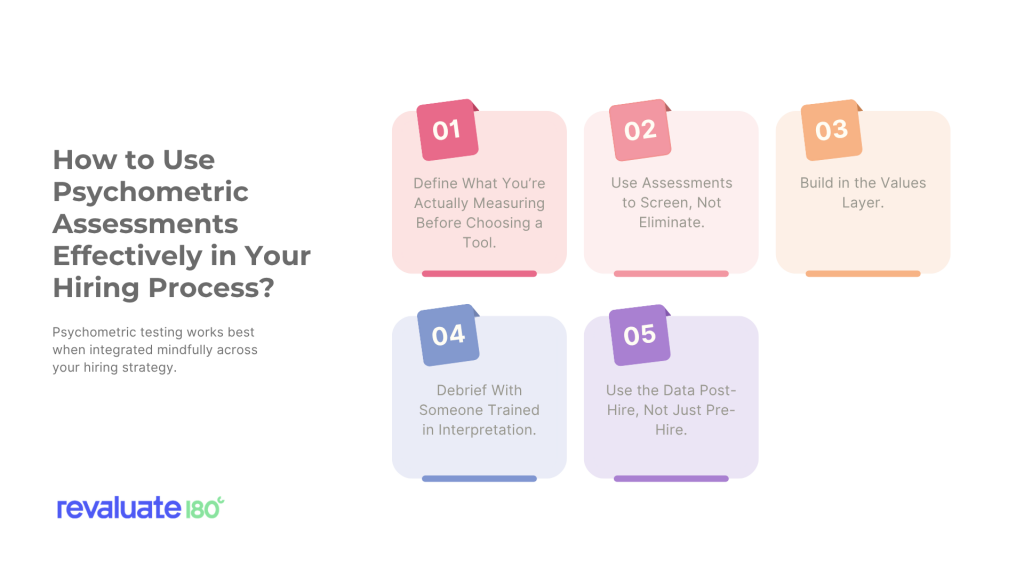
Step 1: Define what you’re actually measuring before choosing a tool
The very first step should always be about understanding the role itself. Many organizations select assessments before clearly defining their job description and priorities, but the first step should always be to determine which metrics you need to measure the indicators.
You can always start by asking questions like:
- What cognitive demands does this role implicate?
- How much ambiguity exists in this role?
- What interpersonal dynamics matter most?
- What behaviors meet the success metrics?
- What values align with this environment?
Different roles require different assessment strategies. For instance, financial analysts may require strong numerical reasoning, sales professionals may require resilience and interpersonal influence, and leadership roles may require emotional intelligence and decision-making under chaos.
Step 2: Use assessments to screen, not eliminate
Psychometric assessments should serve as one perspective, not the final verdict. The strongest hiring systems combine multiple evaluation methods, including structured interviews, technical testing, work samples, reference checks, behavioral interviews, and values-based analysis.
Since no test can provide all the insights, treating assessments as rigid elimination tools, organizations should use them to identify areas for discussion, highlight strengths, surface development needs, guide interview questions, and compare patterns across candidates.
Step 3: Build in the values layer
This is where many hiring systems are incomplete, since many organizations often assess intelligence with competency, and communication style with personality.
You can add a values-based assessment that aligns candidates’ motivations and helps organizations predict engagement, turnover, cultural compatibility, team integration, and leadership alignment.
Step 4: Debrief with someone trained in interpretation
Assessment results require nuance since raw scores alone can mislead a trained organizational psychologist or qualified practitioner who can help interpret behavioral trade-offs and contextual strengths.
Also, since these tests cannot reveal the overall pointers, interpretation matters as much as testing itself.
Step 5: Use the data post-hire, not just pre-hire
Many organizations lose their assessment data after recruitment. But that’s not the right strategy. The same insights you’ve gathered can help you improve your onboarding process, leadership coaching, team communication, employee development, conflict management, and career planning.
For instance, you can reveal a new hire’s motivational drivers through a well-tailored feedback style and communication opportunities. This can transform assessment data into a long-term talent strategy rather than a one-time hiring exercise.
Skills Get Them In. Values Keep Them.
Traditional psychometric assessments are also crucial because they help organizations evaluate cognitive and problem-solving abilities, as well as behavioral tendencies that define their workplace judgment and communication style.
Since modern hiring requires a more complete picture, organizations are no longer hiring for capability but for engagement, adaptability, team dynamics, leadership alignment, and long-term retention strategies. This is where values need to be aligned with the role.
A candidate can possess every technical skill required for a role and still struggle if the environment conflicts with what drives them at a deeper level. A strong hiring system understands both a candidate's motivation and intent.
R180's values-based assessment goes beyond traditional psychometrics. It surfaces what drives people at a core level, corrects for unconscious bias in how we read others, and gives leaders a team-level picture rather than just individual scores. Used in recruitment and beyond, it turns hiring data into a long-term talent strategy.