A team's performance and outcomes depend on multiple factors that shape the entire lifecycle of its dynamics. It is important to track key metrics that determine the productivity and capabilities of all team members, ensuring the team's performance meets client/customer expectations.
In addition to collecting metrics on individual team members, team performance measurement involves aggregating and analyzing individual metrics and determining how they affect outputs.
In this guide, we’ll learn more about tracking the key metrics that help determine how effectively a team is performing and how to improve each metric to ensure consistency.
TL;DR
- Periodically evaluating a team’s performance is essential for companies and leaders to better understand and support their teams.
- Some essential metrics to track include productivity and output checks, quality checks based on feedback and reviews, adherence to timelines and deadlines, engagement and collaboration levels, and task-specific KPIs.
- Tracking performance metrics must be adaptable to the team and the nature of their work, to fairly review and recognize effort.
- Performance metrics can sometimes deceive decision-makers, necessitating a deep analysis of behavioral insights and patterns that influence team dynamics and performance.
Why Measure Team Performance?
Companies and HR professionals must periodically audit the factors that contribute to a team’s performance and analyze the root causes of inabilities to meet performance expectations.
Here are some common insights that we can derive by diving deep into team performance metrics and measures.
Helps you understand what’s working and what is not
Suppose your company came up with a new strategy where teams must log into a tool twice a day, in the morning and before winding up work, to discuss tasks at hand and tasks completed. The tool keeps track of tasks and sends reminders to let employees know their pending tasks and update them in the tool.
While this can be a great way to track timelines and schedules, some team members may feel this is an additional burden, especially during critical work tasks, impacting overall productivity and team performance. Assessing how a team functions from time to time helps improve performance.
Improves decision-making
A lack of clarity among team members can affect the way the team makes decisions at different stages of a task schedule. Similarly, unclear expectations and unrealistic task schedules set by leaders and higher management can burn out the team and affect its performance.
Understanding such parameters and helping team members clarify their work requirements helps them make informed decisions that the whole team agrees on. Team decisions must be collective, not made by leaders or a few members.
Supports team growth and development
Consistent team performance over the long term is achieved by fostering healthy, enthusiastic teams eager to learn and grow together. So, it is crucial to ensure that the team members engage with one another beyond just work discussions and meetings.
Sometimes, small factors like cultural differences and misunderstandings can be barriers to effective collaboration among key members. Identifying and resolving such disagreements early on helps these teams to function smoothly without affecting performance.
Keeps teams aligned with goals
It is common for team members to work on multiple tasks simultaneously, which can make it difficult for the team to prioritize, ultimately affecting overall team output. That is why team leaders and HR business partners must audit how team members spend their time on different projects and tasks.
Analyzing team members' work styles, reducing their workload, and setting clear priorities help all members focus on achieving their work goals without distractions or confusion. Aligning individual goals with the team’s work goals is crucial for effective team performance.
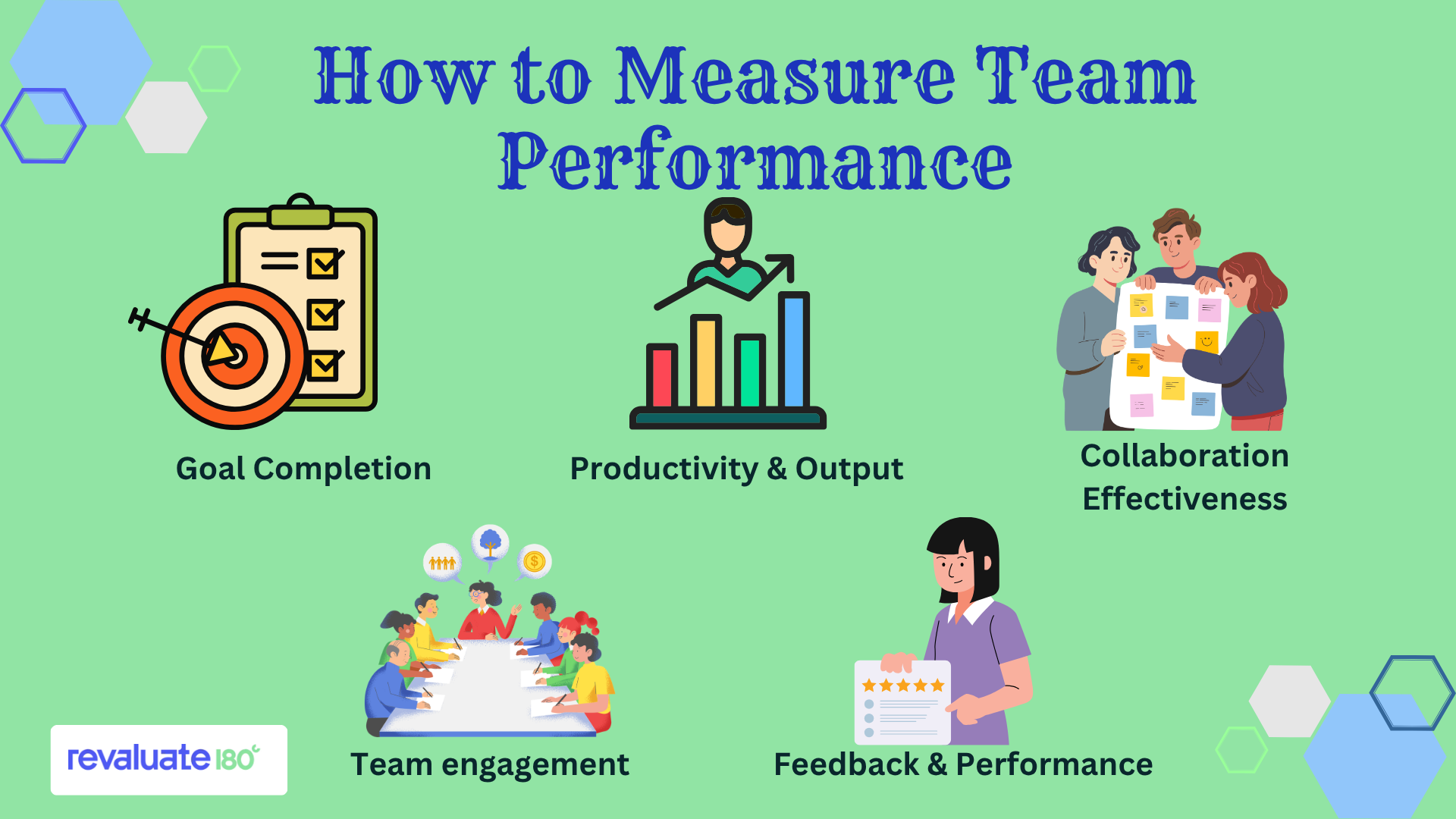
Key Metrics to Measure Team Performance
Team performance metrics measure tangible indicators of how a team is performing to achieve its goals and complete its tasks. These metrics combine individual performance indicators along with factors that influence a team’s work dynamics to give an overall analysis and insights into how a team is faring.
Here are the main areas HR professionals and leaders must focus on when measuring team performance.
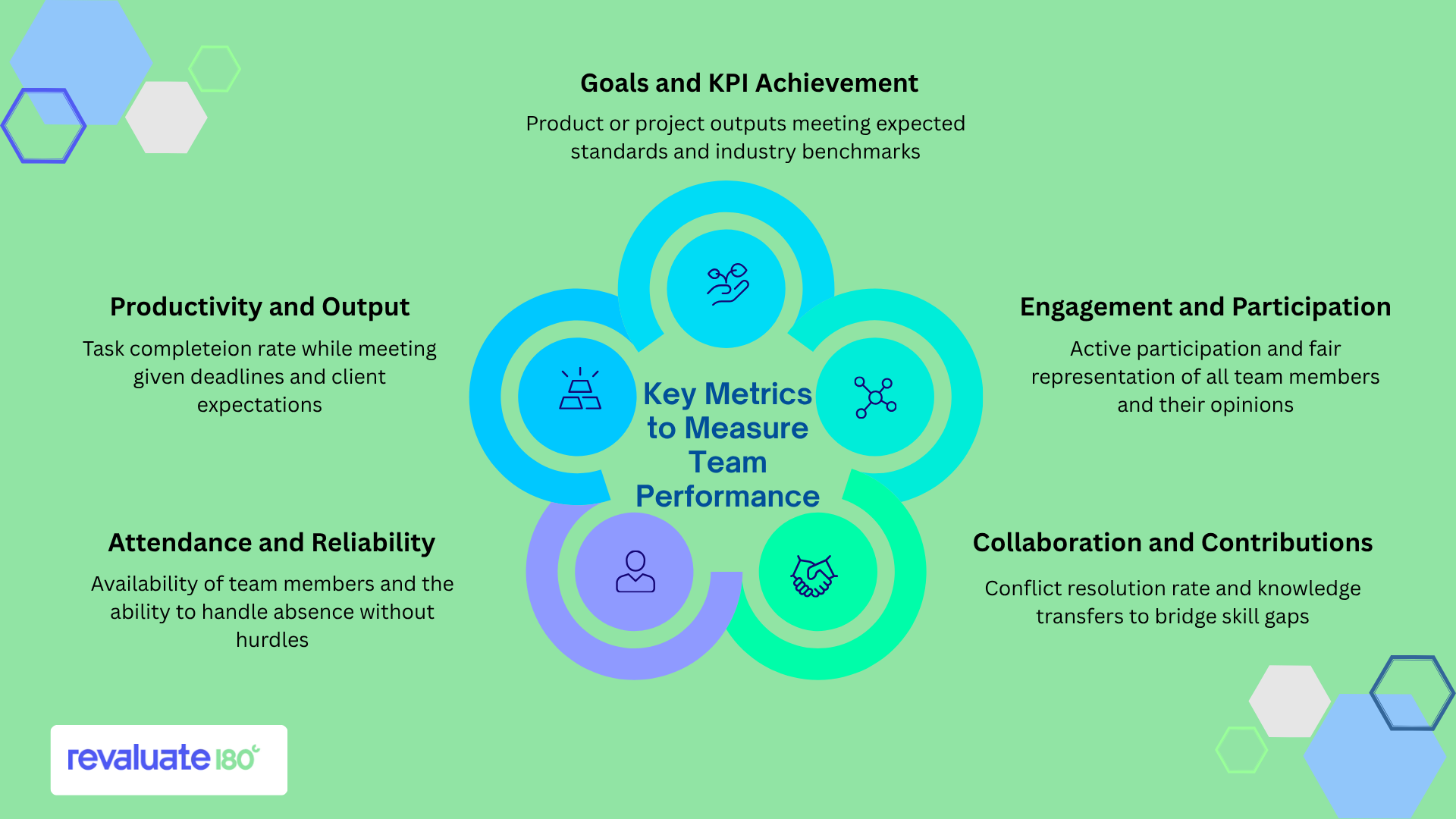
1. Productivity and Output
The end product or service that a team delivers at the end of a project or task schedule is undoubtedly a visible metric for measuring the team’s effectiveness. Clients and customers can easily judge the team’s work performance by comparing the end result with their requirements and expectations.
Key parameters to measure performance include:
- The percentage of work or product assembly completed within the given time frame.
- Ability to meet deadlines while completing smaller sprints or project phases to show progressive outputs.
- Final overall output evaluated against client expectations and mandatory parameters.
Companies can prepare proprietary checklists to ensure processes and compliance policies are completed before delivering the final output, making it easier to verify and evaluate the required performance metrics.
2. Quality of Work
Quality evaluations at different stages of a work schedule help teams understand how they are handling requirements, any additional changes, technical glitches, and skill shortages. Since most work tasks involve stakeholder reviews and feedback at the end of each work phase, teams can address any quality issues before proceeding to the next project phase.
Key indicators that reflect how a team focuses on work quality include:
- Error rates due to skill deficiencies, absence of key members, or other reasons.
- Number of times a task had to be redone or reworked to meet expected requirements.
- Feedback and ratings from customers or clients on their satisfaction with recent developments.
Measuring error rates and customer feedback helps identify any confusion, communication gaps, or technical roadblocks that can be rectified by the team members or by seeking aid from other professionals and peers.
3. Efficiency and Workflow
Efficiency metrics measure how your team members function on average during a project phase. These metrics are crucial for identifying key team members who contribute the most, and for supporting passive members to engage better and improve their performance.
Key metrics to measure work efficiency include:
- Task completion times - more time taken would require retrospection and analysis.
- Bottlenecks encountered during negotiations, discussions, technical implementations, testing, retrospection, and other project phases.
- Process efficiency through metrics such as time between handoffs of project phases, active time vs. idle time, task cycle times, and similar timestamping metrics.
Measuring process efficiency is crucial to understanding how internal or external factors influence individual contributions to team efficiency.
For instance, higher idle times indicate employees spending less time on work-related tasks. Similarly, quick handovers and initiation of subsequent project cycles indicate smooth functioning of teams.
4. Engagement and Participation
Team engagement levels and involvement are direct metrics that indicate the level of enthusiasm team members have for giving their best performance. Involvement of team members in work-related activities and recreational initiatives helps leaders identify disengaged employees and find ways to better engage them.
Key indicators to denote engagement levels and team participation metrics include:
- Level of involvement and participation in discussions and meetings, formal or informal.
- Willingness of every member to make contributions in every activity, role play, and critical project phases.
- Participating in feedback surveys and providing meaningful feedback rather than just name-sake responses.
Engagement surveys are among the most useful tools for measuring engagement levels and gaining insights into the factors that hinder the active engagement of one or more employees in the team.
5. Collaboration and Team Contribution
Teams seldom function as standalone entities, and often require interactions and collaborations with other teams, clients, and third-party stakeholders for discussions and project implementations. It is during such instances that a team gets to exhibit its unity, skill sets, and decision-making prowess, which subsequently ensure smooth collaborations to improve performance.
Key metrics that measure a team’s ability to leverage its strengths include:
- How the team stays united and works across different phases, including gathering requirements, designing, implementing, testing, and retrospecting.
- Having regular sessions to share knowledge and skills so that every team member is proficient in all the skills required for the team’s work tasks.
- Support within the team, such as handling the sudden absence of a key member, taking up work tasks without causing burnout for team members, and so on.
These metrics are crucial for understanding the team’s work culture and assessing whether they align with the company’s core values and business goals.
6. Attendance and Reliability
Physical presence at the work desk or active hours online (for remote employees) are significant indicators of the time employees spend on work tasks and team discussions. Employee presence or availability is a sign that team members and leaders can rely on them to complete tasks within the given time, while absence can hinder productivity, depending on the duration or reasons for the absence.
Key indicators of how reliable employees are for their teams include:
- Absenteeism or the time, hours, or days when employees are away from work apart from the PTO hours provided by the company.
- Punctuality among employees, such as showing up during a team's core work hours, not being absent without valid reasons, and similar behaviors.
- Consistency in task completion so that dependent tasks do not affect the productivity and effort of other team members.
It is interesting to note that improving employee engagement within a team directly contributes to reducing absenteeism. When team members support each other and create an environment that runs on trust and mutual understanding, employees look forward to coming to work.
7. Goal and KPI Achievement
Every industry has its own set of Key Performance Indicators (KPIs) that leaders and HR professionals use to track team productivity and performance. These metrics help pinpoint issues in core production or technical areas that can impact subsequent stages of service or product development.
Specific measures to ensure the team meets its business goals include:
- Accurate goal tracking, which includes completing individual tasks, progress goals, and contributions to team activities.
- Tracking KPIs. Examples of KPIs in a software project include the number of passing test cases, outlier coverage, stress testing results, and so on.
- Meeting project milestones and deadlines as per expectations.
How to Measure Team Performance
Now that we know the key metrics to measure team performance, let’s understand how team leaders and HR business partners should plan to measure them from the moment a team is formed.
1. Set clear goals and expectations
Teams must work with SMART goals (Specific, Measurable, Achievable, Relevant, and Time-Bound). SMART goals ensure greater alignment between individual goals and unified team goals.
Furthermore, business goals and team expectations must align with the organization’s core working policies and values, so that employees can work to their best ability in an ethical and fair work environment.
2. Choose the right metrics
It is important to shortlist and select the right performance metrics that provide accurate insights into each team. Being mindful in measuring business-relevant, team-specific, and quality KPIs helps analyze root causes of challenges within a team.
Generic metrics such as task duration, attendance, and error rates can be tailored to suit each team’s business goals. Specific metrics, such as passing test cases, manufacturing defects, and others, must not be ignored when assessing overall performance.
3. Combine data with team feedback
Data from KPIs and key performance metrics alone cannot confirm the existence of challenges or roadblocks within a team. For instance, a team member's prolonged absence from the office may not mean zero contributions, as the employee may have completed the required knowledge transfers before going on leave.
For such reasons, it is important to collect team feedback through surveys and one-to-one meetings with team leaders. This feedback data, combined with performance metric scores, can provide more detailed insights into team performance and barriers.
4. Track performance regularly
Measuring KPIs, goal completion, and tracking task schedules should be done regularly to ensure consistency in a team’s performance. This practice helps monitor individual members’ engagement levels and how it affects the team’s overall engagement.
Leaders must encourage and facilitate retrospection sessions at the end of every work/project cycle or sprint to help members analyze their strengths, areas of improvement, and how to improve in the next phase.
5. Focus on trends, not one-time results
Team performance cannot be evaluated the same way as a product or service is evaluated for final results. Performance measurement must be conducted over several periods to understand patterns and variations in key metrics and parameters that assess a team’s capabilities.
For instance, plotting the average time taken to complete four to five sprints of a project and drawing inferences from these patterns gives a clear picture of how consistent a team is, identifies any drop in performance, and digs deeper to find root causes.
6. Review results with the team
Leaders or HR business partners must discuss the results of the inferences from team performance metrics and team members’ feedback. This retrospection helps members understand how to bridge the gap between expectations and their areas for improvement.
Team reviews may be followed by workshops, role-play sessions, and discussions on what could have been avoided and how to prevent similar situations in the future. These sessions help boost employee engagement without feeling burnt out.
7. Use insights to improve team performance
Team performance insights serve as a foundation for redefining a team’s plan of action to fulfill business goals and meet task schedules. In fact, these insights can serve as benchmarks to improve your team’s KPIs and QoS (Quality of Service), ensuring the team’s performance improvement remains visible to leaders.
Hiring an HR consultant can help you get the right performance measurement parameters and derive specific insights that can help you improve your team’s performance in the desired areas.
What Metrics Don’t Show About Team Performance
Measuring team performance is not solely about numbers from key metrics that audit the progress and processes within a team. Numbers can provide details on what is happening, such as missed deadlines, slow output, quality drops, and more.
These data are merely surface-level or vanity metrics that show the top of the iceberg. But underneath lie several unexplored insights. That is why these metrics do not reveal the exact or direct reasons for a team’s performance lag.
Performance issues may not just be due to burnout or skill gaps. Sometimes the smallest of confusion or misunderstandings may contribute to large-scale problems, such as:
- The only female member of a team full of men is hesitant to share her opinions or challenges.
- Decisions getting delayed because the team’s new leader is still in the onboarding phase.
- Team members are not aligned on priorities due to differences in their work positions/designations.
- Bad communication practices because of linguistic differences among team members.
These behavioral patterns hardly show up in performance metrics because they are highly idiosyncratic and mostly disregarded.
Such performance barriers do not appear on dashboards but affect the day-to-day functioning of a team, gradually leading to declining performance and active disengagement.
That’s why it helps to look beyond metrics and focus on how the team operates. Observing behavioral patterns in a team’s collaboration, feedback, and decision-making can give you a much clearer picture of what’s working and what’s not.
Revaluate180 can support this by helping teams surface patterns in behavior, alignment, and team dynamics. When you combine these insights with your existing metrics, it becomes much easier to understand performance more fully.

Unlock AI-Powered Hiring Analytics
Transform the way you hire with insights that create aligned, collaborative, and high-performing teams.
- Smarter Hiring Decisions
- Reduce Expensive Turnover
- AI-Driven Insights
- Optimize Team Performance