Today, most global attrition and turnover is attributed to company culture. It's interesting to note that turnover happens even in some of the best corporate workplace cultures.
Then, where does the dissatisfaction come from?
Company values often receive less attention than a company's workplace culture. Sometimes, the terms culture fit and values fit are used interchangeably, when there are significant differences between them.
We’ll learn how affirming a company's values is just as important as maintaining a great work culture for attracting and retaining the best talent in your organization.
TL;DR
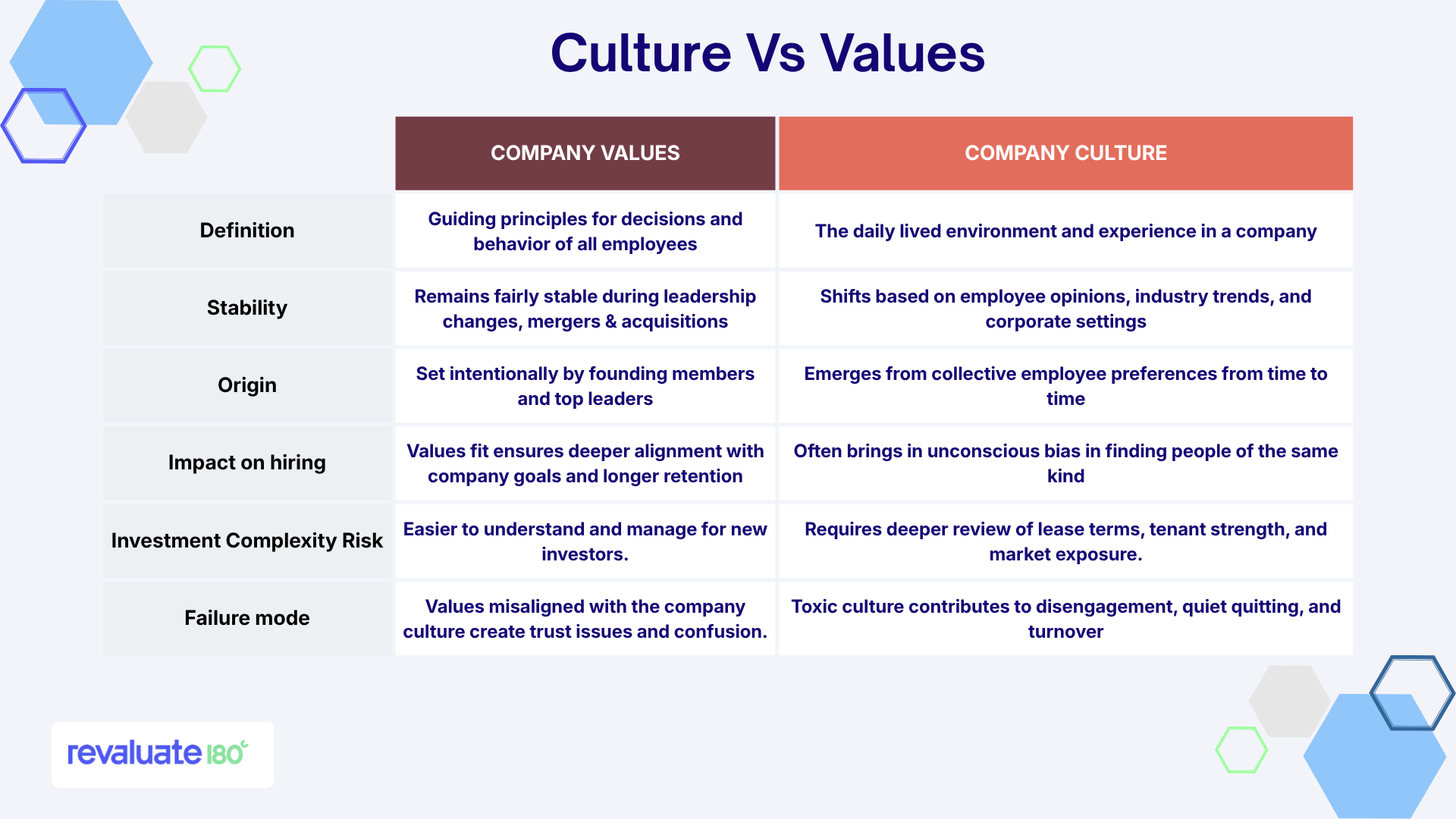
- Culture refers to the working environment that employees experience every day, including leadership styles, engagement, and collaboration.
- Values are the core principles companies must remain rooted in to grow and excel in their business.
- Failing to distinguish between culture and values results in employees who aren't "aligned" with the company's core values, and who therefore can't function effectively.
- Values fit is a durable and reliable predictor of an employee's performance and retention.
Why People Confuse Culture and Values
Many workplaces still use the terms company culture and values interchangeably in most of their official documentation - job descriptions, onboarding decks, HR conversations, and leadership addresses. Ideologically, culture and values are two different concepts.
A lack of clarity around culture and values often leads to assumptions and biases, ultimately resulting in hiring decisions based on personalities or "vibes" rather than verified alignment with the company's core values.
For example, a company had a senior executive who'd worked with them for 20 years. He was the go-to person who could come up with cost-effective solutions to any of the team's client requests. When a client wanted him to take ownership of their new module and manage it on their behalf, he wasn't willing to take on the additional responsibility. This caused the client to cut ties with the company and find another partner.
An effective senior executive failed to take responsibility and accountability for work entrusted to him by the company's esteemed client. This incident is a clear example of how job expertise and values are completely different and require dedicated evaluation frameworks.
In short, an employee being culturally fit doesn't equate to being fit by the company's values.
Bad hires cost companies around 30-50% of their annual salary. Let's look at why leaders and HR professionals must know how to distinguish between culture and values when making the right hiring decisions.
What Are Company Values, Really?
Values are the core beliefs and principles set by a company's founders and top management from inception. Just like team values, they are the guiding forces that all employees, old and new, must align with to help the business scale and grow as envisioned by its leaders.
Values are non-negotiable, stable company principles that guide decision-making and conflict resolution, and help set priorities. These values don't change even with rebranding, business partnerships, or changes in the CEO or C-Suite.
For each individual, values may fall into different categories. Authentic values are the ones employees follow as part of their belief system, shaped by their background, culture, education, and other factors. Performative values, on the other hand, are the ones employees and leaders adopt in different workplaces in order to blend in.
Stated values are the ones companies include in their vision and mission statements, encouraging all employees to follow them diligently in every workplace activity. Lived values show how employees actually work.
The gap between stated values and lived values reveals how aligned employees are with the company's value system, and offers critical insight into employee engagement and retention.
Company Values Examples in the Workplace
Just like team values, company values outline the ethical guidelines that every employee, from the CEO down to entry-level workers, must follow.
Common examples of company values include:
- Transparency: being open about decisions, challenges, and the "why" behind them, not just the "what."
- Psychological safety: creating space where employees can speak up, disagree, or admit mistakes without fear of repercussions.
- Customer-centricity: making decisions with the customer's best interest at the core, not just what's convenient internally.
- Ownership: taking responsibility for outcomes, not just tasks, even when things go wrong.
- Being results-oriented: focusing on outcomes and impact, not just effort or activity.
How do these values apply to all levels?
For instance, transparency for a junior executive might mean knowing how their team or company is handling a crisis situation in a timely manner. For a C-Suite leader, transparency might mean staying aware of what leaders working under them are doing and understanding how top management makes decisions before announcing them to the rest of the company.
What matters for companies is how a value is implemented in real time, not whether it's just exhibited as a decorative asset. Values must be reflected in everyday conversations and work dynamics without any trade-offs.
What is Company Culture?
A company's culture is a living expression of its values. Culture is way beyond what you see on a company's "Careers" page or in articles on their professional networks.
Company culture, or corporate work culture, is shaped by everyday happenings in a company - when employees arrive at work, engagement activities within and between teams, cafeteria breaks, leadership styles, internal communications and feedback, and so on.
A company's culture must be adaptable and shaped by industry trends. A good work culture depends on leadership behavior, hiring practices, recognition patterns, communication styles, and company policies and rules.
Similar to team culture, a company's work culture is always present wherever people work; what matters is which practices are more dominant.
While cultures evolve over time with industry challenges, values remain the guiding pillars. Shifting value bases happens only over a long period, after a company has reached certain growth milestones.
What Shapes Culture Day-to-Day?
As mentioned earlier, culture stems from the regular activities that occur within a company. The fairness of these activities collectively contributes to a great culture or a toxic workplace environment.
Some of these activities include:
- Who gets promoted, and why?
- What behaviors get rewarded, and why?
- How are conflicts and disagreements handled?
- What do the first 90 days look like for a new hire?
- How does the company communicate critical information to its employees?
- How can employees share feedback so it reaches the right people?
How employees feel about how a company handles these situations goes a long way toward shaping their opinion of whether its stated cultural claims actually match reality.
Culture vs Values - The Core Differences
Culture Fit vs Values Fit in Hiring
The most obvious hiring criteria set by hiring managers is to find people who would suit the company culture. In other words, people like themselves who have thrived in the company.
This very thought, though well-intentioned, is fundamentally flawed.
Looking for people like themselves often creates an unconscious bias toward similar backgrounds and academic profiles, which kills diversity and innovation. So hiring for cultural fit actually introduces more bias. And with rapid cultural change, hiring for cultural fit brings even more ambiguity.
This is where hiring for values fit brings the change companies need. Questions about values alignment go beyond academic qualifications and dig deeper into a candidate's core values and belief system. Assessing for values fit shows that two employees with completely different personalities can both be strong value-fit hires.
Questions That Actually Reveal Values Alignment
Most questions on personality and values are often saved for the final round of assessment after the hiring decision is made. However, there must be a dedicated evaluation round in the hiring pipeline, alongside technical interviews, to assess how candidates respond to different situations.
Here are some examples of questions to test candidates’ value alignment and relevance to the company’s values.
- "Tell me about a time you disagreed with a decision but had to execute on it. How did you handle it?"
- “What does accountability mean to you in practice?”
- "When have you prioritized doing the right thing over the easy thing?"
- “Have you ever thought about yourself being a misfit in your earlier companies? If yes, why?"
- “How have you handled differences of opinion among your colleagues?”
Answers to these questions reveal a candidate’s true values in action, rather than simply showing whether they'll fit in.
When Culture and Values Fall Out of Alignment
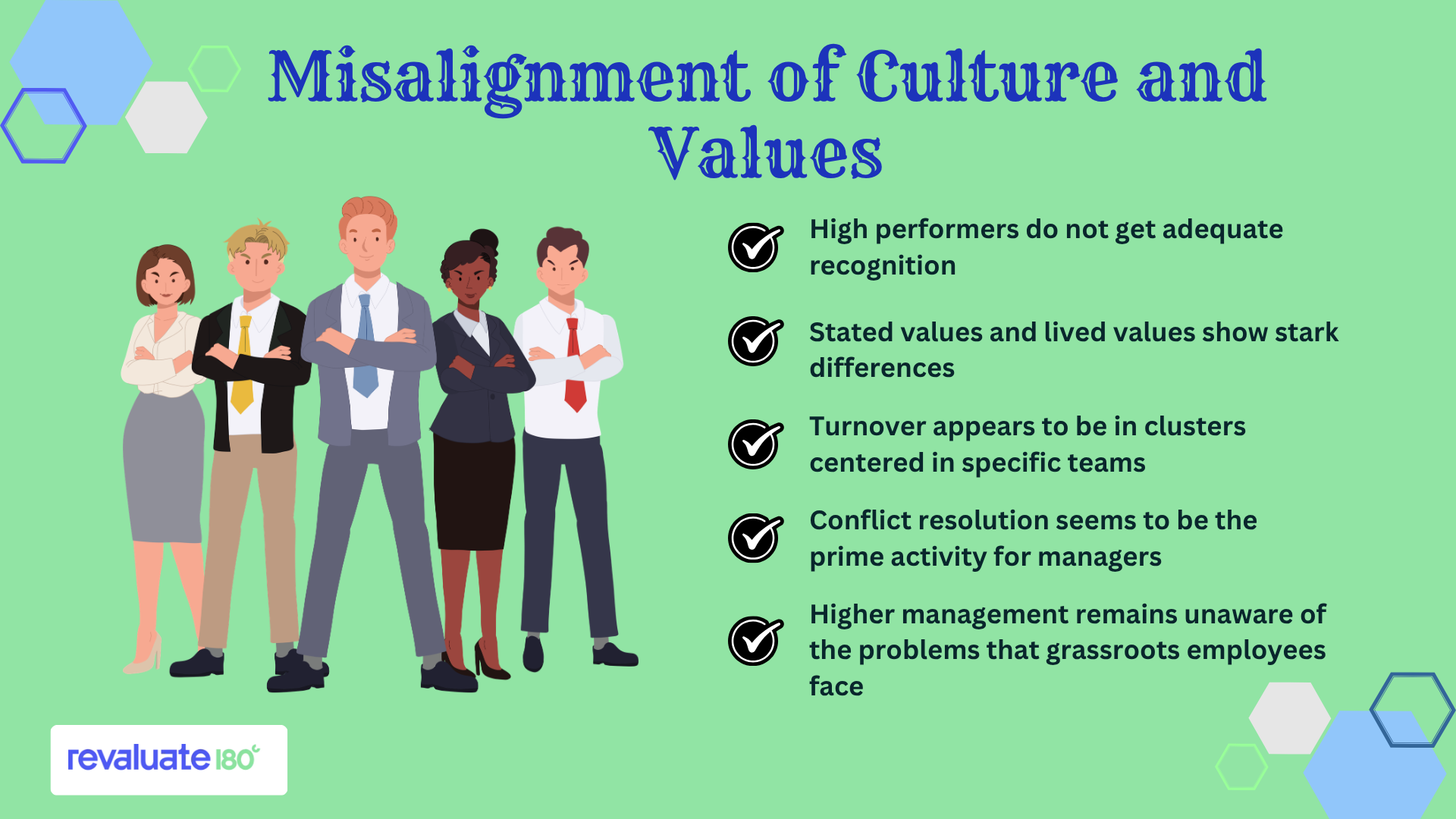
An ideal company culture aligns with the company’s core values in all aspects, such as delivering results, engaging employees, appraising them on time, and creating a psychologically safe working environment. When culture and values diverge, things get out of hand.
Culture and values begin to diverge when these signs increase:
Employees start noticing the gap between a company's stated values and what actually happens. When stated values prove to be mere projections on paper and in promotions, employees begin to show their frustrations.
Company culture works in a top-down manner. Ideal culture practices must begin from the top management and filter down to each level of leaders and team members. If leaders do not embody values, culture slowly drifts.
Common inflection points that cause rapid cultural drift include rapid cost scaling, mergers and acquisitions, leadership changes, and shifts to remote or hybrid work.
The Real Cost of Misalignment
1. Employee engagement: Engagement levels determine how involved employees are in their work and workplace. Culture shifts first show up as a drop in engagement, leading to employee disengagement, which in turn triggers quiet quitting.
2. Lowering productivity: A tense work environment has a direct psychological impact on deteriorating company culture. Naturally, employees focus less on innovation and productivity, leading to financial losses for the business.
3. Retention risk: Bad workplace culture is one of the top reasons for employee turnover around the world. A declining workplace culture can become a real pain point for companies trying to retain their top performers and best employees.
An iHire survey shows that nearly 53.7% of US employees have quit their jobs due to a toxic work environment, and almost 75% agree they have worked in a company with a toxic work culture.
How to Build Alignment Between Culture and Values
Setting values and aligning them with company culture is a crucial step leaders and organization heads must revisit at every milestone of a company's growth.
Leaders must set practical examples by living the values themselves, not just preaching their importance during onboarding and appraisal meetings.
1. Start with values genuinely held
Core values shouldn't exceed 10 to 12 in any company, since most values can be classified as subcategories of broader core values. Values such as transparency, integrity, respect, accountability, and trust apply to all employees, regardless of their roles.
Brief incoming candidates and provide periodic reminders to existing employees on how to uphold the company's core values through role-specific actions. This clarity helps prevent stated values from becoming merely decorative.
2. Make values operational
Values only start to matter when they're tied to performance appraisals, recognition, and appreciation. Career progression must include sufficient values criteria, especially for leadership roles, so that those who take accountability, communicate transparently, and handle conflict well are prioritized alongside their technical expertise.
Leaders and managers should encourage peer recognition, rewards, and appreciation for exemplary values exhibition in their teams. For instance, someone who consistently gives honest feedback on company initiatives might be recognized by their team for their candor.
3. Hire and develop for values fit
Values assessment must be an integral part of the hiring process. Expected values should be clearly specified in job descriptions and advertisements, signaling that your company takes values alignment as seriously as technical expertise.
Behavioral and values assessments, followed by situational interviews from technical recruiters, help critically analyze how candidates will fit into the company in the long term. More than role fitness, it's values fitness that determines retention for the company.
4. Create feedback loops
A values assessment model can feel overwhelming if it hasn't been part of your hiring and onboarding process before. Survey your employees on whether they actually experience the stated values in their day-to-day work.
These feedback surveys also help identify gaps between stated and lived values and the levels that contribute most to deviations between values and the actual work culture. This makes it easier to address value deviations early, before employees begin to disengage or quit.
5. Make the leadership the culture lever
All leaders in the company, especially the CEOs and C-suite members, must be living examples of the values practiced every day. Values propagate top-down, and if leaders adhere to certain ethics and guidelines, the whole organization will follow suit.
Practical Steps for Leaders
Here are some practical steps for leaders to align values with culture:
- Conduct periodic audits of value gaps to assess whether employees are experiencing and adhering to your core values.
- Use structured assessments to surface values alignment in hiring, avoiding gut instinct and unconscious bias.
- Tag value moments in everyday incidents to build awareness, not just talk about values during all-hands meetings.
- Invest in tools and platforms that support accurate values assessment and insight.
Stop Guessing at Alignment - Here's How R180 Helps
Culture fit and values fit are often relied on heavily in gut instincts when selecting candidates for job roles, and this practice is still followed. Such biased preconceptions are not systemic and are prone to error.
Revaluate180 aims to solve this very specific problem: aligning culture and value fit for maximum employee retention. We conduct values and behavior-based assessments that reveal how people make decisions based on their beliefs.
R180’s data-driven model identifies values, behavioral patterns, and “value blockers” based on a candidate’s background and the factors that shape how they think and work. These unconscious biases and blind spots prevent individuals from executing the stated values into actual performance.
Our assessments and workshops are ideal for making the right hiring decisions, auditing team alignment, leadership development, and crafting retention and engagement strategies. We have helped executives, HR leaders, and founders who seek clarity on what is actually driving team performance and not just what looks good on paper.
If your team's performance gaps feel unexplainable, the problem is likely alignment, not capability. Our structured team assessment gives leaders a clear picture of what's driving behavior, where the disconnects are, and what to do about it. No guesswork. Book a free 30-minute call with us.

Unlock AI-Powered Hiring Analytics
Transform the way you hire with insights that create aligned, collaborative, and high-performing teams.
- Smarter Hiring Decisions
- Reduce Expensive Turnover
- AI-Driven Insights
- Optimize Team Performance