Understand how a wrong hiring decision can lead to catastrophic consequences for a company, including financial losses and employee turnover. We share with you some of the proven techniques to avoid hiring mistakes in today’s AI-driven hiring practices.
A popular company's recruitment team was confident in their selection process after coming across a candidate who perfectly matched their role expectations and skill requirements. Little did they realize they had chosen the wrong person, someone who was derailing the newly joined team, causing several of the best performers to quit and move elsewhere.
Let's admit it. Recruitment teams are like any other business unit working on tight timelines to get the best candidates from the job market.
Despite well-established guides and steps in the hiring process, most decisions still rely on gut instincts and preconceived notions.
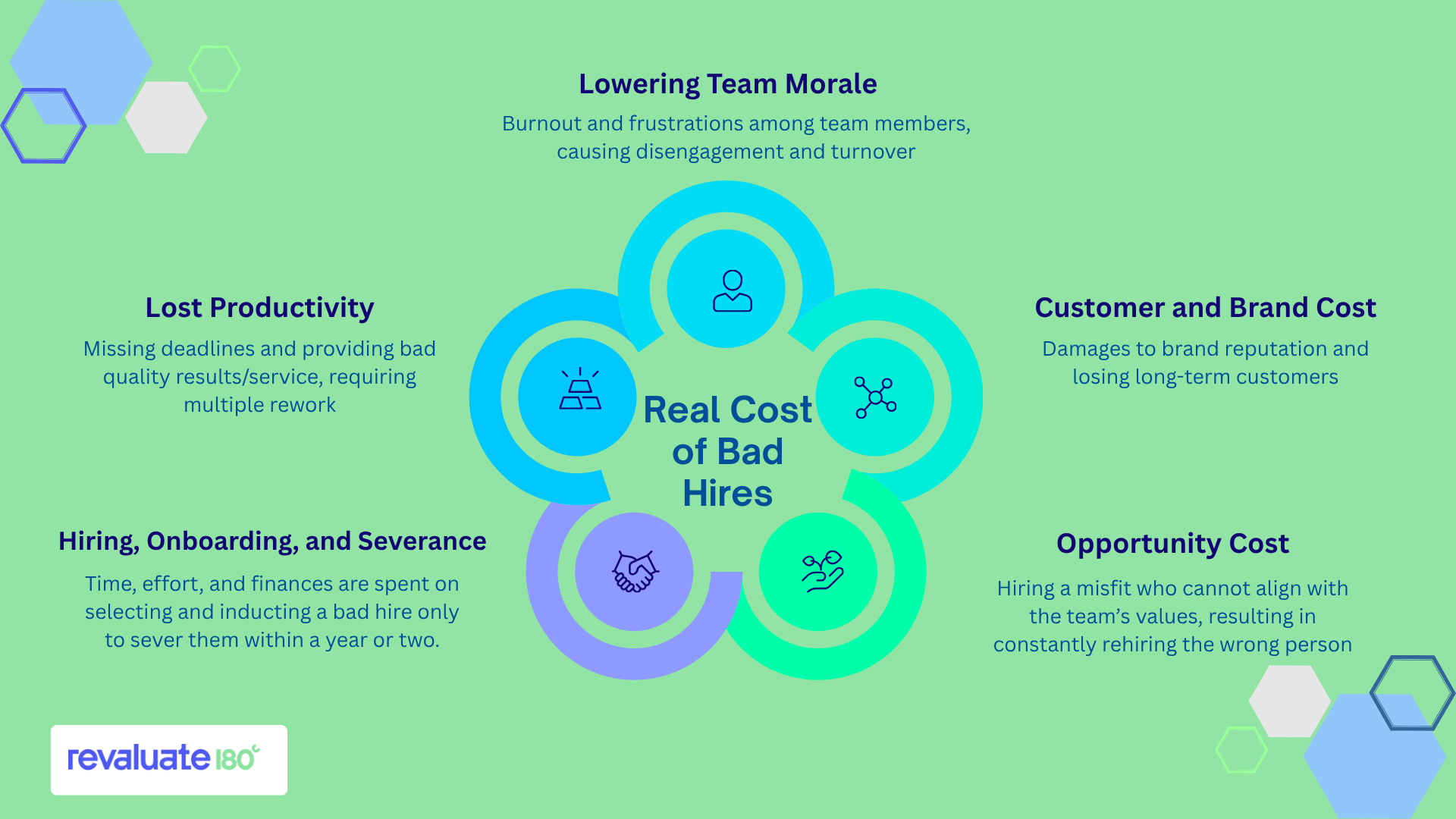
The real cost of a bad hire isn't just wasted paycheques and benefits. There are far more visible and invisible forms of damage.
Understanding how a wrong hiring decision can lead to a catastrophic ripple effect for a company, affecting finances and retention, is crucial. Below, we share some proven techniques to avoid hiring mistakes in today's AI-driven hiring landscape.
TL;DR
- One bad hire costs 30% to 150% of the person's annual salary. But there are more unfathomable costs that leave companies confused about where they went wrong.
- The less obvious costs include lost productivity, low team morale, time and effort spent by leaders and managers, and declining customer trust.
- Many companies attempt to rectify hiring mistakes by fine-tuning their skill requirements, without addressing value alignment and team dynamics, which are the silent killers.
- You can avoid bad hires without slowing the hiring process by making it more efficient with the right data on work values and team goals.
- Learn how R180's value-based assessment helps leaders catch a strong yet potentially misfit hire before it becomes a $50K mistake.
So, how much does a bad hire actually cost?
Several statistics shed light on the costs of hiring a bad or misfit candidate.
- The Society of Human Resource Management (SHRM) estimates that the cost of a wrong hire can go up to 5x the employee's annual salary.
- The U.S. Department of Labor estimates the costs can reach up to 30% of an employee’s first-year earnings. This metric is a conservative floor value and may increase.
- A CareerBuilder survey shows that 75% of employers ended up hiring the wrong person for a role, costing them an average of $17,000.
- It's worth noting that these figures cover only direct, tangible losses. The real losses tell a bigger story.
The direct costs you can actually calculate
The costs of a bad hire are often measured against the pay package of a misfit candidate. But ideally, they should be broken down by time, effort, and money spent at every stage, from talent acquisition to severance.
1. Hiring costs: The costs of selecting a candidate include advertising across different platforms and media. Building the selection committee, setting decision-making criteria, and aligning stakeholders all take considerable time and effort. Add to that the miscellaneous costs of conducting multiple interview rounds, whether at the company office or an external venue.
2. Onboarding and training costs: Bringing a new hire up to speed typically involves 2-3 months of onboarding and training to familiarise them with the work environment, policies, workflows, and other essentials. New employees also receive access to proprietary software and tools, necessary licenses and equipment, and other indirect benefits from day one. All of this becomes a high sunk cost when the employee leaves within a year.
3. HR admin time: HR business partners and other dedicated points of contact spend a substantial portion of their time guiding new employees through processes and policies during their first weeks or months. From sending offer letters and updating the company HRIS to coordinating onboarding sessions, running engagement surveys, conducting exit interviews, and managing severance, the workload is relentless when hiring keeps going wrong.
4. Rehiring costs: Now imagine repeating all three steps above multiple times in a single financial year. This keeps your teams, leaders, and HR focused almost entirely on hiring and induction, leaving very little bandwidth for business goals, productive work, and growth.
The hidden costs no one talks about
So, what actually happens when the wrong person is hired onto a team? One bad hire can cause a ripple effect of disengagement and turmoil within a team, spreading to collaborating teams and clients alike. Multiple bad hires in a team multiply the consequences, leading to several undesirable outcomes for the company.
Lost productivity: yours, theirs, and the team’s
One common trait among bad hires is that they never quite learn the work. They keep assuring their managers and leaders that they're getting familiar with tasks and just need more time.
In reality, their work is often completed by a more experienced team member or redone by the team because it doesn't meet expectations. Without meaningful contributions from such hires, the entire team ends up losing productive time.
The right hire, on the other hand, delivers what's expected, helping improve the team's overall productivity.
Team morale and the “ripple cost”
No one likes working more than they're paid for, especially doing someone else's job.
High-performing team members are usually the first to bear the burden of picking up incomplete or substandard work left by bad hires. The problem begins when these high performers quietly disengage after being repeatedly assigned work that isn't theirs. Disengagement leads to quiet quitting and eventually, turnover. Your best employees walk out the door while the bad hire stays.
Now consider the cost of losing and replacing your top performers, with no guarantee of finding someone equally skilled.
The customer and brand cost
Instead of delivering results on time, bad hires often trigger multiple rounds of rectifications, negotiations, and damage control with clients or business partners. Consistently falling short on delivery standards and work quality directly impacts the client's perception of your brand.
The situation becomes even more critical when the leaders and team members who directly interact with clients are themselves bad hires, who are unable to communicate clearly or manage work progress. The cost of lost customers can far outweigh the salary of any single bad hire.
The opportunity cost
You've realized you didn't hire the right person. So, whose loss is it really?
You're back at square one, paying a salary for someone whose presence or work barely makes a difference in your team. Projects get delayed, revenue stalls, and business goals slip further out of reach.
That opportunity could have gone to a candidate who actually fits your team and not just one who looked perfect on paper.
The root cause most companies miss: values misalignment
Candidates selected through the hiring process often meet most of the expectations set by the recruitment panel. Yet why do they still turn out to be a bad hire or misfit once they join the team?
The answer lies in a lack of alignment between the hiring team and the actual work team. Here are some key blind spots that many hiring managers overlook when selecting candidates.
Skills can be trained. Values can’t be instilled.
The reasons for bad hires are often attributed to skill gaps or a "work culture" mismatch. But the term "culture fit" is vague and prone to bias because culture shifts and adapts as business goals and situations evolve.
A person's values, on the other hand, are far easier to measure and assess for team compatibility. When someone's core beliefs and values conflict with a team's working dynamics, they struggle to perform at their full potential, forcing themselves to adapt to a work style that was never a natural fit.
Value misalignment is specific and measurable by tracking key performance and value indicators.
What values misalignment actually looks like at work
Bad hires are hard to spot. In the world of LinkedIn and other professional networks, they present themselves as the ideal candidate, someone everyone would love to work with.
But over time, certain patterns emerge that quietly signal underlying conflict and tension within a team:
- A technically strong candidate who prioritizes individual recognition, while the team operates on shared accountability.
- A leader whose decision-making style is impressive on paper but clashes with how the company actually operates. For example, a manager who champions autonomy joining a company that relies on close tracking of progress in critical tasks.
- A quiet quitter who appears fine on the surface but is gradually unraveling, showing up in passive participation, unexplained absences, declining work quality, and more.
These patterns are often dismissed as temporary disengagement, and companies may attempt to address them through engagement initiatives. But the root cause traces back to one wrong hiring decision.
Why does unconscious bias make this worse?
We all carry preconceived notions shaped by our own experiences and relationships. Hiring managers are no different, and these preconceptions can quietly influence hiring decisions without being noticed.
In most cases, such biases lack any objective basis. For instance, a hiring manager who believes candidates from a particular university tend to perform better may unconsciously use that as a filtering criterion, putting equally capable candidates at an unfair disadvantage.
When hiring managers have limited knowledge of the teams or roles they're hiring for, it creates several blind spots. They select whoever "feels right" based on their own instincts, without checking whether the actual team would agree.
The ultimate cost of bias-driven hiring is a compounding one where teams are filled with misfits struggling to find common ground.
Warning Signs You’ve Made a Bad Hire
While a bad hire may appear perfectly capable during onboarding, their inability to blend in and work with the team gradually becomes apparent. The consequences ripple slowly outward, starting with minor friction at the team level and eventually pushing top performers to leave the team or the company altogether.
Here are some common red flags that indicate one or more bad hires may be present in the team:
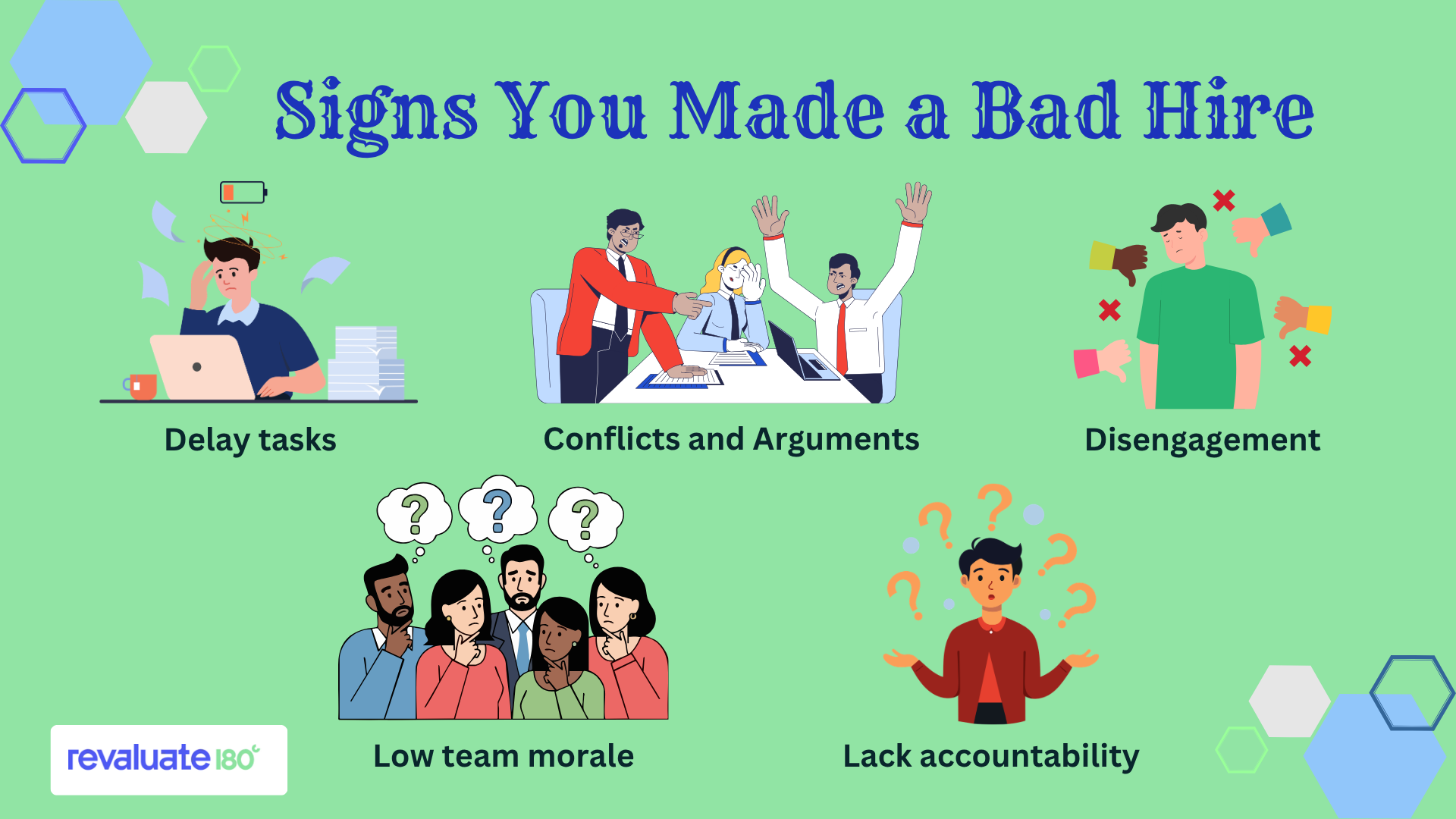
1. Missing targets and stalling on ramp-up: They frequently miss targets and keep seeking extensions on their ramp-up or learning period. This behavior clearly indicates that they can't perform the tasks they claimed to have experience in.
2. Frequent conflicts without resolution: They regularly argue with teammates and management without providing solutions or accepting them. Over time, such conflicts can lower team morale.
3. Quiet quitting and lack of accountability: They do the bare minimum, avoid accountability, and become increasingly passive in attendance, work contribution, and participation in discussions and meetings.
4. Frustration spreading across the team: You notice more team members expressing their frustration to leaders. The situation worsens when they begin actively looking for opportunities elsewhere.
5. Leaders spending disproportionate time on conflict resolution: Managers, HR partners, and senior leaders repeatedly step in to resolve conflicts involving the same person.
How to prevent bad hires
A wrong hire can cost your company far more than just a candidate's salary. But can this be prevented during the hiring process? Yes, of course.
All it takes is smartly refining the traditional stages of your hiring pipeline by incorporating evidence-based decision-making strategies, so you consistently bring in candidates who align with the team's values.
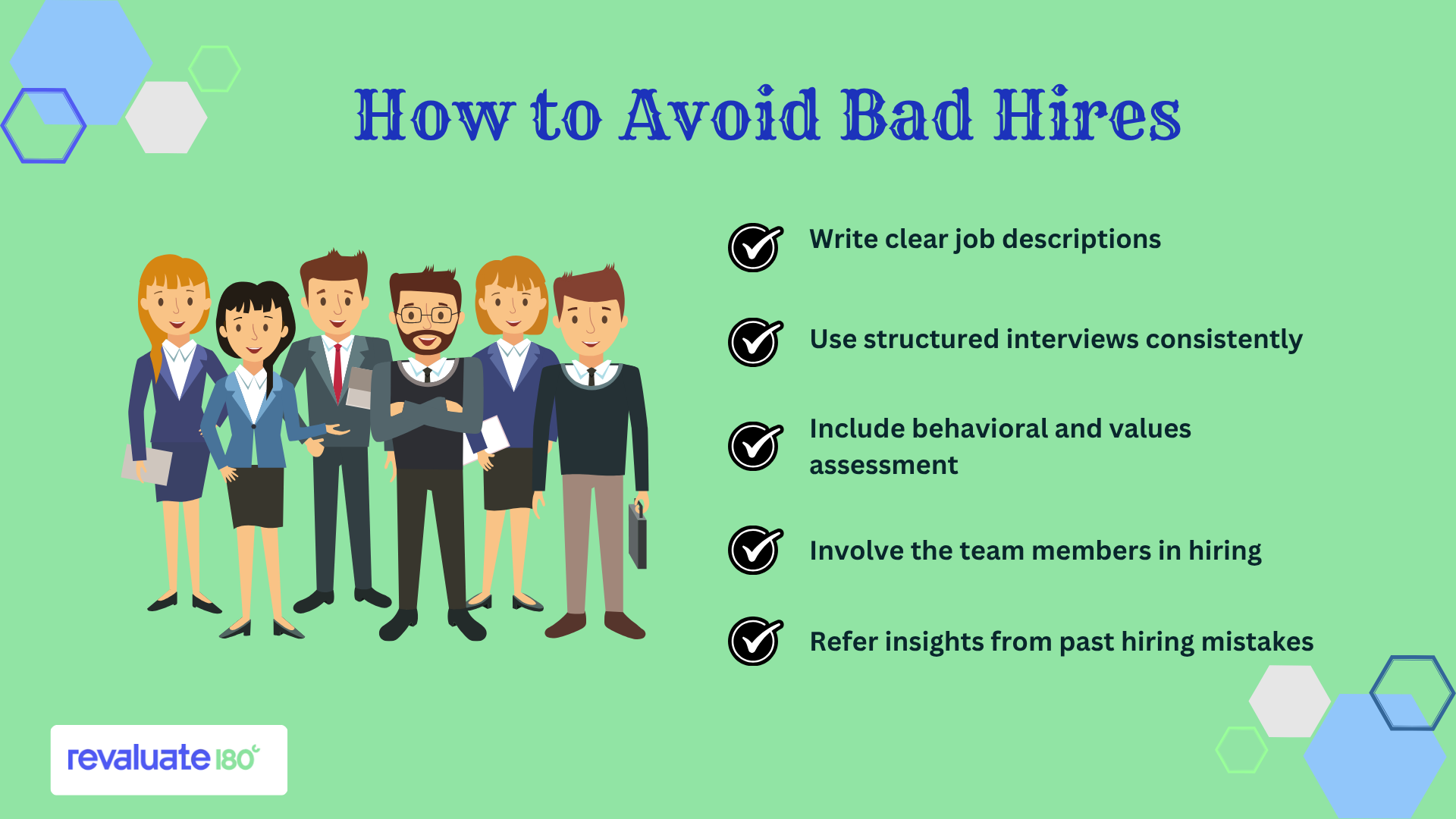
1. Write better job specs – define the values and behaviors, not just the skills
Hiring managers mostly rely on standard job descriptions, even for roles that involve frequent rehiring. Analyzing past hiring mistakes and refining job descriptions to include more detail can go a long way toward attracting candidates who will genuinely blend well with the team.
Job descriptions should go beyond technical skills and prerequisites to include desired values and behavioral traits that align with how the team works. Being specific about these requirements helps filter out mismatches early in the hiring process.
2. Use structured interviews consistently
Unstructured interviews lack standard filtering rules or decision-making criteria, as they rely entirely on the individual interviewer's judgment at each stage. Research suggests this approach yields only around 14% accuracy in predicting the right candidate.
Studies show that structured interviews offer 3 to 5 times greater predictive validity when assessing a candidate's fit for a role. They use a standardized set of questions, periodically refined based on candidate performance and feedback. This process helps eliminate bias and unfair selections.
3. Add behavioral and values-based assessment data
Bad hires often leave traces of their inability to fit in, which is visible through references and past work records. Thorough background screenings and behavioral reference checks are therefore essential to reducing hiring risk.
However, background checks alone aren't sufficient. Candidates with a difficult past deserve a fair chance to prove themselves. Values and behavior-based assessments that examine decision-making patterns, motivational drivers, and responses to pressure offer a more accurate picture of how someone will perform and fit within the team.
4. Involve the team, not just the hiring manager
Last but most importantly, involve team leaders and members in the hiring process while selecting a new candidate. Having a few team members participate in interview panels across different rounds adds significant value.
Their presence helps detect patterns that hiring managers might miss, drawing on firsthand experience with similar team dynamics. Team members can also identify areas where a selected candidate may need support and flag these to the HR partner during onboarding.
Closing Thoughts
Bad hires are costly, both financially and operationally, and also in terms of the effort they drain from your team. However, as we've seen, these losses are largely preventable. Companies that get this right aren't just hiring faster, but they're hiring with better data.
If your team is experiencing disengagement or reduced productivity, or if you suspect you're stuck with a bad hire, Revaluate180 can help. Our values and behavior-based assessment reveal alignment gaps, behavioral patterns, and decision drivers before they become expensive problems.
Reach out to us for a demo of our values assessment and start building a stronger, more aligned team.