One term that has been gaining increasing attention among corporate leaders and HR professionals is the concept of “quiet quitting”. Most leaders and managers are unclear about quiet quitting, but are growing concerned about its impact on long-term employee retention.
Quiet quitting is now common among the new-gen workforce comprising Gen Z and millennials, who opt to do the bare minimum rather than exceed expectations. This mode of working is the opposite of the “hustle” culture considered normal in many professions.
In this article, we’ll learn more about quiet quitting, how it sets in, the warning signs, and how organizations can prevent it by improving engagement and work culture.
TL;DR
- Quiet quitting is a strategy adopted by employees to do the bare minimum required in their work roles, setting precise boundaries and engaging neutrally.
- Employees adopt this approach at the workplace to avoid burnout or to show their resentment when the company does not listen to their demands.
- Quiet quitting by employees who were once actively engaged often stems from a lack of recognition and career growth, poor leadership, burnout at work, and a poor work culture.
- Quiet quitting is preventable when company leaders align individuals' values with their work culture through initiatives that affirm employee wellness alongside business growth.
What is Quiet Quitting?
Quiet quitting is a neutral or passive mentality exhibited by employees who work only to fulfill the mandatory requirements of their job role. This behavior is most commonly a warning sign that an employee will be quitting or leaving the company in the near future.
Moreover, quiet quitting is also a common sign of growing disengagement or reduced productivity from an otherwise actively engaged employee. Such employees often resort to quiet quitting when their employers fail to address their needs and concerns.
For companies, an increase in quiet quitting rates would mean a drastic reduction in engagement levels and productivity. Employees rarely think about growing in their roles or developing creative, innovative solutions to business challenges.
It can be very difficult for employers to define clear job expectations. This ambiguity makes it difficult for leaders to resolve employee disputes on work deliverables during critical times.
Why Quiet Quitting is Becoming More Common
A Gallup study shows “quiet quitters” comprise at least 50% of the U.S workforce. This number has risen further post-COVID-19, with younger employees increasingly losing engagement sooner during their tenure.
Here are some common reasons employees quickly resort to quiet quitting in their jobs.
- Employees increasingly prioritize personal well-being: The aftermath of the COVID-19 pandemic saw more employees preferring flexible or remote working options over an attractive pay cheque. Optimal work-life balance helped employees tend to their loved ones during difficult times without losing their productivity at work.
- Many workers no longer see constant overwork as a sign of success: Gen Z employees have seen boomers and millennials burn out at work and lose their health and peace over work targets that hardly improve their quality of life. Establishing strict boundaries from the beginning is now their way of avoiding work burden and focusing on work quality.
- Employees are more conscious of protecting their mental health: Being adaptive at the workplace is often interpreted as being available or flexible enough to go beyond boundaries to accomplish work tasks. When employers exploit this availability, employees often become quiet quitters to protect their peace and well-being.
What Causes Quiet Quitting?
Quiet quitting is the opposite of “loud quitting”, where employees openly display their disinterest in working for the company. Such actions often leave a negative mark on employees’ careers, especially when their new employers conduct background checks into their conduct in previous companies.
In order to secure promising careers in the near future, while continuing to their current work roles, many employees switch to quiet quitting mode by doing exactly what is expected from their work tasks, no more, no less.
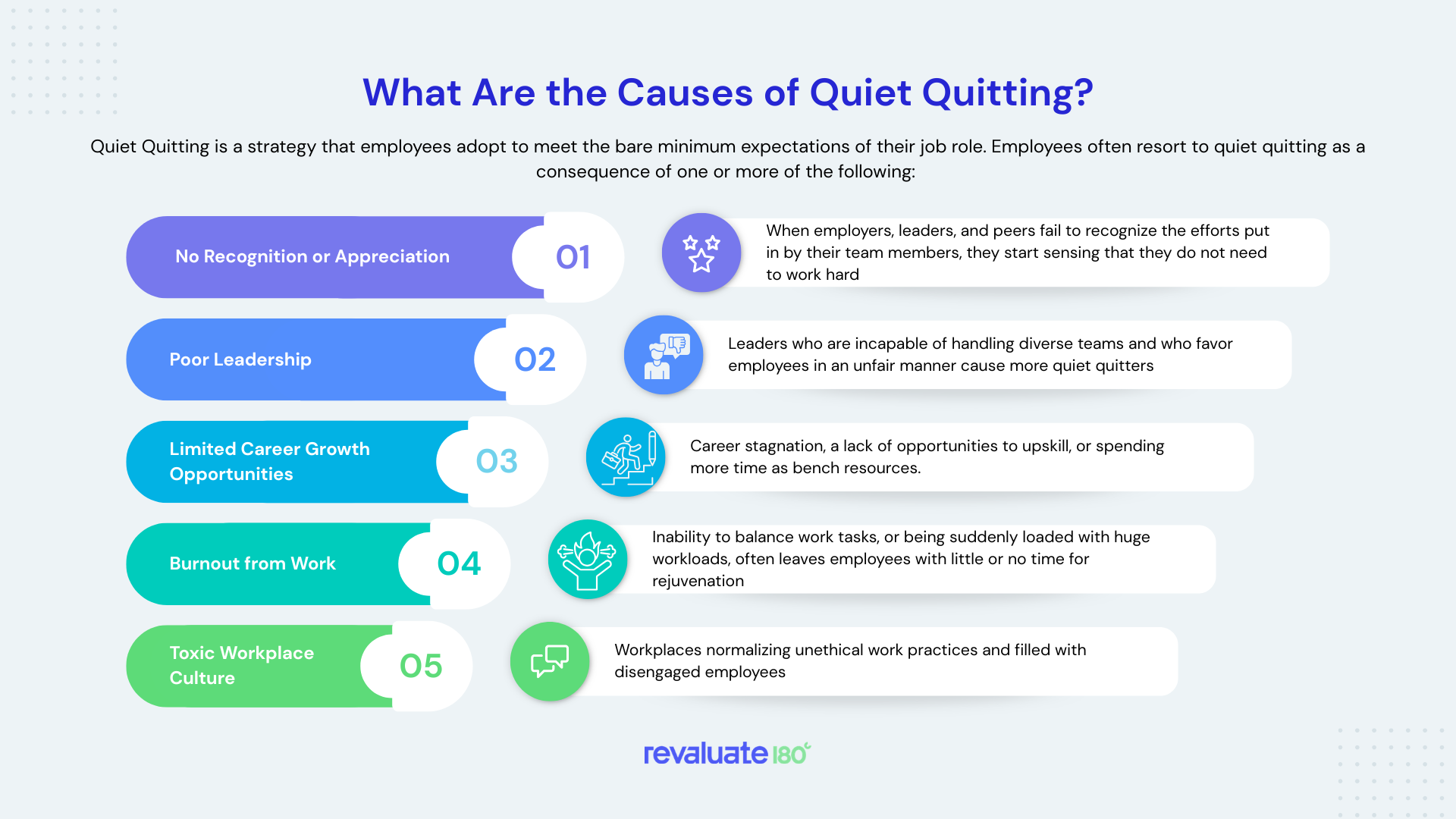
So what makes a promising career in a company turn into an unfulfilling role that drives employees to quit quietly? Here are some common reasons employers and organizations cause quiet quitting.
No recognition or appreciation
Timely recognition and appreciation for valuable contributions at work, regardless of size or impact, is crucial for employees to feel their work is valued. When employers, leaders, and peers fail to recognize the efforts of their team members, team members begin to feel they do not need to work hard.
If paycheques are the only benefits that employees get for their work, they would obviously prefer doing the bare minimum, with no need to prove themselves or outperform their peers. That is why recognition constitutes a prime part of indirect compensation to improve retention.
Poor leadership
Leaders who are incapable of managing diverse teams and who favor employees unfairly are often the silent triggers that prompt employees to start quiet quitting. In fact, bad leadership is the second-largest reason employees leave their jobs.
When leaders themselves are not clear about the work goals their team must accomplish, have poor decision-making skills, lack clear communication, and do not regard employees' concerns and feedback, their team members stop trying hard and become passive at work. Sometimes, leaders themselves start quietly quitting by displaying a lack of accountability.
Limited career growth opportunities
Employees join a company to help it meet its business goals while also learning and advancing in their own professional careers. Career stagnation, a lack of opportunities to upskill, or spending more time as bench resources make employees reconsider their decision to stay and contribute to the company.
The period after the half-yearly or annual performance appraisals is when several employees quietly quit because their growth does not meet their expectations. Several employees use this period to quietly quit, look for opportunities elsewhere, and eventually leave their jobs.
Burnout from work
Being unable to balance work tasks or suddenly being loaded with a huge workload often leaves employees with little or no time for rejuvenation. Burnout at work, with no appreciation and recognition for the effort, is one of the biggest causes of quiet quitting.
Today, many professionals proactively reject additional work to prevent burnout, choosing to limit themselves to a reasonable workload within their working hours. This behavior is often viewed by employers as being less flexible, leading them to deny such employees opportunities for career progression.
Toxic workplace culture
Workplaces and teams that normalize poor work ethics and practices are common reasons quiet quitting has become popular among the current generation of employees. Arriving early to work and leaving late, skipping meals for work, attending meetings post-work hours, being available for calls anytime, and not giving dedicated personal time are some toxic workplace traits that prompt employees to do the bare minimum.
Several recruiters and HR professionals believe that the growing trend of quiet quitting is pushing organizations to eliminate toxic workplace cultures and create safer, more inclusive environments.
What are the Signs of Quiet Quitting Leaders Should Watch For
Just as they track employee engagement levels, leaders and managers can identify common signs of employees who have switched to quiet quitting. A visible increase in disinterest in fully engaging at work indicates that these employees are now working only to meet the bare minimum requirements.
Reduced participation in meetings or projects
Employees who were enthusiastic participants in every meeting or team discussion can suddenly turn neutral or passive. Attendance at such meetings becomes just for the sake of it, sometimes with a preference for absence over attendance at team meetings.
Lack of initiative or willingness to take on new work
Some of the best employees have willingly stepped forward to take up work responsibilities and finish them in the best possible way. When such employees show the least interest in taking on new responsibilities or try to avoid them, they may be exhibiting signs of quiet quitting.
Minimal interaction with colleagues
Quiet quitting is ideally a phase in which employees literally go quiet, for instance, giving the silent treatment to their team members and leaders. Such behaviors are often seen as a tactic used by employees to show their resentment by reducing interactions with most of their colleagues.
Declining enthusiasm or motivation
Quiet quitters are not interested in being active at work or in their tasks, maintaining a cold or neutral attitude. They show little interest in everyday work tasks, refuse to assist team members, spend time distracted from work, and clock just the right number of hours required.
Increased absenteeism
Quiet quitting behavior becomes more apparent when employees start absenting themselves from work. They respond to important deadlines or mandatory meetings by simply being absent without giving any concrete reasons or preparing the team for their absence.
What Leaders Can Do to Prevent Quiet Quitting
Quiet quitting can be hard on managers and leaders who are trying their best to make such employees fully engaged and productive at work. Since quiet quitting often reflects employees setting protective boundaries, leaders can proactively establish clarity in several areas to prevent employees from needing to assert boundaries through disengagement.
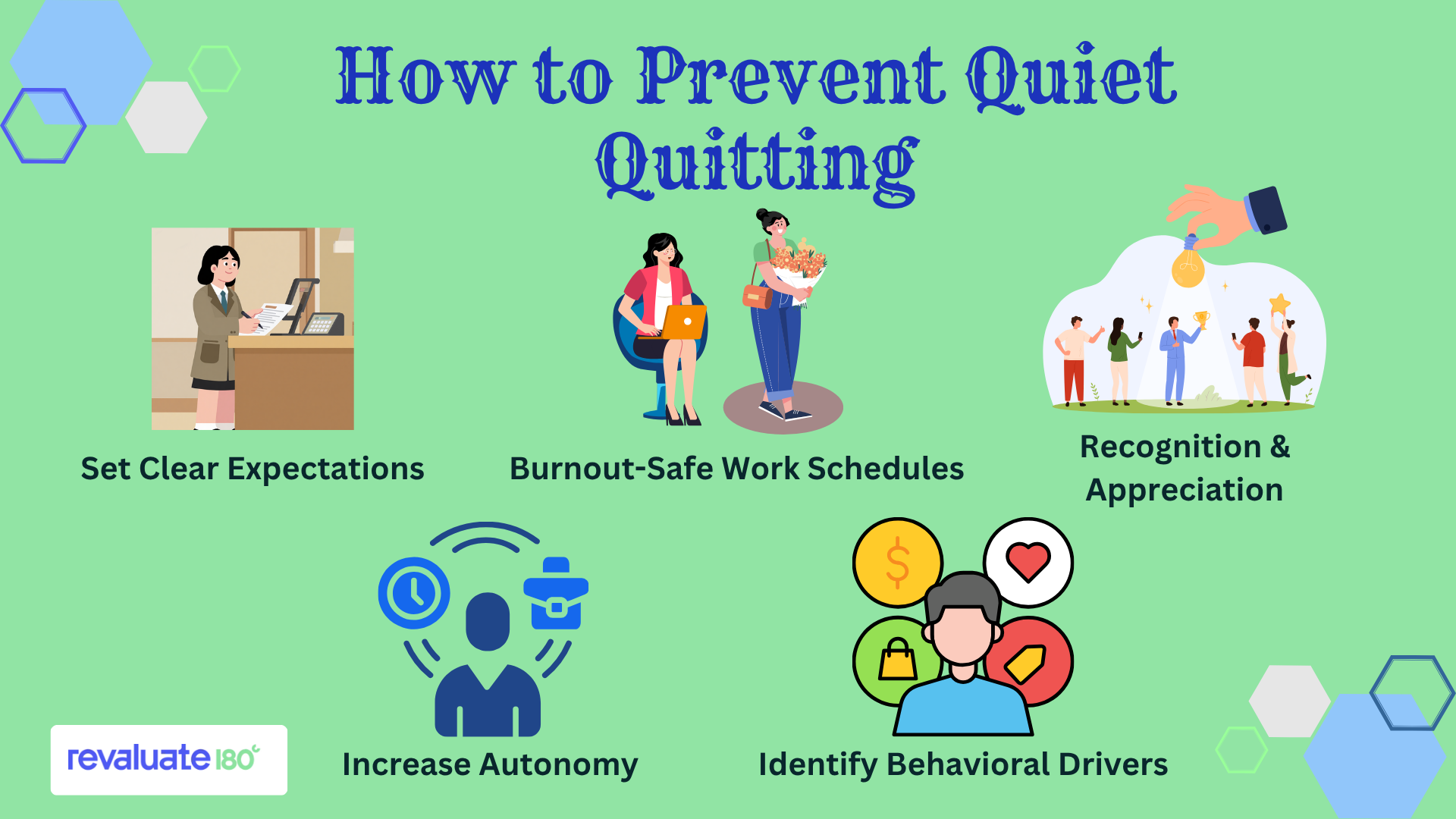
1. Set clear role expectations and boundaries
Clear job descriptions, right from the start of the recruitment process and hiring, help companies land the right person for the right job role. Structured interviews in the hiring process, and involving leaders and team members in the final hiring decision, help teams get the right employee who will be more than willing to blend into the existing work dynamics.
2. Design workloads that prevent burnout
Creating highly productive teams that collectively harmonize individual strengths is crucial for preventing quiet quitters. Every member must be aware of others' work so that a single absence does not bottleneck the entire team.
Furthermore, leaders must encourage all members to help each other learn and upskill so that work tasks can be fairly distributed and completed smoothly.
3. Recognize and appreciate employee contributions
Timely recognition, even if it's just a few words of appreciation, goes a long way toward helping employees. Companies must invest in dedicated employee engagement platforms that offer peer recognition and appreciation options.
Such platforms also offer instant rewards for accomplishments, such as coupons, vouchers, reward points, or cash, giving employees flexibility in what they receive.
4. Give employees more ownership and autonomy
Constant micromanagement is often a poor managerial trait that leads employees to quiet quit. That is why leaders must encourage employees to take responsibility for completing and ensuring the quality of a task.
Autonomy helps employees feel that the company trusts them in their work, motivating them to do their best and exceed expectations.
5. Address cultural and leadership misalignment
Ambiguities and confusion arise when leadership strategies and expectations misalign with the company's core values. Leaders and managers must be clear about the direction that they must lead their teams and use evidence-based decision-making to meet business goals.
Additionally, HR and managers must be open to creating inclusive workplaces where employees from different backgrounds can come together and align culturally to meet the company’s goals.
6. Understand the behavioral drivers behind disengagement
Individual values and backgrounds play a crucial role in determining an employee’s conduct and working style in the workplace. Sometimes, quiet quitting appears to have no clear cause, when in reality it stems from cultural misunderstandings and behavioral differences within the team.
Here is where Revaluate180 helps organizations uncover these deeper behavioral and value-based factors, allowing leaders to improve team alignment, strengthen collaboration, and address disengagement before it escalates to quiet quitting.
Avoid Quiet Quitting with Behavioral Insights
Quiet quitting often stems from deeper misalignment between employees, leadership expectations, and team dynamics. Understanding values, behaviors, and collaboration patterns can help leaders identify early engagement risks and address them before employees mentally withdraw from their roles.
Organizations that use behavioral insights are better equipped to build teams that remain motivated and aligned.
If you detect signs of quiet quitting or disengagement among your employees, Revaluate180 helps to uncover deeper insights into the factors affecting your team dynamics, leadership alignment, and motivation.
By analyzing behavioral patterns and workplace values, Revaluate180 provides leaders with actionable insights to improve engagement, strengthen collaboration, and reduce retention risks.

Unlock AI-Powered Hiring Analytics
Transform the way you hire with insights that create aligned, collaborative, and high-performing teams.
- Smarter Hiring Decisions
- Reduce Expensive Turnover
- AI-Driven Insights
- Optimize Team Performance