Working together with diverse individuals and accomplishing business goals is the ultimate challenge in almost every workplace. Additionally, consistently delivering expected work results is a crucial indicator of workplace productivity.
Achieving ideal productivity goals requires different strategies for different teams, given their diverse team members and dynamics. From creating a positive work environment and improving employee engagement to instilling team values, small changes go a long way toward increasing overall team productivity.
In this post, we'll learn strategies to improve team productivity, help teams meet their goals, and ensure team engagement remains high.
TL;DR
- Team productivity results from several team behaviors and practices that help teams work to their fullest potential and produce exemplary results.
- Team productivity can be improved by aligning team members with the team’s goals, taking collective accountability and ownership, handling changes together, and spending time together on useful activities.
- Ideal measurement metrics of team productivity include output quality, turnaround times, goals completed, and team collaboration indices.
- Learn how an individual’s values and behavior help shape a team’s work culture that directly impacts team productivity.
What is Team Productivity?
Team productivity is the collective result of individual members' efforts aligned with shared goals and practices to meet or exceed expectations. A team’s productivity depends on several factors, including active engagement, clear communication, effective challenge navigation, collaboration, and other strategies that unite diverse employees around common goals.
It is a common misconception that productive teams are always filled with highly competent members. In reality, most high-performing teams succeed by leveraging each member’s strengths and providing the support needed to help those who need assistance complete tasks.
15 Ideas on How to Increase Team Productivity
Every team can be productive, not necessarily by hiring the brightest or most highly skilled talents. By following simple practices, any team can improve productivity and achieve consistent performance.
Here are some proven techniques to help teams work together to achieve the best results.
1. Set clear goals and priorities
High-quality outputs that require little rework result when the team is clear about what is to be done from the beginning. Every team must set SMART goals at the very beginning of their work/project phases so they don't spend much time negotiating and clarifying what each member must do.
Team goals must be further split into individual goals so that each member’s work contributes to the team's progress or completion in a significant way.
2. Define ownership for every task
Individual team members improve their productivity when they have clarity about the tasks they must do and the autonomy to complete them without much interference. Each member must be encouraged to take ownership of completing a given task end-to-end, so that other members do not have to frequently keep track of one another.
Every member must make it a practice to come forward and provide timely updates on task completion without requiring repeated reminders or notifications.
3. Break work into smaller, trackable steps
Work goals can seem overwhelming if they are vague and difficult to track. That is why it is important to create sets of measurable, trackable subtasks to record productivity.
Clear steps help team members prioritize and plan the timelines for related tasks, ensuring dependent tasks are completed on time without bottlenecks.
4. Reduce unnecessary meetings
While team discussions are necessary to clear confusion and improve task clarity, sometimes repetitive meetings can waste the time of all members. For instance, two members may not be sure of the priority of tasks that need to be done, and can be resolved by the team leader or members with dependent tasks alone.
Tracking progress need not involve dedicated daily meetings and can be simplified with task-tracking tools, chat groups, and discussion threads.
5. Create a single source of truth for work
If meetings are a mundane activity that eats up actual work time, the absence of clear work progress and requirements can create confusion for team members. Rather than having a single member or leader bottlenecked in tracking and passing information, it is best to have a common repository where every member can see work progress and how much they need to catch up.
Team leaders must verify the authenticity of information shared through the common repository to prevent misinformation and ensure task tracking is not based on assumptions.
6. Improve how the team communicates day-to-day
Poor communication is mostly not due to language barriers, but inhibitions, preconceptions, and biases. What appears culturally appropriate for one member may seem offensive to another, affecting their day-to-day collaborative working.
That is why communicating and resolving inhibitions and preconceived notions is crucial for the smooth functioning of a team. Teams can run several icebreaker activities each week to boost engagement among team members.
7. Identify and remove workflow bottlenecks
Often, teams have members who struggle to complete tasks on time, which blocks the progress of dependent tasks. Such struggles or delays could be due to poor communication, a lack of skill expertise, or a lack of clarity on the work to be done.
Team leaders must swiftly identify and assist members who need additional support in completing tasks on time and meeting the required quality expectations.
8. Align the team on what “done” means
Every team member needs to understand what it means to announce their task is complete. For instance, a developer may have completed a function module that another member must use to complete their task further.
Here, the developer must log their task completion only after running several testing scenarios, such as stress tests, unit tests, functional tests, and others. Proper completion of a task prevents rework and ensures smooth progress of subsequent tasks.
9. Encourage deep work and reduce multitasking
It is quite common for members to be involved in more than one work task in one or more work projects simultaneously. In such cases, it is important to focus on and prioritize one task for a given time period rather than juggling multiple workflows.
Deep work on one task at a time helps ensure maximum efficiency, reducing error rates and distractions.
10. Balance workload across the team
Teams often lack efficiency because one or more members remain burdened with more tasks than others, often citing their skill expertise. Such skewed work distribution often leads to burnout in the long run, prompting hardworking employees to consider leaving their jobs.
To avoid this ripple effect, it is essential to ensure fair distribution of work among all team members. Members must be encouraged to upskill and build expertise to be on par with one another.
11. Use the right tools
Although tools are meant to ease the burden of tracking, monitoring, and logging, they can sometimes overwhelm teams that spend too much time switching between them. That is why it is crucial to select the right tools that are easy to use, have a short learning curve, and do not take up much of the team’s productive time.
Depending on the team’s core functionality, say management, leaders must research and choose the best portals/suites that enable the most essential functions to be dealt with in a common platform.
12. Build a culture of accountability
Apart from team leaders taking accountability, every team member must foster an inherent attitude of accountability for their work from beginning to end. In addition to their own tasks, team members must hold themselves accountable for any key tasks they perform.
Being accountable ensures that no challenge remains unresolved and that everyone is ready to step in and provide the required assistance.
13. Encourage faster decision-making
Most teams spend their precious time negotiating and making every decision, which directly affects their productivity and the time they actually spend on the work. Evidence-based decision-making helps teams make quicker, more informed decisions without repeating past mistakes.
Today, several companies use data-driven decision-making platforms to support leadership decisions and achieve more accurate results that best address a challenge.
14. Provide regular, actionable feedback
Consistent productivity is achievable only when teams learn from their mistakes and identify areas for improvement. Teams must have regular feedback sessions, where every member can share how things can be improved in the next work phase, offer suggestions to other members, and appreciate generous contributions.
In addition, team leaders must provide consolidated feedback to each member, outlining how they can upskill, learn to communicate better, take ownership of tasks, and more.
15. Recognize progress and not only final results
A culture of timely appreciation and recognition is most important for boosting a team’s productivity in the workplace. Celebrating small wins in the progress of work with a few words or small tokens of appreciation goes a long way in motivating team members to perform better.
Several employee engagement platforms have dedicated portals for rewards and recognition to encourage instant appreciation among teams.
How to Measure Team Productivity
Improving team productivity involves several strategies. Some may improve by making a few changes, while others may require complete team restructuring and policy changes to enhance productivity.
So, how does one know which team is most productive, requires support, or is least productive?
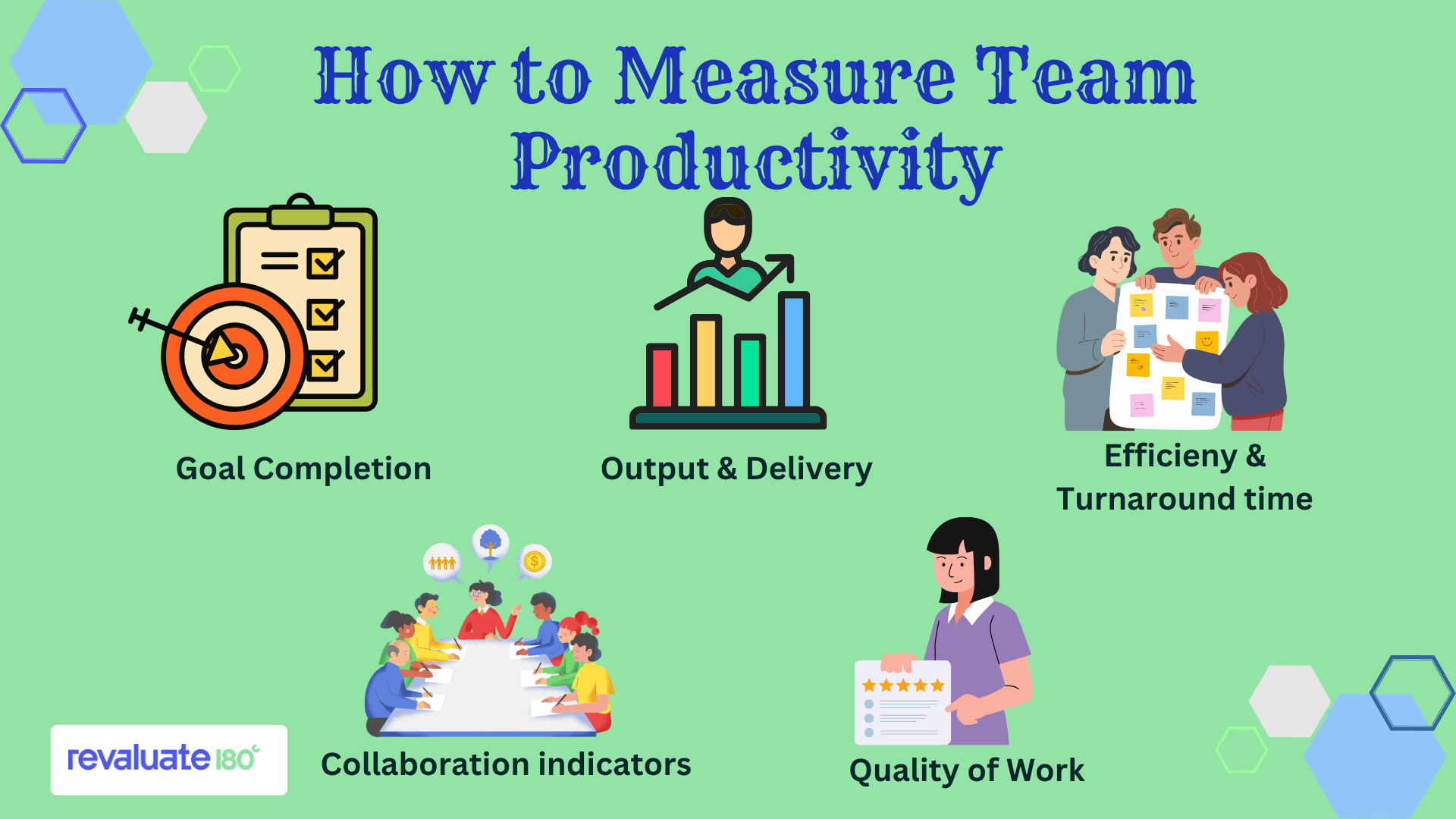
Here are some common metrics leaders and HR professionals may use to assess a team’s productivity.
1. Output and delivery
First and foremost, a team’s productivity is determined by how they deliver the results or services expected by clients or higher management. Teams that meet the required standards and exceed expectations by delivering on time or ahead of schedule demonstrate high productivity.
2. Quality of work
The quality of work significantly enhances team productivity. For instance, teams may deliver the expected output on time, but any compromise on quality can indicate burnout in some team members or a lack of coordination.
3. Goal and milestone completion
Since it is a good practice to break work into several subtasks and assign ownership to team members, leaders may track the progress and timelines of each task, goal, and milestone to verify consistent progress across the team.
4. Efficiency and turnaround time
The time taken to complete a given task is a clear indicator and benchmark for a team’s productivity. Time shows the efficiency or the ability of a team to overcome challenges and communication gaps, leverage collective skill sets, and deliver results as expected.
5. Team collaboration indicators
A team’s overall culture and work dynamics are best determined through metrics such as team engagement levels, retention rate, and absenteeism. Such details provide a clear indication of how team members collaborate, show up at work, and resolve challenges, ensuring work quality is not affected.
How Team Behavior and Alignment Impact Productivity
Team productivity is not just about strategies, tools, metrics, or processes. It is also shaped by patterns such as:
- How people communicate
- How teams make decisions
- How teams prioritize accountability
- How teams share feedback
Such patterns are distinct for each team, with few overlaps or similar patterns. Since every team has a unique way of handling its tasks and has different degrees of alignment with goals, these factors directly impact productivity.
Two teams with the same tools and goals can perform very differently based on how they work together. Revaluate180 helps leaders understand these patterns, making it easier to identify what’s slowing teams down and where improvements can be made.
Closing Thoughts
A team’s productivity is influenced by several factors, from individual commitment to team dynamics. We came across several ways to improve team productivity through simple changes at the team level.
Aligning individual values with team goals is crucial for improving team productivity. Connect with us if you wish to assess how your team members can collaborate and contribute to a healthy team that delivers results consistently.

Unlock AI-Powered Hiring Analytics
Transform the way you hire with insights that create aligned, collaborative, and high-performing teams.
- Smarter Hiring Decisions
- Reduce Expensive Turnover
- AI-Driven Insights
- Optimize Team Performance