Employee engagement refers to how motivated and dedicated employees are toward their work and their organization, with several factors contributing to the overall experience.
Employee engagement surveys are often considered the best instruments for measuring engagement levels over time, areas for improvement, and overall employee satisfaction. However, surveys are not foolproof and cannot always pinpoint the exact reasons for low or neutral engagement.
Let's look at some practical, day-to-day techniques that go beyond surveys to measure employee engagement and provide a root-cause analysis of engagement issues.
TL;DR
- Employee engagement surveys are great tools to measure how happy and satisfied employees are within a company.
- Engagement surveys alone cannot reliably determine the causes of disengagement and often overlook several employee concerns that go unaddressed.
- Measuring employee engagement must include observing employee participation in the workplace, how they collaborate with their teams, interact with their peers, and how they influence and motivate each other.
- Learn how combining results from different feedback channels and leadership insights helps provide meaningful insights into employee engagement.
Why surveys don’t always tell the full story
Engagement surveys contain several topics and sub-topics, each with a set of 5-10 questions of varying types. Most questions require employees to analyze and select the right choice or score for each question to support their responses.
Because of the elaborate nature of such surveys, employees may experience survey fatigue. The initial enthusiasm for completing the survey gradually fades, and employees may not provide honest answers, leading to random responses just to finish it.
Moreover, surveys capture only a moment in time, such as how employees remain engaged during a financial quarter. Engagement is a long-term quality that develops over time and cannot be fully captured by periodic survey responses alone.
Engagement issues are often best noticed in day-to-day interactions, discussions, and work performance. That is why behavioral indicators give clearer insights into the root causes of neutral or negative engagement than survey responses do.
10 ways to measure employee engagement other than surveys
Conducting and evaluating employee engagement surveys requires significant time and effort, from preparing the right set of questions to analyzing and communicating the results, and implementing the necessary changes. In the interim, several cases of disengagement may go unnoticed, sometimes even leading to sudden, unexpected turnovers.
Along with engagement surveys, leaders and HR professionals must follow these strategies to monitor employee engagement levels at any given time.
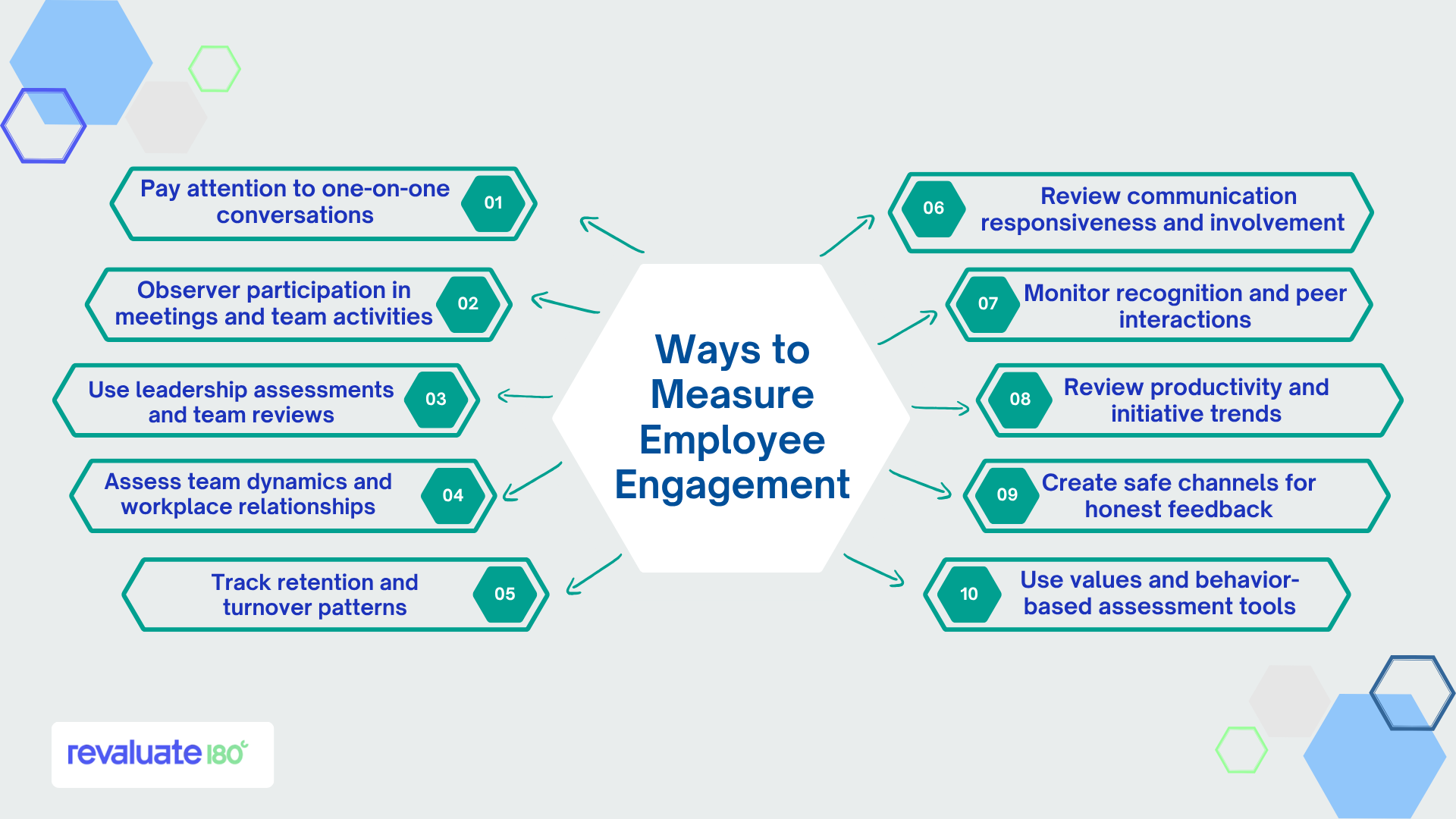
1. Pay attention to one-on-one conversations
Team members' discussions and in-person interactions are often the first indicators of employee satisfaction levels at work. Leaders and team members will often notice changes in behavior, motivation, enthusiasm, and team dynamics during one-to-one conversations.
Upon noticing any deviation from their usual engagement pattern, leaders must reach out to their reportees for a check-in to see if there are any underlying concerns worth addressing.
2. Observe participation in meetings and team activities
Engaged employees tend to contribute more consistently in discussions and collaborative work. Their energy and tone ideally remain the same during official meetings and team-bonding activities outside work, reflecting their overall satisfaction at the workplace.
Leaders should observe how each team member engages in all workplace activities, noting neutral or passive participants for follow-up.
3. Use leadership assessments and team reviews
Just as leaders must keep tabs on their reportees, analyzing employee feedback about their leaders can help uncover engagement issues within a team.
HR business partners must routinely conduct leadership assessments to gather employee feedback on how their leaders and teams support them. Such reviews can help identify how leadership behaviors influence engagement across teams.
4. Assess team dynamics and workplace relationships
Workplace relationships are another strong indicator of employee engagement, since productivity at work involves collaboration, trust, accountability, and peer interactions. Sudden strains in professional relationships can often indicate differences in workplace decisions, leading to rifts between team members or poor work performance.
Team bonding and teamwork quality are directly reflected in the quality of work output. Therefore, periodically assessing team dynamics and unity is crucial for workplace productivity.
5. Track retention and turnover patterns
Engagement survey results are best complemented by workplace metrics that signal underlying engagement issues. Employee retention and turnover rates over time are the best predictors of overall employee engagement.
For instance, a high turnover rate indicates a significant number of employees leaving the company due to engagement or work culture-related reasons. Similarly, rapidly declining retention rates predict a growing number of employees likely to leave in the near future.
6. Review communication responsiveness and involvement
Proactivity and responsiveness in the workplace are important behavioral indicators of employee engagement. For instance, a lack of feedback or input on team-level or managerial decisions from an employee can signal their disengagement or lack of interest.
Similar patterns of delayed responses to communication, neutrality in interactions, or a lack of involvement in most work tasks and reviews indicate a reduction in employee engagement, requiring immediate attention.
7. Monitor recognition and peer interactions
Actively engaged team members radiate motivation, support, and encouragement toward their co-workers. Monitoring team-level recognition by leaders and individual employee achievements reflects how consistently and actively these employees perform.
Teams or employees who are seldom recognized or do not receive timely appreciation often begin to disengage, which directly impacts their work performance.
8. Review productivity and initiative trends
A lack of accountability by leaders and employees often reflects a reduced commitment to taking ownership during challenging times. Actively engaged employees are always willing to work through failures regardless of the causes or consequences.
Measuring workplace productivity helps assess team-level and company-wide engagement levels, which are crucial to ensuring a company meets its business goals.
9. Create safe channels for honest feedback
While engagement surveys are among the best channels for employee feedback, the data they generate may be analyzed by multiple third-party analysts or platforms, making it susceptible to privacy breaches. That is why secure, company-wide feedback channels with trustworthy employee representatives offer a more ethical and confidential way to collect honest employee feedback.
For example, several companies have a POSH committee with employee representatives who receive employee complaints regarding sexual harassment without judgment. Such instruments are crucial for the timely resolution of sensitive concerns, rather than depending on surveys, where anonymous or secure sharing of concerns can be difficult.
10. Use values and behavior-based assessment tools
Assessing employees' individual values and beliefs based on their academic, linguistic, and ethnic backgrounds helps leaders understand how their values shape their working style and engagement levels. Most traditional surveys fail to capture values and behaviors that may, consciously or unconsciously, contribute to neutral or negative engagement at the workplace.
Therefore, it is crucial to use dedicated tools and platforms to analyze diverse employee backgrounds and how they shape how employees engage with a company, to better understand differences and find common ground.
Why Combining Multiple Approaches Works Best
Measuring employee engagement goes beyond surveys alone. Engagement surveys provide valuable feedback across several key areas of the employee experience.
However, day-to-day behaviors, communication patterns, leadership styles, and team dynamics often paint a fuller picture of how employees actually engage and stay motivated at work.
Organizations that combine employee observations, feedback, behavioral insights, and engagement survey data are more likely to identify turnover or retention problems earlier and take corrective measures proactively.
Revaluate180 helps organizations with team values and behavior-based assessments, enabling leaders to better understand team dynamics, workplace behaviors, and engagement patterns across the organization.
Contact us if you are looking for a data-driven approach to improving engagement levels in your organization.

Unlock AI-Powered Hiring Analytics
Transform the way you hire with insights that create aligned, collaborative, and high-performing teams.
- Smarter Hiring Decisions
- Reduce Expensive Turnover
- AI-Driven Insights
- Optimize Team Performance