It is 2026, and companies are still struggling with an omnipresent issue: employee retention.
No matter how transparent the hiring process is, how well-optimized your hiring decisions are, or how well-prepared you are for onboarding, it can be painfully frustrating to see employees leave after investing a lot of time and effort in hiring, training, and onboarding.
There are several reasons why people leave their jobs. Often, the reasons are personal preferences, organizational factors, or work culture.
In this post, we’ll discover the top reasons why employees are leaving their jobs in recent times and how companies can reduce turnover with the right initiatives.
TL;DR
- Employees leave their jobs when their expectations of the workplace do not align with what their employers offer.
- Common reasons for employees to quit their jobs include feeling a lack of opportunities to learn and grow, not receiving the right compensation, or finding better opportunities with improved benefits elsewhere.
- Organizations may also be the reasons people leave their jobs due to workplace burnout, toxic work culture, poor leadership, improper communication, and weak feedback channels.
- Learn how data-driven decision-making and periodic feedback collection help improve employee retention and change their decision to leave their job.
What Are the Most Common Reasons Employees Leave Their Jobs?
Year on year, some reasons for leaving are never going away from this list, while some other reasons may surprise you. Here are some of the top reasons people quit their jobs in 2026.
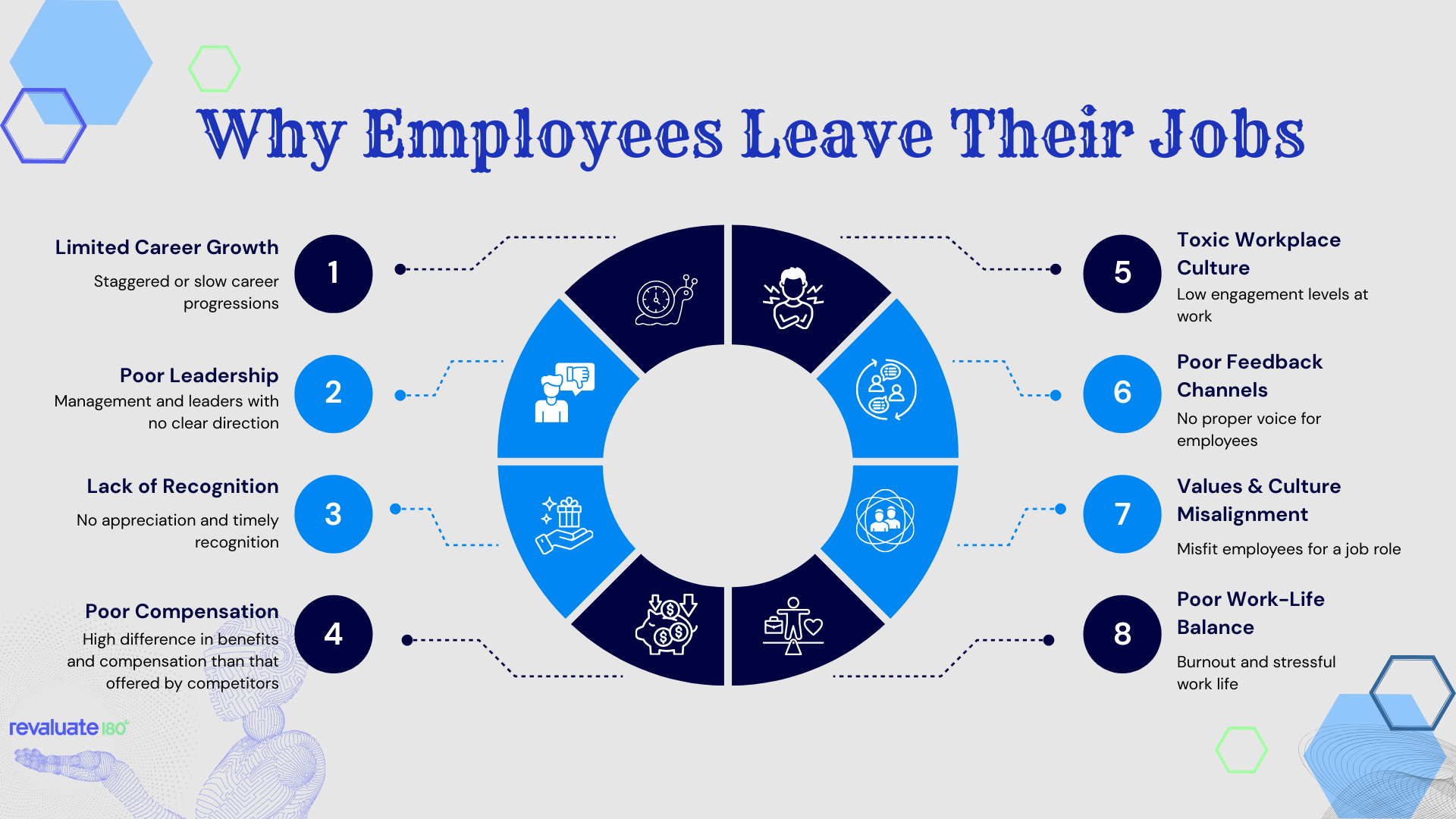
1. Limited career growth opportunities
A lack of career progression and stagnation in a role continue to be the number one reason employees seek opportunities elsewhere. This reason is strongly supported by statistics coming from ADP’s People At Work 2025 report, which shows:
- 1 in 5 workers globally cite a lack of opportunities as a barrier to career progression.
- More than one-third (34%) of employees who do not find growth opportunities in their company are seeking new jobs elsewhere.
Additionally, the advent of AI and automation has already rendered many job roles obsolete, leading to large-scale AI-related layoffs. In such circumstances, it becomes difficult for employees to sustain in the job market unless they upskill and grow in their careers.
The fear of career stagnation and a lack of opportunities to learn and upskill while working in a company leads employees to see a bleak future there, causing them to actively seek opportunities outside and to leave immediately upon receiving a promotion offer.
2. Poor leadership and management
Leaders continue to be one of the top reasons why employees quit, creating a highly insatiable work environment with no proper direction. iHire’s 2025 Talent Retention Report shows:
- 24.2% employees left their jobs due to poor company leadership.
- 22.8% employees quit because they were unhappy with their immediate manager or supervisor.
The problem arises when the company management fails to recognize such leaders who contribute to the exit of many employees. Also, the way employees evaluate their managers differs from how their own superiors and leaders evaluate them.
Several employees cite a lack of transparent communication, the persistence of biased decisions, and a lack of accountability as reasons for poor leadership.
Leadership-related exits are increasingly common among Gen Z employees, who cite poor communication as the main reason. Also, not getting timely appreciation and a sense of feeling left out within a team has also prompted many employees to move to companies where they feel inclusive and secure.
3. Lack of recognition and appreciation
Peer recognition and appreciation are among the most important indirect benefits, crucial for recruitment and retention. Appreciation from peers and immediate managers can be a great source of motivation for employees to continuously exceed expectations, fueling both their career growth and the company’s business.
A lack of appreciation and timely recognition is a growing problem, especially among millennials, that leads employees to seek jobs in companies that offer recognition. A survey from Bonusly shows the following results:
- 46% of employees left their jobs because they felt unappreciated.
- 41% felt that favouritism from their managers made them feel unappreciated.
Lack of transparent communication, fostering unconscious biases, and failing to consider employee feedback are often the root causes of a work culture that fails to prioritize recognition and rewards.
Apart from recognition coming from leaders, employees also value peer support. A lack of peer appreciation clearly indicates an environment where employees are disengaged and do not wish to see each other grow.
4. Unsatisfactory compensation and benefits
Pay packages and benefits are always solid reasons for employees to leave a job or move to a new one. Moreover, today, benefits such as flexible working hours, remote work, and wellness initiatives are increasingly sought after when considering a job role.
With current inflation rates exceeding salary increases, employees are concerned about staying in a job role that barely covers the cost of living every year. Here are some trends reported by BambooHR on how compensation is a prime factor for employees to leave their jobs:
- Only 41% employees feel that their current pay is sufficient to sustain their lifestyle.
- 77% employees would consider leaving their job for a higher pay package, with an average salary hike of 12.5%.
Additionally, pay parity across employee groups within the company has triggered several resignations. For instance, more men continue to receive higher salary raises than their female counterparts. Similarly, the raises that top leaders and management professionals receive are far beyond the compensation received by their reportees.
With current volatility in global markets, employees are preferring higher salaries over other benefits such as stock holdings, bonds, and profit-sharing initiatives that several companies offer as part of their compensation.
5. Poor work-life balance
One of the recent reasons for employees to leave their jobs, especially after the COVID-19 lockdowns, is the lack of workplace flexibility. A study from ARAG on work-life balance shows the following results:
- 54% of surveyed employees have left a company due to work-life balance challenges.
- 57% of employees felt they worked well beyond their scheduled hours, leading to burnout, financial stress, and family stress.
This balance was partially restored when employees began working from home during the COVID-19 pandemic, allowing them to tend to their loved ones while balancing their work tasks more efficiently.
In fact, the post-pandemic phase saw several companies make remote work and flexible work hours a key benefit, helping them retain their best resources. In contrast, several companies that revoked remote work and mandated regular office-based work saw higher turnover, with employees prioritizing this flexibility over pay packages.
Yet again, team leaders and managers play an important role in helping employees better balance their workloads. Not being able to delegate tasks fairly results in a few employees taking on extra work, leaving them stressed and with no time for rejuvenation.
6. Toxic workplace culture
While we discuss diversity and inclusion across all companies, we still have to deal with several workplaces where employees find the workplace environment difficult to cope with. According to Monster’s mental health in workplace survey 2025, the following reasons were seen as direct contributors to harming employee wellness:
- 57% prefer quitting their job rather than staying in a toxic workplace.
- 29% are ready to take a salary cut to stay in a non-toxic workplace.
- 51% report they can perform better if the company removes toxic employees.
Toxic workplaces are created by one or more disengaged employees who spread their hatred towards their work and workplace contagiously. For instance, a bad manager who is biased towards certain employees can influence another leader to practice the same in their team or group.
Similarly, gender based discrimination, differences based on ethnic or cultural backgrounds, often cause rifts between employees if not managed properly by leaders. Such toxic practices often cause employees to move to places where they feel valued and included with people like themselves.
7. Lack of purpose or meaningful work
When employees find themselves stuck in a role that does not suit them and their leaders do not allocate work that challenges them, their immediate response will be to look for a job elsewhere.
How can employees not find purpose in a job role after clearing several rounds of evaluations and interviews?
Such problems arise when companies do not hire the right person for the right job role. Candidates hired in such positions often find stark differences between their expectations of the job they applied for and the reality.
Unclear job descriptions, communication gaps between the recruitment team and the candidate’s new team, unfair evaluation metrics, and a biased selection panel often leave candidates feeling stuck, doing nothing meaningful at work.
8. Lack of feedback or clear direction
A company functions effectively only when it gives all its employees the opportunity to voice their opinions and concerns. Analyzing employee feedback and making decisions that support employees is therefore crucial to ensuring their long-term retention and improved productivity.
Not providing the right feedback channels often results in a dictatorial management that relies solely on top leaders' decisions, without considering employees’ feelings. A lack of transparency in decision-making and failure to consider employees’ feedback make employees feel less valued in a company, prompting them to move elsewhere.
Without hearing from employees, top leaders and HR professionals lack the right data and insights to make decisions, leading to employee initiatives that lack clear direction and timelines. This ambiguity and confusion among top leaders propagates throughout the company, causing many to leave from such a hostile environment.
9. Values and cultural misalignment
A crucial criterion that employers must evaluate during recruitment but often ignore is whether an employee can work within their company’s culture. Often, recruiters assume that employees will get used to the company’s work culture, such as working late hours, staying overtime, and showing up at the office whenever required, without describing these practices as part of the job.
While most are willing to go the extra mile to tackle challenging tasks and ensure the desired output, this cannot be generalized to all employees. Every employee has beliefs and values shaped by their academic, ethnic, and linguistic backgrounds. What may be normal for one can be a red flag for another.
When employees end up in teams where others’ normal is not aligned with their values, they decide to switch to other teams for opportunities. For these reasons, evaluating a candidate’s “cultural fitness” for a role helps improve retention.
10. Better opportunities elsewhere
Whatever employees feel is lacking in their company, they try to find it elsewhere. Better pay packages, flexible working hours, benefits, wellness initiatives, and a job that challenges them to learn and grow in their careers often tempt employees to leave their jobs without a second thought.
If companies consider their employees’ feedback at different points, they can bridge the gap between employees' expectations and what the company offers. However, failing to invest in retention and hiring the right person for a role can sometimes be a costly mistake for the company.
Peer comparison and peer referrals often make employees feel they will work better in a place where their friends, family, and colleagues work, making the switch easier without long application procedures. In fact, many studies show that referral hires transition smoothly into a role; one leaving employee can cause several more to follow suit.
What Organizations Can Do to Reduce Employee Turnover?
When companies identify the root causes of employee turnover, they can take preventive actions to reduce the number of employees who may leave for the same reasons in the future.
Companies must periodically review their employee retention initiatives and focus on the following areas to ensure they align with industry standards while keeping employees engaged.
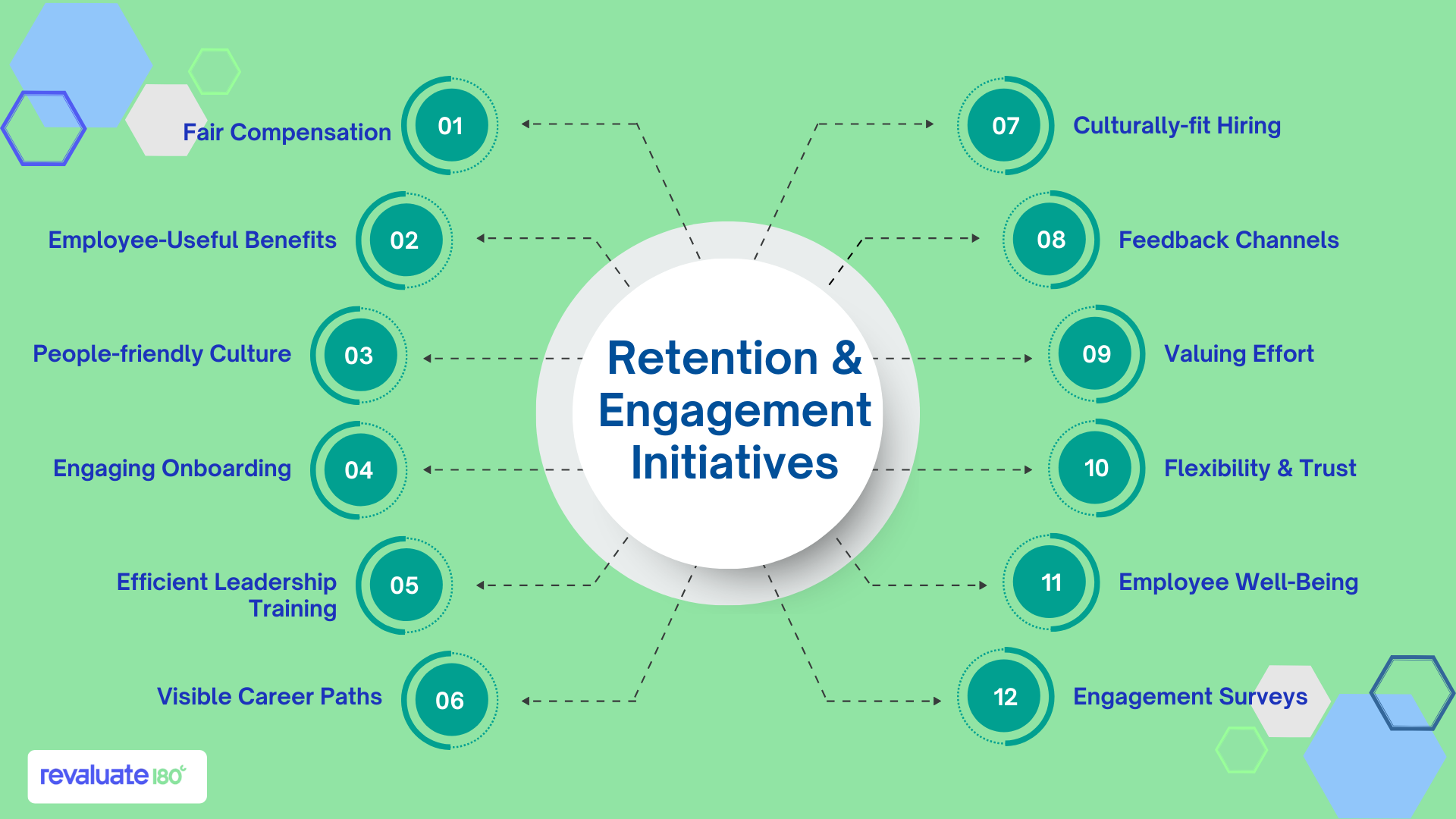
Invest in leadership and manager development
Since a large number of employees cite managers or leaders as a reason for their exit, companies must identify the leaders who, knowingly or unknowingly, become a cause of such exits. Rather than penalizing them, companies should train leaders to be role models who understand the uniqueness of their teams and how to leverage the best of their collective strengths.
Additionally, all leaders, new and experienced, must undergo regular training and workshops to understand the current challenges employees face in their industry, create an inclusive environment with diverse employees, and improve their communication skills.
Provide clear career growth opportunities
Companies must provide transparent information on the policies and standards they follow for career progression, so that all employees understand the effort they need to put in to grow within the company. Furthermore, the company must adhere to fair evaluation and appraisal processes to ensure timely promotions for the right employees.
Additionally, companies should encourage employees to take time to learn alongside their job roles, so they remain skilled and relevant in the industry. Opportunities for distance learning programs and university tie-ups assure employees that the company wants them to learn and grow.
Recognize and appreciate employee contributions
Appreciation and recognition in companies must go beyond traditional quarterly, half-yearly, or annual rewards, ensuring recognition occurs at the right time for significant contributions. Supporting a culture of peer appreciation and rewards with employee-preferred options makes employees feel valued for their effort at work, pushing them to exceed their past performances.
Several employee engagement software platforms offer a comprehensive rewards and appreciation portal that encourages peer recognition, provides instant, flexible reward options, and fosters company-wide appreciation, boosting a positive work culture and encouraging improvement.
Support work-life balance and wellbeing
Prioritizing employee wellness is as important as setting business goals and growth objectives. Identifying the factors that drive employee productivity and developing wellness initiatives to support them is, therefore, a mandatory investment that delivers multifold returns for both employees and the company.
Flexible working hours, recreational activities at work, wellness initiatives, and a comprehensive plan of indirect benefits help employees focus on work while the company takes care of their dependencies.
Build a positive and transparent workplace culture
Team culture and the company’s overall work culture play an important role in ensuring employees have a great future there. Transparent and open communication, inter-team collaboration, assessing employees' cultural fit, and ensuring employees remain accountable for their work are ways to improve your company’s work culture.
Feedback surveys, such as engagement surveys, retention surveys, onboarding surveys, and pulse surveys, help companies understand how to improve their work culture.
Use behavioral and values insights to improve retention
AI is the new retention aid for companies, providing data and insights to support accurate leadership decisions. Data collected from several feedback surveys and exit interviews with departing employees is analyzed to yield meaningful insights that help HR professionals identify the specific reasons employees leave their jobs.
Such insights also help track the behavioral patterns of existing employees and identify those who show signs of disengagement or are ready to leave the company. Leaders can use these data to understand the concerns of such employees better and assist them accordingly.
Conclusion
Employees leave their jobs for reasons that companies fail to support or encourage, which reduces their productivity and motivation to work there. Not updating age-old policies, avoiding two-way feedback channels, and failing to analyze leadership decisions can significantly impact a company’s retention rates.
If your organization is experiencing such turnover or struggling to understand why employees leave, Revaluate180 helps uncover the root causes through data-driven insights, leadership alignment, and behavioral analysis. Their approach helps organizations strengthen engagement, improve workplace culture, and build long-term retention strategies.

Unlock AI-Powered Hiring Analytics
Transform the way you hire with insights that create aligned, collaborative, and high-performing teams.
- Smarter Hiring Decisions
- Reduce Expensive Turnover
- AI-Driven Insights
- Optimize Team Performance