Every good leader begins their journey wishing to lead and assist their teams in the right direction. They genuinely care about every member's well-being and work hard to uncover even the smallest inconveniences. This ideal scenario remains a dream for many leaders who see their team's engagement as neutral or low despite their best efforts.
Blind spots emerge when leaders cannot understand why their teams are not functioning well despite having the right intentions. Leadership blind spots are the gaps between how a leader thinks they are showing up and how the team actually experiences them, revealing unspoken realities.
A Gallup study shows that managers and leaders drive 70% of the variance in team engagement, which can make or break an employee's experience at work. Therefore, it is always wise to uncover blind spots in leadership behavior.
Let’s look into some surprising reasons that blur the gap between a leader's vision and the team's reality. We will also learn how you can uncover these blind spots and fix them as early as possible.
TL;DR
- Leadership blind spots are invisible patterns and behaviors that quietly damage trust, engagement, and performance within a team.
- The most common leadership blind spots include avoiding difficult discussions, being inaccessible, ignoring feedback, and over-relying on the team's strengths.
- The most frequently overlooked blind spot is leaders assuming their team shares their values and priorities.
- Leaders are often unaware of these blind spots because teams stop speaking up about them over time and assume these behaviors are normal.
- Fixing blind spots requires structured, data-backed insights into how your team is actually wired by values, and what will drive the desired leadership outcomes.
What Are Leadership Blind Spots?
Let's get this clear before we define it. Blind spots do not indicate any inherent flaws in leaders or their team members.
Leadership blind spots are the gaps between a leader's vision and intentions for the team and the team's actual impact. Blind spots indicate that the leader needs to be more aware of how their decisions shape how their team functions and whether they are yielding the desired results.
So, why do blind spots form in the first place?
Many factors, whether conscious or unconscious, can contribute to the formation of blind spots within a team's leadership. Leaders relying on past success formulas, their seniority or past experiences, confirmation biases, and preconceived notions are often the foremost reasons.
Due to their reliance on the aforementioned factors, leaders often pay little attention to candid feedback and suggestions from their team members, which can gradually cause team members to shut down and show disengagement.
Being confident is a crucial leadership trait. Sometimes, however, this confidence in one's ideas and intentions, without verifying their relevance in reality, makes it less likely that team members will challenge or negotiate with the leader.
The Most Common Leadership Blind Spots
Some of the biggest blind spots in leadership occur through small, everyday interactions that are often regarded as harmless or well-intentioned. Below are some common situations and how leaders can assess their actions and their team's responsiveness.
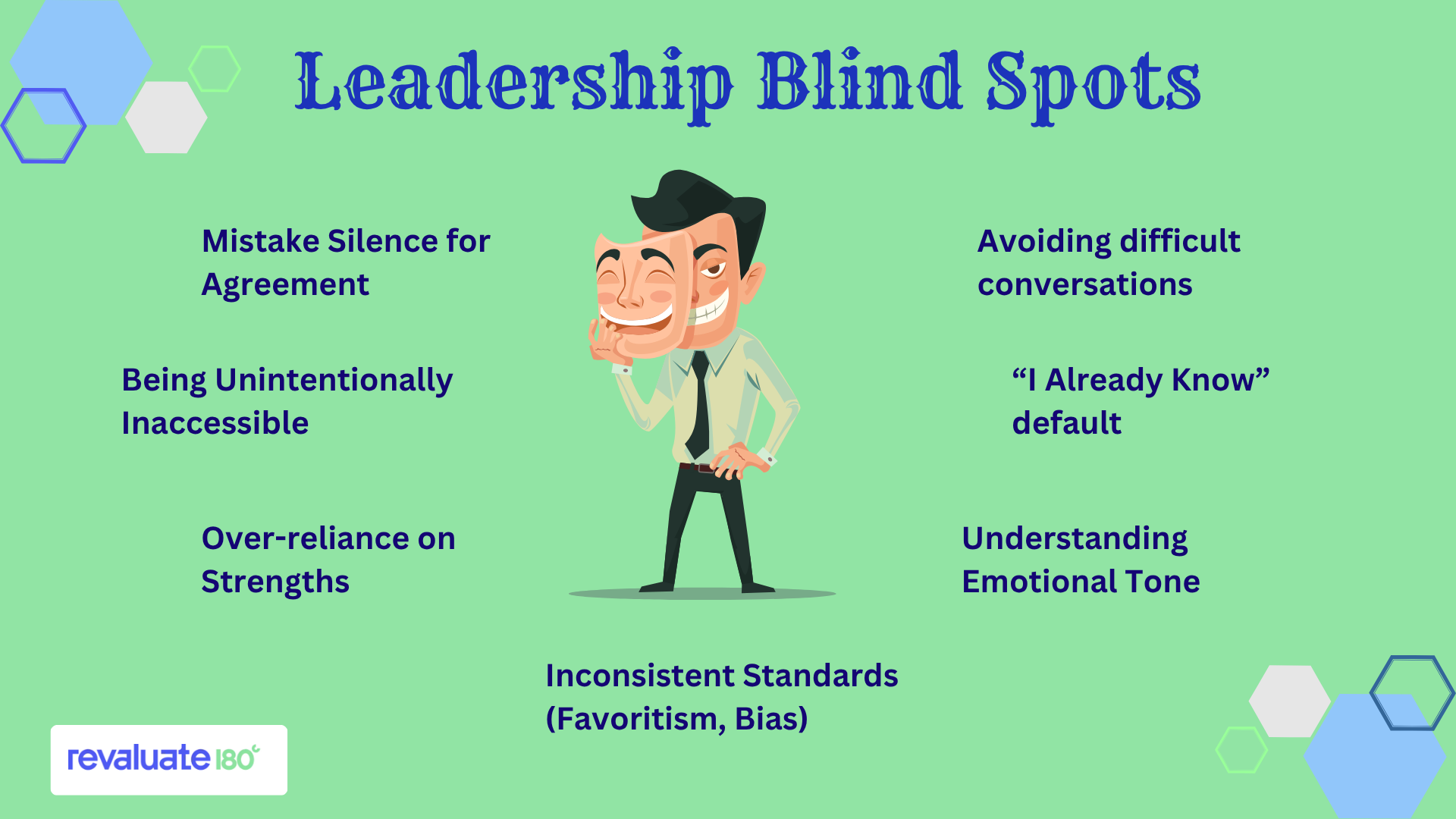
1. Avoiding difficult conversations
Leadership accountability includes having transparent communication with team members. Leaders can have abstract conversations while maintaining necessary confidentiality on certain topics related to the company and clients.
However, avoiding discussions on topics that team members are asking about can create unwanted tension, signaling that such subjects are somehow off-limits.
For example, a team suddenly notices key members leaving neighboring teams and grows anxious. When they get a chance to speak with their leader, they try to ask why such exits are increasing.
Instead of sharing the actual reasons, the leader tries to avoid such questions, fearing that the other team members may consider leaving too. However, the team perceives this behavior as a lack of accountability.
Avoiding difficult topics often makes teams feel that their leader simply agrees with whatever top management says. Members become apprehensive about whether their leader would genuinely voice their concerns to higher management and eventually stop raising their own.
2. Mistake silence for agreement
A very common scenario we encounter in almost every workplace team meeting is the leader presenting an idea, and everyone remains silent. This silence can be mistaken for wholesome acceptance if no one raises queries or objections.
However, in most cases, people are afraid to speak up. They sense that the decision has already been made and that their opinions hold no weight.
For example, a leader proposes a specific method for implementing a module, citing past experience. However, a few team members raise concerns about constraints specific to their current client's requirements. But the leader is certain that the suggested approach will work, providing evidence from past success.
Despite hearing the concerns raised, the leader moves forward with the same implementation method. From that point on, these members feel that their genuine opinions no longer matter, and their agreement or disagreement does not make a change.
Even one or two such incidents of leadership disagreements can make members feel psychologically unsafe during discussions, leading them to remain silent. This blind spot creates a false sense of team buy-in, even when the proposed approach may not be feasible.
3. The “I already know” default
Leaders reach their positions through years of expertise, and it is no wonder they are well-versed in the challenges of their work. But this awareness can sometimes project them as leaders who are unwilling to learn or adapt themselves to face unforeseen future challenges.
When leaders respond to their team members as though they already know everything about a particular challenge, it can stifle the curiosity of team members who are keen to learn and find new solutions.
For example, a project manager informs the team leader about a new client's mounting requirements. The leader responds that these can be managed with existing resources by offering perks such as free dinners to help the team stay and work longer.
The project manager was suggesting adding resources to prevent existing members from burning out. But the leader brushes off the request, citing the need for approval from higher management.
When leaders are not open to hearing their team's input and rely mostly on their own expertise, team members feel undervalued, creating a significant leadership blind spot.
4. Being inaccessible (without realizing it)
Every leader says something like this:
“Feel free to reach out to me for any concerns.”
“My door is always open.”
“I am always available to help.”
The reality often says otherwise. Truly hearing team members means being emotionally present in the conversation and empathizing with them. One-to-one conversations are futile if the leader is not in a position to genuinely understand employees and provide the right guidance.
An employee conveys her interest in joining another team within the organization, hopeful of getting opportunities that suit her skill set. She explains to the leader why she feels the new team will be a great place for her to work.
Instead of providing her with concrete opinions, the leader brushes off her requests multiple times, saying she will get to do the same work in her current team within a few weeks, which never happens. Such namesake conversations and false promises lead team members to stop reaching out to the leader with real concerns.
Leadership accessibility is about genuinely hearing employees and resolving their concerns in a timely and meaningful manner. A leader's tone, body language, and attitude signal far more about their true accessibility than their words do.
5. Over-relying on strengths
Your expertise helped you reach where you are, no doubt about that. But does that mean it's your way or the highway?
Relying solely on your own strengths is one of the biggest mistakes leaders make, causing team members to remain passive and simply defer to decisions rather than contribute meaningfully.
Micromanagement and excessive delegation of day-to-day tasks are common scenarios where leaders or managers try to impose their own work preferences and styles on their team members.
Such leaders believe their methods, whether being detail-oriented or focusing on the big picture, will help employees grow, just as these approaches helped them. In reality, they are dismissing their employees' individual working styles.
Leaders were once individual contributors who had to learn the trade and face challenges to build their expertise. Not allowing employees to work in ways that suit them often creates friction, lowering overall team productivity and engagement.
6. Inconsistent standards (favoritism, perceived or real)
Unconscious biases, preconceived notions, and preferential treatment exhibited by leaders are often unintentional. However, these behaviors become entrenched when team members accept unfair or favorable treatment as the norm.
High-performing team members who do not fall under their leaders' favored umbrella often resort to quiet quitting and eventually leave the company. This blind spot is often the greatest disruptor of company culture.
Preferential treatment of employees from similar ethnic, linguistic, or academic backgrounds and favoring them for career progression is a widespread leadership issue that has become normalized across many industries.
Leaders may believe that people who share their working styles, possess expected skill sets, or come from similar career paths are simply the best fit, without adequately recognizing the achievements and capabilities of other team members.
Inconsistent evaluation and unfair treatment of team members are among the biggest contributors to low team engagement. Leadership biases often disrupt team and company culture over time, reduce diversity, and even deter new candidates from accepting offers due to concerns about the work environment.
7. Underestimating emotional tone
No matter their expertise in handling work challenges, every leader must prioritize communication. The way leaders convey their intentions, accept criticism, deliver feedback, and navigate team discussions shapes how they are perceived.
Neglecting how you deliver your message can often undermine your credibility and reputation.
For example, a technical team presented ideas as part of an innovation initiative. During the meeting, the leader began evaluating which ideas were worth pursuing and which were not. When members whose ideas were rejected asked for reasons, the leader snapped at one of them, saying they needed to do their homework before presenting ideas.
While this may have been a reaction to time pressure, it did not sit well with those who felt publicly dismissed in front of the team.
A single frustrated comment can undo weeks of goodwill and encouragement that you give to your team. Teams remember a leader's tone and emotional reactions more than the ideas or suggestions shared. As a result, members tend to become passive and less willing to engage openly.
The Blind Spot Most Leaders Have Never Heard Of
The blind spots we have discussed so far are relatable. Most of us have witnessed or been part of such biases, whether as a victim or, at times, as the one responsible.
Here is another blind spot most leaders are unaware of, yet it is silently causing damage in your teams.
Assuming your team shares your values
Every leader operates on a set of values, beliefs, and priorities that shape how they interpret their team's behavior. For instance, a leader who values speed may view detail-oriented or paced work as slow or resistant, while neglecting the quality it produces.
Similarly, a leader who values autonomy may interpret a team member's need for guidance as a lack of initiative.
In both cases, the values themselves are not the problem. The assumption that your team must see and prioritize things exactly the way you do is what causes the disconnect.
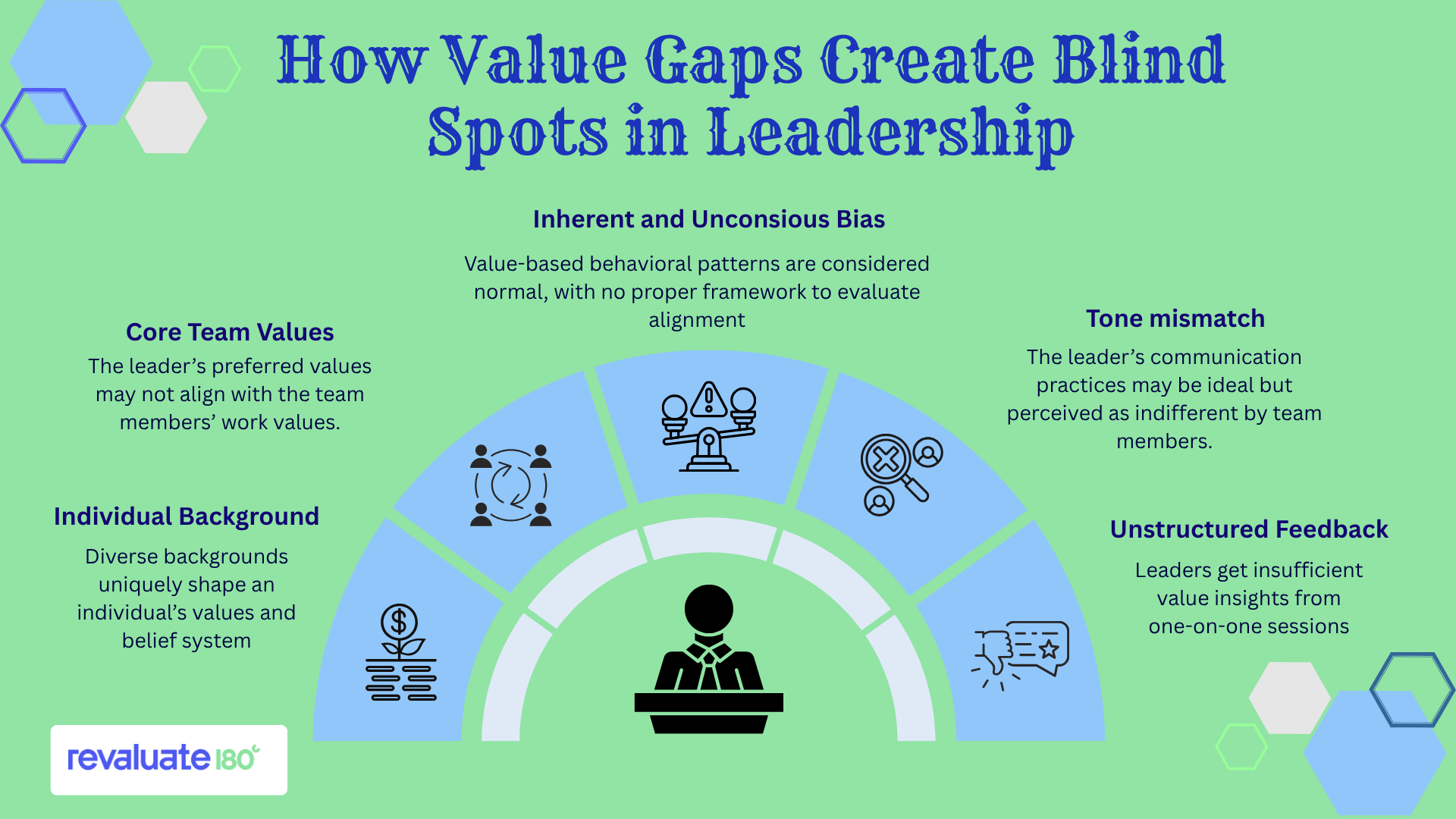
Why shared values matter for leaders?
When a team member's values and work preferences go unrecognized, leaders jump to conclusions about who is capable, who is a good fit, and who is not based on incomplete or biased information. No one openly tells their leader, "My values don't align with yours." They simply leave for a place where they feel understood and valued.
Values alignment rarely makes it into performance reviews or one-to-one discussions, which is a primary reason why leaders lose some of their best people.
This is exactly what we at Revaluate180 strive to address, not by pointing fingers at leaders or team members, but by mapping the team's combined value profiles and behavioral patterns against leadership values to understand what has truly been driving outcomes.
How to Uncover Your Leadership Blind Spots
By detecting certain signs and patterns within your team, you can identify whether a blind spot is creating a gap between your leadership vision and your actual outcomes. Here are some proven ways to surface these inefficiencies under your leadership:
1. Listen for patterns in what your team doesn’t say
As discussed earlier, silence in meetings may indicate either wholehearted acceptance or complete surrender to the leader, with no other option. Occasional silence can be tolerated, but complete silence or low response rates in all leadership meetings can indicate something terribly wrong with your teams.
Use these alternate methods to detect what your team members feel but are not saying directly:
- Review responses from anonymous engagement and retention surveys to understand how your team members perceive your leadership.
- Connect with your HR business partner to understand how your team is faring in terms of engagement and what can be done to improve.
- Analyze feedback from past exit interviews to identify possible areas where blind spots could have occurred.
2. Pay attention to recurring friction, not just one-off incidents
When one employee feels burnt out, it may be attributed either to inefficiency or to a need for more time to cope with the new work environment. But if all members joining a team feel the same way, it can indicate a problem in the team's work structure or leadership dynamics.
Similarly, incidents that cause friction or inconvenience to more than one member of a team require an investigation into what is going wrong. Leaders must analyze recurring inconveniences and discuss with the team how they can provide practical solutions to prevent such friction as soon as possible.
3. Look at outcomes, not intentions
If you feel your team is not meeting your expectations, it is rarely a capability issue. The failure may be attributed to a lack of values alignment, motivation, or a mismatch in values that is not mapped properly.
Values alignment does not necessarily mean your team must follow your value and belief system religiously. Ultimately, the outcome and quality of service/product delivered are what matter, whether or not they are aligned with your intentions in implementing the work tasks.
Believing in your team’s values and collective ownership drives the best outcomes for any team.
4. Get structured data on your team, not just casual check-ins
Blind spots cannot be addressed just by having an informal conversation with your team members. Chances are, the blind spots prevent your team members from providing crisp, constructive responses, leaving them with only social answers for the sake of asking.
Thankfully, values- and behavior-based assessments provide a more structured and reliable picture than informal conversations.
They can uncover:
- Individual backgrounds and diverse beliefs that shape how people work
- Each member's most and least preferred values at work
- Gaps between individual values and the team's shared values
- Whether team members feel their values are respected by their leaders
5. Track what surprises you
If team members seem to have the wrong impression of you, that in itself is a signal worth paying attention to. For example, we discussed how a single frustrated comment made in a tense moment can significantly shift how team members perceive and interact with you going forward.
Such signs do not necessarily mean the team has turned against you, but they may simply indicate a dip in psychological safety. Leadership training and self-reflection can go a long way in addressing these misunderstandings.
Why Training Alone Won’t Fix This
Leaders are encouraged to attend periodic training to stay up to date on team management strategies. However, most leadership training programs focus on skills like communication, delegation, and feedback delivery.
Skills training does not address the root cause of the challenges. Without understanding the underlying values, decision-making patterns, and team dynamics that drive certain behaviors, leaders often repeat the same mistakes even after completing training programs.
Meaningful change starts with understanding team values: why they matter, and how to align individuals with diverse values and behavioral patterns so the team can engage and perform at its best.
Ready to See What You're Missing?
Leaders rarely acknowledge blind spots until something forces them to, such as when a once-engaged employee goes quiet, collaboration drops without explanation, or someone tells the hard truth in their exit interview.
Leadership blind spots are not character flaws. They are invisible blockers. And you cannot fix what you cannot see.
That is why we encourage leaders to take up R180's team assessment, which provides a clear, structured picture of what is actually driving their team's behavior. The insights help identify alignment gaps, decision patterns, and engagement risks that never show up in a performance review.
When leaders understand how their team functions, both individually and collectively, many problems start to make sense. Connect with us today to reveal what is really going on beneath the surface, so you can act on evidence rather than guesswork.

Unlock AI-Powered Hiring Analytics
Transform the way you hire with insights that create aligned, collaborative, and high-performing teams.
- Smarter Hiring Decisions
- Reduce Expensive Turnover
- AI-Driven Insights
- Optimize Team Performance