Over 80% of employers and employees at small businesses believe that creating a sense of community at work is crucial for business growth. As employees spend most of their lives at work, the biggest milestones are achieved through unity and team collaboration, proving that the dynamics between employees at the workplace are a primary driver of performance and innovation.
Since team dynamics have a direct link with employee engagement and productivity, how do you make sure that the team dynamics at your workplace are ever-growing? In this post, we’ve put a comparative value through some real-world examples so you can realistically spot some strategies you can use for your organization.
TL;DR
- Strong team dynamics are characterized by trust, clear role expectations, open communication, and a shared mission that drives better results.
- Healthy dynamics are also built on shared accountability, supportive feedback, healthy conflict, balanced participation, cross-functional collaboration, and adaptability to change.
- While these are visible traits, hidden factors such as values, norms, and rewarded behaviors quietly shape how teams function. Leaders can strengthen dynamics by clarifying goals and fostering an environment that encourages constructive feedback.
- Revaluate180 can help you uncover the underlying values and behaviors driving your team dynamics, building healthier, higher-performing teams.
What is Team Dynamics?
Team dynamics involve the behavioral and interpersonal forces that shape how members interact, communicate, and collaborate toward a shared company mission. Understanding these influences can help leaders foster more cohesive and productive teams.
In practice, effective team dynamics mean open communication, mutual respect, trust, and a supportive mindset that encourages open dialogue without ego. When dynamics are healthy, teams collaborate strategically and creatively, where even if someone breaks down, communication and effective strategies can bring people back up.
Teams thrive when every member complements each other’s strengths and works collectively towards a common goal. According to McKinsey research, teams that score above average on trust are 5.1 times more likely to produce results and 3.3 times more efficient than teams with below-average trust. Emphasizing shared goals encourages a sense of purpose and motivation among team members.
What Are the Factors That Affect Team Dynamics?
Factors that influence team dynamics can be described as follows:
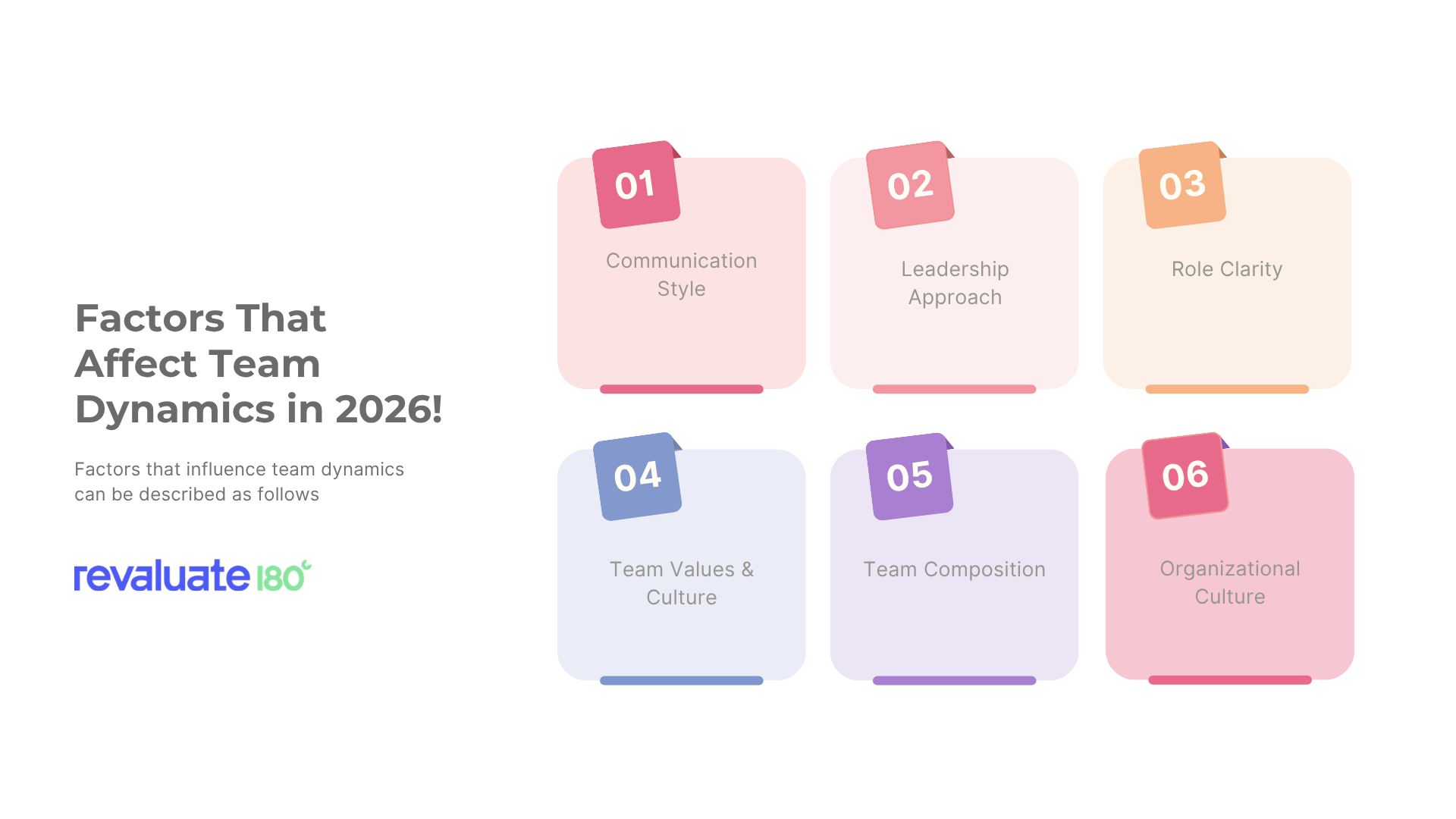
Communication styles
Clear and open communication can elevate your team's performance. Establishing regular standups or collaborative tools promotes transparency and alignment, helping leaders actively foster effective dialogue and active listening within their teams.
Leadership approach
Leaders shape the social dynamics among teams. While a collaborative and empathetic leader can build trust and confidence, an autocratic work style can stifle participation. Team rapport is directly impacted when leaders resolve conflicts, share decision-making narratives, and model behaviors directly with each other.
Role clarity
Leaders shape norms by understanding who’s responsible for what to prevent overlap and gaps between team members. Well-defined roles provide accountability and reduce confusion, paving the way to achieving milestones. Frameworks like the RACI matrix can clarify roles and define who’s responsible, accountable, consulted, and informed for each task, so every team member understands how they can contribute to the company.
Team values
Shared values such as innovation, support, and integrity shape how people act when facing real-world challenges. A culture that values collaboration encourages teamwork, whereas one that values individual competition may erode trust. Therefore, alignment around values such as transparency and empowerment shapes team behavior and communication, helping resolve workplace conflict.
Team composition
Diversity in skills and backgrounds can highly influence thinking styles. This is crucial for boosting problem-solving, but it also raises potential conflicts. Cognitive diversity often enhances creativity, but only if it’s managed well. Building inclusive norms ensures different perspectives are recognized without creating divisiveness.
Organizational culture
Company-wide norms and incentives are foundational to the company’s reputation. If the organization rewards individuals more than collaboration, even talented teams may devolve into fighting among themselves. Good culture ensures that what’s officially stated aligns with what is actually rewarded through positive behavior reinforcement.
10 Examples of Effective Team Dynamics
Strong team dynamics are more evident when they set strong examples in an organization. Here are the top ten personally curated examples of effective team dynamics:
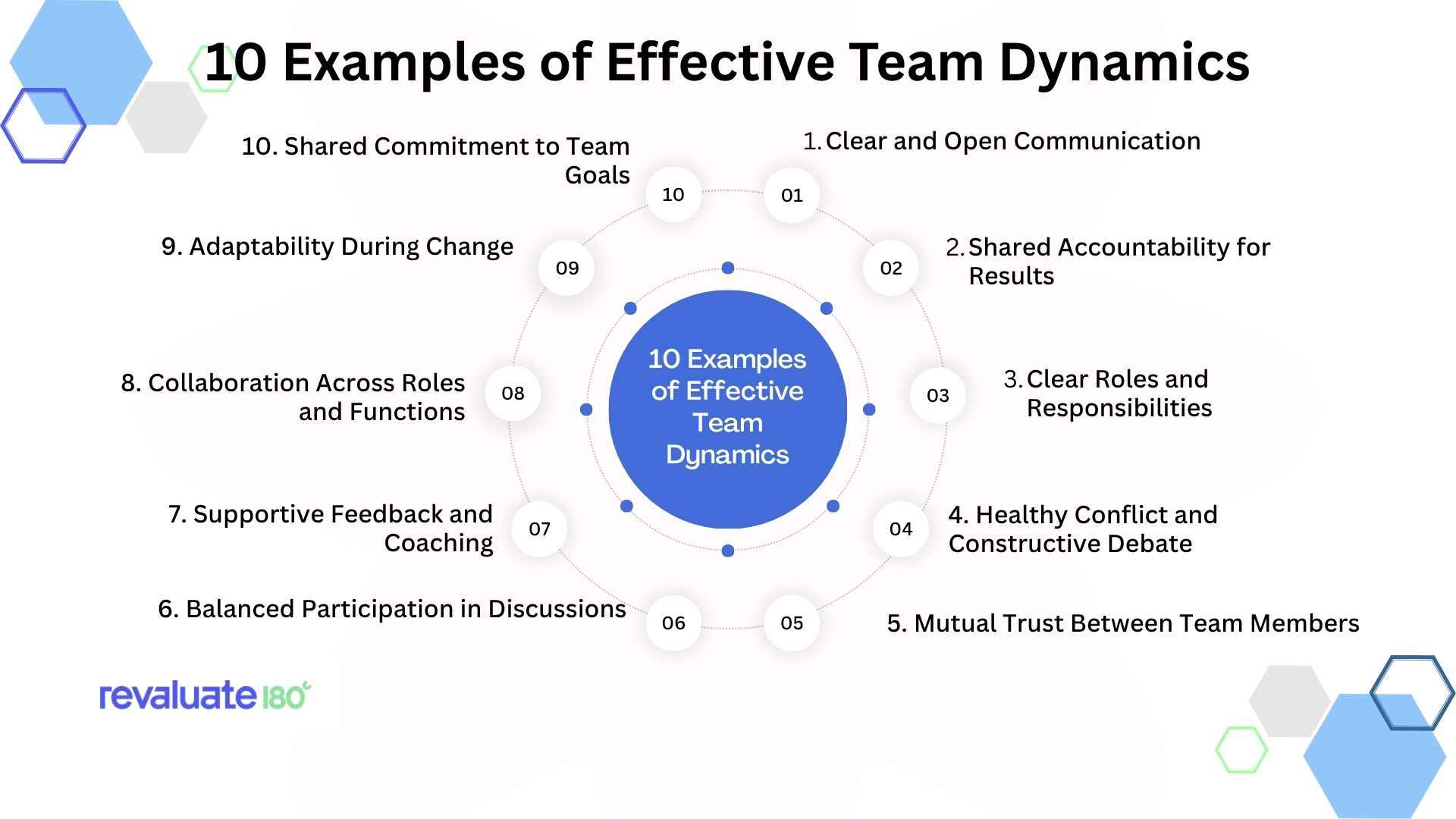
1. Clear and open communication
In hospital ER teams, every second counts on the stat. Doctors, nurses, and technicians rely on clear communication to coordinate care and initiatives. For instance, team members use closed-loop communication and concise language during trauma care so everyone knows the next action step immediately.
Each person understands the patient’s current status, the next priority step, and any changes. This openness ensures rapid decision-making and accuracy under pressure, allowing effective teams to express ideas or suggestions without hesitation.
In practice, ER teams routinely hold quick huddles and use standardized handoffs to keep everyone aligned and demonstrate clear communication that can actually save lives.
2. Shared accountability for results
In many agile software companies, for instance, product development squads work together and share responsibilities for delivering features, rather than pinning success on a single person. Each cross-functional team owns a product from end to end, so if a release hits a snag, the whole squad collaborates to fix it rather than blaming each other.
They set common ground, such as sprint objectives, and review progress together, fostering a sense of collective ownership. When everyone knows the team will be held accountable for results, motivation feels different. Accountability in this context means each member contributes and helps others meet deadlines.
Being accountable for the tasks and commitments becomes a hallmark of effective teams. In this example of agile squads, shared responsibilities ensure the team stays on track and maintains high standards in all quarters.
3. Clear roles and responsibilities
Look into a championship sports team where you can see each member knows exactly what their role is in the game. On football teams, for instance, the quarterback, wide receivers, linemen, and others each have very specific duties in each game.
Everyone knows their assignment and how it contributes to the game plan. This sense of clarity enables split-second coordination, allowing the quarterback to trust the receivers to run their routes, the linemen to block the opponents, etc.
Similarly, in business teams, clearly defined roles prevent overlap and confusion, as high-performing teams mirror sports teams with clear roles, thereby assuming common ground. This clarity means team members can focus on their expertise and seamlessly hand off tasks, resulting in efficient performance.
4. Healthy conflict and constructive debate
Effective teams don’t avoid disagreement but structure it. Pixar Animation is famous for its braintrust meetings, where directors present projects and other directors give candid feedback. All ideas are shared on the table, where criticism is encouraged and met not with defensiveness but with constructive affirmation and careful listening.
Pixar even uses techniques like plussing, adopted from improv, where, instead of dismissing ideas, team members try to build on them, keeping trust intact.
This results in a group that debates openly without any hesitation and improves outcomes rather than shutting down novel ideas. This structured debate ensures diverse perspectives that refine each idea as new information comes in.
5. Mutual trust between team members
High-stakes missions demand utmost trust and commitment towards the role. NASA’s Apollo crews and mission control exemplify the need for every astronaut on board and the engineers to trust one another implicitly. Every role is critical, and each person relies on teammates to do their job seamlessly.
When Apollo 13’s oxygen tank exploded, the astronauts and engineers worked as one cohesive problem-solving unit. As one crew member puts it, the mission became a fine example of cooperation between ground and space. Ground control devised an ad-hoc fix for rising carbon dioxide, and astronauts executed it with confidence by asking for help without hesitation. Knowing others have your back builds psychological trust, enabling teams to adapt to new challenges together.
6. Balanced participation in discussions
In truly dynamic teams, every voice is unique and heard. Some innovative startups use round-robin brainstorming, where each person takes a turn sharing ideas without interruption. This format prevents meetings from being dominated by a few loud voices and ensures everyone’s contribution is accounted for.
This balanced participation surfaces more ideas and identifies blind spots early. For instance, in product brainstorming sessions, one engineer might catch a design flaw that others overlooked. In another instance, an introverted team member might suggest a user insight.
By giving all members a rightful chance, teams harness their full potential and creativity, which builds engagement and breeds innovation in all phases.
7. Supportive feedback and coaching
Top sports teams emphasize continuous feedback since coaches and veterans provide real-time coaching during practices and games. For example, in basketball or soccer, a coach might pull a player aside during a break to show them a better technique, or teammates might call out positioning cues mid-play.
This supportive feedback is not about blame but growth. Effective teams value constructive feedback that focuses on skills and improvement rather than taking any conflicts personally at work.
Such ongoing coaching builds competence and confidence, enabling players to refine their skills with each session, and businesses to thrive when timely feedback is provided. A culture that normalizes these feedback systems helps people learn quickly and strengthens the entire team.
8. Collaboration across roles and functions
Apple’s development of the iPhone has been an epitome of technological success, demonstrating powerful cross-functional collaboration. From the very start, hardworking engineers, software designers, and marketers sat together to shape the product.
Rather than passing designs down a chain, these groups worked side by side. For instance, designers influenced engineering, and engineers provided early feedback to design. An apple kept innovating, dozens of specialized teams like optical engineers, software developers, industrial designers, and marketers have iterated closely.
This breakdown of silos ensured that decisions on technical and user experience were well-informed by each other throughout the process. Strong team dynamics mean different disciplines share knowledge freely without hesitation and align on decisions by respecting each other’s expertise.
9. Adaptability during change
Effective teams pivot when circumstances demand that they stay bound together. During the COVID-19 travel shutdown, Airbnb’s leadership and cross-functional teams adapted quickly. They shifted their business model to offer local stays and flexible cancellations, so there won’t be any misunderstandings in communication during the crisis.
On the flip side, companies without strong dynamics experienced significant disruption in growth and collaboration. At Airbnb, the team’s alignment on goals and willingness to change plans on the fly shows high dexterity. The adaptability shows that when teams have trust and shared purpose, they can navigate sudden change without losing momentum.
10. Shared commitment to team goals
For instance, consider a cross-functional team launching a major project. Such teams often set shared Key Performance Indicators (KPIs), so everyone is rowing in the same direction. When developers and the marketing department focus on a unified objective, it creates a sense of purpose.
Common goals help align efforts. For instance, when everyone is working towards the same objective, there’s a sense of purpose that drives motivation and increases focus. Launch teams hold joint planning sessions and celebrate milestones together, so the entire team feels responsible for achieving the outcome. Shared commitment means the team succeeds or fails as one, reinforcing cooperation at every step.
The above examples illustrate how effective team dynamics can be when put into practice. In all cases, teams have patterns of behavior such as open communication, trust, defined roles, and adaptability that boost their collaboration strategies for better results.
Understanding the Values and Behaviors Behind Team Dynamics
Beyond these examples, healthy team dynamics are rooted deeper in values and behaviors. How team members behave in meetings, how they handle conflict, and what values they believe shape that particular dynamic altogether. For instance, if a group values transparency, members will freely share ideas and admit mistakes that would otherwise be swept under the carpet until they damage the team’s reputation. And if a team values a strict set of rules, they might prioritize conformity and risk aversion.
Teams also carry patterns like defaulting to bold debate, rewarding innovation, and penalizing mistakes. By identifying these unseen forces, leaders can align incentives and norms that can become the blueprint to success.
This means practically asking whether they listen as much as we talk. Are mistakes being treated as learning opportunities? Are behavioral patterns well recognized? Observing everyday interactions and maintaining feedback loops reveals the actual team dynamics.
For instance, if teamwork becomes a priority, people praise those collaborative achievements that directly reinforce core values.
Closing Thoughts
Teams are the fuel that fires modern organizations’ success. When team dynamics are healthy, people feel engaged and empowered. So when they’re off, even the best plans can derail. On the bright side, dynamics aren’t constant. Teams can change and grow in so many unexpected ways. Leaders should continuously monitor for red flags through strategies like communication breakdowns or mistrust motives, etc, to address them early.
To obtain the strategic benefits from this, you must use data whenever possible. Our team of experts at Revaluate180 gives leaders a mirror into their team’s health, highlighting their strengths and gaps in values and dynamics. Data-driven insights can complement intuition, helping craft targeted strategies to strengthen the team.
Contact us today to boost your team dynamics. We’ll help you uncover the values, behavior, and alignment patterns that are influencing how your team works together. With these valuable insights, leaders can easily build healthier, high-performing teams that communicate more effectively.
Unlock AI-Powered Hiring Analytics
Transform the way you hire with insights that create aligned, collaborative, and high-performing teams.
- Smarter Hiring Decisions
- Reduce Expensive Turnover
- AI-Driven Insights
- Optimize Team Performance