Half of the U.S. workforce is at risk of quiet quitting. But what exactly does it mean, and what are the root causes of it? More importantly, how can you put a stop to it before it damages your workplace ethics? We’ll find answers to all these questions by addressing the top 10 signs of quiet quitting you shouldn’t ignore at work.
TL;DR
- Quiet quitting isn’t about employees abruptly leaving their work. It’s when they psychologically check out of work while still clocking in the hours.
- Look for subtle signs like doing just the bare minimum, withdrawing in meetings, or showing very low enthusiasm.
- These early signs are often the consequence of burnout, lack of recognition, or misalignment with the company’s mission.
- If you ignore these signs for a long time, you will risk dragging down work productivity and employee morale.
- Punishing the problem will make it even worse. Instead, you can conduct proactive leadership through honest communication, clear role expectations, and re-engaging work.
What is Quiet Quitting in the Workplace?
Quiet quitting isn’t just a corporate term for mass layoffs, but it describes those who have mentally checked out while staying on the job. In simple terms, employees still show up at work, but they limit their efforts to the absolute minimum required by their role.
For instance, gone are the extra emails at 10 pm, or the weekend brainstorming, or stepping up for a last-minute project. What remains is a disengaged, compliant employee who has effectively checked out of your company culture.
10 Signs of Quiet Quitting at Work
We’ve carefully curated the top 10 red flags of quiet quitting after thoroughly analyzing employees across sectors. Each sign can emerge early or later to evaluate the real cost of disengagement. After carefully assessing all the signs, you can get a clear picture of disengagement.
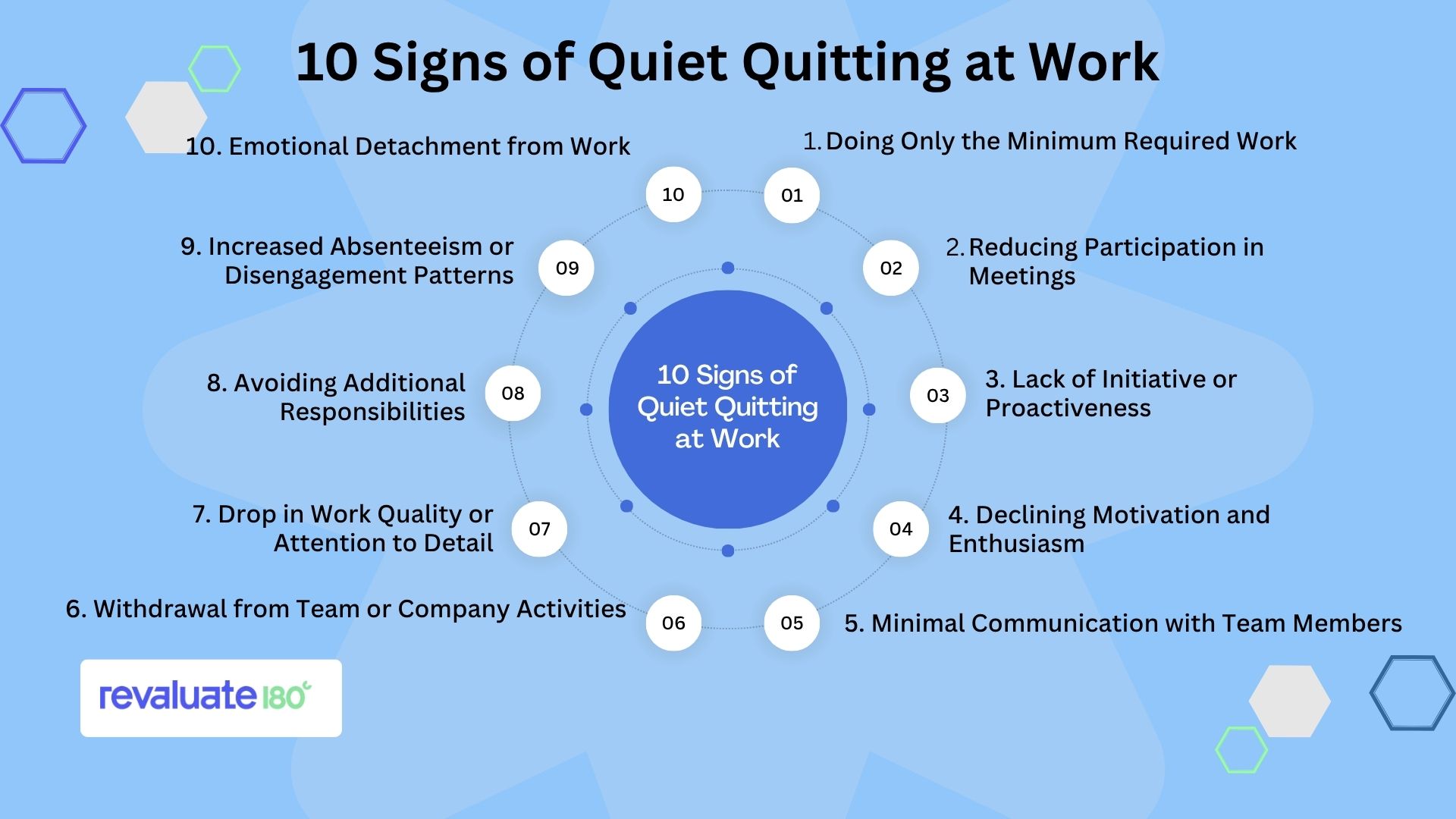
1. Doing only the minimum required work
Quiet quitters no longer go beyond their paycheck. They complete their assigned tasks and move on to the next one. For example, Sara used to check for the exciting QA strategies on weekends, but now resists doing anything beyond her assigned task.
This bare-minimum approach is a classic warning sign that eventually leads to a pattern where the employee finishes only what’s absolutely necessary. In extreme cases, they might even let some non-critical tasks slide.
2. Reduced participation in meetings
Team members who were once engaged suddenly go silent. You may notice early on that they used to contribute ideas to the table, but now barely add anything. Declining meeting participation often signals that the worker has mentally checked out because they feel their efforts are not appreciated or that their input does not matter. This may start gradually with one-word replies and can lead to attrition if not addressed.
3. Lack of initiative or proactiveness
The early-bird who pitched ideas to the deck is now content just going through the motions of everyday protocols. Quiet quitters don’t personally volunteer for new projects, tasks, or ideas. For instance, when the team asks for brainstorming for the new product launch, Rogger stops staying late to sketch out proposals. They might as well explicitly refuse to join. This absence of initiative often arises from a sense of disengagement or overwhelm, so they avoid additional effort.
4. Declining motivation and enthusiasm
You sense their reduced enthusiasm and feel like they seem bored or flat about work they once enjoyed. Early signs include their faded expressions, monotonous emails, or a general lack of interest in projects. Over time, this detachment shows up as missed milestones or even as sabotage of teams and projects. You can look for subtle hints like eye-rolling during goal discussions or passive comments and expressions of doing just enough to get by.
5. Minimal communication with team members
Quiet quitters start with social withdrawal. They may start with minimal friendly chats, skip non-essential calls, or avoid small talk. Early cues include suddenly turning off their chats and being unavailable for conversation at times. If this continues, the person might ignore team bonding invites that often accompany their disengagement.
6. Withdrawal from team or company activities
Beyond daily work, quite quitters stop participating in additional events such as voluntary meetings, training sessions, or team-building outings. Early on, they might frequently cancel team invites that later become a way to opt out of important planning workshops.
7. Drop in work quality or attention to detail
When engagement falls below the line, the quality of work often suffers. Initially, you might see small errors or missed subtleties that the worker could’ve caught before, which often escalate into issues like incomplete documentation, sloppy coding, or missed deadlines.
8. Avoiding additional responsibilities
Quiet Quitters draw firm boundaries around their job. If given a chance to take on extra work, they shy away. Even if the work aligns with their role, you might observe them politely deferring tasks due to being busy with their current work. If not doing anything, they may refuse or ignore new tasks without needing to explain further.
9. Increased absenteeism or disengagement patterns
Some quiet quitters start taking physical leave to match their mental withdrawal. You can look for early signs like frequent tardiness, subtle sick leave, or no-response patterns that later turn into calling in for minor excuses or taking unplanned time off.
Even if they aren’t sick days, look for the unscheduled absences that often stem from stress or ailments. Even if they aren’t using sick days, watch for disengagement patterns such as repeated log-offs, extended breaks, or spending company hours on non-work sites.
10. Emotional detachment from work
Quiet quitters emotionally distance themselves as their final move. They stop being proud of their work, enthusiasm wears off, and they stop committing to their goals. You might notice their poignant behavior that gradually becomes cynical as the issue persists. You can look for early signs, like a neutral or negative tone, while discussing work that, over time, can become more careless if ignored.
These behaviors often come together one way or the other. A single missed deadline may not mean much, but if the communication keeps dropping with efforts at work, quiet quitting is likely underway.
Why Employees Show Signs of Quiet Quitting
If you ask why a good employee would quietly quit? You don’t have to scrutinize their laziness since it’s a response to your workplace conditions. Common reasons include:
Lack of recognition
When hard work goes unnoticed, motivation and productivity drop. Employees who never hear any form of appreciation or reward decide to look for opportunities elsewhere. If contributions are continuously ignored, people grow resentful. For instance, a QA engineer works late at night to run bug checks but never hears appreciation, and may quietly decide to stop staying late.
Poor leadership communication
Managers who are unable to clarify goals and the company’s mission fail to recognize efforts that lead to disengagement. Harvard Business Review notes that poor leadership through unclear role expectations, inconsistent feedback loops, and micromanagement can be the top reason behind quiet quitting. So instead of quitting directly, employees withdrew communication to the minimal safe zone.
Burnout and workload pressure
Overwork is a classic trigger to quiet quitting. An exhausted employee might check out of work by limiting their energy to preserve sanity. Since burnout leads to such a mentality, a worker may appear physically available but be mentally absent. In fact, experts and HR research say quiet quitting is often a way to cope with exhaustion and workloads that are otherwise affecting their mental health.
Limited growth opportunities
When career paths feel stagnant, people don’t just lose engagement; they also lose core motivation. If employees see no advancement in their professional lives, they think that putting in more effort doesn’t change their prospects. This fits perfectly with the narrative since the absence of growth is a major factor in quieting.
Cultural or values misalignment
Lastly, if the company’s culture or mission no longer resonates with them, withdrawal is inevitable. Perhaps due to the rapidly shifting company values, or a long-term employee feels alienated by new priorities and culture? Reasons could be many, but when work isn’t your life and the job conflicts with your personal values, people tend to look for opportunities elsewhere and stay for the paycheck only.
What Leaders Should Do When They Notice These Signs
Spotting early signs of quiet quitting is just half the game. The other half is being a responsible leader and acting on it. The goal is not to demand more work from disengaged employees, but to reconnect and solve the underlying issue that is stressing them and getting in the way of their work. Let’s see some evidence-based steps you can follow:
Have direct, non-judgemental conversations
The very first recommended action is a one-on-one conversation before performance stutters. Approach with empathy rather than criticism, and with curiosity rather than accusation. Look for feedback as a blueprint for growth rather than a tool for scrutiny.
Clarify expectations and workload boundaries
Sometimes, quiet quitting is a direct result of employees either not knowing what’s really expected of them or feeling demanded beyond reasonable bounds. This confusion directly leads to disengagement. Use these problem statements in conversations to reset clarity.
Identify root causes and not just behaviors
When you notice quiet quitting patterns, one must not just rush into discipline. You can instead dig deeper into the reasons why it’s happening. You can ask questions like, "Are they unhappy with the paycheck?" Overloaded with tasks? Uncertain about their career paths? Find answers to these questions and uncover issues such as burnout, recognition gaps, and career concerns.
Re-engage employees through meaningful work
After carefully diagnosing the issues, your first step is to rebuild engagement by adjusting tasks, giving them a new challenge to work on, and aligning projects with their needs and interests. Praise and appreciation drive deeper engagement when they’re timely and personal, rather than jaded or low-effort gestures.
Clarify career paths and long-term growth
If limited growth is the cause, address it immediately. Not everything has to be figured out on their own; it’s your responsibility to guide them towards success. Share career pathways and offer growth training and consultation. Even small steps, like mentorship or a stretch goal, can reignite ambition right back at their seat. Discussing future plans becomes essential when you ask, "What skills do you want to build?" How can we help in your process? And, if the job truly has any room for growth?
Use behavioral insights and data
Today’s managers can help themselves through effective tools more than ever to spot disengagement early. For instance, HR analytics and engagement platforms can help flag patterns such as slower email response times, fewer logins, and a lack of participation in team events that might otherwise go unnoticed. Conduct regular pulse surveys, anonymous feedback, and sentiment analysis to quantify the vibe before it erodes trust and morale.
Follow up and support
After the initial conversation to figure out the core issue, you must set weekly follow-ups to show you’re committed to improvement. Provide necessary support through resource allocation, coaching, and counseling if needed. Keep an eye on progress without micromanaging. You can document any agreed changes so the employees understand what they’re expected to do.
Stop Quiet Quitting Before It’s Too Late
If you see these quiet quitting signs in your team, you must not wait till it gets worse. Our clients at Revaluate180 have uncovered hidden issues from misaligned goals to burnout hotspots to take proactive decisions early on. With an insight-driven evaluation process, leaders can turn quiet quitters back into core collaborators in their company’s mission. Help your organization today by stopping disengagement in its tracks and strengthening your leadership.