Employee disengagement refers to a decline in enthusiasm and motivation to work, leading employees to withdraw from their tasks and team activities.
The real cost of disengaged employees often manifests as financial losses and indirect costs, such as wasted time and resources spent on hiring and training employees who eventually leave.
In this post, we’ll understand how employee disengagement creates a ripple effect, where one disengaged employee can impact team morale, productivity, and business outcomes, and how companies can reduce their disengagement costs.
TL;DR
- Employee engagement is a key factor in a company's sustainability in its industry. Unhappy or disengaged employees mean losses for the company.
- Gallup's 2023 State of the Workplace report shows active disengagement costing the economy $8.8 trillion in lost productivity.
- Disengagement causes employees to lose morale, reduce their creativity, withdraw from team bonding and discussions, deliver poor customer service, and ultimately cause massive turnover.
- Disengaged employees cost companies valuable time and resources, creating a poor workplace culture, a lack of transparent communication, delays in task completion, and poor decision-making.
- Find out how the right engagement initiatives can help reduce losses for your company and help your employees perform at their best while growing your business.
Who Are Disengaged Employees?
Disengaged employees are the ones who remain passive or show a lack of commitment to their workplace, refraining from enthusiastically participating in work tasks, team discussions, group activities, and innovative ideas. All of a sudden, this disengagement becomes a reason to quit the company and move elsewhere for better opportunities.
Furthermore, disengaged employees spread the low energy and negative vibes to those around them, causing the average engagement levels of their team or group to drop. Disengagement is therefore a contagious pattern that affects all levels of employees, making day-to-day task completion and business growth highly challenging.
How Much Do Disengaged Employees Cost Organizations?
The real cost of disengaged employees is staggering. According to Gallup's State of the Workplace report 2023, active disengagement costs $8.8 trillion in lost productivity, equal to 9% of global GDP.
Disengaged employees ultimately lead to huge turnover, resulting in wasted time and resources on recruitment, hiring, and training. SHRM benchmarking data show the average cost per hire is around $4,700, while replacing an employee due to turnover costs nearly 3 to 4 times the position's salary.
Beyond direct costs, disengaged employees also spread low morale to actively engaged or neutral employees, creating a ripple effect throughout the organization.
Disengagement is often marked by increased absenteeism or failure to complete work tasks on time, thereby affecting dependent work tasks and the quality of business deliverables.
Poor quality of service and products directly affects the company's brand image and customer experience, resulting in reduced market share among competitors.
What Are the Effects of Disengaged Employees?
Beyond direct financial losses, disengaged employees create these additional costs that affect a company's brand reputation and business profits.
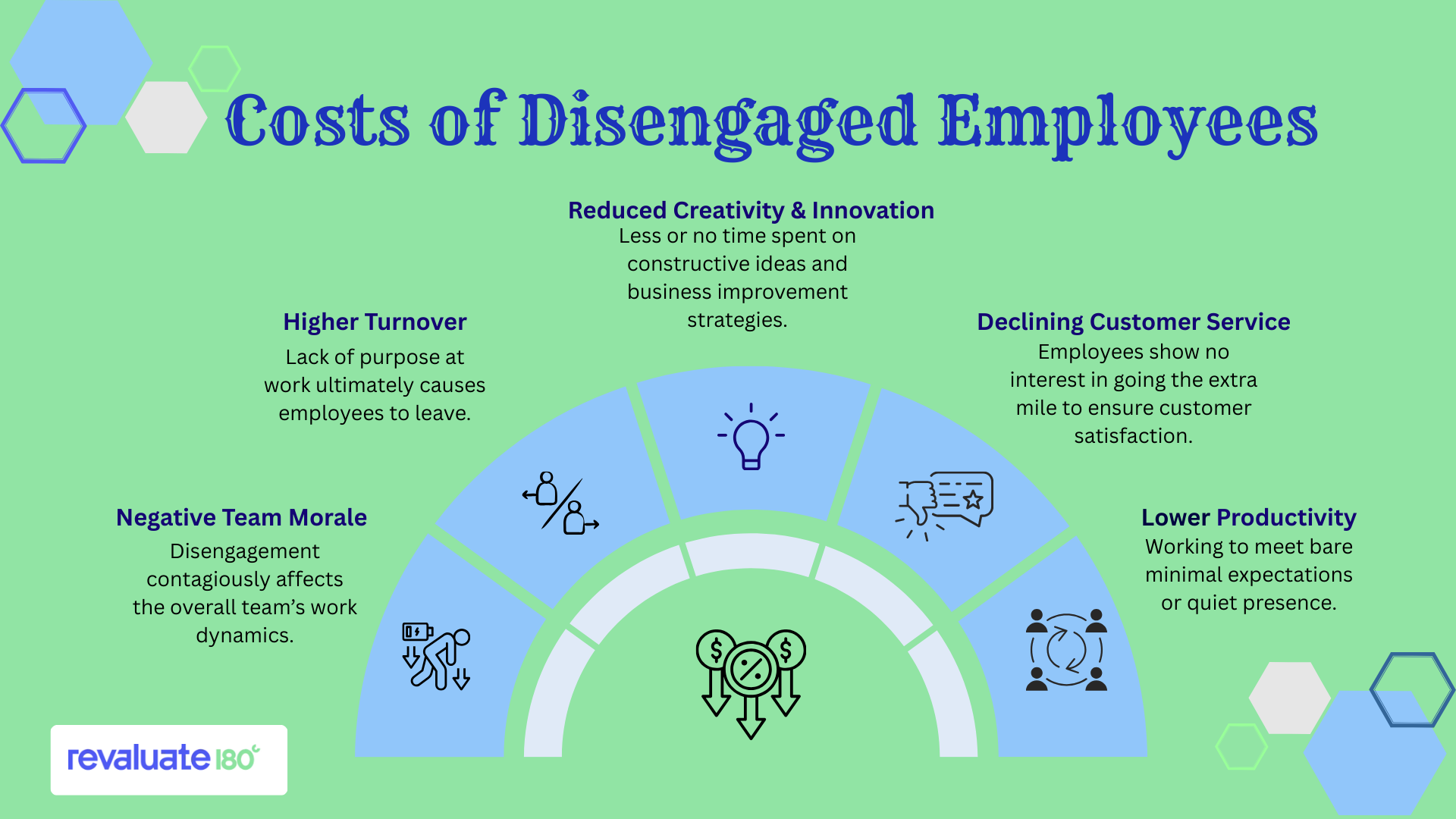
Lower productivity and performance
Good employees disengage at work for several reasons, and the direct impact of disengagement shows up when they do not perform at their best. They do the bare minimum, avoid new responsibilities, and are no longer interested in learning or growing.
Higher employee turnover and attrition
The ultimate consequence of employee disengagement is the employee's decision to quit the company. In the process, the employee creates a negative ripple effect, with several other employees becoming passive and disengaged, slowly increasing the number who exit. Such a consequence leads to poor retention rates and higher turnover in the company.
Reduced creativity and innovation
Poor engagement levels indicate that the employee hardly works to meet the bare minimum expectations. They are barely focused on their job, indicating they no longer wish to exceed expectations or come up with innovative ideas.
This loss of creativity creates a void of innovative thinking and excellence among a company's employees.
Declining customer service
Actively engaged employees go the extra mile to ensure the highest quality in the products and services they deliver. In contrast, disengaged employees pay little attention to detail and look for every opportunity to blame others when mistakes occur.
Declining enthusiasm and employee engagement directly lead to customer dissatisfaction with the quality of the company’s services and offerings.
Negative influence on team morale
When one team member fails to fulfill their responsibilities on time, it influences others to do the same. One or more employees’ procrastination causes several related tasks to miss their timelines.
Subsequent blame-shifting, arguments, negotiations, and delays have a negative impact on a team’s morale and work dynamics.
How Disengagement Creates a Domino Effect Across Teams
Disengagement arises from different reasons across employees, each of which can trigger a domino effect throughout the organization. One disengaged team member can trigger several events that ultimately tarnish the company's reputation and business.
Here are some of the common effects of disengagement among employees:
Disengaged employees influence team behavior
One employee may be unhappy with the way the team works or feel burdened by excessive work because they are a star performer. Such an employee retaliates by suddenly failing to show up for work on time, leaving a lot of work pending, and stopping from answering queries from team members.
Naturally, other team members get frustrated and resort to similar behavior when their leaders or managers question them regarding work progress. Blame-shifting, arguments, constant negotiations, and team disputes alter the team's overall work dynamics and behavior.
High performers lose motivation
Actively engaged employees are consistent performers who have achieved the right growth and progress for their workplace dedication and enthusiasm. However, when they land in a team filled with disengaged employees and poor leaders who lack accountability, they tend to lose their zeal to contribute actively at work.
The team's negative mood contagiously affects active engagers, who can no longer engage in meaningful, progressive conversations with their team members. They have no channels to share their creative ideas, so they start looking for opportunities outside the company.
Collaboration weakens
One common sign of disengagement is when employees begin distancing themselves from team members and peers, refraining from conversations, discussions, and team activities. This behavior impacts the collaborative nature of work within a team and company, as others may find it difficult to negotiate task completion with disengaged employees.
A 2024 Gallup survey shows that teams with strong negative influences faced a 65% drop in collaborative projects.
Workplace culture deteriorates
The different signs of disengagement - lack of conversations, collaborations, work commitment, and responsibility - are direct contributors to a toxic workplace culture. A workplace filled with disengaged employees will never be welcoming to new employees, who, in turn, begin to disengage or leave within a short time after joining.
Toxic workplace culture is a common reason for poor employee retention and lower employee engagement levels.
How Organizations Can Reduce the Cost of Disengaged Employees
The compounding effects of disengagement can be easily avoided when companies take the right precautions to identify signs of disengagement early. Understanding disengagement patterns and the reasons for disengagement can help companies support such employees in becoming actively engaged again.
Invest in leadership and manager development
The most common reason for disengagement and employee exit worldwide is a bad relationship between employees and their immediate leader/manager. A Gallup survey shows companies fail to choose the right candidate for the job 82% of the time.
Leaders must be accountable for the decisions they make and their communication with the team, and ensure fair treatment of all team members so that no one feels left out, unclear, or confused about their role. Investing in leadership training to develop collaborative, supportive leaders is therefore a must for all companies.
Create strong recognition and feedback systems
Timely appreciation for significant contributions is always a foolproof initiative to boost employee morale. Employee engagement platforms include comprehensive rewards and recognition portals to facilitate peer appreciation, flexible reward options, and more.
In addition, strong two-way feedback channels are essential to ensure that employees' voices and opinions are considered before major organizational decisions are made.
Provide growth and career development opportunities
The LinkedIn Workplace Learning Report shows that an increasing number of companies are prioritizing career development to achieve higher retention rates. Companies implementing these programs see strong results, with more employees benefiting from initiatives like internal job mobility, leadership training, and culture development.
Sufficient learning and development are crucial to reducing disengagement by keeping employees occupied even during periods of minimal work. Such initiatives keep employees creative and curious to learn more and upskill themselves for new challenges at work.
Encourage open communication and transparency
A lack of proper communication or speaking with uncertainty and doubts often causes confusion within teams. When leaders are not strong communicators, the problem multiplies, leading to biased treatment, unfair favors, and growing misunderstanding.
Improving team communication is an important focus for companies. Dedicated communication workshops, role plays, and training sessions help teams understand their blockers and leverage collective strengths to support their growth.
Support employee well-being and work-life balance
Companies around the world are encouraging employees to take time away from work through Paid Time Off (PTO) and flexible working policies to ensure they can spend time with their loved ones. Such initiatives help employees prevent burnout at work and get sufficient breaks between hectic work schedules.
Similarly, companies must implement engagement initiatives and team-building activities to ensure employee wellness. When companies show they care for their employees and implement employee benefits initiatives, disengagement can be nipped in the bud.
Engagement is a Business Strategy, Not Just an HR Initiative
Disengaged employees cost their companies significant financial losses, effort, and resources spent on hiring, training, and development. Despite these investments, such employees end up shunning their duties and underperforming. Thankfully, it is possible to detect early signs of disengagement and support such employees in returning to peak performance by addressing their genuine needs.
Revaluate180 has been helping companies with employee disengagement by targeting root causes through values and behavioral insights, leadership alignment, and data-driven analytics. This approach helps organizations strengthen engagement, improve workforce culture, and reduce the costly impact of disengaged employees.
If your organization is struggling with disengagement or declining retention, connect with us to schedule value assessments and debriefing workshops to understand the root causes. Get data-backed insights on the right initiatives to reverse disengagement and drive business growth.

Unlock AI-Powered Hiring Analytics
Transform the way you hire with insights that create aligned, collaborative, and high-performing teams.
- Smarter Hiring Decisions
- Reduce Expensive Turnover
- AI-Driven Insights
- Optimize Team Performance