With sudden layoffs and geopolitical uncertainty leaving employees unsure about a secure future at work, more and more are rejecting the “hustle” culture. Quiet quitting is the opposite of hustle culture, and more employees are now resorting to it as a boundary-setting work strategy.
The consequences of quiet quitting include affecting a company's overall productivity and profits. Failing to prevent quiet quitting can ultimately lead to large-scale turnover, resulting in a never-ending cycle of hiring, training, and exiting.
In this post, we will share proven strategies to understand the root causes of quiet quitting and stop it before it spreads across your organization.
TL;DR
- Quiet quitting is a workplace attitude in which employees do only the bare minimum expected of them, rather than striving for breakthrough results and quality.
- Employees often resort to quiet quitting due to disengagement at work, unmet genuine requirements, communication gaps, or unclear expectations.
- Leaders and managers can prevent quiet quitting by setting clear expectations and role clarity, addressing skill and communication inconsistencies, creating reasonable workloads, and establishing accountable systems for processing and responding to employee feedback.
- Learn how behavioral insights can help identify the root causes of quiet quitting across teams and how to tackle them at the grassroots level.
What Causes Quiet Quitting in the Workplace?
Quiet quitting creates rifts in a team’s work dynamics when enthusiastic, actively engaged employees suddenly become neutral or increasingly passive toward their team and work tasks.
This sudden shift in engagement levels often affects the whole team, especially when working on tasks that require high involvement and full effort from all team members.
Here are some common reasons employees start quiet quitting at work.
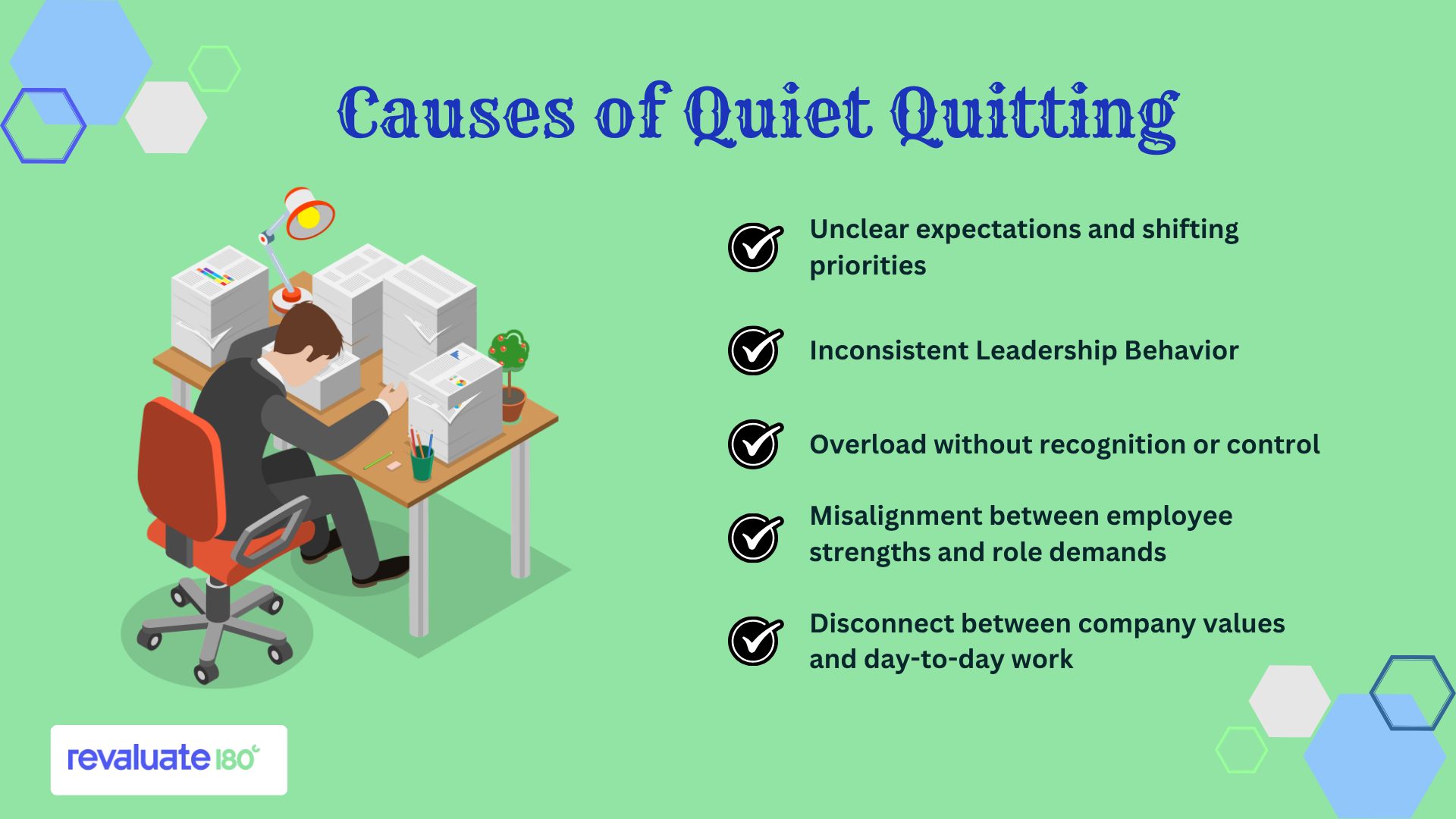
Unclear expectations and shifting priorities
Lack of clarity in their job role or a complete mismatch between their initial job expectations and the actual work they do are among the main causes of quiet quitting among employees.
Often, employees are given a different picture of their job role and what is expected from them during the hiring process, but priorities and deliverables change later. Such ambiguities often arise due to the following reasons:
- Doing the job of more than one person.
- Being an overloaded team member while others have fewer work tasks.
- Doing jobs that are irrelevant to their job description.
- Not getting the expected technical guidance and onboarding support to transition to their role.
Inconsistent leadership behavior
Leaders have been among the biggest contributors to poor retention, disengagement, and, now, quiet quitting.
Employees resort to quiet quitting when leaders lack accountability and prioritize saving themselves first in case the team lands in a soup. Here are some common scenarios where leaders show their inconsistencies:
- Not clear about the direction or goals for their team.
- Hold biases and unfairly favor some team members.
- Do not fairly distribute work tasks.
- Cannot navigate conflicts within the team.
- Cannot process feedback and communicate effectively with their team members and their own leaders.
Lack of proper leadership communication and failure to respond to employee feedback and concerns are common causes of inconsistent leadership that can spoil the team’s work culture.
Overload without recognition or control
Avoiding overload and burnout at work has led many Gen Z employees to adopt a ‘quiet quitting’ attitude, right from the beginning of their careers.
Hustle culture, where employees put in their best effort and work beyond their comfort zone, often yields better productivity but can burn employees out in the long run. Gen Z has been conscious of avoiding this culture, influencing more of their seniors to adopt this attitude.
Here are some reasons that make employees feel less valued for the work they do:
- Not getting the deserved appreciation and recognition on time.
- Missing out on one or more employees while rewarding others who contributed to a task.
- Taking employee availability for granted.
- Not providing enough autonomy to employees.
Misalignment between employee strengths and role demands
Companies often hire employees with an initial set of requirements, testing them on specific skills and expertise. Upon hiring, they get to work on tasks that are not based on their area of expertise.
Such mismatches in their job role and what they actually applied for are often common reasons for quiet quitting and subsequent turnover within the first few months of joining.
Misalignment in employee skills and role demands often occurs when:
- Companies hire employees en masse and randomly allocate them to different roles.
- Do not train employees or provide the skills required for the job.
- Do not include team members in the candidate selection process.
Effective onboarding is crucial for employee retention in the first few months, and companies must conduct onboarding surveys to address any ambiguities and confusion employees face.
Disconnect between company values and day-to-day work
Most companies fail to evaluate an employee’s individual value profile and its relevance to the company’s core values and goals.
Cultural and value disconnects or ignorance are a silent yet common contributor to quiet quitting in several ways:
- Ignoring employees’ belief systems and the diverse backgrounds that shape their work experience.
- One’s normal can be culturally inappropriate for some coming from a different culture or background.
- Not using inclusive language to address all kinds of employees within a team or the organization.
Forgetting to enforce such deviations from core company values often causes employees to quietly quit from their day-to-day tasks, making them feel the company does not value them.
8 Strategies to Prevent Quiet Quitting
Thankfully, quiet quitting is easy to detect, similar to signs of disengagement. With the right initiatives, companies can swiftly combat quiet quitting and help their employees understand that giving their best effort to the company will always be invaluable to both them and the company.
1. Design roles with clear ownership and boundaries
Quiet quitting often stems from unclear work expectations and a lack of clarity on the work tasks and deliverables. That is why it is important to improve this clarity by keeping a foolproof hiring process.
Being clear about candidate expectations and involving the work team in evaluating candidates’ cultural fitness helps make the right hiring decision, ensuring high retention. Moreover, candidates must be given sufficient autonomy and task timelines to ensure clear validation and progress-tracking metrics.
2. Align workload with real capacity, not assumptions
Several workplaces have leaders tasking certain employees based on preconceived notions and assumptions. For instance, some companies often see leaders tasking single men or women with more than their married counterparts, just on the assumption that singles can stretch and slog in the absence of a visible relationship.
Work schedules and growth opportunities must be provided fairly to all employees, irrespective of their relationship status or diversity, and in line with their skills and proficiency. Moreover, employees must be encouraged to adjust their boundaries gradually and in a feasible manner that facilitates their progress and the team’s success.
3. Build accountability systems that don’t rely on pressure
Hire employees who will suit best with their team and always find a way to get the work done. This hiring strategy goes a long way toward improving engagement levels and retention rates.
Moreover, encourage a work culture in which employees and their managers remain accountable for the work they do and the related dependencies. Reducing micromanagement helps each employee take charge of their work end-to-end, making them feel that the company values and trusts them.
4. Standardize feedback loops across teams
Feedback, onboarding, retention, and engagement surveys, one-on-one sessions with managers, and their analyses provide accurate insights into parameters such as engagement levels, signs of quiet quitting, and areas for improvement.
Providing such two-way feedback channels is essential to evaluate how leaders and HR professionals can help employees stay engaged and prevent quiet quitting in their teams.
5. Identify misalignment between role, strengths, and motivation
Differences between job expectations and reality must be bridged by leaders and hiring managers so that only the right people are selected for target teams and roles. Identifying gaps in the hiring process, improving onboarding, and providing training are ways to ensure a smooth transition into a job role.
Identifying individual motivational factors and cultural parameters that fuel an employee’s performance is another way to improve employee engagement levels, helping them move beyond quiet quitting.
6. Fix leadership inconsistency across teams
Leaders across all levels must be mindful of how they schedule and allocate work tasks to their team members, ensuring treatment and distribution remain fair and equal. Similarly, their evaluations and appraisals must be fair so that everyone gets their due progress and growth.
Since managerial inability and a lack of leadership accountability are direct contributors to quiet quitting, leaders must serve as representatives of the company’s vision and direction, helping their teams head towards fulfilling the company’s goals and business objectives.
7. Make team dynamics visible
Understanding how a team works at its best, their working style, time spent in core tasks and recreational activities, and other team dynamics play a crucial role in improving engagement and preventing quiet quitting.
Team dynamics should never be rigid; rather, they should be more adaptive to welcome and accommodate new employees. Evaluating candidates’ fit with the team’s work dynamics is a crucial step in the hiring process to reduce early turnover and minimize the risk of quiet quitting.
8. Detect disengagement patterns before performance drops
Regularly monitoring and tracking employee performance and task timelines helps detect early signs of quiet quitting and disengagement. Signs such as delays in task completion, prolonged absences, or lack of participation in team activities must be probed immediately by team members or leaders to identify any underlying concerns.
Resolving issues at the earliest signs of discomfort or neutral engagement helps employees bounce back with the right support rather than spiraling into quiet quitting or directly quitting their jobs.
Why Most Quiet Quitting Solutions Fail
Several companies ignore the actual causes of quiet quitting by offering compensatory measures that do not address the root causes of quiet quitting. Rather than focusing on solutions, such as improving communication and feedback, companies come up with counter-solutions like:
- Offering perks and incentives
- Increasing engagement activities without measuring engagement levels
- Encouraging more communication among team members without identifying the ones who are struggling
Such approaches can only worsen quiet quitting, proving that the company will never take the time to understand why it is happening in the first place. Coming up with quiet quitting solutions without the right analysis and insights fails because they:
- Treat symptoms instead of root causes
- Ignore individual, team-level, and leadership issues
- Rely on short-term fixes that hardly motivate quiet quitters
Just as quiet quitters set boundaries at work through various signs, solutions to address quiet quitting must also be precise and targeted.
Using Behavioral Insights to Prevent Quiet Quitting

Quiet quitting is often driven by misalignment between employee values and motivations, leadership expectations, and team dynamics.
Dealing with quiet quitting involves understanding these deeper factors to help organizations address disengagement before it becomes visible.
Solutions like Revaluate180 provide insights into employee behavior, value alignment, and leadership effectiveness, helping leaders proactively prevent quiet quitting rather than react to it later.
If your organization is experiencing signs of quiet quitting, R180 helps uncover the root causes through behavioral insights, leadership analysis, and team alignment data. This strategy enables leaders to proactively improve engagement, strengthen collaboration, and reduce disengagement before it impacts performance and retention.

Unlock AI-Powered Hiring Analytics
Transform the way you hire with insights that create aligned, collaborative, and high-performing teams.
- Smarter Hiring Decisions
- Reduce Expensive Turnover
- AI-Driven Insights
- Optimize Team Performance